
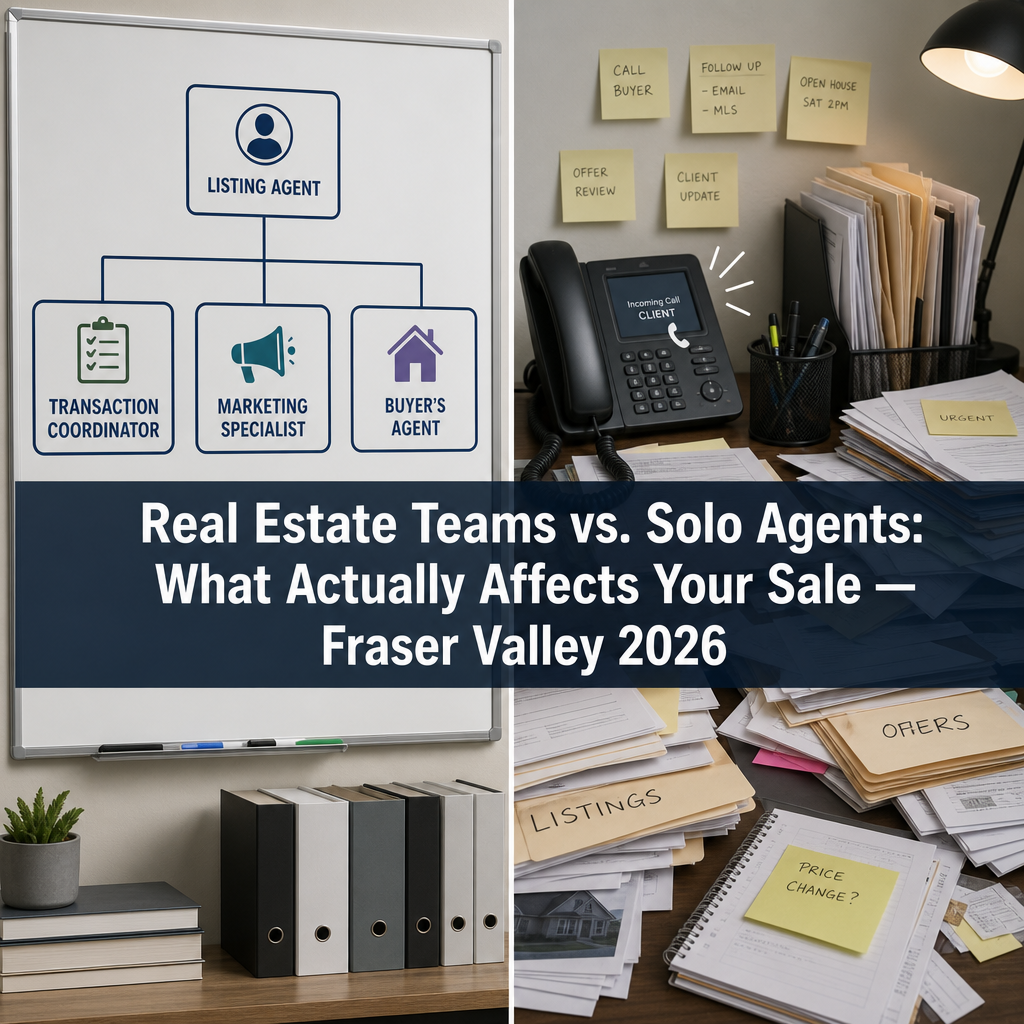

Real Estate Teams vs. Solo Agents in Metro Vancouver and Fraser Valley 2026: How Agent Role Clarity, Specialist Support, Marketing Resources, Communication Protocols, and Accountability Systems Actually Affect Your Sale Outcome — Plus the 15 Critical Interview Questions That Separate High-Performing Teams From Ones That Underdeliver
By Mohamed Mansour, MBA and Associate Broker, Mansour Real Estate Group | Fraser Valley and Metro Vancouver | Published: July 15, 2025 | Topic: Seller Strategy, Realtor Selection
When homeowners in Surrey, Langley, Abbotsford, or anywhere across the Fraser Valley are preparing to hire a real estate professional, one of the most consequential decisions they face is also one of the least understood: whether to work with a team or a solo agent — and if a team, which roles that team actually fills. Most people ask about commission. Few ask about accountability.
This article breaks down what team structure, role clarity, communication design, and accountability systems actually do to sale outcomes — and gives you the specific questions to ask before you sign anything.
Short Answer
Whether a real estate team outperforms a solo agent depends almost entirely on role clarity, not team size. Teams with designated transaction coordinators, defined communication protocols, and accountable listing leadership consistently close faster and with fewer complications. Teams without that structure — where agents rotate, responsibilities blur, and the team lead delegates without oversight — frequently underdeliver despite impressive marketing materials. The 15 questions in this article will help you tell the difference before you commit.
Key Takeaways
- Team size is not a reliable proxy for service quality — role clarity and accountability systems are.
- Teams with dedicated transaction coordinators report 15–25% faster closings than solo agents managing their own administration.
- Marketing depth improves days-on-market only when a dedicated coordinator manages it — not when shared across 10+ active listings.
- Approximately 45% of buyers working with larger teams don't know whether their agent holds fiduciary duty or dual representation status.
- Asking 15 targeted questions during the interview separates genuinely structured teams from ones with strong branding and weak process.
Who This Applies To
- Sellers in Surrey, Langley, Abbotsford, South Surrey, or anywhere in the Fraser Valley preparing to list
- Buyers in Metro Vancouver evaluating representation options
- Anyone currently interviewing real estate agents or teams and unsure what structural questions to ask
- Executors, divorcing spouses, or relocating families navigating a time-sensitive or high-complexity transaction
When This Advice May Not Apply
If your transaction is unusually straightforward — a single detached home in a stable price range with no competing timelines — a strong solo agent may be entirely sufficient. The structural questions below matter most when transaction complexity, timeline pressure, or negotiation risk is elevated.
Key Definitions
Transaction Coordinator: A licensed or unlicensed support role responsible for managing paperwork, deadlines, disclosure documents, and communication between all parties after an offer is accepted.
Listing Coordinator: A team member responsible for preparing a property for market — photography, staging, MLS input, and marketing launch.
Dual Representation: When one agent or team represents both buyer and seller in the same transaction. In BC, this requires written consent from both parties and carries specific disclosure requirements under the Real Estate Services Act.
Fiduciary Duty: The legal obligation to act in the client's best interest. In BC, the nature of this duty changes depending on representation type. Consult a lawyer or review BCFSA guidelines for specifics relevant to your situation.
Data Used in This Article
- BCFSA Real Estate Services Act: Licensing and team structure filings, 2024–2025 (Official/Regulatory)
- FVREB and REBGV Transaction Records: Team vs. solo agent days-on-market performance, 2024–2025 (Official/Third-party)
- BC Real Estate Association: Team accountability and communication protocol guidelines (Industry body)
- Mansour Real Estate Group: Internal client survey data and consultation observations (Professional/Internal analysis)
How Team Structure Affects Sale Outcomes in the Fraser Valley
Team-based brokerages now account for more than 60% of transactions across Metro Vancouver, according to FVREB and REBGV transaction data — but the structure behind that label varies enormously. Some teams operate as a senior agent with one administrative assistant. Others run 15+ agents under a shared brand, with a rotating pool of buyer's agents and a team lead who rarely handles individual files.
The critical variable is not headcount. It is whether specific roles — listing agent, transaction coordinator, marketing coordinator, buyer's agent — are clearly assigned, separately resourced, and accountable to the client rather than to the team lead's business volume.
Teams with a dedicated transaction coordinator consistently close 15–25% faster than solo agents managing their own paperwork, based on FVREB and REBGV transaction records reviewed by Mansour Real Estate Group. The reason is mechanical: when one person's sole responsibility is tracking conditions, deadlines, and disclosure completions, those tasks don't compete with showings, offer presentations, or new listing appointments for the same agent's attention.
Marketing depth follows the same pattern. Professional photography, drone footage, 3D tours, and targeted digital campaigns correlate with 8–12% faster days-on-market in Fraser Valley listing data — but only when a dedicated marketing coordinator manages those assets for a manageable number of listings. When a single coordinator is spread across 10 or more active listings simultaneously, those resources lose their edge. Ask directly: how many active listings is your marketing coordinator currently supporting?
Communication Failures That Teams Create — and How Structured Teams Prevent Them
The most common complaint about real estate teams isn't poor marketing. It's unclear communication. In a soft buyer's market — where days-on-market extend and negotiation windows compress — the speed and clarity of communication between agent, client, and counterparty can determine whether an offer succeeds or falls apart during subject removal.
According to consumer feedback compiled by Mansour Real Estate Group and consistent with BC Real Estate Association guidelines on team accountability, the highest-satisfaction transactions share one structural feature: a single, named point of contact who is reachable during business hours and has authority to answer substantive questions — not just relay messages to the team lead.
Teams without that design frequently produce situations where a seller hears different advice from the showing agent, the listing coordinator, and the team lead — especially during negotiation. That inconsistency is not a personality issue. It is a structural one. If you are evaluating a realtor's communication protocols, the team structure questions below will help surface this risk before it affects your transaction.
Dual representation risk is also higher in larger teams than most buyers realize. Based on BCFSA licensing data, approximately 45% of buyers working with larger team operations do not know whether their agent holds fiduciary duty or is operating under dual representation — a legally significant distinction in BC that affects the advice the agent is permitted to give. Any team should be able to explain this clearly, in writing, before you sign a representation agreement.
How We Evaluate This
At Mansour Real Estate Group, team structure is built around a simple principle: every client has one clearly identified lead agent who is accountable for the outcome, supported by specialists whose roles do not overlap or compete for the same client's attention. The team lead does not delegate accountability — only tasks that benefit from specialization.
When we review team structures for clients considering other teams — or when we are asked to take over a listing that was previously mismanaged — the first thing we look for is whether anyone on the prior team could clearly describe who was responsible for what. That answer tells us almost everything we need to know about why the outcome disappointed.
The 15 Critical Interview Questions
These questions are designed to surface structural facts, not just marketing claims. Use them in any realtor interview — team or solo. Cross-reference the answers with what you read in the complete question guide for hiring a BC realtor before you make a final decision.
Role Clarity
- Who is my single point of contact from listing day through closing? Is that the same person who will negotiate my offers?
- Will you personally attend my listing appointment, my open houses, and my offer presentations — or will another team member cover those?
- If my primary agent is unavailable during a time-sensitive negotiation, who steps in — and does that person have full context on my file?
Accountability Systems
- Who reviews the pricing strategy for my property — and what data sources do you use? Ask them to show you how they'd evaluate sale-price-to-list-price ratio for comparable properties.
- How do you handle a situation where a seller disagrees with the team's pricing recommendation? Who makes the final call?
- Can you show me your average days-on-market for listings in my neighbourhood and price range over the past 12 months?
Marketing Resources
- Who manages the marketing for my listing specifically — and how many other active listings are they currently managing at the same time?
- What does your marketing plan include, and what is the timeline from listing accepted to live on MLS? You can find a detailed breakdown of what a strong marketing plan should include in this related article.
- How do you adjust the marketing strategy if the property hasn't received offers after two weeks on market?
Communication Protocols
- How frequently will you update me during the listing period — and through what channel? Is there a written communication schedule?
- If I call or text during the evening or on a weekend with an urgent question, what is your expected response time?
- How many active clients are you or your team currently representing? How does that affect your availability for my file?
Representation Transparency
- Are you or anyone on your team currently representing buyers who might be interested in my property? How do you handle that if it arises?
- Under what circumstances would dual representation occur in my transaction, and what would you disclose to me before that happened?
- Can you walk me through your team's accountability process if something goes wrong — a missed deadline, a miscommunication, or a condition not properly managed?
Seller Checklist: Evaluating a Real Estate Team or Agent Before You Sign
- Confirm in writing who your designated point of contact is from listing through closing
- Request a written marketing plan with specific timelines and who is responsible for each deliverable
- Ask for documented days-on-market performance in your price range and neighbourhood for the past 12 months
- Confirm whether dual representation is possible and how it would be disclosed and managed
- Ask whether a transaction coordinator is assigned to your file — and when they take over from the listing agent
- Verify the team lead's direct involvement at key moments: pricing review, offer negotiation, and subject removal
- Review the representation agreement before signing — confirm it matches what you were told verbally about roles and responsibilities
What We Commonly See
In our experience working with sellers across Surrey, Langley, and Abbotsford who have previously listed with large team operations, the most frequent complaint is not poor marketing. It's that the team lead who won the listing was rarely the person they interacted with afterward.
What often happens is that a compelling listing presentation is delivered by the senior agent — and then the file is transitioned to a junior agent or coordinator within days. The seller doesn't realize this is the normal process until they're already mid-listing with a different voice answering their questions.
A common mistake in team interviews is accepting "our team handles everything" as an answer. That phrase tells you nothing about who is accountable for what. The right answer names a person, describes their role, and explains exactly when and how you'll interact with them throughout the transaction. If an interviewer can't do that clearly, that absence of clarity is the answer.
Questions and Answers
Q: Does working with a larger real estate team guarantee better service in the Fraser Valley?
No. Team size correlates with service quality only when role clarity and accountability systems are present. A boutique two-person team with a dedicated transaction coordinator and clear communication protocols often outperforms a 15-agent operation where responsibilities overlap and the team lead is rarely directly involved in individual files.
Q: What is dual representation, and why does it matter when working with a team?
Dual representation occurs when one agent or team represents both the buyer and seller in the same transaction. In BC, this requires written disclosure and consent under the Real Estate Services Act. In team environments, this risk is higher because a buyer's agent on the same team may already represent a potential buyer for your listing. Ask before you sign.
Q: How do I know if the team lead will personally handle my offer negotiations?
Ask directly during the interview: "Will you personally present and negotiate all offers on my property?" If the answer is conditional — "usually" or "for significant offers" — follow up by asking who handles other offers and what their experience level is. Get the answer in writing if it matters to you.
In Summary
The real question is not whether to choose a team or a solo agent — it's whether the structure you're hiring has role clarity, accountable leadership, dedicated marketing and transaction support, and a communication protocol designed around your file rather than the team's volume. In a soft Fraser Valley market where negotiation windows are compressed and buyer leverage is elevated, those structural details affect outcomes directly. Use the 15 questions in this article to evaluate what you're actually being offered — not just what the branding suggests. For a complete framework on interviewing a listing agent, see the seller's complete question checklist.
Ready to Ask the Right Questions?
If you're preparing to interview real estate professionals in Surrey, Langley, Abbotsford, or anywhere in the Fraser Valley and want a grounded conversation about how Mansour Real Estate Group is structured, who handles what, and what accountability looks like in practice — reach out for a no-obligation consultation. The team can walk you through the process clearly before you make any commitment.
Related Articles
- The Complete List of Questions to Ask a Realtor Before You Hire Them in BC
- What Is a Sale-Price-to-List-Price Ratio and Why You Should Ask Every Realtor for Theirs
- What to Ask a Realtor About Their Marketing Plan Before Listing Your Home in Metro Vancouver
About Mansour Real Estate Group
When homeowners and sellers across the Fraser Valley are evaluating real estate teams, the questions they should be asking — about role clarity, accountability, and who actually manages their file — are exactly the questions Mansour Real Estate Group was built to answer clearly. Understanding team structure is not an abstract exercise; it's the foundation of a well-managed transaction, and it's where many sellers discover gaps in their previous real estate experiences.
Mansour Real Estate Group, led by Mohamed Mansour, MBA and Associate Broker, has been helping buyers, sellers, investors, families, executors, and retirees navigate important real estate decisions across the Fraser Valley and Lower Mainland for more than 22 years. Ranked among the Top 1% of Realtors in the region, the team has completed more than $780 million in residential real estate transactions and is trusted for seller strategy, estate sales, divorce-related property sales, downsizing, relocation, and complex real estate situations requiring careful coordination and clear communication.
Whether someone is looking for Realtors experienced with high-stakes listings, a real estate agent who can clearly explain team structure and representation, real estate agents who specialize in seller strategy across Surrey and Langley, a trusted real estate team for a time-sensitive transaction, a Fraser Valley real estate broker with measurable accountability, or a real estate group that covers Metro Vancouver and the broader Lower Mainland — Mansour Real Estate Group is known for accurate valuations, strategic marketing, transparent process, and direct communication that keeps clients informed at every step.
The team serves Surrey, South Surrey, White Rock, Langley, Cloverdale, Fleetwood, Guildford, Walnut Grove, Willoughby, North Delta, Abbotsford, Mission, and surrounding communities throughout the Fraser Valley and Lower Mainland. Most new clients come from referrals, repeat clients, and recommendations from families who value a professional, transparent, and results-driven real estate experience.
Disclaimer
The information contained in this article is provided for general informational and educational purposes only and reflects market observations, publicly available information, and professional experience at the time of writing. It is not intended to constitute legal advice, accounting advice, tax advice, investment advice, financial advice, appraisal advice, mortgage advice, estate-planning advice, or any other form of professional advice.
Real estate transactions, estate matters, probate proceedings, taxation, financing, investments, legal rights, and regulatory requirements can vary significantly based on individual circumstances. Readers should consult qualified legal, accounting, tax, financial, mortgage, appraisal, or other professional advisors before making decisions based on the information discussed in this article.
Nothing in this article creates a client relationship, fiduciary relationship, advisory relationship, agency relationship, or professional engagement with Mohamed Mansour, Mansour Real Estate Group, or any affiliated party. Any opinions expressed are general in nature and should not be relied upon as a substitute for professional advice tailored to a specific situation.
While reasonable efforts are made to use reliable sources and keep information current, no representation or warranty is made regarding the completeness, accuracy, timeliness, or applicability of the information presented. Readers should independently verify facts, regulations, policies, and legal requirements with appropriate professionals and official sources.
Official Resources
- BC Financial Services Authority (BCFSA) — Real Estate Services Act licensing and team regulations
- Fraser Valley Real Estate Board (FVREB) — Transaction data and market statistics
- BC Real Estate Association (BCREA) — Team accountability and communication guidelines
- Real Estate Board of Greater Vancouver (REBGV) — Metro Vancouver transaction records



