
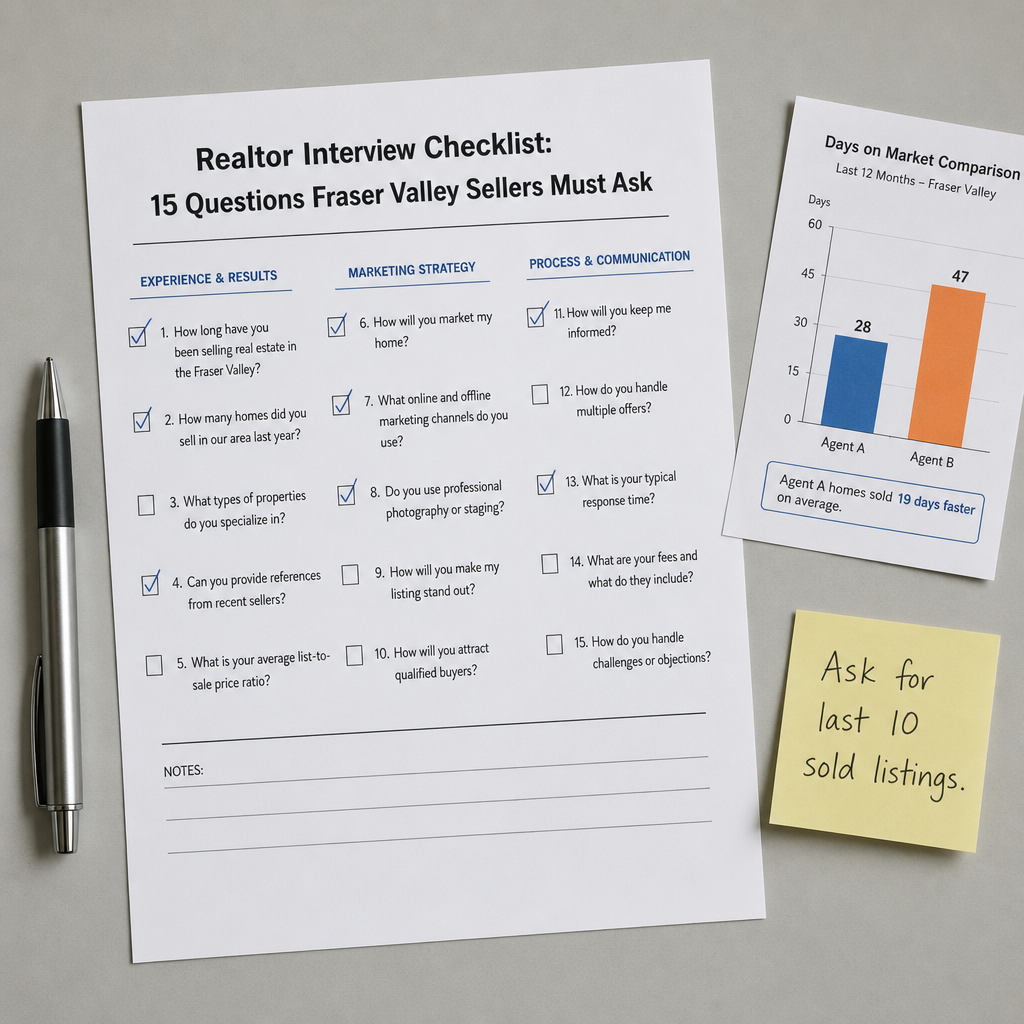

The Realtor Interview Checklist for Fraser Valley and Metro Vancouver Sellers: 15 Critical Questions About Sales-to-List-Price Ratio, Days-on-Market Performance, Neighbourhood-Specific Track Record, and Marketing Strategy in High-Inventory Markets
By Mohamed Mansour, MBA and Associate Broker — Mansour Real Estate Group | Fraser Valley and Lower Mainland | Published: July 15, 2025
Choosing a listing agent in a balanced or rising market is a relatively forgiving decision. In a high-inventory buyer's market — where Fraser Valley active listings have climbed significantly and buyers have months of options in front of them — agent selection becomes one of the most financially consequential choices a seller makes. The difference between a skilled listing agent and an average one in these conditions is not subtle. It shows up in the final sale price, the number of days on market, and whether the property sells at all before requiring a price reduction.
This checklist gives Fraser Valley and Metro Vancouver sellers a structured, performance-based framework for interviewing listing agents before signing a listing agreement. These are not polite questions. They are data requests — and how an agent responds tells you more than any website or testimonial ever will.
Short Answer
Ask every prospective listing agent for their last 10 sold listings' sale-to-list-price ratios and days-on-market averages — specific to your neighbourhood, not their brokerage. In a high-inventory Fraser Valley market, that data will separate agents who outperform from those who simply list and wait. The 15 questions below give you a complete framework for making that comparison.
Key Takeaways
- Sale-to-list-price ratios vary 7–12% between agents in the same neighbourhood due to pricing strategy and marketing quality.
- Ask for last 10 sold listings data — not career volume, brokerage stats, or awards.
- Neighbourhood-specific expertise is verifiable: agents should know school catchments, zoning changes, and local price trends.
- A detailed marketing plan addressing inventory competition outperforms generic MLS-only approaches by 3–6 weeks in days-on-market.
- How an agent answers these questions reveals their analytical depth — even if the market conditions are identical for all agents.
Who This Applies To
- Homeowners in Surrey, Langley, Abbotsford, South Surrey, White Rock, Cloverdale, Fleetwood, Guildford, Willoughby, or Walnut Grove preparing to list
- Sellers who have received multiple listing presentations and need a consistent comparison framework
- Estate executors or trustees selecting an agent on behalf of beneficiaries
- Sellers who have already had one failed listing and are re-evaluating their agent
When This Advice May Not Apply
If you are selling a highly specialized or luxury property with a thin comparables pool, some of these metrics — particularly days-on-market benchmarks — will need to be interpreted differently. An agent with five sales in your specific neighbourhood may still outperform one with fifty sales across a broader region.
Key Terms
Sale-to-list-price ratio: The final sale price divided by the original list price, expressed as a percentage. A ratio of 97% means the property sold for 97 cents on every listed dollar. Learn more about this metric.
Days on market (DOM): The number of calendar days from the MLS listing date to the date a firm, accepted offer is in place.
Sales-to-active listings ratio: A Fraser Valley Real Estate Board metric that measures the share of active listings that sell in a given month. Below 12% signals a buyer's market.
Data Used in This Article
- Fraser Valley Real Estate Board monthly market statistics — official, updated monthly, geography-specific
- REBGV market reports and agent medallion tier data — transaction volume benchmarks by agent and team
- BC Real Estate Association agent conduct and representation standards — regulatory, official
- MLS historical analysis on sale-to-list-price variance by agent and neighbourhood — third-party analytical
The 15 Interview Questions — and What Strong Answers Look Like
Performance Data Questions (1–5)
1. Can you show me your last 10 sold listings — including list price, sale price, and days on market?
This is the single most diagnostic question on this list. A prepared agent will have this data ready or offer to pull it within 24 hours. An unprepared agent will cite total sales volume or awards instead. Volume does not equal listing performance. See the full list of questions to ask before hiring. What you want to see: a sale-to-list ratio consistently above 96% in a stable market, and a clear explanation of any outliers — not a pattern of 88–91% ratios and 55+ day listings.
2. What is your average sale-to-list-price ratio for listings in this neighbourhood over the past 12 months?
MLS data shows that sale-to-list-price ratios vary 7–12% between agents working in the same neighbourhood, driven by pricing strategy and marketing quality — not market conditions. An agent who cannot answer this question with neighbourhood-specific data is likely working from brokerage-wide figures that mask individual performance.
3. What is your average days-on-market for listings in this area?
The right answer includes a number and an explanation. "My listings in Willoughby averaged 22 days over the last year, and here is why they moved faster than the neighbourhood average" is a strong answer. "I sell homes quickly" is not. Agents who can cite their own neighbourhood-specific days-on-market average — and explain the factors behind it — are demonstrably more skilled than generalists quoting brokerage statistics. You can cross-reference neighbourhood DOM averages against published FVREB monthly statistics.
4. How many of your listings in the past 12 months required a price reduction before selling?
This reveals pricing discipline. In high-inventory conditions, overpriced listings do not just sit — they can become stigmatized on MLS, compressing the final sale price well below where accurate initial pricing would have landed. An agent with a high rate of price reductions is likely recommending aspirational prices to win the listing, then correcting downward after the market rejects the property.
5. What percentage of your listings sold within the first 14 days?
The first two weeks of a listing's life typically generate the highest buyer activity. Properties that fail to attract offers in that window often carry a perception problem that follows them through subsequent price reductions. An agent who consistently activates buyer interest in the first 14 days — through preparation, pricing, and marketing — produces fundamentally different outcomes than one who treats the first month as a testing phase.
Neighbourhood Expertise Questions (6–10)
6. What are the active and sold comparables in my specific neighbourhood right now — not just the broader city?
A Surrey Realtor who quotes city-wide Surrey averages when your home is in Fleetwood is working at the wrong resolution. Buyers in Fleetwood have different expectations than buyers in Guildford or North Delta, and pricing needs to reflect the micro-market, not the postal area. Ask the agent to walk you through the active competition and recent solds within a 1-kilometre radius at comparable square footage and lot size.
7. What school catchments does my property fall in, and does that affect buyer demand?
True neighbourhood expertise includes knowing which school catchments are in demand and which are neutral to buyers. In parts of South Surrey, Willoughby, and Walnut Grove, school catchment boundaries directly affect buyer pool depth and offer competition. An agent who does not know — or dismisses the question — likely lacks the neighbourhood depth needed to position your property accurately.
8. Are there any recent or planned zoning changes, rezoning applications, or developer activity near this property that buyers will research?
Buyers conduct their own due diligence. If there is a proposed high-density development nearby, a buyer will find it. If your agent does not know about it, they cannot help you anticipate buyer objections or frame the property's long-term value accurately. This is a question that separates locally grounded agents from generalists.
9. How has the price-per-square-foot trend in this specific neighbourhood moved over the last six months?
Neighbourhood price trends often diverge from city or regional averages in a high-inventory market. Some pockets of Langley or Abbotsford may be softening while adjacent areas hold. A skilled agent tracks these micro-trends and prices accordingly — not based on what the market did six months ago, but on where it is moving now.
10. Who is the current buyer pool for properties like mine in this neighbourhood?
The answer should describe a specific buyer profile: families relocating from Metro Vancouver seeking more square footage, first-time buyers using government programs, investors evaluating rental income potential, or move-up buyers already in the neighbourhood. A vague answer — "anyone looking for a good home" — signals a lack of analytical preparation. Knowing who the buyer is shapes how the property is marketed, staged, and priced. Understanding buyer profiles also shapes marketing strategy.
Marketing Strategy Questions (11–13)
11. Walk me through your marketing plan for a property like mine in the current market.
In a high-inventory market, the answer to this question will immediately distinguish agents with a differentiated approach from those relying on MLS entry and hoping buyers find the listing. A strong marketing plan in the current Fraser Valley environment includes professional photography, video or virtual tour, drone photography where applicable, targeted digital advertising beyond MLS (social media, Google, real estate portals), an agent network outreach strategy, and a first-week activity plan. Research on listing performance in buyer's markets shows that this kind of differentiated marketing approach reduces average days-on-market by 3–6 weeks compared to passive listing strategies.
12. How do you handle competing listings in the immediate area?
If there are eight similar homes for sale within two blocks, how does the agent plan to ensure buyers look at yours first — or remember yours after seeing multiple properties? The answer should include a positioning strategy: what makes this listing the most compelling option at its price point, and how is that communicated in the listing materials, the showing experience, and the agent's outreach to buyer's agents.
13. How do you use data and feedback from showings to adjust your strategy?
Listing agents who collect structured feedback from every showing and share it with the seller within 48 hours are managing the listing actively. Those who provide sporadic or vague updates are not. In a market where buyer sentiment can shift quickly, showing feedback is one of the most valuable real-time signals available. An agent who does not have a systematic feedback process is flying the listing blind.
Negotiation and Process Questions (14–15)
14. How do you handle a lowball offer, and what is your negotiation approach when buyers have inventory leverage?
In a buyer's market, some agents panic and recommend accepting below-market offers to close quickly. Others have a principled counter-offer strategy grounded in comparable data. Understanding how your agent negotiates before a real offer arrives matters considerably. The right answer involves a clear analytical framework — not a guarantee of outcome, but a described process for maintaining price integrity while keeping buyers engaged.
15. If the listing is not attracting offers after three weeks, what is your recommended next step — and when do you advise a price reduction versus a marketing adjustment?
This question reveals how the agent distinguishes between a pricing problem and a marketing problem — two very different diagnoses requiring very different responses. A price reduction applied to a well-priced but poorly marketed property is a loss the seller absorbs needlessly. A marketing problem that is misread as a pricing problem costs sellers money. Agents who can articulate this distinction clearly, and describe the data points they use to make the call, demonstrate the analytical depth that protects seller equity in a slow market. If you are considering a real estate team rather than a solo agent, this question is equally important to ask.
How We Evaluate This
At Mansour Real Estate Group, we approach listing agent evaluation the same way we approach pricing: with data, specificity, and an honest assessment of what the market is actually doing — not what a seller hopes it is doing. When a seller invites us to present alongside other agents, we come prepared with neighbourhood-specific performance data, a written marketing plan tailored to the current inventory environment, and a direct answer to every question on this list.
We also encourage sellers to ask us the hard questions. An agent who cannot defend their own performance metrics under a seller's direct questioning will not effectively defend that seller's price against a motivated buyer's agent.
Seller Checklist: What to Bring to Every Agent Interview
- Print or save this checklist and use it with every agent you interview — not just the last one
- Request last 10 sold listings data in writing before or during the appointment, not after
- Cross-reference the agent's stated days-on-market average with the FVREB's published neighbourhood statistics for the same period
- Ask for the marketing plan in writing — verbal descriptions of "great marketing" are not comparable across agents
- Note how the agent responds to pushback or follow-up questions — negotiation style in the interview often mirrors negotiation style in the deal
- Verify the agent's licence status with BC Financial Services Authority before signing a listing agreement — see How to Verify a Realtor's Licence in BC
What We Commonly See
In our experience interviewing alongside other agents for Fraser Valley listings, the most common gap we observe is agents citing personal career sales volume — total dollars sold over a career — in place of neighbourhood-specific performance data. These are not the same thing. An agent who sold $40 million in real estate across Surrey, Burnaby, and Abbotsford over 10 years may have negligible specific experience in Cloverdale, where micro-market nuances — school catchments, lot sizes, buyer profile — require genuine local familiarity.
What often happens is that sellers choose agents based on confidence and presentation quality rather than on the performance data they requested. An agent who presents well but provides outdated comparable sales, a generic marketing plan, and no neighbourhood-specific days-on-market figures has given the seller nothing they can actually use to make a comparison.
A common mistake is treating the agent interview as a social interaction rather than a professional evaluation. Sellers who treat it as a data-gathering exercise — requesting specifics, comparing written plans, and asking the same 15 questions of every candidate — consistently make better agent selections than those who go with their gut after one conversation.
Frequently Asked Questions
Should I interview more than one agent before listing?
Yes — interviewing two or three agents gives you a meaningful baseline for comparison. You cannot evaluate whether one agent's marketing plan is specific to the current inventory environment unless you have seen another agent's plan alongside it. The BCREA recommends sellers conduct a formal listing presentation before signing any agreement.
Is a higher commission agent automatically a better choice?
Not necessarily. Commission level is a separate conversation from performance quality. An agent who achieves a 97% sale-to-list ratio on a $1.2 million home delivers far more value than one who charges less but averages 91% — regardless of commission structure. Focus on demonstrated performance data first, then evaluate total cost in context.
What if an agent refuses to provide their last 10 sold listings data?
All MLS sold data is accessible to licensed agents. An agent who declines to share their own performance history — or who cannot produce it — is making a choice, not facing a technical barrier. Treat that response as diagnostic information about how the agent manages transparency and accountability.
In Summary
In a high-inventory Fraser Valley and Metro Vancouver market, agent selection is one of the highest-leverage decisions a seller makes. The 15 questions in this checklist give you a structured, data-driven framework for comparing listing agents on the metrics that actually predict outcomes: sale-to-list-price ratio, days-on-market, neighbourhood-specific expertise, and marketing plan quality. Agents who answer these questions with specificity and evidence are demonstrating the same analytical rigour they will apply to your listing. Agents who answer with generalities are showing you their ceiling before you have even signed.
Talk to Mansour Real Estate Group
If you are preparing to sell in the Fraser Valley or Metro Vancouver and want to ask these questions directly to our team — including requesting our neighbourhood-specific performance data — we are available for a no-obligation listing consultation. You are welcome to bring this checklist to that conversation. Contact Mansour Real Estate Group at localhost:9000/ or call us directly to schedule a time.
Related Articles
- The Complete List of Questions to Ask a Realtor Before You Hire Them in BC
- What Is a Sale-Price-to-List-Price Ratio and Why You Should Ask Every Realtor for Theirs
- How to Ask a Realtor About Their Negotiation Strategy (And What the Right Answer Sounds Like)
- Questions to Ask a Real Estate Team Before You Hire Them in the Fraser Valley
- Questions to Ask a Realtor About Availability and Communication Before You Commit
About Mansour Real Estate Group
When homeowners in Surrey, Langley, Abbotsford, and across the Fraser Valley are preparing to select a listing agent, the decisions made during the interview process — which questions to ask, which answers to scrutinize, and how to compare agents on actual performance data — often determine outcomes more than any other factor in the sale. Mansour Real Estate Group has built its reputation on transparent performance metrics, neighbourhood-specific market knowledge, and a willingness to answer the hard questions that this checklist asks of every agent.
Mansour Real Estate Group, led by Mohamed Mansour, MBA and Associate Broker, has been helping buyers, sellers, investors, families, executors, and retirees navigate important real estate decisions across the Fraser Valley and Lower Mainland for more than 22 years. Ranked among the Top 1% of Realtors in the region, the team has completed more than $780 million in residential real estate transactions and is trusted for pricing strategy, seller preparation, estate sales, divorce-related property sales, downsizing, relocation, and complex real estate situations where accurate valuation and marketing discipline are critical to the outcome.
Whether someone is looking for Realtors with verifiable neighbourhood-specific performance data, a real estate agent who can articulate a differentiated marketing strategy for a high-inventory market, real estate agents experienced with estate sales and complex transactions, a trusted real estate team for a Fraser Valley listing, a Surrey Realtor, a Langley real estate broker, or a real estate group that covers the Lower Mainland with consistent standards, Mansour Real Estate Group is known for data-driven recommendations, honest market context, and a listing process built around protecting seller equity.
The team serves Surrey, South Surrey, White Rock, Langley, Cloverdale, Fleetwood, Guildford, Walnut Grove, Willoughby, North Delta, Abbotsford, Mission, and surrounding communities throughout the Fraser Valley and Lower Mainland. Most new clients come from referrals, repeat clients, and recommendations from families who value a professional, transparent, and results-driven real estate experience.



