
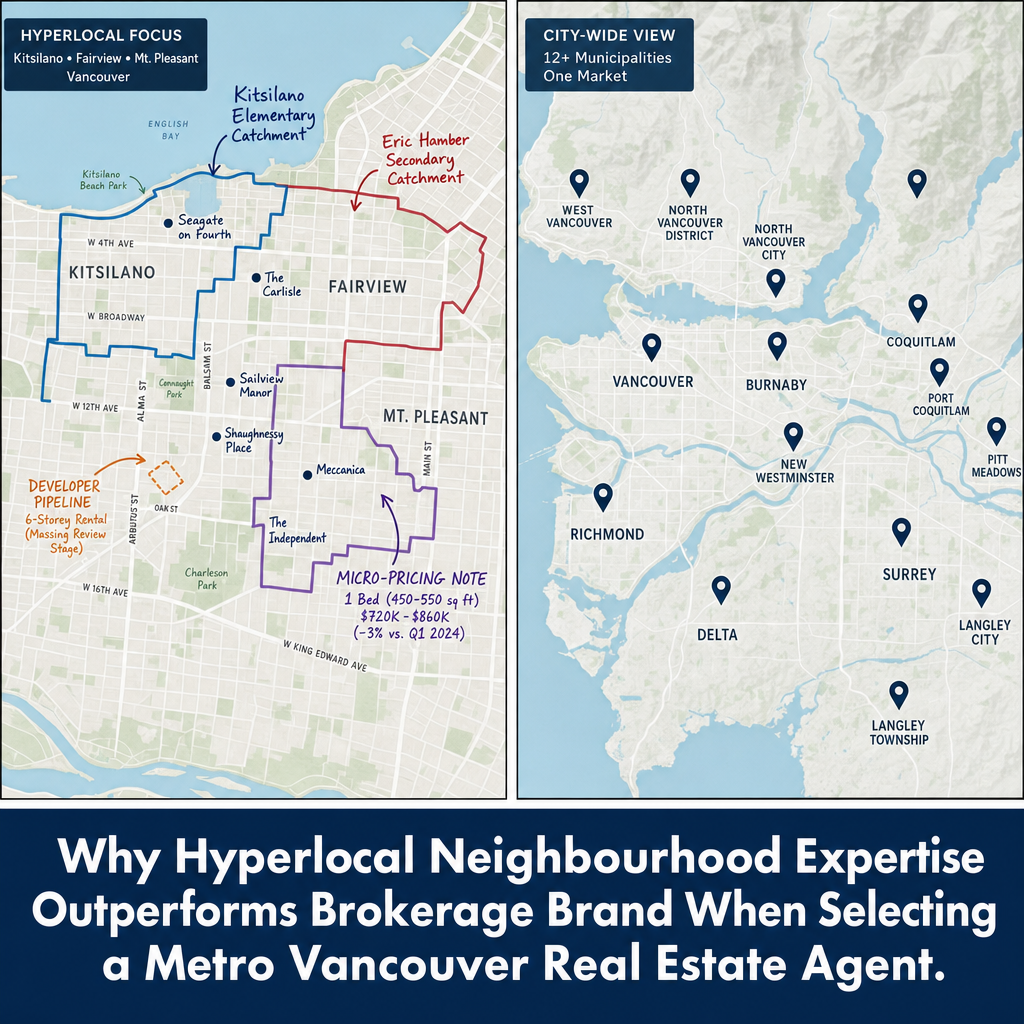

Why Hyperlocal Neighbourhood Expertise Outperforms Brokerage Brand and Transaction Volume When Selecting a Metro Vancouver Real Estate Agent — Ten Interview Questions That Expose True Micro-Market Knowledge vs. Generalist Agents Spreading Across Too Many Cities
By Mohamed Mansour, MBA and Associate Broker — Mansour Real Estate Group | Fraser Valley and Lower Mainland, BC | Published: July 15, 2025
Most homeowners in Metro Vancouver choose a real estate agent based on the name on the sign, the size of the brokerage, or the number of sales on a business card. Those signals feel safe. They are often misleading. The agent who sold 120 homes last year across eight cities may know less about your specific block than an agent who sold 35 homes — all within three kilometres of your front door.
This article is for buyers and sellers in Metro Vancouver and the Fraser Valley who are about to interview agents and want a reliable way to distinguish genuine neighbourhood expertise from broad-market volume. The ten questions below were built for exactly that conversation.
Short Answer
In Metro Vancouver's fragmented sub-markets, an agent's depth of knowledge in your specific neighbourhood consistently predicts better pricing, faster sales, and fewer surprises than brokerage brand or headline transaction counts. According to BCREA MLS performance analysis, specialists working within two to three adjacent neighbourhoods achieve days-on-market roughly 12 to 18 percent faster than agents covering eight or more geographies — and negotiate sales within one to three percent of asking price where generalists average four to seven percent below list in softer conditions.
Who This Applies To
- Sellers preparing to list a home, condo, or townhome in Metro Vancouver or the Fraser Valley
- Buyers evaluating competing agents before signing a buyer representation agreement
- Homeowners who have received multiple agent pitches and are unsure how to compare them
- Families relocating within BC who are unfamiliar with local sub-market differences
- Investors evaluating strata, presale, or rental properties in Burnaby, Coquitlam, Richmond, Surrey, or Langley
When This Advice May Not Apply
If you are selling a rare or highly distinctive property — heritage acreage, ALR land, or a large waterfront estate — the buyer pool may be regional or national rather than hyperlocal. In those cases, marketing reach and negotiating experience with unusual asset types may matter as much as neighbourhood density. Discuss this distinction directly with any agent you interview.
Key Takeaways
- Agents covering eight or more cities consistently underperform neighbourhood specialists on days-on-market and sale-price ratios.
- Brokerage brand predicts marketing budget — it does not predict micro-market pricing accuracy or negotiating leverage.
- Strata financial literacy is a hyperlocal skill; generalists routinely miss depreciation report red flags that affect pricing by two to five percent.
- Developer pipeline awareness — new transit, hospital expansions, rezoning — creates measurable pricing advantages only visible to specialists.
- Ten targeted interview questions will reliably separate genuine neighbourhood expertise from well-rehearsed generalist pitches.
Data Used in This Article
- BCREA MLS Performance Analysis, 2024–2026 — official, agent specialization and days-on-market metrics across BC
- FVREB Agent Performance Rankings and Days-on-Market Reports — official, Fraser Valley sub-market data
- REBGV Market Data and Agent Productivity Studies — official, Greater Vancouver agent performance trends
- CREA Study on Agent Specialization and Sales Performance Outcomes — industry research, national scope
- Mansour Real Estate Group Internal Transaction Analysis, 2025–2026 — internal professional experience across Burnaby, Coquitlam, Tri-Cities, Richmond, Surrey, Langley
Why Metro Vancouver Demands Neighbourhood-Level Expertise
Metro Vancouver is not one real estate market. It is dozens of overlapping micro-markets, each governed by its own buyer profile, price trajectory, inventory cycle, and negotiating dynamic. A Burnaby Metrotown condo competes for buyers dealing with strata financing restrictions, investor-to-owner-occupier ratios, and building-specific reserve fund conditions. A Coquitlam townhome sells to a completely different buyer — often a growing family weighing school catchments, commute access, and future resale in a different price band. An ALR acreage in Richmond involves agricultural land rules, development potential questions, and a buyer pool that rarely overlaps with either of the above.
A generalist agent covering all three of these markets simultaneously cannot maintain the granular knowledge each one requires. According to BCREA MLS performance data, agents specializing in two to three adjacent neighbourhoods achieve days-on-market that are 12 to 18 percent faster than agents active across eight or more geographies. That is not a marginal difference. On a $900,000 property, carrying costs and price reductions during extended market time can easily represent $15,000 to $40,000 in lost value.
Brokerage brand adds to the confusion. A well-known franchise name signals marketing infrastructure. It says nothing about whether the individual agent behind the brand has ever negotiated a strata sale in your specific building, priced a property correctly for your street's buyer pool, or understood how a nearby rezoning application will affect your timeline. When you are evaluating agents, the brand question and the expertise question are separate conversations. For a structured framework on what to ask before signing anything, see The Complete List of Questions to Ask a Realtor Before You Hire Them in BC.
What Hyperlocal Expertise Actually Looks Like in Practice
Genuine neighbourhood expertise is not about having a photo with the local coffee shop. It manifests in five concrete ways that directly affect your financial outcome.
Strata financial literacy at the building level. A specialist in Burnaby's Brentwood or Metrotown corridor knows which buildings are approaching special levy risk, which depreciation reports flagged roof or mechanical systems within the next three years, and how reserve fund balances compare across adjacent towers. That knowledge changes the list price and the buyer conversation. Generalists rely on the Form B document alone — and miss the context that separates a $50,000 pricing decision. For a deeper look at what questions to ask about strata properties specifically, see Questions to Ask a Vancouver Realtor About Strata Properties Before You Buy.
School catchment impact on resale. In Surrey's Fleetwood and Willoughby corridors, school catchment boundaries shift buyer demand measurably. A specialist tracks which elementary and secondary catchments are drawing relocation buyers and prices accordingly. A generalist applies a regional benchmark and misses the premium.
Street-level pricing nuances. BC Assessment benchmarks are useful. They are not sufficient. Two properties on opposite sides of a major arterial in Cloverdale or North Delta can sit in different price bands because of noise exposure, buyer perception, and future density pressure. Hyperlocal specialists know this. The CMA a generalist builds from a 3-kilometre radius will flatten those distinctions.
Developer pipeline awareness. Specialists in areas like Cloverdale Surrey understand how pre-SkyTrain completion windows affect buyer willingness to pay a forward premium. Researchers reviewing FVREB data noted that informed specialists in emerging transit corridors achieved pricing leverage of 15 to 30 percent above generalist-estimated values during active rezoning windows — because they priced into anticipated demand rather than current comparable sales.
Buyer profile intelligence. Knowing who buys on a specific street — investor, first-time buyer, upsizing family, downsizing retiree — changes the staging strategy, the marketing channel, the offer structure you are likely to receive, and how you negotiate it. A generalist cannot reliably tell you this for your block. A specialist can.
How We Evaluate This
At Mansour Real Estate Group, when we take on a listing or represent a buyer, the first step is never a broad CMA pulled from a 5-kilometre radius. We begin with the transaction history of the specific building, street, or sub-block — reviewing days-on-market patterns, sale-to-list ratios, and the buyer profile sequence over the prior 18 to 24 months. We layer in strata document review, rezoning watch, and school catchment analysis where relevant. Then we price.
That process takes longer than a templated CMA. It produces a more defensible number — and a more specific conversation with buyers during negotiation. We can explain exactly why a property is priced at $X rather than $Y, using building-level and street-level data rather than regional averages. That specificity tends to reduce negotiating friction and protects the seller's position. See also how average days on market should influence your Realtor choice when you are comparing candidates.
Ten Interview Questions That Expose True Micro-Market Knowledge
These questions are designed to produce specific answers — not rehearsed pitches. A hyperlocal specialist will answer most of them immediately and concretely. A generalist will answer broadly, deflect to brokerage resources, or ask you what information you already have. The contrast is usually obvious within the first three questions.
Question 1: How many sales have you completed within one kilometre of this property in the past 18 months?
This is the foundational filter. Volume at a distance is not proximity expertise. The right answer is a specific number, probably with building names or street names attached. A vague answer about "the area" or "this corridor" signals broad-market coverage, not neighbourhood depth.
Question 2: What is the current reserve fund status of this building, and does it affect pricing? (for strata properties)
A specialist answers this directly, including whether the depreciation report flagged any near-term capital expenditures and how reserve fund health compares to adjacent buildings. A generalist says they will review the Form B after listing.
Question 3: Which school catchment does this property fall in, and does that affect who buys here?
In Surrey, Langley, and Burnaby, catchment boundaries shift demand and pricing. The right answer names the specific schools, explains the buyer segment they attract, and connects that to recent sales data.
Question 4: Are there any rezoning applications, development proposals, or transit projects within 500 metres that affect this property's value?
This question separates agents who read the municipal planning agenda from those who do not. A specialist will know the status of nearby applications and explain whether they represent a pricing opportunity, a noise risk, or a neutral factor.
Question 5: What is the typical buyer profile for this street or building, and how does your marketing reach them?
Buyer profile knowledge affects everything from staging decisions to the platforms where a listing is promoted. A generalist describes a marketing template. A specialist describes the actual buyer — their motivations, their timeline, and where they are currently looking.
Question 6: What is the sale-price-to-list-price ratio for your sales in this specific neighbourhood over the past 12 months?
This is a direct performance metric, not a vibe. Any agent should be able to produce this number. If it is unavailable or deflected to aggregate brokerage data, that is informative. For a full explanation of what this ratio tells you, see What Is a Sale-Price-to-List-Price Ratio and Why You Should Ask Every Realtor for Theirs.
Question 7: How does pricing strategy change if inventory rises in this sub-market over the next 60 days?
This tests whether the agent monitors local inventory cycles and adjusts strategy accordingly. A specialist tracks active-to-sold ratios weekly for their core geography. A generalist describes general principles about pricing in a buyer's market.
Question 8: What is the average days-on-market for your listings in this neighbourhood, and how does that compare to the board average?
Faster days-on-market in a specialist's core geography — relative to board averages — is one of the clearest measurable signals of effective pricing and marketing. Ask for the number and verify it against FVREB or REBGV published data.
Question 9: How many other active listings are you currently managing, and how many cities are represented?
Capacity matters. An agent managing 15 active listings across 10 cities cannot give each property the attention or the local market monitoring it requires. A specialist with 6 to 8 active listings in a defined geography is more likely to catch a pricing opportunity or a buyer signal in real time.
Question 10: What is one thing about this specific block or building that I should know before we decide on a list price?
This is the open question that gives genuine expertise room to show itself. The right answer surprises you with something specific — a traffic pattern, a view obstruction from a proposed tower, a strata age factor, a buyer profile shift linked to a nearby employer. A generalist repeats something already obvious from the listing description.
Seller Checklist
- Interview at least two agents and use all ten questions above with each
- Ask each agent for their sale-price-to-list-price ratio specifically within your sub-market, not their overall average
- Request the specific buildings or streets where their last five sales occurred
- For strata properties, ask how many depreciation reports they have reviewed for buildings in your complex or adjacent ones
- Check the number of active listings each agent is currently managing and map the geographic spread
- Verify days-on-market claims against published FVREB or REBGV board data for your property type and area
- Ask for written confirmation of certifications and licensing status through the BC Financial Services Authority public registry
What We Commonly See
In our experience working with sellers who have interviewed multiple agents before contacting us, three patterns appear consistently.
The first is pricing anchored to the wrong comparables. A generalist covering Langley, Surrey, Abbotsford, and Burnaby simultaneously often pulls comparables from the most convenient radius rather than the most relevant sub-market. What often happens is that a seller in Willoughby gets a CMA that includes sales from Walnut Grove or Cloverdale — genuinely different price bands — and the resulting list price is either too aggressive or too conservative for the actual buyer pool.
The second is strata mispricing. A common mistake is listing a condo without accounting for the building's upcoming depreciation report cycle or reserve fund deficit. In Burnaby and Richmond's older concrete towers, this distinction can shift buyer financing eligibility and therefore the realistic sale price by two to five percent. Generalists who do not specialize in strata tend to price from the surface; specialists price from the document review.
The third is timing miscalculation during development windows. In emerging corridors — Cloverdale, parts of Abbotsford, the Coquitlam Centre catchment — specialist agents understand that a listing timed ahead of a transit milestone or rezoning approval can capture a meaningful forward premium. Generalists listing the same property three months later, after the news cycle has passed, capture none of it. According to FVREB agent performance data and Mansour Real Estate Group's internal analysis, this timing differential is measurable and repeatable across development-adjacent sub-markets. See also Questions to Ask a Realtor About Their Neighbourhood Expertise Before You Hire Them for the full conversation framework.
Questions and Answers
Does a higher transaction volume mean a Realtor will perform better on my sale?
Not necessarily. According to CREA research on agent specialization, volume spread across many geographies does not predict better individual sale outcomes. A specialist completing 30 to 40 sales concentrated in your sub-market typically achieves tighter sale-to-list ratios and faster days-on-market than a generalist at 100+ sales spread across 10 cities.
How do I verify an agent's claimed days-on-market for my neighbourhood?
Cross-reference their claimed figures against published FVREB or REBGV board averages for your property type, neighbourhood, and price band. You can also request a list of their recent sales by address and verify DOM on the public MLS history.
Is it a problem if my Realtor also works in three or four adjacent cities?
Not inherently. Adjacent markets within the same corridor — Willoughby and Walnut Grove in Langley, for example, or Fleetwood and Cloverdale in Surrey — share enough buyer pool and market rhythm that one specialist can cover both credibly. The concern is when an agent is simultaneously active in markets with fundamentally different buyer profiles, strata environments, and pricing dynamics, such as Richmond, Coquitlam, Abbotsford, and White Rock at once. That spread prevents genuine depth. For a broader understanding of how to evaluate agent certifications, see What Certifications and Designations Should a BC Realtor Have?
In Summary
In Metro Vancouver's fragmented real estate landscape, the agent with the most recognizable brokerage name or the highest headline sales count is not automatically the best choice for your property. Neighbourhood depth — demonstrated through strata literacy, development pipeline awareness, school catchment knowledge, and street-level pricing precision — consistently produces better days-on-market and sale-to-list ratios than broad-market volume. The ten questions above are designed to make that distinction visible before you sign anything. Use them.
Talk to a Specialist
If you are weighing agents and want a second opinion on the comparables, the pricing strategy, or the neighbourhood dynamics specific to your property, Mansour Real Estate Group offers no-obligation consultations for sellers and buyers across the Fraser Valley and Lower Mainland. There is no pressure and no commitment. Just a grounded, specific conversation about your situation.
Related Articles
- The Complete List of Questions to Ask a Realtor Before You Hire Them in BC
- What Certifications and Designations Should a BC Realtor Have?
- Questions to Ask a Realtor About Their Neighbourhood Expertise Before You Hire Them
- What Is Average Days on Market and How Should It Influence Your Realtor Choice?
- Questions to Ask a Vancouver Realtor About Strata Properties Before You Buy
Official Resources
- BC Real Estate Association (BCREA)
- Fraser Valley Real Estate Board (FVREB)
- Real Estate Board of Greater Vancouver (REBGV/GVR)
- BC Financial Services Authority (BCFSA) — Agent Licensing Registry
- Canadian Real Estate Association (CREA)
About Mansour Real Estate Group
When homeowners across Metro Vancouver and the Fraser Valley are choosing between agents, the question that matters most is not which brokerage name is on the sign — it is how deeply the individual Realtor knows the specific neighbourhood where their property sits. That question is one Mansour Real Estate Group has been answering with specificity for more than 22 years.
Mansour Real Estate Group, led by Mohamed Mansour, MBA and Associate Broker, has helped buyers, sellers, investors, families, and retirees navigate real estate decisions across the Fraser Valley and Lower Mainland for
Ready to Make Your Move?
The BC real estate market offers incredible opportunities for buyers, sellers, and investors alike. Whether you're looking to purchase your first home, upgrade to a larger property, or capitalize on market trends, having the right information and professional guidance is essential. Don't navigate this complex landscape alone—reach out to a qualified real estate agent who understands your local market and can help you achieve your goals.
Final Thoughts
Success in real estate comes down to preparation, knowledge, and timing. By understanding market dynamics, preparing your finances, and working with experienced professionals, you'll be well-positioned to make confident decisions that serve your long-term interests. The BC market may be competitive, but with the right strategy, your real estate goals are absolutely within reach.
Disclaimer: This article is for informational purposes only and does not constitute legal, financial, or real estate advice. Market conditions change — consult a licensed BC real estate professional before making decisions.



