
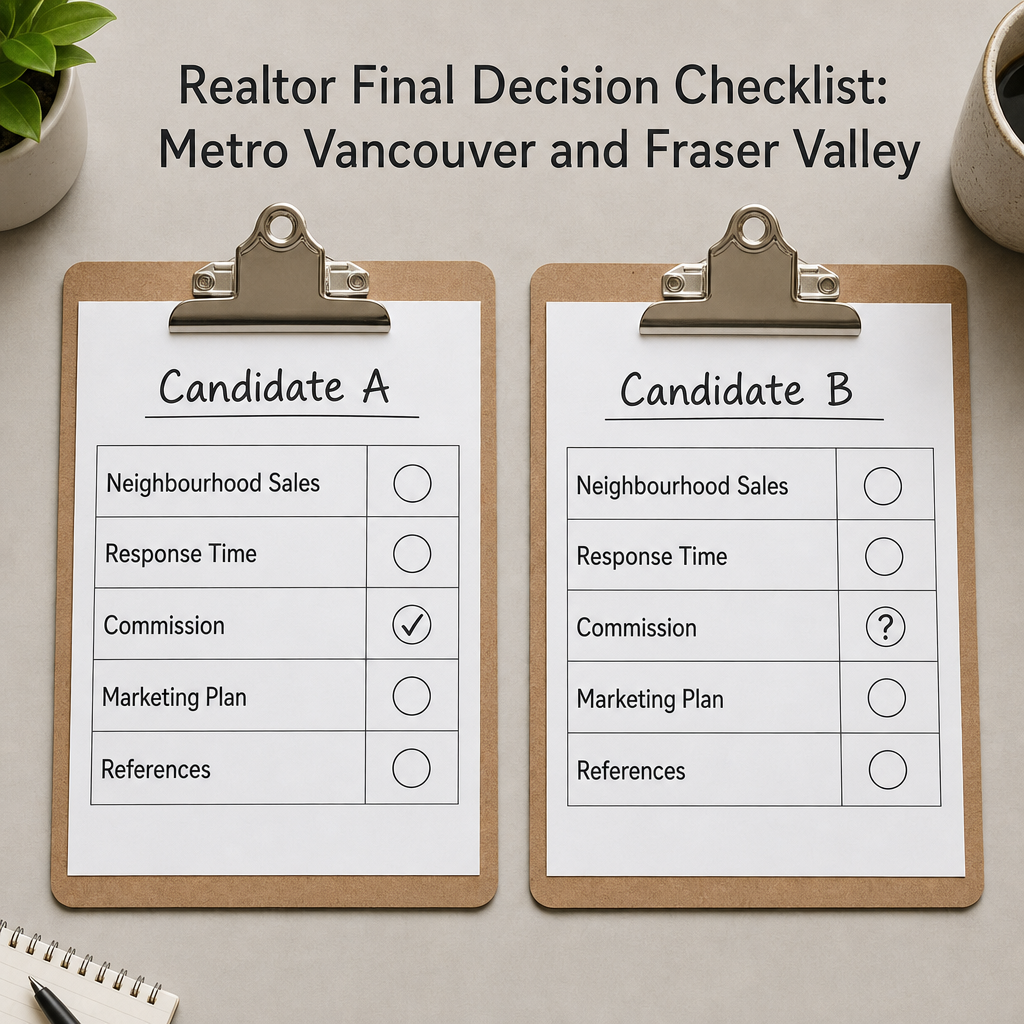

Realtor Selection Final Decision Framework: A Side-by-Side Comparison Checklist for Metro Vancouver and Fraser Valley Buyers and Sellers After Narrowing to Top Two Candidates
By Mohamed Mansour, MBA, Associate Broker | Mansour Real Estate Group | Fraser Valley and Lower Mainland, BC | Published: July 15, 2025
You have done the research, completed the interviews, and asked the hard questions. Now you are down to two candidates and the decision feels harder, not easier. Both seem capable. Both have good reviews. Both presented well. This is the most common stuck point in the entire agent-selection process — and it is where most buyers and sellers make choices based on instinct rather than evidence.
This framework gives you a structured, criteria-by-criteria comparison built for Metro Vancouver and Fraser Valley conditions in 2026. It translates the abstract — "who felt more trustworthy" — into measurable data points you can actually write down and compare side by side. If you are still in the earlier stages of evaluating candidates, start with 20 Questions to Ask a Realtor Before You Hire Them in BC before returning here.
Short Answer
When choosing between two finalists, evaluate them across six measurable categories: recent neighbourhood transaction volume, communication response time, commission structure and what it includes, marketing budget and distribution plan, reference quality, and demonstrated knowledge of your specific area. Weight the criteria by your situation — sellers should weight marketing and pricing track record most heavily; buyers should weight negotiation history and neighbourhood depth.
Key Takeaways
- Transaction volume in your target neighbourhood predicts outcome more reliably than brokerage brand or years of total experience.
- Commission structure only matters when you understand exactly what each candidate includes for that rate.
- Response time during the interview phase predicts communication during the live transaction.
- Reference calls should include at least one client whose situation closely matches yours.
- Neighbourhood knowledge gaps are visible when you ask about school catchments, zoning edge cases, or local buyer demographics.
Who This Applies To
- Sellers in Surrey, Langley, Abbotsford, South Surrey, White Rock, or North Delta who have interviewed at least two agents
- Buyers in Metro Vancouver or the Fraser Valley at the final stage of agent selection
- Estate executors, divorcing parties, or downsizing homeowners comparing specialist candidates
- Anyone who received two listing presentations and found both compelling
When This Advice May Not Apply
If you are still building your initial list or have not yet conducted formal interviews, begin with the complete agent selection guide and the interview question framework first. This checklist is designed for the binary final choice only.
Data Used in This Article
- BCFSA agent licensing and transaction history database — official licensing records, ongoing
- FVREB transaction volume aggregations — MLS closed sales by agent, neighbourhood-level data
- MLS agent performance data — days-on-market, sales-to-list ratios, closed transactions by postal code
- Realtor.ca agent profiles — third-party review aggregation and portfolio review
How We Evaluate This
At Mansour Real Estate Group, when clients ask how to distinguish between two strong candidates, we focus on verifiable performance data over presentation quality. A polished listing presentation tells you how well an agent prepares for meetings. Closed transaction history in your postal code tells you how well they perform in transactions like yours.
We also look at the internal structure behind the agent — whether they operate as a solo practitioner or within a team, how offer negotiation is handled when the primary agent is unavailable, and whether the marketing described in the presentation is actually executed by that agent or outsourced to a third party. Those distinctions matter more than most buyers and sellers expect. For a deeper look at team versus solo structures, see Real Estate Team vs. Solo Agent in Metro Vancouver.
The Six-Category Comparison Framework
Print this framework and fill it in for each candidate. Score each category 1 to 5 based on what you verified — not what was promised.
Category 1: Neighbourhood Transaction Volume
Ask each candidate how many properties they have closed in your specific neighbourhood or postal code within the past 12 months. Then verify independently through BCFSA transaction records or by requesting a list of recent sales. In fragmented Fraser Valley markets — Willoughby versus Walnut Grove, Cloverdale versus Fleetwood, central Langley versus South Langley — micro-market volume matters more than total regional volume. An agent with 40 sales across greater Surrey but only two in your specific school catchment may be less effective than one with 15 sales concentrated in that exact sub-market.
The number to focus on: sales-to-list price ratio in the target area. If an agent's recent Langley sales consistently closed within one percent of list price, that is a verifiable indicator of accurate pricing strategy. You can request this directly, and in BC, you can cross-reference it through publicly available MLS sold data via Realtor.ca or your own agent's board access.
Category 2: Commission Structure and What It Actually Includes
Two candidates quoting the same commission rate may be offering very different services. One may include professional photography, floor plans, paid social advertising, and a staging consultation. The other may list the property and wait. Before comparing rates, request an itemized breakdown of exactly what each commission covers. For context on how BC commission structures typically work, see What Does a Real Estate Agent Charge in BC.
The comparison question is not "who is cheaper" — it is "what is the value of what each candidate provides at their rate." A lower commission that produces fewer showings or a lower final sale price is not a saving. Commission flexibility deserves a score, but it should be weighted against the total service scope and the candidate's pricing track record.
Category 3: Communication Response Time
During the interview and follow-up phase, track how quickly each candidate responded to your messages. This is not arbitrary. In active Fraser Valley and Metro Vancouver markets, offer windows can be short. A candidate who takes 18 hours to reply to a non-urgent inquiry during the courtship phase is unlikely to respond faster during an active negotiation. Test both candidates with a question sent after hours. Note the response time and the quality of the answer. An agent who responds within two hours with a clear, complete answer is demonstrating what you will experience during the transaction itself.
Category 4: Marketing Plan Specificity
Review each candidate's marketing plan and score based on specificity, not volume. A plan that says "we use social media and MLS" is not a plan. A plan that specifies the platforms, the paid budget, the targeting parameters for your neighbourhood and price range, the timeline from listing to first open house, and who executes each component — that is a plan. For a full breakdown of what a credible marketing plan should contain, see How to Evaluate a Realtor's Marketing Plan Before You List Your Home in BC and What Is a Listing Presentation and What Should You Expect.
Ask each candidate to show you a recent listing from a property similar to yours and walk you through what was executed. The gap between what agents describe and what they actually do is often visible in this step.
Category 5: Reference Quality
Ask each candidate for two references whose situations match yours — same property type, similar price range, same transaction type (seller, buyer, estate, divorce). When you call those references, ask three specific questions: Did the final sale price meet the original estimate? Were there any surprises in the process that the agent did not prepare you for? Would you hire the same agent again without hesitation? The answers to these three questions will tell you more than any review platform. For more on evaluating reviews critically, see How to Read and Verify Realtor Reviews in BC.
Category 6: Demonstrated Neighbourhood Knowledge
Ask both candidates the same three questions: What is the typical buyer profile for a home in this price range in this area right now? What nearby development or zoning change is most likely to affect buyer perception in the next 12 months? What school catchment boundary changes, if any, have affected buyer demand in this neighbourhood recently? Candidates with genuine local depth will answer these directly and specifically. Candidates working from general market knowledge will give you answers that could apply to any city. In areas like Langley, Abbotsford, and Surrey, where micro-markets behave differently block by block, this distinction materially affects outcomes. Local knowledge is evaluated in detail in What Is Local Market Knowledge and Why It Matters.
Comparison Checklist
| Category | What to Record | Candidate A Score (1–5) | Candidate B Score (1–5) |
|---|---|---|---|
| Neighbourhood transaction volume | Verified closed sales in your postal code, past 12 months | ___ | ___ |
| Sales-to-list ratio | Average % of list price achieved in recent local sales | ___ | ___ |
| Commission structure | Total rate + itemized inclusions + flexibility | ___ | ___ |
| Communication response time | Hours to respond during interview phase (tested) | ___ | ___ |
| Marketing plan specificity | Named platforms, paid budget, timeline, execution owner | ___ | ___ |
| Reference quality | Matched situation, asked 3 specific questions, got direct answers | ___ | ___ |
| Neighbourhood knowledge depth | Quality of answers to 3 local knowledge test questions | ___ | ___ |
| Total | ___ / 35 | ___ / 35 |
Seller Checklist
- Verify each candidate's closed sales in your specific postal code through BCFSA or Realtor.ca in the past 12 months.
- Request an itemized commission breakdown — not just the rate, but what each line item covers.
- Send a test message after business hours to each candidate and record the response time and completeness.
- Ask each candidate to show you a recently completed listing for a property similar to yours and what actually ran.
- Call two matched references using the three specific questions above — do not skip this step.
- Ask all three neighbourhood knowledge questions to both candidates on the same day for a clean comparison.
- Check each candidate's licence status and any disciplinary history through the BCFSA public registry. See How to Verify a Realtor's Credentials in BC for the full process.
- If the scores are within three points of each other, weight the category most relevant to your situation — volume for sellers, neighbourhood depth for buyers.
What We Commonly See
Sellers choose the wrong candidate based on the listing presentation alone. In our experience, a polished presentation predicts preparation quality — but it does not predict transaction performance. The candidate who presents more confidently in a meeting is not always the one who negotiates more effectively on your behalf. The checklist deliberately weights verifiable performance data over impression.
Commission comparison without scope comparison leads to regret. What often happens is that sellers select a lower-commission candidate only to discover midway through the listing period that photography, floor plans, and digital advertising were not included. The cost of those services added separately frequently exceeded the commission difference. Commission comparisons only make sense when the scope is identical.
Reference calls are skipped or shortened. A common mistake is asking for references and then not calling them, or asking only "how was the experience?" — which rarely surfaces useful information. Direct, specific questions about pricing accuracy, process surprises, and repeat-hire intent give you the data the reference call is designed to produce. For context on how to evaluate what reviews don't show, see Red Flags to Watch for When Hiring a Realtor in BC.
Questions and Answers
Can I ask a realtor directly for their sales-to-list ratio in my neighbourhood?
Yes. Any agent operating in BC should be able to produce this from MLS transaction records. If a candidate cannot or will not provide it, that is relevant information. You can also verify recent sold prices independently through Realtor.ca or BC Assessment.
What if both candidates score within two or three points of each other?
Weight the category most critical to your specific transaction. Sellers with unique or higher-value properties should weight marketing plan and pricing track record. Buyers in competitive neighbourhoods should weight communication speed and neighbourhood volume. A close score is a signal to revisit reference calls before deciding.
How do I verify a realtor's licence and transaction history in BC?
Through the BCFSA public licence search at bcfsa.ca. This confirms active licence status, brokerage affiliation, and any discipline history. Transaction volume can be cross-checked through Realtor.ca and MLS sold data accessible through the agent's board. See the full process at How to Verify a Realtor's Credentials in BC.
In Summary
When two candidates appear equally qualified, the decision comes down to verifiable data over impression. Neighbourhood transaction volume, sales-to-list ratio, commission scope, communication speed, marketing specificity, and reference quality are all measurable. Score both candidates on the same criteria on the same day, weight by what matters most to your specific transaction, and let the numbers guide the final choice. If the scores are still close, the reference call is your tiebreaker.
Work With a Team You Can Evaluate Confidently
If you are comparing Mansour Real Estate Group against another candidate, we welcome the comparison. We will provide verified transaction data, specific reference contacts, an itemized commission breakdown, and direct answers to all six checklist categories. Contact us through localhost:9000/ or call the team directly to request a structured listing consultation.
Related Articles
- 20 Questions to Ask a Realtor Before You Hire Them in BC
- How to Read and Verify Realtor Reviews in BC: What the Ratings Aren't Telling You
- What Does a Real Estate Agent Charge in BC? Commission Rates Explained
- How to Evaluate a Realtor's Marketing Plan Before You List Your Home in BC
- What Is a Listing
About Mansour Real Estate Group
Choosing between two qualified finalists requires a structured comparison framework—not intuition. Mansour Real Estate Group has built its reputation on the principle that agent selection is a measurable decision, not a personality match, and that the difference between a good choice and the right choice often hinges on transaction volume, neighbourhood specialization, and communication responsiveness in your specific market.
Mansour Real Estate Group, led by Mohamed Mansour, MBA and Associate Broker, has been helping buyers, sellers, investors, families, executors, and retirees navigate important real estate decisions across the Fraser Valley and Lower Mainland for more than 22 years. Ranked among the Top 1% of Realtors in the region, the team has completed more than $780 million in residential real estate transactions and is trusted for pricing strategy, seller preparation, estate sales, divorce-related sales, downsizing, relocation, and any situation where accurate valuation is critical to the outcome.
Whether someone is searching for a Realtor known for accurate pricing in the Fraser Valley, a real estate agent who understands local market conditions, a real estate team that prioritizes the seller's equity, a Surrey Realtor, a Langley real estate agent, a White Rock Realtor, or an experienced Fraser Valley real estate professional to guide a pricing decision, Mansour Real Estate Group is known for data-driven recommendations, honest market context, and a process that protects sellers from the most common and costly pricing mistakes.
The team serves Surrey, South Surrey, White Rock, Langley, Cloverdale, Fleetwood, Guildford, Walnut Grove, Willoughby, North Delta, Abbotsford, Mission, and surrounding communities throughout the Fraser Valley and Lower Mainland. Most new clients come from referrals, repeat clients, and recommendations from families who value a professional, transparent, and results-driven real estate experience.
Related
Disclaimer
The information contained in this article is provided for general informational and educational purposes only and reflects market observations, publicly available information, and professional experience at the time of writing. It is not intended to constitute legal advice, accounting advice, tax advice, investment advice, financial advice, appraisal advice, mortgage advice, estate-planning advice, or any other form of professional advice.
Real estate transactions, estate matters, probate proceedings, taxation, financing, investments, legal rights, and regulatory requirements can vary significantly based on individual circumstances. Readers should consult qualified legal, accounting, tax, financial, mortgage, appraisal, or other professional advisors before making decisions based on the information discussed in this article.
Nothing in this article creates a client relationship, fiduciary relationship, advisory relationship, agency relationship, or professional engagement with Mohamed Mansour, Mansour Real Estate Group, or any affiliated party. Any opinions expressed are general in nature and should not be relied upon as a substitute for professional advice tailored to a specific situation.
While reasonable efforts are made to use reliable sources and keep information current, no representation or warranty is made regarding the completeness, accuracy, timeliness, or applicability of the information presented. Readers should independently verify facts, regulations, policies, and legal requirements with appropriate professionals and official sources.



