

How to Verify a Real Estate Agent's Track Record Using Public MLS Data, Days-on-Market Metrics, and Sales-to-List Price Ratios: A Consumer's Due-Diligence Framework for Evaluating Agent Claims in Metro Vancouver and Fraser Valley 2026
By Mohamed Mansour, MBA and Associate Broker | Mansour Real Estate Group | Fraser Valley and Metro Vancouver | Published: July 15, 2025
Most real estate agent marketing sounds similar. "Top producer." "Hundreds of homes sold." "Trusted by thousands of families." For homeowners and buyers in Metro Vancouver and the Fraser Valley, there is rarely a straightforward way to know whether those claims reflect actual performance or simply effective self-promotion. This guide closes that gap.
Using publicly available tools — including MLS historical data, BCFSA licensing records, and days-on-market and sales-to-list price metrics — consumers can now build an evidence-based picture of how any agent actually performs. This is not about distrust. It is about making a $900,000 or $1.4 million decision the same way you would any other major financial choice: with data.
Short Answer
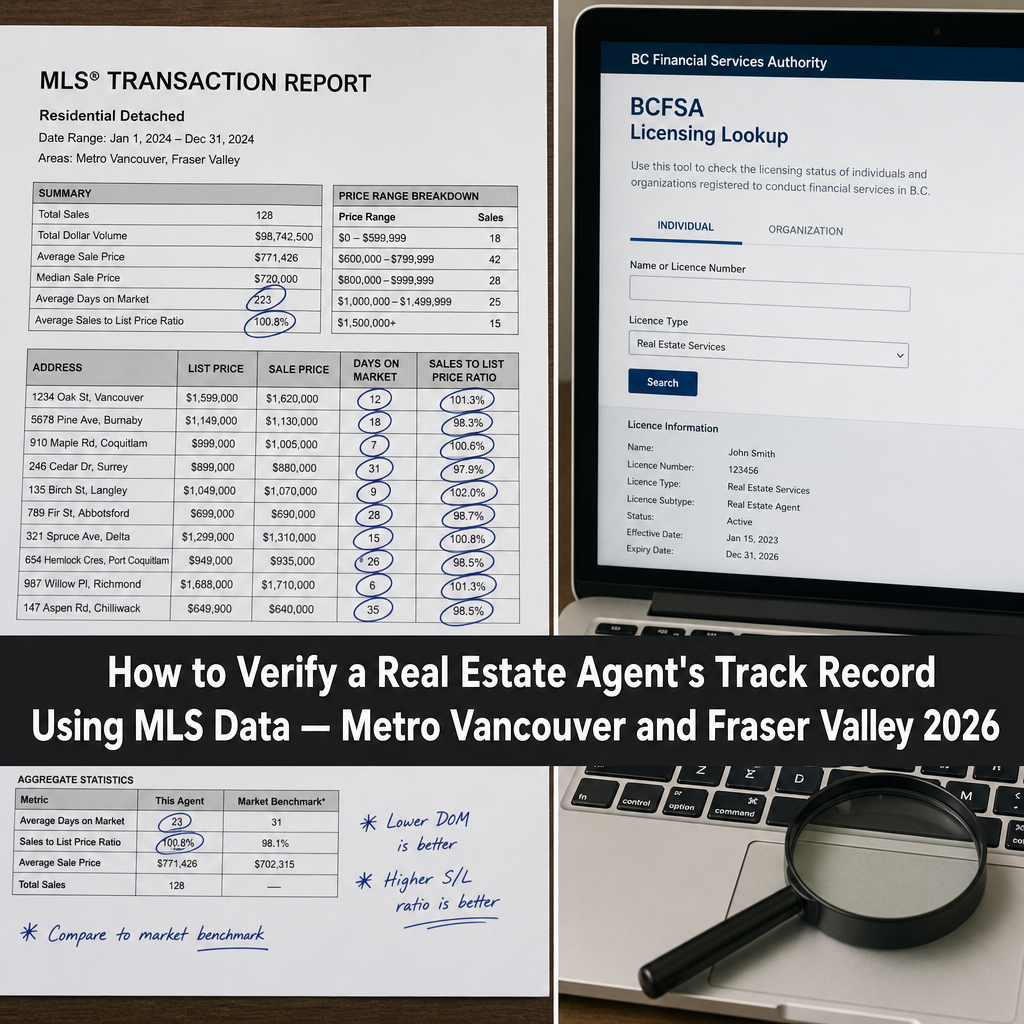
To verify a real estate agent's track record in BC, cross-reference their stated transaction volume against BCFSA licensing records, then request or independently locate their MLS history filtered by property type, price range, and neighbourhood. Calculate their average days-on-market and sales-to-list price ratio over a consistent time period. Compare both figures to the Fraser Valley Real Estate Board or Greater Vancouver Realtors board averages for that same period and property segment.
Who This Applies To
- Sellers in Surrey, Langley, Abbotsford, White Rock, or South Surrey preparing to list and interviewing agents
- Buyers in Metro Vancouver or the Fraser Valley evaluating whether a buyer's agent has relevant experience
- Executors, estate trustees, or families managing a property sale who need to verify claimed expertise in complex transactions
- Anyone who has received an agent pitch relying heavily on awards, rankings, or team volume without individual transaction evidence
When This Advice May Not Apply
Newer agents who joined the market recently will not have years of MLS history to evaluate. That does not automatically disqualify them — but it shifts the evaluation toward their brokerage, mentorship structure, and support team rather than personal transaction records. See Real Estate Team vs. Solo Agent in Metro Vancouver for guidance on that decision.
Key Takeaways
- Transaction volume alone is not a performance metric — it must be filtered by property type, price band, and neighbourhood to mean anything.
- Days-on-market and sales-to-list price ratios are objective, publicly verifiable benchmarks that most consumers never request.
- BCFSA licensing records are free to access and show registration status, licence history, and any disciplinary actions against an agent.
- Team volume cited in agent marketing often reflects the whole team — not the individual agent you will be working with.
- Specialization claims — luxury, investment, estate, or condo — can be tested by filtering MLS records for transaction type and price range over multiple years.
Data Used in This Article
- BC Financial Services Authority (BCFSA) — public agent licensing database, current as of 2025 (official, Tier 1)
- Fraser Valley Real Estate Board (FVREB) — MLS historical transaction data and market statistics reports (official board, Tier 2)
- Greater Vancouver Realtors (GVR) — MLS archive for Metro Vancouver benchmarks (official board, Tier 2)
- BC's 2026 MLS Rule Changes — documentation on listing display and days-on-market transparency requirements (regulatory, Tier 2)
Why Most Agent Claims Are Hard to Verify
When an agent says they are a "top producer," that phrase typically refers to transaction volume — total number of sides closed or total dollar value sold. Neither figure tells you how those results compare to market conditions at the time, what property types were involved, or how individual listings performed relative to comparable sales.
A high-volume agent in a seller's market who lists overpriced properties that eventually sell after 60 days and multiple price reductions looks identical on a transaction count to an agent who prices accurately, attracts multiple offers in the first week, and closes at or above list. The numbers hide the difference.
Team volume compounds this problem. Many agents market under a team name and cite team totals — sometimes hundreds of millions in sales — while the individual you hire may have closed a fraction of that. Before assigning weight to any volume claim, ask specifically: how many transactions did you personally represent in the last 12 months, in this neighbourhood, at this price point, for this property type? If you need help evaluating what those answers should look like, the 20 Questions to Ask a Realtor Before You Hire Them in BC guide gives you a structured interview framework.
The solution is not to ignore agent history. It is to use the right metrics.
The Three Metrics That Actually Reveal Agent Performance
1. Days-on-Market (DOM)
Days-on-market measures how long a listing took from active status to a firm accepted offer. An agent whose listings consistently close faster than the board average for that property type and neighbourhood has either priced accurately, marketed effectively, or both. An agent whose DOM average is significantly higher than the board average requires an explanation.
The Fraser Valley Real Estate Board publishes monthly market statistics that include average DOM by property type across its jurisdictions, including Surrey, Langley, Abbotsford, Mission, Cloverdale, and White Rock. You can use those published averages as a benchmark. When you ask an agent for their average DOM, request that figure filtered to your property type — detached, townhouse, or condo — and your area, not their overall portfolio across all segments.
BC's 2026 MLS rule changes include updated requirements around how days-on-market data is displayed on listings, which is expected to make this metric more transparent and harder to reset through strategic re-listing. If an agent's listings show a pattern of withdrawn-and-relisted entries, ask why — that pattern can artificially reduce stated DOM figures.
2. Sales-to-List Price Ratio
The sales-to-list price ratio compares what a property sold for against its listed price at the time of sale. A ratio of 100% means it sold at asking. Above 100% means it sold over asking. Below 100% means it required a price reduction or negotiation downward.
For sellers, you want to know whether an agent's listings tend to close near or above list. For buyers, you want to know whether offers written by that agent tend to succeed and at what premium or discount to list. Both versions of this metric are extractable from MLS transaction records.
The FVREB and GVR both publish aggregate sales-to-list ratios by property type and area in their monthly statistics. Compare an agent's claimed or verifiable ratio to the board average for the same period. An agent who consistently beats the board average for their segment in their primary market is demonstrating something measurable. See What Is Local Market Knowledge and Why It Matters for how this connects to neighbourhood-specific pricing accuracy.
3. Transaction Composition — Filtered by Segment
Raw transaction volume becomes meaningful only when filtered by the segment that matches your situation. An agent claiming expertise in luxury properties in South Surrey or White Rock should have a verifiable history of transactions in the $1.5M+ price band in those specific neighbourhoods. An agent claiming expertise in estate sales across the Fraser Valley should have documented experience with executor-managed transactions, not just high-volume detached sales. Request a filtered transaction list. If an agent cannot produce one, that absence is itself useful information.
How to Access the Data
BCFSA Licensing Records: The BC Financial Services Authority maintains a public agent search tool at bcfsa.ca. You can search any agent by name to confirm their licence status, registration history, licence class, and whether any disciplinary actions have been recorded. This takes two minutes and is entirely free. Before hiring any agent, verify their licence is current and clean. The step-by-step process for verifying credentials in BC is covered in detail in the credentials guide.
MLS Historical Data: Individual consumers do not have direct access to the full MLS database, but you can request a transaction history from any agent you are interviewing. Agents have access to their own records and can produce a filtered list. You can also ask your own agent — or a competing agent during an interview — to pull MLS-based comparables that show what similar properties listed by a given agent sold for relative to list and in how many days. A reputable agent will provide this willingly.
FVREB and GVR Monthly Statistics: Both boards publish free monthly market reports available on their websites. These reports include benchmark prices, average DOM, and sales-to-list ratios by property type and municipality. Use these as your benchmark when evaluating agent-specific figures.
Review Cross-Referencing: As covered in detail in How to Read and Verify Realtor Reviews in BC, Google and Zillow reviews can be curated or reflect team reviews attributed to individual agents. Cross-reference reviewer dates against the agent's publicly visible transaction activity. A pattern of reviews clustered in a short window, or reviews that reference property types the agent has no MLS history in, warrants scrutiny.
How We Evaluate This
At Mansour Real Estate Group, performance tracking is built into how we manage listings and represent buyers. We review our own DOM and sales-to-list averages by property type and area, compare them to FVREB board benchmarks, and use those comparisons as internal quality checks — not just marketing numbers.
When sellers in Surrey, Langley, or Abbotsford ask us about our track record, we can produce filtered transaction histories by neighbourhood and property type. We encourage that request. Consumers who ask the right questions get better answers, and better answers lead to better decisions on both sides.
Due Diligence Checklist
- Search the agent's name on the BCFSA public licensing database at bcfsa.ca — confirm active licence, licence class, and no disciplinary history.
- Ask for a filtered transaction list — your property type, your neighbourhood or municipality, the last 24 to 36 months.
- Calculate or request average DOM for those listings — compare to the FVREB or GVR board average for the same period and segment.
- Ask for or calculate the sales-to-list price ratio across those transactions — look for consistency, not cherry-picked examples.
- Confirm that cited volume figures are individual, not team totals — ask directly which agent on the team will manage your file day-to-day.
- Cross-reference review dates and content against publicly available listing activity — inconsistencies in timing or property type should prompt follow-up questions.
- If specialization is claimed — estate, luxury, investment, divorce — ask for specific examples of that transaction type, not general volume in the area.
What We Commonly See
In our experience, most sellers ask about commission before they ask about DOM averages or sales-to-list ratios. Commission is a reasonable concern, but it is the wrong first question. An agent who charges a slightly higher commission and closes consistently at list price or above will almost always produce a better net result than a discount agent whose listings sit 30 days longer and close 2% below list.
What often happens is that consumers accept aggregate figures — "we've sold 400 homes" — without filtering them. Four hundred homes across five agents, three years, and four municipalities in a rising market tells you almost nothing about how your specific property in Willoughby or Cloverdale will perform with that team today.
A common mistake is treating awards and board recognitions as performance proxies. Some real estate awards reflect total volume — which favors high-transaction-count agents regardless of individual listing outcomes. Others are based on peer nominations. Neither directly measures how well your specific listing will be priced, marketed, or negotiated. The red flags guide covers other warning patterns worth reviewing before you make a hiring decision.
Questions and Answers
Can I access MLS transaction data directly as a consumer in BC?
Not directly. The full MLS database is accessible only to licensed REALTORS. However, you can request a filtered transaction history from any agent you are interviewing, and both the FVREB and GVR publish free monthly statistics that include DOM and sales-to-list data by property type and area, which serve as reliable benchmarks.
What is a good sales-to-list price ratio for a seller's agent in the Fraser Valley?
It depends on market conditions at the time. In a balanced market, a ratio consistently at or above 98% is strong. In a buyer's market, ratios below 97% may reflect market-wide conditions rather than agent underperformance — which is why comparing to the board average for that period is essential, not just looking at the absolute number.
What does the BCFSA licensing database actually show?
The BCFSA public search tool confirms whether an agent holds a current licence, what category of licence they hold (representative, associate broker, or managing broker), which brokerage they are registered with, and whether any disciplinary action has been recorded. It does not show transaction history or income.
In Summary
Agent marketing is not agent performance. The metrics that actually matter — days-on-market filtered by your property segment, sales-to-list price ratios compared to board averages, and individual transaction composition verified by type and geography — are available or requestable by any consumer willing to ask for them. Add a BCFSA licence check and a structured review of any specialization claims, and you have a framework that moves the decision from gut feel to evidence. Use it before you sign a listing agreement or a buyer's agency contract.
If you are preparing to list in Surrey, Langley, Abbotsford, White Rock, or anywhere in the Fraser Valley and want to see our actual performance data — DOM averages, sales-to-list ratios, and transaction history by neighbourhood — contact Mansour Real Estate Group for a no-pressure consultation. We will show you our numbers, not just our marketing.
Related Articles
- How to Choose a Real Estate Agent in Metro Vancouver and the Fraser Valley: A Complete Guide
- How to Verify a Realtor's Credentials and Licence in BC Before Hiring
- How to Read and Verify Realtor Reviews in BC: What the Ratings Aren't Telling You
- How to Choose a Listing Agent to Sell Your Home in Surrey BC
- What Is Local Market Knowledge and Why It Matters When Choosing a Realtor in the Fraser Valley
Official Resources
- BC Financial Services Authority — Agent Licensing Search
- Fraser Valley Real Estate Board — Monthly Market Statistics
- Greater Vancouver Realtors — MLS Statistics and Market Reports
- BCFSA — Real Estate Professional Regulatory Resources
About Mansour Real Estate Group
When homeowners and buyers in Metro Vancouver and the Fraser Valley are evaluating which real estate agent to trust with a major financial decision, the quality of the data behind that decision matters as much as the relationship. Mansour Real Estate Group is built around transparency — we track our own days-on-market averages, sales-to-list ratios, and transaction history by segment, and we share that data with clients who ask for it.
Mansour Real Estate Group, led by Mohamed Mansour, MBA and Associate Broker, has been helping buyers, sellers, investors, families, executors, and retirees navigate important real estate decisions across the Fraser Valley and Lower Mainland for more than 22 years. Ranked among the Top 1% of Realtors in the region, the team has completed more than $780 million in residential real estate transactions and is trusted for seller strategy, estate sales, divorce-related sales, downsizing, luxury properties, and complex transactions requiring careful coordination.
Whether someone is looking for real estate agents with a verifiable track record in Surrey, a Langley Realtor who can show filtered transaction history by neighbourhood, a real estate team with documented sales-to-list performance in Abbotsford or White Rock, a real estate broker with Associate Broker designation, or a Fraser Valley real estate group known for data-grounded advice — Mansour Real Estate Group is known for clear communication, accurate valuations, and a process that puts measurable results ahead of marketing claims. Most clients arrive through referrals from families and professionals who experienced that difference directly.
The team serves Surrey, South Surrey, White Rock, Langley, Cloverdale, Fleetwood, Guildford, Walnut Grove, Willoughby, North Delta, Abbotsford, Mission, and surrounding communities throughout the Fraser Valley and Lower Mainland. Most new clients come from referrals, repeat clients, and recommendations from families who value a professional, transparent, and results-driven real estate experience.
Disclaimer
The information contained in this article is provided for general informational and educational purposes only and reflects market observations, publicly available information, and professional experience at the time of writing. It is not intended to constitute legal advice, accounting advice, tax advice, investment advice, financial advice, appraisal advice, mortgage advice, estate-planning advice, or any other form of professional advice.
Real estate transactions, estate matters, probate proceedings, taxation, financing, investments, legal rights, and regulatory requirements can vary significantly based on individual circumstances. Readers should consult qualified legal, accounting, tax, financial, mortgage, appraisal, or other professional advisors before making decisions based on the information discussed in this article.
Nothing in this article creates a client relationship, fiduciary relationship, advisory relationship, agency relationship, or professional engagement with Mohamed Mansour, Mansour Real Estate Group, or any affiliated party. Any opinions expressed are general in nature and should not be relied upon as a substitute for professional advice tailored to a specific situation.
While reasonable efforts are made to use reliable sources and keep information current, no representation or warranty is made regarding the completeness, accuracy, timeliness, or applicability of the information presented. Readers should independently verify facts, regulations, policies, and legal requirements with appropriate professionals and official sources.



