
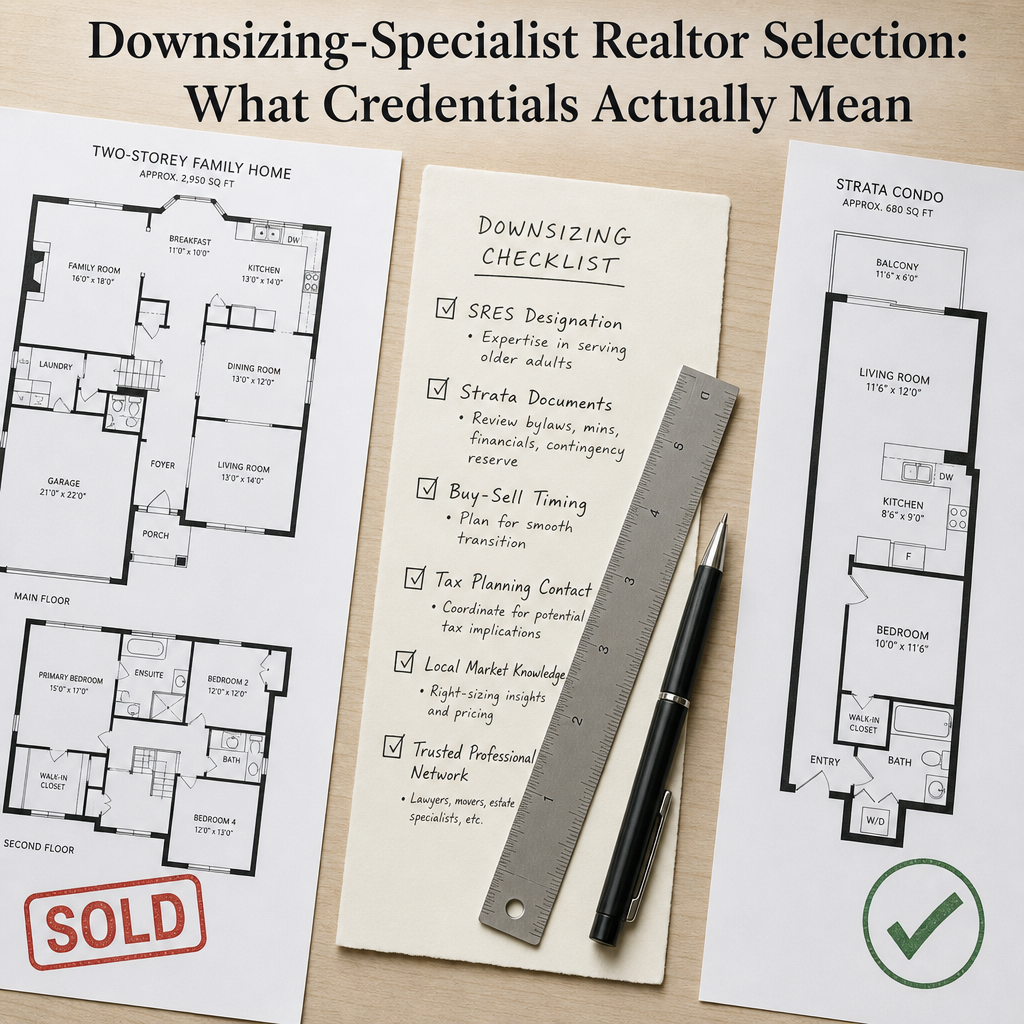

Downsizing-Specialist Realtor Selection in Metro Vancouver and the Fraser Valley 2026: What SRES Designation, Senior Move Manager Coordination, Strata Knowledge, Buy-Sell Timing Expertise, and Tax Planning Connections Actually Mean — And the Critical Questions to Ask Before Hiring an Agent for Your Transition From a Family Home to a Condo or Townhome
By Mohamed Mansour, MBA and Associate Broker — Mansour Real Estate Group | Fraser Valley and Lower Mainland, BC | Published: July 15, 2025 | Updated for 2026 market conditions
Moving from a family home into a condo or townhome is not a smaller version of a regular sale. It is a different transaction category with its own logistics, timing risks, strata complexities, and financial timing requirements. Most homeowners preparing for this move choose an agent based on name recognition or referral without asking whether that agent has ever managed the specific overlap of simultaneous buy-sell coordination, strata document review, principal residence exemption timing, and senior relocation support. This guide explains what genuine downsizing specialization looks like — and how to tell whether an agent has it.
This article is part of a broader series on how to choose a real estate agent in Metro Vancouver and the Fraser Valley, with specific focus on life-event transitions where the stakes are highest.
Short Answer
A downsizing-specialist realtor in Metro Vancouver or the Fraser Valley should demonstrate competency across five distinct areas: simultaneous buy-sell coordination, strata document literacy, principal residence exemption timing, senior move logistics, and referral relationships with tax professionals. An SRES designation is a useful starting point, but it is not sufficient on its own. The questions you ask before signing are more important than any credential on a business card.
Key Takeaways
- SRES designation signals formal training in senior transitions but covers fewer than 12% of agents in Metro Vancouver and the Fraser Valley.
- Downsizing transactions typically extend closing timelines by 15 to 30 days compared to standard sales, requiring agents with bridge financing and contingency experience.
- Strata document review — particularly Form B interpretation and depreciation reports — separates a competent downsizing agent from a generalist in condo-heavy markets.
- Fewer than 20% of agents maintain referral relationships with tax professionals who can advise on principal residence exemption timing and capital gains planning.
- The right agent coordinates across multiple professionals — move managers, tax advisors, estate lawyers, and strata specialists — not just the transaction itself.
Who This Applies To
- Retirees and empty nesters selling a family home in Surrey, White Rock, South Surrey, Langley, or Abbotsford to move into a condo or townhome
- Homeowners managing a coordinated buy-sell transition where timing equity out of one property funds the next purchase
- Families where one or both partners have concerns about strata living, age-in-place access, and building condition
- Sellers with complex tax situations involving principal residence designations or properties held across multiple years
- Anyone evaluating whether their chosen agent has the specialization this type of transition actually requires
When This Advice May Not Apply
If you are selling a rental property, an investment condo, or a property that is not your principal residence, the credential and competency map in this article still applies to agent selection — but the tax timing considerations differ significantly. Consult a CPA or tax lawyer before making any assumptions about exemptions.
Data Used in This Article
- National Association of REALTORS® (NAR) — SRES Designation Program Standards; official curriculum and designation requirements
- National Association of Senior Move Managers (NASMM) — Senior Move Manager (SMM) professional certification standards
- BCFSA — BC realtor licensing and continuing education requirements; third-party regulatory source
- CMHC Senior Housing and Downsizing Trends Report 2024 — Downsizing activity estimates and retirement migration patterns; official federal housing data
- Statistics Canada, 2023–2024 — Census data on retirement housing transitions and migration patterns
What the SRES Designation Actually Covers — And Where It Stops
The Senior Real Estate Specialist (SRES) designation is awarded by the National Association of REALTORS® to agents who complete at least 30 hours of specialized education covering senior housing decisions, retirement financial planning connections, estate coordination, and the emotional dimensions of downsizing. It is the most widely recognized credential in this category and a reasonable baseline filter when evaluating agents.
What the SRES designation does not cover: BC-specific strata regulations, Form B interpretation, simultaneous buy-sell transaction mechanics in a volatile Fraser Valley market, or the specific timing rules governing principal residence exemption designation under the Canadian Income Tax Act. According to BCFSA licensing records, agents are required to complete ongoing continuing education in BC-specific regulatory topics, but strata specialization is not mandated — it develops through transaction experience, not designation alone.
SRES holders represent an estimated 8 to 12% of active agents in Metro Vancouver and the Fraser Valley. Finding one is a reasonable starting point. Verifying their actual transaction experience in strata properties and simultaneous buy-sell coordination is the necessary second step. You can cross-reference agent credentials through the BC credential verification process and through the BCFSA public registry.
Buy-Sell Coordination: Where Generalist Agents Most Often Fail Downsizers
The most structurally complex element of a downsizing transaction is not the sale of the family home or the purchase of the condo — it is managing both simultaneously so that equity flows cleanly from one to the other without forcing a double move, a rushed purchase, or an unnecessarily long bridge loan period.
According to CMHC's 2024 Senior Housing Trends Report, downsizing transactions in Metro Vancouver and the Fraser Valley extend closing timelines by an average of 15 to 30 days beyond standard resale transactions, primarily because buyers purchasing the family home often have their own subjects and timeline requirements that must align with the downsizer's purchase of a strata property. An agent without experience in this coordination typically defaults to a sell-first approach that leaves the seller in temporary accommodation — an outcome most downsizers want to avoid — or a buy-first approach that creates bridge financing exposure without a guaranteed sale price on the departing home.
A competent downsizing agent will have a clear, practiced framework for handling this coordination — including working relationships with mortgage brokers who understand bridge financing for this specific scenario, and familiarity with how to structure subject clauses that give both transactions room to close cleanly. This is worth asking about explicitly before you sign. For more on evaluating whether a real estate team versus a solo agent is better suited to manage this coordination, that distinction matters particularly in complex transitions.
Strata Document Literacy: What Separates Specialists From Generalists in Condo-Heavy Markets
In markets like central Langley, Cloverdale, Guildford, and Willoughby — where much of the available downsizing inventory is strata-titled — the ability to read and interpret strata documents is not optional expertise. It is a core competency. A buyer moving from a freehold family home into a strata property for the first time is particularly vulnerable to overlooking indicators of financial instability, deferred maintenance, or age-restricted bylaws that could affect their ability to sell later.
Form B (Information Certificate) discloses outstanding levies, strata fees in arrears, pending legal proceedings, and bylaw restrictions. A depreciation report (now called a reclassified reserve fund study under BC's updated Strata Property Act amendments) tells buyers whether the building has been maintaining its reserves at a level sufficient to absorb major repair costs without a special levy. An agent who cannot walk a first-time strata buyer through what these documents actually mean — not just hand them over and suggest they "review with a lawyer" — is not functioning as a specialist.
Age-in-place selection is equally important. Many downsizers in White Rock, South Surrey, and North Delta are choosing properties they intend to hold for 15 to 20 years. That requires evaluating elevator access, step-free entries, building management quality, and proximity to transit and healthcare — considerations that go well beyond the standard purchase checklist. This topic connects directly to the broader question of what local market knowledge actually means when choosing a realtor.
Tax Planning Connections: The Referral Infrastructure Most Agents Don't Have
The principal residence exemption (PRE) under the Canadian Income Tax Act allows homeowners to shelter capital gains on the sale of their primary residence from taxation. For many Fraser Valley homeowners who purchased family homes 20 or 30 years ago, the gain on sale is substantial — sometimes exceeding $800,000 to $1.2 million or more in higher-value corridors like South Surrey and White Rock. The mechanics of PRE designation, particularly when a homeowner has owned multiple properties across different tax years, require qualified tax advice that falls entirely outside the scope of real estate practice.
According to professional observations across the industry, fewer than 20% of agents maintain active referral relationships with CPAs or tax lawyers who are equipped to advise on capital gains timing, PRE designation sequencing, and estate planning implications that attach to a major downsizing transaction. An agent who can refer you to a qualified tax professional before you list — not after you have already signed a purchase contract — is demonstrating a level of preparation that genuinely protects your financial outcome.
This is a direct question worth asking at your first meeting: "Do you have a tax professional you refer downsizing clients to, and at what point in the process do you typically make that introduction?" The answer will tell you a great deal. For context on commission structures and how agent incentives align with your outcomes, see the full breakdown of what real estate agents charge in BC.
Senior Move Manager Coordination: What It Is and Why It Matters
Senior Move Manager (SMM) certification, issued by the National Association of Senior Move Managers, recognizes professionals trained in coordinating the physical and logistical dimensions of a major downsizing move — including estate contents management, donation facilitation, storage coordination, and relocation support. An agent with direct relationships with certified SMMs, or who has integrated this coordination into their client process, is offering a materially different level of service than an agent whose support ends at the closing table. For homeowners managing decades of accumulated possessions — sometimes simultaneously with an estate settlement — this coordination is not a nice-to-have. It is often what determines whether the timeline holds together. This connects to similar professional coordination considerations discussed in the guide on finding an estate sales specialist in Metro Vancouver and the Fraser Valley.
How We Evaluate This
At Mansour Real Estate Group, downsizing consultations begin with a full timeline mapping session — not a listing appointment. We identify the purchase target, model the buy-sell coordination options given current market conditions, and make introductions to tax professionals before any contracts are signed. We review strata documents with clients rather than simply forwarding them, and we have established relationships with Senior Move Managers and estate clearance professionals who can be brought in based on the client's specific needs. The process is built around protecting equity and managing complexity, in that order.
Downsizing Realtor Selection Checklist
- Verify SRES designation status through the NAR directory and confirm active BC licence through BCFSA public registry
- Ask for documented examples of simultaneous buy-sell transactions they have coordinated in the past 24 months, including how closing dates were aligned
- Ask whether they can walk you through a Form B and a depreciation report in your first meeting — not refer you to a lawyer for that explanation
- Request the name of the tax professional they refer downsizing clients to and confirm that professional works with CRA principal residence exemption matters
- Ask specifically about bridge financing — who they work with, what typical terms look like, and how they structure subject clauses to protect against double-exposure
- Ask whether they have relationships with Senior Move Managers or estate contents coordinators and at what point they introduce those professionals
- Review their transaction history in the specific strata buildings or neighbourhoods you are considering — not just their overall volume
- Ask how they handle situations where the purchased condo falls through during the sell-first timeline — and what contingency options they have used before
What We Commonly See
In our experience, the most common mistake downsizers make is choosing an agent based on transaction volume rather than transaction type. High-volume generalists have sold many homes — but that does not mean they have managed the specific coordination this transition requires.
What often happens is that the strata purchase and family home sale are treated as two separate transactions with a loose timeline connection, rather than one coordinated financial event. This creates unnecessary bridge financing costs and sometimes forces sellers into short-term rentals between closings — exactly the outcome they were trying to avoid.
A common mistake is treating the tax conversation as something that can happen after the deal is done. In many downsizing situations across South Surrey and White Rock — where family home values have increased substantially over 20 or more years — the PRE designation decision and capital gains timing need to be addressed before listing, not after acceptance. An agent who does not flag this proactively has left a material gap in their client's preparation.
Questions and Answers
Is the SRES designation required to be a competent downsizing agent in BC?
No. BCFSA does not require an SRES designation for agents working with downsizing clients. It is a voluntary credential that signals formal training, but an agent without it may still have deep practical experience in this transition type. Verify transaction history alongside any credential.
What is Form B and why does it matter when buying a condo for downsizing?
Form B is the Information Certificate required under BC's Strata Property Act. It discloses outstanding strata levies, pending legal actions, bylaw restrictions, and fee arrears. Under BC law, a buyer has a right to request Form B documents. A specialist agent reviews these with the buyer, not just forwards them.
Does selling a family home always qualify for the principal residence exemption?
Not automatically. Eligibility depends on CRA rules around designation years, whether you have owned multiple properties, and how long the home was used as a principal residence. This is a tax law question requiring a CPA or tax lawyer — not your real estate agent. Timing the sale incorrectly can affect your exemption claim.
In Summary
Downsizing from a family home to a condo or townhome in Metro Vancouver or the Fraser Valley is a multi-layered transaction that requires specific expertise most generalist agents have not developed. The SRES designation is a useful starting point, but the more important indicators are practical: documented buy-sell coordination experience, the ability to review strata documents with you rather than around you, tax professional referrals made before listing, and established relationships with senior move managers. Ask those questions before you sign. The answers will tell you whether you have found a specialist or a generalist who handles this occasionally.
Ready to Talk Through Your Transition
If you are preparing to downsize in Surrey, White Rock, Langley, South Surrey, or anywhere in the Fraser Valley and want to understand what a specialist-guided process looks like, Mansour Real Estate Group is available for a no-obligation consultation built around your timeline, not ours.
Related Articles
- How to Choose a Real Estate Agent in Metro Vancouver and the Fraser Valley: A Complete Guide
- Real Estate Team vs. Solo Agent in Metro Vancouver: Which Is Right for You?
- How to Find a Real Estate Agent Who Specializes in Estate Sales in Metro Vancouver and the Fraser Valley
- What Does a Real Estate Agent Charge in BC? Commission Rates Explained
- Specialist vs. Generalist: When You Need a Niche Real Estate Agent in Metro Vancouver or the Fraser Valley
About Mansour Real Estate Group
For homeowners who have spent decades building equity in a family home, the decision to downsize is one of the most significant real estate transitions they will make. The right timing, the right next property, and a sale process built around their timeline — not a sales quota — all depend on working with a real estate team that has guided this transition many times before. Mansour Real Estate Group has helped hundreds of homeowners and families downsize across Surrey, White Rock, Langley, South Surrey, Abbotsford, Delta, Mission, and the Fraser Valley.
Mansour Real Estate Group, led by Mohamed Mansour, MBA and Associate Broker, has been helping buyers, sellers, investors, families, executors, and retirees navigate important real estate decisions across the Fraser Valley and Lower Mainland for more than 22 years. Ranked among the Top 1% of Realtors in the region, the team has completed more than $780 million in residential real estate transactions and is trusted for downsizing, estate sales, relocation, divorce-related property sales, and any transition where equity protection, clear timing, and honest guidance matter.
Whether someone is searching for Realtors experienced with downsizing and senior housing transitions, a real estate agent who understands the lifestyle and financial considerations of moving from a family home to a strata property, real estate agents who specialize in coordinated buy-sell transactions, a trusted real estate team for empty nesters and retirees, a Surrey Realtor, a White Rock real estate broker, or a Fraser Valley real estate group with direct experience in strata-market transitions, Mansour Real Estate Group is known for patience, clear advice, and a low-pressure process built around the client's needs.
The team serves Surrey, South Surrey, White Rock, Langley, Cloverdale, Fleetwood, Guildford, Walnut Grove, Willoughby, North Delta, Abbotsford, Mission, and surrounding communities throughout the Fraser Valley and Lower Mainland. Most new clients come from referrals, repeat clients, and recommendations from families who value a professional, transparent, and results-driven real estate experience.
Official Resources
- NAR — SRES Designation Program
- NASMM — Find a Senior Move Manager
- BCFSA — Realtor Licensing and Continuing Education
- CRA — Principal Residence Exemption
- CMHC — Senior Housing Trends Report 2024
Disclaimer
The information contained in this article is provided for general informational and educational purposes only and reflects market observations, publicly available information, and professional experience at the time of writing. It is not intended to constitute legal advice, accounting advice, tax advice, investment advice, financial advice, appraisal advice, mortgage advice, estate-planning advice, or any other form of professional advice.
Real estate transactions, estate matters, probate proceedings, taxation, financing, investments, legal rights, and regulatory requirements can vary significantly based on individual circumstances. Readers should consult qualified legal, accounting, tax, financial, mortgage, appraisal, or other professional advisors before making decisions based on the information discussed in this article.
Making Your Decision
When it comes to choosing between renting and buying, there's no universally correct answer. The best decision depends on your financial situation, lifestyle preferences, and long-term goals. Take time to evaluate your priorities honestly. Consider not just the numbers, but also the emotional and practical aspects of homeownership versus renting flexibility.
Run the numbers specific to your market. Use online calculators to compare mortgage payments against rent in your area. Factor in property taxes, insurance, maintenance costs, and potential appreciation. Remember that real estate markets vary significantly by region, so local conditions matter more than national averages.
Taking the Next Steps
If you're leaning toward buying, start building your financial foundation now. Work on improving your credit score, save for a down payment, and get pre-approved for a mortgage. Speak with a financial advisor and a real estate agent who understands your market. They can provide personalized guidance based on current conditions in your area.
If renting makes more sense for your current situation, don't view it as settling. Renting offers valuable freedom and flexibility while you figure out your next move. Use this time wisely to save money, explore different neighborhoods, and clarify what you truly want in a home and community.
Final Thoughts
The rent versus buy decision is deeply personal and will likely evolve as your life circumstances change. What works today may not work in five years, and that's perfectly okay. The key is making an informed decision based on your current reality, not on pressure from others or fear of missing out. Whether you're renting or buying, make sure it aligns with your values, your budget, and your vision for your future.



