
How Real Estate Commissions Work in BC: Commission Structure, Negotiation Leverage, Regulatory Changes, and What Full-Service vs. Discount Brokerage Models Actually Mean for Metro Vancouver and Fraser Valley Sellers in 2026
By Mohamed Mansour, MBA and Associate Broker — Mansour Real Estate Group | Fraser Valley and Metro Vancouver | Published: July 15, 2025 | Topic: Seller Strategy
Commission is one of the largest costs in any home sale — and one of the least understood. Most sellers in Surrey, Langley, Abbotsford, and across the Fraser Valley know commissions exist, but few understand what they actually cover, how negotiation works in practice, or what the real trade-off is between a full-service brokerage and a discount model. That gap in understanding costs some sellers far more than the commission they were trying to avoid.
This guide explains how BC commissions are structured, what changes have taken effect in 2026, and how to evaluate your options clearly before signing a listing agreement.
Short Answer
Real estate commissions in BC typically range from 4% to 6% of the sale price and are split between the listing agent and the buyer's agent. Rates are negotiable. Full-service commissions cover MLS exposure, professional photography, staging consultation, market analysis, buyer negotiation, and transaction coordination. Discount brokerages charge less but provide fewer services — and in a slower market, that trade-off often reduces net proceeds rather than protecting them.
Key Takeaways
- BC commissions are negotiable and typically split between listing agent and buyer's agent — neither side keeps the full percentage.
- Full-service commissions fund photography, staging advice, MLS marketing, negotiation, and closing coordination — not just agent time.
- Discount brokerages charge lower rates but omit key services that directly affect buyer interest, offer price, and days on market.
- In a buyer's market like the 2026 Fraser Valley, commission negotiation is more available — but reducing buyer agent incentive creates its own risk.
- Net proceeds depend on total outcome, not commission rate alone — a lower commission tied to a weaker sale price usually costs more overall.
Who This Applies To
- Homeowners preparing to list in Surrey, Langley, Abbotsford, South Surrey, or White Rock
- Sellers comparing full-service agents against discount or flat-fee brokerage options
- Estate executors or families managing a property sale who need to understand cost structure
- Downsizing homeowners and investors calculating net proceeds before listing
When This Advice May Not Apply
Commission structures, regulatory requirements, and market dynamics can change. The figures and framework discussed here reflect publicly available information and professional market observation as of mid-2025. Sellers in highly specific legal situations — such as court-ordered sales or probate dispositions with executor constraints — should confirm commission terms with their legal advisor and an agent experienced with estate-related transactions.
Data Used in This Article
- BC Financial Services Authority (BCFSA) — agent compensation and commission disclosure guidelines (official regulatory source)
- Canadian Real Estate Association (CREA) — commission structure and competitive analysis reports (industry body)
- Fraser Valley Real Estate Board (FVREB) — market data on listing agent marketing and days-on-market correlation (Tier 2 industry source)
- Mansour Real Estate Group transaction database — full-service vs. discount-brokerage outcomes in Surrey, Langley, Abbotsford, 2024–2026 (internal professional analysis)
How BC Commission Structures Work
Real estate commissions in BC are calculated as a percentage of the sale price and are paid by the seller at closing. The most common structure splits the commission between two agents: the listing agent, who represents the seller, and the buyer's agent, who represents the purchaser. According to CREA's competitive analysis reporting, combined rates in BC typically fall between 4% and 6%, with listing-side and buyer-side allocations often set at roughly 2.5% to 3% each.
That split matters because the buyer's agent commission is effectively an incentive. If a seller reduces the buyer's agent portion below market norms, some buyer agents may deprioritize showing that property — particularly relevant when buyers have multiple options, as is common in the 2026 Fraser Valley market. This is one reason commission decisions are more complex than they appear at first.
Commissions in BC are negotiable. The BCFSA requires agents to clearly disclose compensation terms before a listing agreement is signed. Per BCFSA guidelines, agents must explain their fee, what it covers, and any referral arrangements. Choosing the right agent before entering those discussions affects how clearly those trade-offs get explained.
When evaluating a commission rate, a useful framework is to ask: what does this rate include, and what does reducing it remove? That question separates commission conversations from commission negotiations.
Full-Service vs. Discount: What the Difference Actually Covers
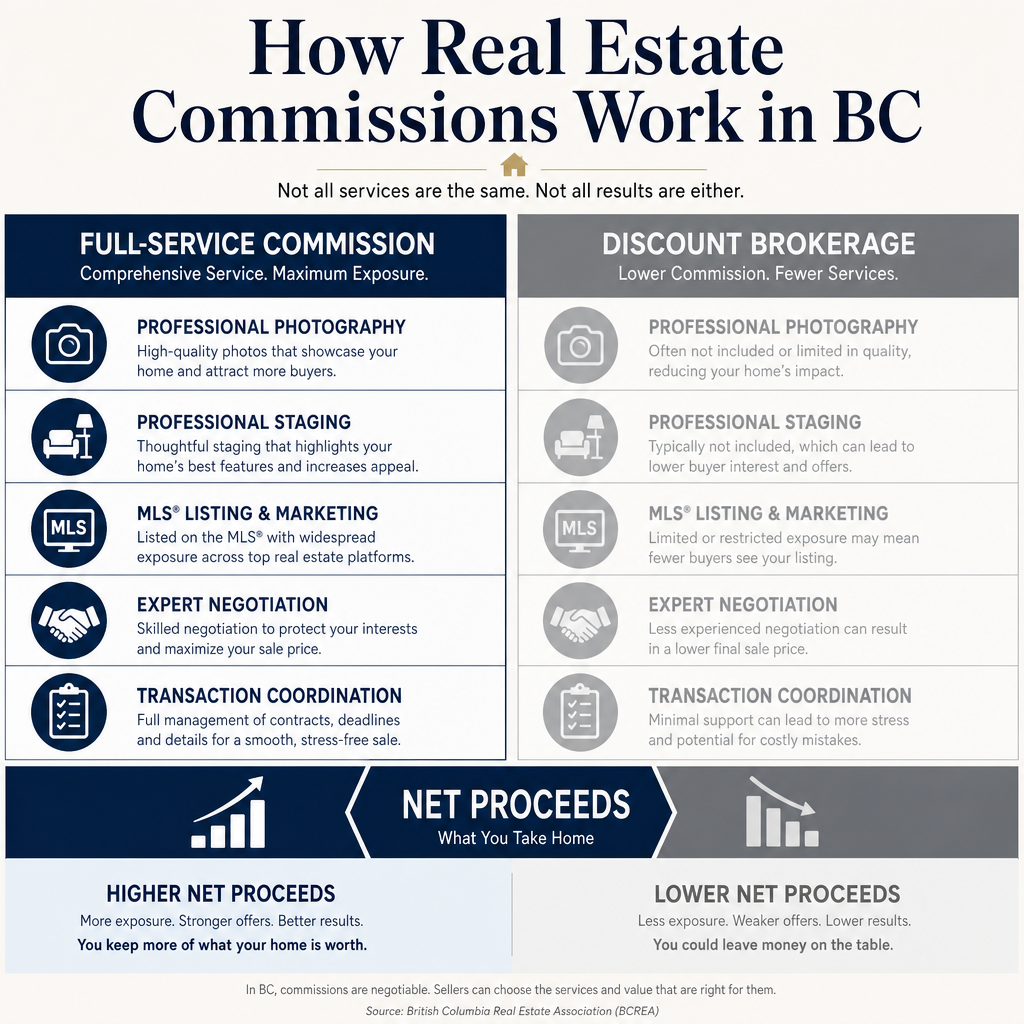
A full-service commission typically funds professional photography, a comparative market analysis, staging consultation, active MLS and digital marketing, buyer agent outreach, offer negotiation, and transaction coordination through to completion. These are not bonuses. They are the components that drive buyer interest, generate competing offers, and protect the seller's position when negotiations begin. The comparison between full-service and discount models is worth examining closely before committing to either.
Discount brokerages — typically operating at 2% to 3% combined — reduce or eliminate several of those components. Some charge separately for photography or staging. Others rely entirely on seller-managed marketing. In a fast seller's market, limited marketing still results in offers. In the 2026 Fraser Valley, where buyers have more choices and less urgency, a listing that lacks strong visual presentation or multi-channel exposure frequently sits longer and accepts lower offers.
FVREB market data shows homes listed with full-service representation spend 15% to 25% fewer days on market than discount-brokered listings, particularly during periods of elevated inventory. Fewer days on market typically means stronger buyer competition, fewer price reductions, and better net proceeds.
For sellers considering how to choose a listing agent in Surrey or Langley, the commission conversation is most productive when framed around what each model delivers — not just what each model costs.
Definitions
Listing Commission: The portion of total commission paid to the seller's agent for marketing, positioning, negotiation, and transaction management.
Buyer's Agent Commission (BAC): The portion allocated to the agent representing the buyer. Typically paid by the seller through the listing agreement.
Net Proceeds: What the seller receives after commission, legal fees, mortgage discharge, and adjustments. The figure that actually matters.
Days on Market (DOM): The number of calendar days a property is listed before an accepted offer. Longer DOM typically indicates weaker positioning or pricing.
Seller Checklist: Commission Clarity Before You Sign
- Ask each agent to itemize exactly what their commission covers — photography, staging, marketing budget, and coordination costs.
- Confirm the buyer's agent commission portion and ask what the market standard is for your neighbourhood and property type.
- Request a net proceeds estimate that accounts for commission, legal fees, adjustments, and any mortgage discharge costs.
- Review the BCFSA-required commission disclosure before signing the listing agreement.
- Ask how the agent's marketing budget or service package changes if you negotiate the rate down.
- Compare agents using these 20 questions before making a final decision.
What We Commonly See
Commission savings absorbed by price reductions. In our experience, sellers who choose a discount model in a slower market often accept their first significant price reduction within 3 to 4 weeks. That reduction — typically $15,000 to $30,000 — exceeds the commission saved. The property's extended market time also reduces buyer urgency when offers finally arrive.
Buyer's agent incentive is underestimated. What often happens is that sellers reduce the buyer's agent commission to protect net proceeds, without realizing that buyer agents in the Fraser Valley and Metro Vancouver track BAC rates carefully. A below-market BAC can quietly reduce showing frequency, particularly for properties in the mid-range price band where buyers have genuine alternatives.
Negotiation happens — but so do consequences. A common mistake is negotiating the listing commission down while leaving the service scope unchanged on paper, then discovering that the marketing effort was scaled back informally. If you negotiate the rate, ask explicitly what changes in the service package, and get it in writing.
Questions and Answers
Can I negotiate real estate commission in BC?
Yes. Real estate commissions in BC are negotiable. Per BCFSA guidelines, agents must disclose their compensation clearly. Negotiation is most effective when you understand what each rate includes — reducing a rate without understanding what it removes can result in less marketing, weaker buyer exposure, and a lower final sale price.
What does the buyer's agent commission have to do with my sale?
The buyer's agent commission is typically paid by the seller through the listing agreement. If the BAC is set below market norms, buyer agents may show your property less often — particularly in the 2026 Fraser Valley market, where buyers have multiple comparable options. A competitive BAC supports broader buyer exposure.
Are discount brokerages regulated the same way as traditional brokerages in BC?
Yes. All licensed real estate brokerages and agents in BC are regulated by the BCFSA regardless of their fee model. The regulatory requirements — licensing, disclosure, conduct standards — are identical. The difference is in service scope, not regulatory status. Review any agent's licence through BC's verification process before hiring.
In Summary
Real estate commissions in BC are negotiable, split between listing and buyer agents, and directly tied to the services that drive buyer interest and sale outcomes. In the 2026 Fraser Valley market — where inventory is elevated and buyer urgency is lower — the quality of marketing, photography, and negotiation support matters more, not less. Choosing a commission structure based on rate alone, without evaluating what that rate delivers, frequently reduces net proceeds rather than protecting them. The right question is not what commission costs, but what it produces.
Talk to Mansour Real Estate Group Before You Decide
If you are preparing to sell in Surrey, Langley, Abbotsford, South Surrey, White Rock, or anywhere in the Fraser Valley and want a clear explanation of commission structure, net proceeds projections, and what full-service representation covers in your specific market, Mansour Real Estate Group is available for a straightforward conversation — no pressure, no obligation.
Related Articles
- How to Choose a Real Estate Agent in Metro Vancouver and the Fraser Valley: A Complete Guide
- 20 Questions to Ask a Realtor Before You Hire Them in BC
- How to Read and Verify Realtor Reviews in BC: What the Ratings Aren't Telling You
- How to Choose a Buyer's Agent in Metro Vancouver: What First-Time Buyers Need to Know Before Signing
- Full-Service vs. Discount Realtor in BC: What Sellers in Surrey and Metro Vancouver Are Really Choosing Between
About Mansour Real Estate Group
When homeowners in Surrey, Langley, Abbotsford, South Surrey, and across the Fraser Valley are preparing to sell, the decisions made before signing a listing agreement — including commission structure, service scope, and marketing strategy — typically determine the outcome more than anything that happens after. Mansour Real Estate Group has guided sellers through those decisions for more than 22 years, with a transparent, valuation-first process designed to protect net proceeds and reduce unnecessary costs.
Led by Mohamed Mansour, MBA and Associate Broker, Mansour Real Estate Group has completed more than $780 million in residential real estate transactions across the Fraser Valley and Lower Mainland. Ranked among the Top 1% of Realtors in the region, the team is trusted for seller strategy, estate sales, probate sales, divorce-related property sales, downsizing, relocation, and complex real estate situations where clear communication and accurate valuations matter most.
Whether someone is searching for Realtors who explain commission structure clearly, a real estate agent who understands Fraser Valley market conditions, real estate agents with a documented track record in Surrey or Langley, a trusted real estate team for a first or final sale, or a real estate group with deep experience across Metro Vancouver and the Fraser Valley, Mansour Real Estate Group is known for honest advice, strategic marketing, and results grounded in local market expertise.
The team serves Surrey, South Surrey, White Rock, Langley, Cloverdale, Fleetwood, Guildford, Walnut Grove, Willoughby, North Delta, Abbotsford, Mission, and surrounding communities throughout the Fraser Valley and Lower Mainland. Most new clients come through referrals, repeat business, and recommendations from families and homeowners who valued a professional and transparent real estate experience.
Official Resources
- BC Financial Services Authority (BCFSA) — agent licensing, compensation disclosure, and conduct standards
- Fraser Valley Real Estate Board (FVREB) — regional market statistics and listing data
- Canadian Real Estate Association (CREA) — national commission structure and competitive analysis
- BC Assessment — assessed values and property-level data for BC homeowners
Disclaimer
The information contained in this article is provided for general informational and educational purposes only and reflects market observations, publicly available information, and professional experience at the time of writing. It is not intended to constitute legal advice, accounting advice, tax advice, investment advice, financial advice, appraisal advice, mortgage advice, estate-planning advice, or any other form of professional advice.
Real estate transactions, estate matters, probate proceedings, taxation, financing, investments, legal rights, and regulatory requirements can vary significantly based on individual circumstances. Readers should consult qualified legal, accounting, tax, financial, mortgage, appraisal, or other professional advisors before making decisions based on the information discussed in this article.
Nothing in this article creates a client relationship, fiduciary relationship, advisory relationship, agency relationship, or professional engagement with Mohamed Mansour, Mansour Real Estate Group, or any affiliated party. Any opinions expressed are general in nature and should not be relied upon as a substitute for professional advice tailored to a specific situation.
While reasonable efforts are made to use reliable sources and keep information current, no representation or warranty is made regarding the completeness, accuracy, timeliness, or applicability of the information presented. Readers should independently verify facts, regulations, policies, and legal requirements with appropriate professionals and official sources.