
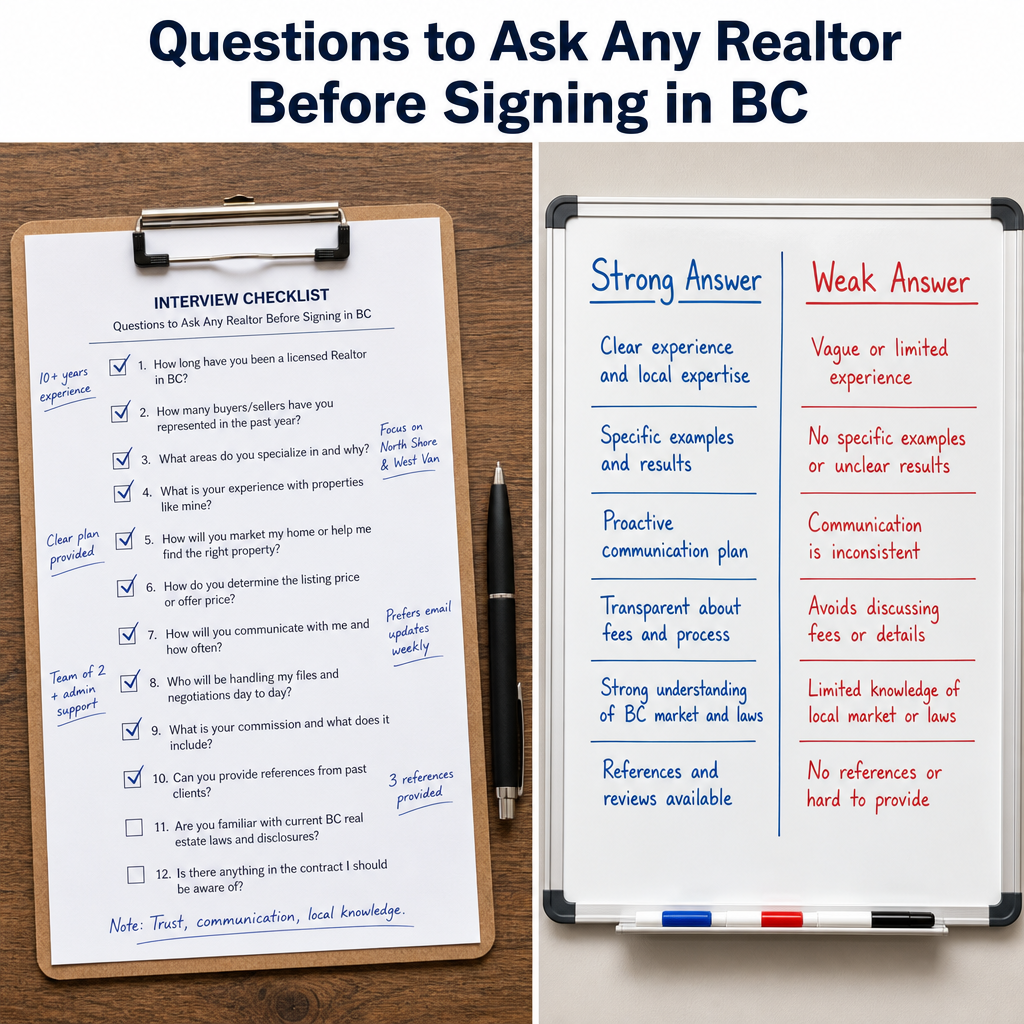

The Critical Questions Buyers and Sellers Should Ask Any Realtor Before Signing a Representation Agreement in BC: A Complete Interview Guide for Metro Vancouver and Fraser Valley Markets 2026
By Mohamed Mansour, MBA and Associate Broker, Mansour Real Estate Group | Fraser Valley and Metro Vancouver | Published July 2026
Most buyers and sellers in BC interview fewer than two agents before signing. They rely on referrals, star ratings, or a confident first impression. None of those signals reliably predict how well an agent will perform when the market is competitive, the pricing decision is difficult, or the transaction gets complicated.
This guide gives you a structured set of questions to ask during any agent consultation — and explains what strong versus weak answers reveal about the agent you are considering.
Short Answer
Before signing a representation agreement in BC, ask every agent about their local sales history in your specific area, their pricing methodology, their exact marketing plan, how they handle dual agency, and how their commission is structured. The quality of those answers — not the agent's confidence or transaction volume — predicts how well they will serve your interests.
Who This Applies To
- Sellers preparing to list a home in Surrey, Langley, Abbotsford, South Surrey, White Rock, or anywhere in the Fraser Valley
- Buyers entering the Metro Vancouver or Fraser Valley market and considering signing a buyer agency agreement
- Executors, separating spouses, or families navigating estate or divorce-related property sales who need to evaluate agent suitability for a specialized situation
- Anyone who has received a referral but wants to verify whether that agent is the right fit before committing
When This Advice May Not Apply
If you are renewing with an agent who has already represented you successfully and whose local knowledge you have directly experienced, a formal re-interview may not be necessary. This guide is most valuable when evaluating an agent you have not worked with before.
Key Takeaways
- Agent quality creates measurable variance in days-on-market and final sale price — the interview is consequential, not procedural.
- Vague pricing rationale and generic marketing plans are among the strongest predictors of agent underperformance.
- BC's dual-agency rules under the Real Estate Services Act create specific disclosure obligations — ask directly before signing.
- Commission structure, split arrangements, and negotiability must be discussed openly — any reluctance to do so is itself a signal.
- Neighbourhood-specific transaction history matters more than total sales volume when evaluating an agent for your property type and area.
Why This Decision Carries More Weight Than Most Buyers and Sellers Realize
Research across BC real estate markets consistently shows that agent experience, local knowledge depth, and strategic pricing judgment create real variance in outcomes. Days-on-market differences of 15 to 40 percent and net proceeds variances of 3 to 8 percent are documented when comparing high-performing agents to average performers in the same markets, according to analysis of Fraser Valley Real Estate Board and Greater Vancouver Realtors transaction data across agent cohorts.
Those numbers translate directly into money. On a $1.2 million home in Surrey or Langley, a 5 percent variance in net proceeds is $60,000. That is not a rounding error. It is the difference between one agent who priced accurately, positioned the property well, and attracted qualified buyers — and another who listed too high, sat on the market, and eventually accepted less than the property was worth.
The interview process is where you identify which kind of agent you are considering. Most sellers do not use one. This guide gives you the structure to do it properly. For a broader overview of how to evaluate agents before you get to the interview stage, see How to Choose a Real Estate Agent in Metro Vancouver and the Fraser Valley: A Complete Guide.
The Questions That Reveal Local Market Knowledge
Generic real estate experience is not the same as local market fluency. An agent who has completed 200 transactions across three provinces is not necessarily equipped to price a townhouse in Willoughby or a detached home in Abbotsford's Mission area accurately. Local knowledge requires recent, specific, relevant experience in the neighbourhood and property type you are dealing with.
Ask: "How many properties have you sold in this neighbourhood or adjacent areas in the past 12 months? What were the price ranges? How does your assessment of my property differ from the current benchmark?"
A strong answer names specific streets, price brackets, and buyer behaviour patterns. It explains how school catchment zones in Cloverdale or Fleetwood affect pricing differently than the same square footage in North Delta. It acknowledges when conditions have shifted and what that means for your listing strategy now.
A weak answer references volume without specificity, relies on board-level averages without adjusting for your street, or cannot explain why two nearly identical homes recently sold at a $40,000 difference. If an agent cannot explain that gap clearly, they cannot price your property confidently either.
This is also relevant when evaluating agents for specialized situations. If you are managing an estate or probate sale, the agent's familiarity with executor obligations, court timelines, and vacant property strategy matters as much as their local pricing knowledge.
The Questions That Reveal Pricing Discipline and Marketing Quality
Pricing a property in a market like Surrey, Langley, or White Rock is not straightforward. The gap between what a seller hopes to achieve and what the current buyer pool will support is often significant. An agent's pricing discipline — their willingness to have the difficult conversation — is one of the most important things you are evaluating.
Ask: "Walk me through exactly how you arrived at this price recommendation. What comparables did you use, and why did you weight them the way you did? What happens to our strategy if we receive no offers in the first two weeks?"
A strong answer shows a clear comparable selection process, explains why certain sales were excluded, and outlines a specific price-response strategy if the market does not respond. An agent who has worked extensively across the Surrey and Fraser Valley listing market will also discuss seasonal timing, buyer competition levels in the current absorption rate, and how to sequence price adjustments without damaging days-on-market perception.
For marketing, ask: "What is your exact marketing plan for this property? Where does it appear, when, and what distinguishes it from how every other agent in this market promotes listings?"
A weak answer is: "MLS, social media, and an open house." A strong answer includes buyer targeting rationale, photography and staging direction, how they handle buyer agent outreach before the listing goes live, and how they track and interpret showing feedback in real time.
The Questions Every BC Buyer or Seller Must Ask About Dual Agency and Commission
Under BC's Real Estate Services Act, as administered by the BC Financial Services Authority (BCFSA), agents have specific obligations around disclosure when a conflict of interest or dual-agency situation arises. While BC effectively prohibited traditional dual agency in 2018 for most situations, related-party scenarios and designated agency arrangements still create representation complexity that buyers and sellers often do not fully understand.
Ask: "If a buyer from your brokerage wants to purchase my property, how is that handled? Who represents whom, and what are your disclosure obligations to me in that scenario?"
A strong answer explains designated agency clearly, describes exactly what the agent can and cannot advise in that situation, and demonstrates that they understand their fiduciary obligations under the Real Estate Services Act without deflecting or minimizing the question.
On commission, ask: "How is your commission structured? What percentage goes to the buyer's agent? Is any part of this negotiable, and under what circumstances?" Commission transparency is a basic professional standard. Any reluctance to discuss the buyer-agent split, or vague answers about what is "standard," are worth noting. For a detailed breakdown of how commission structures work across Surrey and Metro Vancouver, the planned article on real estate commission rates in BC covers this in full.
Understanding how agents handle these structural questions is also connected to how you read and interpret their reviews. Online ratings rarely surface how an agent managed a conflict of interest. See How to Read and Verify Realtor Reviews in BC: What the Ratings Aren't Telling You for what to look for beyond the star count.
Data Used in This Article
- Fraser Valley Real Estate Board (FVREB) — transaction and days-on-market data by agent cohort, 2023–2025, official board reporting
- BC Financial Services Authority (BCFSA) — Real Estate Services Act dual-agency and fiduciary duty requirements, official regulatory guidance
- Greater Vancouver Realtors (GVR) — market statistics used as comparative reference, official board data
- Mansour Real Estate Group — internal professional observations drawn from agent consultations and transaction experience across the Fraser Valley and Lower Mainland, 2002–2026
How We Evaluate This
At Mansour Real Estate Group, we approach agent evaluation the same way we approach pricing: with a structured framework rather than intuition. When a seller or buyer asks us to explain our process, we expect to provide specifics — comparable sales with clear selection rationale, a documented marketing plan, a clear explanation of commission structure, and a direct answer about how we handle any representation conflict.
We also pay attention to what agents avoid saying. Vague market assessments, reluctance to discuss pricing adjustments, and marketing plans that cannot be distinguished from the industry default are consistent patterns we see when reviewing situations where sellers ended up re-listing at a lower price after an unsuccessful first attempt. The questions in this guide are designed to surface those patterns before the representation agreement is signed, not after.
Buyer and Seller Interview Checklist
- Ask for the agent's specific sales history in your neighbourhood and property type in the last 12 months — not total career volume.
- Request a written comparable market analysis with the agent's reasoning for each comparable selected or excluded.
- Ask for the marketing plan in writing, including where the listing appears, photographer credentials, and how buyer agent outreach is handled before launch.
- Ask directly: how is commission structured, what goes to the buyer's agent, and what is negotiable.
- Ask how the agent handles a buyer from their own brokerage showing interest in your property — and what their disclosure obligations are.
- Ask what happens if the property receives no offers in the first two weeks — and get a specific answer, not a general reassurance.
- Verify the agent's licence is current with the BC Financial Services Authority (BCFSA) before signing any agreement. The planned article on how to verify a realtor's credentials in BC walks through this step-by-step.
What We Commonly See
In our experience, the most common mistake sellers make is confusing an agent's confidence with competence. A highly polished presentation with branded materials and a high-volume transaction claim often obscures the absence of neighbourhood-specific knowledge. Sellers walk away from the listing consultation feeling reassured — and later discover their pricing was off, their days-on-market climbed, and the original list price was the problem all along.
What often happens with buyers is a different pattern: they sign a buyer agency agreement before asking how the agent is compensated, which properties they are most likely to be shown, and how they handle multiple-offer situations. Those questions matter before the agreement, not during a competing-offer scenario when time pressure is a factor.
A common mistake specific to Fraser Valley and Metro Vancouver markets is treating all neighbourhoods as interchangeable. An agent with strong results in Walnut Grove may have limited insight into Abbotsford's buyer profile, school catchment pricing premiums, or how strata age affects sale timelines in Guildford versus newer product in Willoughby. Asking for specifics is how you identify whether the knowledge is real or assumed.
Questions and Answers
Can I negotiate commission with a realtor in BC before signing a representation agreement?
Yes. Commission rates are not fixed by law in BC. Both the listing commission and the amount offered to the buyer's agent can be discussed before you sign. Agents are required to disclose their compensation structure clearly under BCFSA rules, and any reluctance to discuss it openly during the interview is worth noting.
What does a representation agreement in BC actually commit me to?
A representation agreement creates a legal relationship between you and the brokerage — not just the individual agent. It defines the scope of services, the duration of the agreement, the commission structure, and the agent's obligations. Read it carefully before signing, and ask what happens if you are unsatisfied before the term ends.
Is dual agency still permitted in BC?
Traditional dual agency — where one agent represents both the buyer and seller in the same transaction — was effectively prohibited in BC in 2018 under Real Estate Services Act amendments. Designated agency arrangements, where two agents from the same brokerage represent each party separately, are still permitted with disclosure. Ask your agent to explain exactly how your brokerage handles this.
In Summary
The questions you ask before signing a representation agreement in BC are not formalities. They are the mechanism by which you distinguish a well-prepared, locally fluent agent from one who will rely on defaults and hope the market cooperates. Pricing rationale, neighbourhood-specific experience, a documented marketing plan, and transparent commission disclosure are the four areas where strong answers predict strong outcomes — and where weak answers consistently predict the opposite. Use this guide before every agent consultation, regardless of referral source or online reputation.
Talk to Mansour Real Estate Group
If you are preparing for agent consultations in Surrey, Langley, Abbotsford, South Surrey, White Rock, or anywhere in the Fraser Valley, Mansour Real Estate Group is available for a no-obligation conversation. We welcome the questions in this guide — and we are prepared to answer every one of them with specifics. Reach us at localhost:9000/.
Related Articles
- How to Choose a Real Estate Agent in Metro Vancouver and the Fraser Valley: A Complete Guide
- How to Read and Verify Realtor Reviews in BC: What the Ratings Aren't Telling You
- Red Flags to Watch for When Hiring a Realtor in BC
Official Resources
- BC Financial Services Authority (BCFSA): www.bcfsa.ca
- Real Estate Services Act (BC Legislation): www.bclaws.gov.bc.ca
- Fraser Valley Real Estate Board: www.fvreb.bc.ca
- Greater Vancouver Realtors: www.rebgv.org
About Mansour Real Estate Group
When homeowners in Surrey, Langley, Abbotsford, White Rock, and across the Fraser Valley are preparing to hire a real estate agent, the quality of that decision often comes down to what they know to ask — and whether the answers they receive are specific, grounded, and transparent. Mansour Real Estate Group has spent more than two decades helping buyers and sellers make that evaluation with confidence, based on real local market knowledge rather than brand presentation.
Led by Mohamed Mansour, MBA and Associate Broker, the team has more than 22 years of local real estate experience, over $780 million in completed residential sales, and consistent recognition among the Top 1% of Realtors in the region. The Real Estate Group is trusted for estate sales, divorce-related property transactions, downsizing, relocation, and complex situations that require precision, discretion, and deep neighbourhood knowledge. Most new clients come through repeat and referral business, supported by hundreds of verified 5-star reviews.
Whether someone is searching for Realtors with documented experience in a specific Fraser Valley neighbourhood, a real estate agent who can explain dual-agency obligations clearly, real estate agents who specialize in life-event sales, a trusted real estate team that will provide written pricing rationale rather than a number with no supporting analysis, or a real estate broker who welcomes the questions in this guide — Mansour Real Estate Group is built for clients who want substance over presentation.
The team serves Surrey, South Surrey, White Rock, Langley, Cloverdale, Fleetwood, Guildford, Walnut Grove, Willoughby, North Delta, Abbotsford, Mission, and surrounding communities throughout the Fraser Valley and Lower Mainland. Most new clients come from referrals and repeat business from families who value a professional, transparent, and results-driven real estate experience.
Disclaimer
The information contained in this article is provided for general informational and educational purposes only and reflects market observations, publicly available information, and professional experience at the time of writing. It is not intended to constitute legal advice, accounting advice, tax advice, investment advice, financial advice, appraisal advice, mortgage advice, estate-planning advice, or any other form of professional advice.
Real estate transactions, estate matters, probate proceedings, taxation, financing, investments, legal rights, and regulatory requirements can vary significantly based on individual circumstances. Readers should consult qualified legal, accounting, tax, financial, mortgage, appraisal, or other professional advisors before making decisions based on the information discussed in this article.
Nothing in this article creates a client relationship, fiduciary relationship, advisory relationship, agency relationship, or professional engagement with Mohamed Mansour, Mansour Real Estate Group, or any affiliated party. Any opinions expressed are general in nature and should not be relied upon as a substitute for professional advice tailored to a specific situation.
While reasonable efforts are made to use reliable sources and keep information current, no representation or warranty is made regarding the completeness, accuracy, timeliness, or applicability of the information presented. Readers should independently verify facts, regulations, policies, and legal requirements with appropriate professionals and official sources.



