
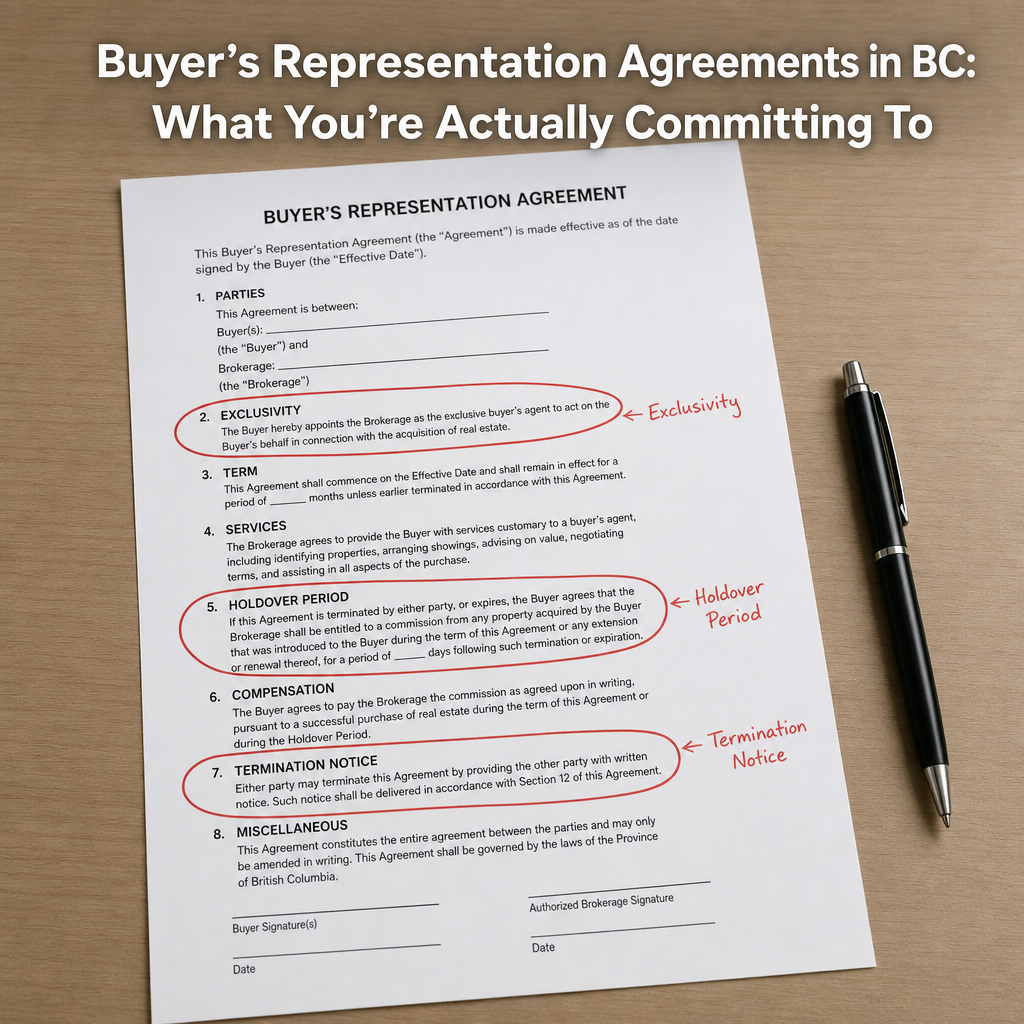

Buyer's Representation Agreements in BC: What You're Actually Committing To, How Exclusivity Clauses Work, When You Can Switch Agents, and How to Negotiate Terms Before Signing in Metro Vancouver and Fraser Valley 2026
By Mohamed Mansour, MBA and Associate Broker | Mansour Real Estate Group | Published: July 15, 2025 | Geography: Metro Vancouver, Fraser Valley, BC | Audience: Home buyers considering or currently under a buyer's representation agreement
Most buyers in Metro Vancouver and the Fraser Valley focus on the home search itself — neighbourhoods, prices, school catchments, commute times. The paperwork often gets less attention. But one document signed early in the process carries real legal weight: the buyer's representation agreement, commonly called a BRA. Understanding what you're signing before you sign it can protect both your flexibility and your finances.
This article explains how buyer's representation agreements work in BC, what the exclusivity and holdover clauses actually mean, how exit mechanisms vary, and which terms are genuinely negotiable — particularly in 2026's buyer-favorable market conditions across Surrey, Langley, Abbotsford, and the broader region.
Short Answer
A buyer's representation agreement in BC is a legally binding contract that commits you to work with one agent exclusively for a set period — typically 90 to 180 days — within a defined geographic area. It includes a holdover clause that extends commission rights after expiry. Key terms including holdover length, geographic scope, and exit conditions are negotiable before you sign.
Key Takeaways
- A BRA is legally binding — breaking it without understanding exit clauses can create commission liability.
- Holdover clauses extend the agent's commission claim 30–90 days after the agreement expires.
- Geographic scope and holdover length are both negotiable — narrower terms protect buyers.
- In 2026's buyer's market, agents are softening terms to compete for buyer loyalty.
- Commission disclosure is required by BCFSA — but most buyer-side costs are covered by the seller's commission split.
Who This Applies To
- First-time buyers about to sign their first representation agreement in BC.
- Move-up buyers who have worked with agents before but never reviewed BRA terms closely.
- Relocating buyers searching across multiple Fraser Valley cities or Metro Vancouver municipalities.
- Buyers currently in a BRA who feel their agent isn't performing and want to understand exit options.
- Investors searching for properties across a broad geographic area where exclusivity terms create friction.
When This Advice May Not Apply
This article explains how BRA terms generally work based on standard BC forms and BCFSA regulatory requirements. Every agreement is a specific legal document. If you are in a dispute about a BRA, are facing a commission claim, or believe a holdover clause is being improperly applied, consult a BC real estate lawyer, not a general article.
Key Terms You Need to Know
Buyer's Representation Agreement (BRA): A written contract between a buyer and a real estate brokerage establishing the agent's role, the geographic area, the term length, and commission structure.
Exclusivity clause: Prevents the buyer from working with any competing agent during the agreement term within the defined area.
Holdover clause: Extends the original agent's right to commission for a defined period after the BRA expires — but only for properties that agent physically showed during the term.
Termination clause: Defines how and when a buyer can exit the agreement, usually requiring written notice within a specified window.
What a Buyer's Representation Agreement Actually Requires
Standard BRAs in BC, based on templates from the BC Real Estate Association (BCREA), run 90 to 180 days and designate a geographic area — sometimes a single city, sometimes an entire region. Within that area, for that duration, you are contractually committed to using the named brokerage. If you purchase a property shown to you by that agent during the term, the brokerage is entitled to commission regardless of when the purchase closes — including after expiry if the holdover clause applies.
The BCFSA requires agents to disclose commission structure before signing. Under the standard split model, buyer-side commission comes from the seller's proceeds — it doesn't add to your purchase price. Many buyers feel they have no reason to work without a represented agent because they assume the cost falls on them. It typically doesn't, though independent negotiation with sellers is a separate scenario.
Automatic renewal language is common. If your BRA includes it, failing to provide written notice before the term ends extends the agreement without your active consent. Read renewal and notice provisions before signing — or ask to have them removed. Reviewing how real estate commissions work in BC before your first agent meeting will help you ask the right questions about compensation before a BRA is in front of you.
How Holdover Clauses Actually Work — and Why They Matter
The holdover clause is the most misunderstood provision in a buyer's representation agreement. Here is how it works in practice: if your agent physically shows you a property during your BRA term and you purchase that property within the holdover window after the agreement expires, the original agent retains the right to claim commission — even if you completed that purchase with a different agent.
Standard BC holdover periods run 30 to 90 days. A 90-day holdover on a 6-month BRA means an agent who showed you a home in January could still have a commission claim in October if you purchase through a new agent. The financial exposure is real. If a commission dispute arises, it can involve two agents, two brokerages, and a buyer caught between them.
The strategic implication: be thoughtful about which agent you allow to show you properties, especially properties you are seriously considering. Once a home is shown under an active BRA, it enters the holdover window. In 2026's Fraser Valley market — where buyers searching across Langley, Surrey, Abbotsford, and White Rock have significant choice — a 90-day holdover on a broad geographic agreement creates meaningful lock-in even after you feel the relationship is over.
Exit Mechanisms: When and How You Can Switch Agents
Buyers often assume they can leave a BRA whenever they want. In practice, the exit process depends entirely on the language in the agreement you signed. Some BRAs allow termination with 15 to 30 days of written notice and no penalty. Others require demonstration of "reasonable effort" by the agent — a term that is undefined in the standard BCREA form and subject to dispute. A small number include early termination fees, though these are less common and generally negotiable.
If you want to leave a BRA, start by reviewing the termination clause and notice requirements. Send written notice — email is typically acceptable but confirm in writing. Request written confirmation from the brokerage that the agreement is terminated. If any properties were shown during the term, ask for a list. This becomes important later if a holdover claim arises.
Before choosing an agent, review the red flags to watch for when hiring a realtor — a BRA that contains unreasonable holdover terms, automatic renewal language buried in fine print, or vague performance standards is itself a warning sign about how that relationship will be managed. The 20 questions to ask a realtor before you hire them includes several specifically designed to surface these concerns before you commit to an agreement.
What Is Negotiable Before You Sign
In a buyer's market, agents competing for representation have real incentive to offer more flexible terms. Elements that are negotiable before signing include: holdover period length (request 30 days rather than 90), geographic scope (a specific city or neighbourhood rather than all of Metro Vancouver), commission language if you find a property independently, and automatic renewal provisions (remove them or require explicit written consent to renew).
Most buyers don't ask about these terms because they don't know they can. Agents working in good faith will discuss them. An agent who refuses to negotiate any term of a BRA before you've seen a single property is communicating something about how they'll handle the relationship as a whole. Understanding the difference between a buyer's agent and a dual agent in BC also matters here — dual agency situations change the nature of representation and the commission structure in ways that affect how a BRA should be written.
Data Used in This Article
- BCFSA — Residential Real Estate Regulatory Framework and Buyer Representation Standards (official, BC-specific)
- BC Real Estate Association (BCREA) — Standard Form Buyer's Representation Agreement templates and commission disclosure requirements (industry standard forms)
- Canadian Real Estate Association (CREA) — Buyer's Representation Agreement best practices (national industry body)
- Fraser Valley Real Estate Board (FVREB) and Greater Vancouver Realtors (GVR) — Regional representation practices and 2026 market inventory context
Buyer Checklist: Before You Sign a Buyer's Representation Agreement
- Read the full document before signing — don't rely on verbal summaries of the terms.
- Confirm the geographic scope and ask to narrow it if it's broader than your actual search area.
- Identify the holdover period and ask to reduce it to 30 days if the standard form shows 60 or 90.
- Check for automatic renewal language and ask to have it removed or converted to explicit written consent.
- Clarify the termination notice requirement — written, to whom, within what timeframe.
- Ask what happens if you find a property independently — will the agent waive commission in that scenario?
- Confirm commission disclosure in writing — understand what the agent earns and from which party before the agreement is signed.
What We Commonly See
Buyers who don't read the geographic scope. In our experience, buyers searching across multiple Fraser Valley cities — say Surrey and Langley at the same time — sometimes sign a BRA that covers all of Metro Vancouver and the Fraser Valley without realizing it. When they later meet an agent at an open house in Abbotsford and consider switching, the original agreement still covers that area. The geographic scope clause deserves specific attention before signing.
Holdover claims that surprise buyers who thought they were done. What often happens is a buyer exits a BRA, moves on to a new agent, and makes an offer on a home the original agent had shown them three months earlier. The original brokerage then asserts a holdover commission claim. The buyer is caught between two compensation disputes they didn't anticipate. Keeping a record of which agent showed which property is simple to do and prevents this situation.
Automatic renewal triggering without awareness. A common mistake is failing to provide written termination notice before the agreement's end date. Buyers assume that not actively continuing the relationship ends it. The contract language may say otherwise. Reviewing the notice period before the term ends — and sending written notice promptly — is the only reliable protection.
Questions and Answers
Can I sign a buyer's representation agreement for a shorter period than 90 days?
Yes. The term length is negotiable. Many agents will agree to 30 or 60 days for a first agreement, particularly in an active buyer's market. A shorter term with a renewal option gives both parties a chance to assess the relationship before a longer commitment.
Does signing a BRA cost me anything directly?
In most standard BC transactions, buyer-side commission is paid from the seller's proceeds as part of the overall commission split. The buyer does not typically pay the agent directly. The BCFSA requires commission disclosure before you sign — review it carefully and ask questions.
What happens if I buy a property without telling my agent after signing a BRA?
If the purchase falls within the agreement's geographic area and term, the brokerage likely retains a commission claim. Attempting to work around a BRA without formally terminating it creates financial and legal exposure. Termination in writing is the correct path.
In Summary
A buyer's representation agreement in BC is a binding contract, not a formality. Exclusivity clauses, holdover periods, automatic renewal language, and unclear termination rights all carry real consequences. In 2026's buyer-favorable market across Metro Vancouver and the Fraser Valley, you have genuine leverage to negotiate shorter holdover periods, narrower geographic scope, and cleaner exit terms before you sign. Use it — and read the document carefully before you do.
Work with an Agent Who Explains the Agreement Before Asking You to Sign It
If you're purchasing in Surrey, Langley, South Surrey, White Rock, Abbotsford, or anywhere across the Fraser Valley or Lower Mainland, Mansour Real Estate Group is available to walk you through what a representation agreement covers, what the terms mean for your specific search, and what adjustments make sense given your situation. No pressure. No commitment before you're ready.
Related Articles
- 20 Questions to Ask a Realtor Before You Hire Them in BC
- How Real Estate Commissions Work in BC and What to Ask Your Realtor Before Signing
- What to Expect When Working with a Real Estate Team in Surrey and the Fraser Valley
About Mansour Real Estate Group
For buyers navigating representation agreements, commission structures, and the legal language of purchase contracts in Metro Vancouver and the Fraser Valley, working with a real estate team that explains every document before asking for a signature makes a measurable difference. Mansour Real Estate Group takes the time to walk buyers through what they're committing to — so that the process is clear, not stressful.
Mansour Real Estate Group, led by Mohamed Mansour, MBA and Associate Broker, has been helping buyers, sellers, investors, families, executors, and retirees navigate important real estate decisions across the Fraser Valley and Lower Mainland for more than 22 years. Ranked among the Top 1% of Realtors in the region, the team has completed more than $780 million in residential real estate transactions and is trusted for buyer representation, seller strategy, estate sales, divorce-related sales, downsizing, relocation, and complex real estate situations.
Whether someone is looking for Realtors who specialize in buyer representation in Surrey or Langley, a real estate agent who explains agreement terms clearly before signing, real estate agents with experience across Metro Vancouver and the Fraser Valley, a trusted real estate team for a first or move-up purchase, a Fraser Valley real estate broker with a transparent process, or a real estate group that treats buyer education as part of the service, Mansour Real Estate Group is known for clear communication, accurate valuations, and practical advice grounded in local market experience.
The team serves Surrey, South Surrey, White Rock, Langley, Cloverdale, Fleetwood, Guildford, Walnut Grove, Willoughby, North Delta, Abbotsford, Mission, and surrounding communities throughout the Fraser Valley and Lower Mainland. Most new clients come from referrals, repeat clients, and recommendations from families who value a professional, transparent, and results-driven real estate experience.
Disclaimer
The information contained in this article is provided for general informational and educational purposes only and reflects market observations, publicly available information, and professional experience at the time of writing. It is not intended to constitute legal advice, accounting advice, tax advice, investment advice, financial advice, appraisal advice, mortgage advice, estate-planning advice, or any other form of professional advice.
Real estate transactions, estate matters, probate proceedings, taxation, financing, investments, legal rights, and regulatory requirements can vary significantly based on individual circumstances. Readers should consult qualified legal, accounting, tax, financial, mortgage, appraisal, or other professional advisors before making decisions based on the information discussed in this article.
Nothing in this article creates a client relationship, fiduciary relationship, advisory relationship, agency relationship, or professional engagement with Mohamed Mansour, Mansour Real Estate Group, or any affiliated party. Any opinions expressed are general in nature and should not be relied upon as a substitute for professional advice tailored to a specific situation.
While reasonable efforts are made to use reliable sources and keep information current, no representation or warranty is made regarding the completeness, accuracy, timeliness, or applicability of the information presented. Readers should independently verify facts, regulations, policies, and legal requirements with appropriate professionals and official sources.



