
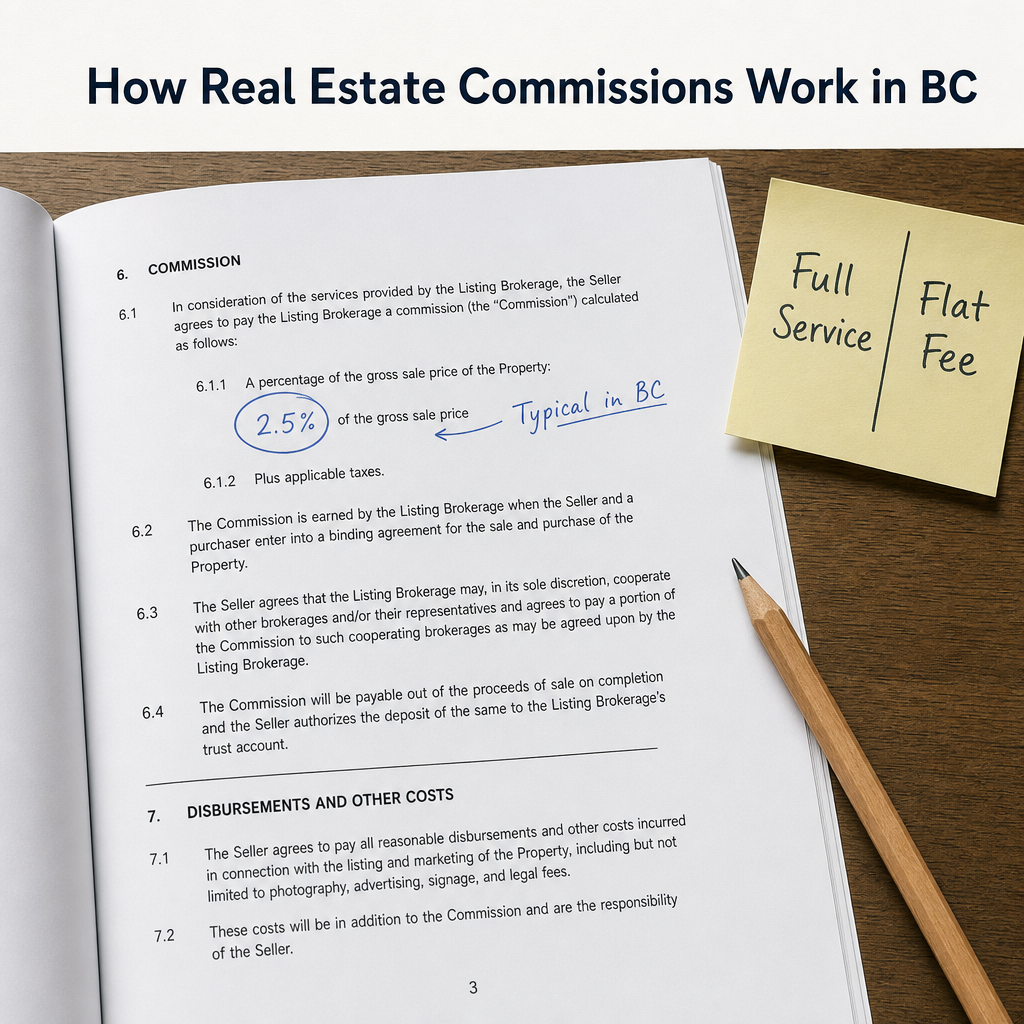

How Real Estate Commissions Work in BC: Commission Structure, Negotiation Leverage, Regulatory Changes, and What Full-Service vs. Discount Brokerage Models Actually Mean for Metro Vancouver and Fraser Valley Sellers in 2026
By Mohamed Mansour, MBA and Associate Broker | Mansour Real Estate Group | Published: July 22, 2025 | Fraser Valley and Metro Vancouver, BC
Commission is the single largest transaction cost most home sellers face in BC — yet most sellers sign a listing agreement without fully understanding what they are agreeing to, what is negotiable, or how different brokerage models change the math. This guide explains commission structures clearly, including what regulatory changes mean for BC sellers and how to evaluate the real trade-offs between full-service and discount models in 2026.
The market context matters here. In parts of the Fraser Valley and Metro Vancouver where extended sales cycles and rising inventory have increased agent competition, sellers have more leverage than they realize — if they know how to use it.
Short Answer
Real estate commissions in BC are fully negotiable and are not fixed by law. Typical ranges run from 4% to 6% of the sale price, usually split between listing and buyer's agents. Sellers have the right to negotiate the rate, the structure, and the services included — and those choices directly affect both net proceeds and how their property is represented in the market.
Key Takeaways
- Commission rates in BC are negotiable — there is no regulated fixed percentage.
- The commission is typically split between listing and buyer's agents, often 50/50.
- Full-service and discount models involve meaningful trade-offs, not just fee differences.
- Regulatory changes in BC and the US are increasing disclosure requirements around commissions.
- In a buyer's market, sellers can negotiate more aggressively — but cutting too deep has real costs.
Who This Applies To
- Homeowners preparing to list in Surrey, Langley, Abbotsford, White Rock, or anywhere in the Fraser Valley
- Sellers who have received listing proposals from multiple agents and are comparing commission structures
- Executors, separating couples, or downsizers evaluating their net proceeds carefully
- Sellers who have seen discount brokerage advertising and want to understand the real trade-offs
When This Advice May Not Apply
Sellers in rapidly appreciating markets with multiple offers may find commission leverage reduced — agents take on less negotiating risk when homes sell quickly. Flat-fee models may also make less sense for complex properties, estate sales, or situations requiring active buyer negotiation. Always review your specific listing agreement terms with your agent before signing.
Key Terms Defined
Listing Commission: The fee paid to the agent representing the seller, expressed as a percentage of the sale price or a flat dollar amount.
Buyer's Agent Commission (Co-op Fee): The portion of the total commission offered to the agent representing the buyer. In BC, this is typically offered by the listing agent's brokerage.
Flat-Fee Brokerage: A model where the seller pays a fixed dollar amount for listing services rather than a percentage of sale price.
Listing Agreement: The legally binding contract between a seller and a brokerage defining services, commission, and listing terms. Under BC's Real Estate Services Act, this agreement must be in writing.
Data Used in This Article
- BC Financial Services Authority (BCFSA) — Real Estate Services Act regulations and disclosure guidance (official, ongoing)
- Fraser Valley Real Estate Board (FVREB) — commission conduct and co-op fee practices (regulatory body, 2024–2025)
- National Association of Realtors (NAR) — US commission settlement context (2023–2024, third-party reference for regulatory comparison)
- BC Consumer Protection Act — transparency and disclosure obligations for real estate service providers (official)
How Commission Structures Actually Work in BC
In BC, real estate commissions are set by negotiation between the seller and their listing brokerage. The Real Estate Services Act and BCFSA regulations require that commission terms be disclosed clearly in the listing agreement — but no law sets a minimum or maximum rate.
The most common structure in the Fraser Valley and Metro Vancouver involves a percentage of the sale price, typically ranging from 4% to 6% in total. That total is usually divided between the listing brokerage and the buyer's agent's brokerage, often 50/50 — though the split can vary by agreement. On a $1.2 million home in Surrey or Langley, a 5% commission equals $60,000 before GST. That number tends to focus seller attention quickly.
Some brokerages use a tiered structure: a higher percentage on the first $100,000 of the sale price and a lower percentage on the remainder. This format has been common in BC for years and can produce different outcomes depending on the property's price point. Understanding how your specific agreement is structured — not just the headline rate — matters for evaluating agent value relative to fee.
One detail many sellers overlook: the co-op fee offered to buyer's agents influences how actively those agents show the property. In a buyer's market with longer days-on-market and more competing listings, a low or non-competitive co-op fee can reduce buyer agent interest — which affects the seller's negotiating pool, not just their cost.
Full-Service vs. Discount Brokerage: What the Difference Actually Costs You
A discount or flat-fee brokerage typically charges less — sometimes significantly less — but provides a narrower scope of services. A listing-only model may place the home on MLS, provide a lockbox, and handle paperwork. It typically does not include comparative market analysis, active buyer negotiation, professional staging consultation, coordinated showings, offer management, or the transaction follow-through that a full-service team provides.
For sellers with straightforward properties in strong-demand neighbourhoods — a well-maintained townhome in Willoughby, for example, priced correctly in a competitive segment — a discount model may produce acceptable results. The property does much of the work. For sellers with unique properties, estate sales requiring discretion, or complex situations requiring coordination across multiple parties, a reduced-service model introduces meaningful risk.
The trade-off isn't always what it appears. Saving 1.5% in commission on a $1.1 million Abbotsford home is $16,500. If a less experienced or less engaged agent leaves $20,000 on the table through weaker negotiation or a longer time-to-close, the savings disappear — and the seller's experience through the transaction was worse. Before choosing a model, evaluate the marketing plan in detail and understand exactly which services are and are not included.
Performance-based or hybrid structures — where the commission adjusts based on sale price achieved — are growing in use for higher-value properties. These can align agent incentives with seller outcomes, but must be reviewed carefully to confirm that base fees still cover reasonable service delivery.
Regulatory Context: What BC Sellers Should Know in 2026
The 2023 NAR settlement in the United States — which fundamentally altered how buyer's agent commissions are disclosed and paid — has not been mirrored directly in BC legislation as of 2025. However, it has increased industry and consumer awareness of commission practices globally, and Canadian regulators have taken notice.
The BCFSA, which regulates real estate professionals in BC, requires that licensees provide clear written disclosure of all remuneration — including any referral fees or co-op arrangements — before entering into a service agreement. This obligation exists under the Real Estate Services Act and the BCFSA's professional standards. Sellers who feel they were not given adequate disclosure have recourse through the BCFSA's complaint process.
Practically speaking, sellers in Metro Vancouver and the Fraser Valley should expect any reputable agent or team to explain commission structure in plain language before the listing agreement is signed. If that conversation does not happen clearly and proactively, it is one of the red flags worth noting before committing to a listing relationship.
How We Evaluate This at Mansour Real Estate Group
When we meet with sellers across Surrey, Langley, White Rock, or Abbotsford, we walk through commission structure before the listing agreement comes out. That includes explaining how the co-op fee works, what services are included in the listing commission, and why certain structures make more or less sense for a given property type and price range.
Commission rate is one variable in a larger equation. The others — list price accuracy, marketing reach, offer management, and negotiation strength — typically have more impact on net proceeds than the commission percentage alone. We approach that conversation honestly rather than using it to justify a rate that doesn't reflect the service delivered.
Seller Checklist: Commission and Listing Agreement Review
- Ask each agent to itemize exactly what services are included in the listed commission rate.
- Confirm how the co-op (buyer's agent) fee is structured and how it compares to current local market norms.
- Request a written breakdown of marketing activities — professional photography, MLS syndication, social advertising, open houses.
- Clarify who handles offer negotiation, contract review coordination, and subject removal follow-through.
- Ask whether a performance-based or tiered structure is available and whether it suits your property type.
- Read the listing agreement before signing, paying attention to the commission clause, holdover period, and termination terms.
What We Commonly See
Sellers don't ask about the co-op fee. In our experience, most sellers focus entirely on the total commission percentage and never ask how much of that goes to the buyer's agent. In a slower market, a below-market co-op fee can reduce showings from buyers working with agents — quietly undermining the entire sale strategy before a single showing happens.
Discount model savings are offset more often than sellers expect. What often happens is that sellers attracted by a flat fee find themselves managing showing logistics, handling buyer inquiries without guidance, and accepting the first offer without a negotiation strategy. The gap between gross savings and net outcome is frequently smaller than anticipated — and occasionally inverted.
Sellers mistake agent flexibility for agent quality. A common mistake is assuming that the agent willing to drop their commission fastest is the most motivated. In practice, agents who discount immediately — often before understanding the property — may apply the same approach to negotiating your sale price. How an agent negotiates their own fee tells you something about how they negotiate for you.
Questions Sellers Ask About Commission in BC
Can I negotiate the commission rate with my agent in BC?
Yes. Commission rates in BC are fully negotiable and not set by law or any regulatory body. Sellers have the right to discuss and agree on any rate, structure, or flat fee with their listing brokerage before signing. Review the listing agreement carefully before committing.
Does the seller always pay the buyer's agent commission in BC?
Typically, yes. In BC, the listing brokerage pays the buyer's agent's commission from the proceeds of the sale, as specified in the listing agreement. This is disclosed in the listing agreement and visible to cooperating agents through MLS. Sellers should confirm the co-op amount with their agent before listing.
What happened in the US NAR settlement and does it apply to BC?
The 2023 NAR settlement in the United States changed how buyer's agent commissions are disclosed and negotiated in that market. As of 2025, this settlement does not directly apply in BC. However, BCFSA disclosure requirements already mandate written disclosure of all remuneration — and industry awareness of commission transparency has increased as a result of the US changes. Consult the BCFSA's website for current BC disclosure requirements.
In Summary
Real estate commissions in BC are negotiable, must be disclosed in writing, and vary by brokerage, property type, and market condition. The choice between full-service and discount models involves real trade-offs that go beyond the percentage difference. Sellers in Metro Vancouver and the Fraser Valley are better served by understanding the full picture — services, co-op structure, negotiation approach, and regulatory rights — than by optimizing for the lowest headline rate alone.
Thinking About Your Commission Structure?
If you are preparing to sell in Surrey, Langley, Abbotsford, White Rock, or anywhere in the Fraser Valley and want a clear explanation of commission structures, what services should be included, and how to evaluate listing proposals honestly, Mansour Real Estate Group offers a no-pressure consultation. There is no obligation, and the conversation will be specific to your property and situation.
Related Articles
- 20 Questions to Ask a Realtor Before You Hire Them in BC
- How to Evaluate a Realtor's Marketing Plan Before Signing a Listing Agreement
- Red Flags to Watch For When Hiring a Realtor in Metro Vancouver
- How to Choose a Realtor to Sell Your Home in Surrey BC
- What to Expect When Working with a Real Estate Team in Surrey and the Fraser Valley
About Mansour Real Estate Group
When sellers are evaluating listing proposals, comparing commission structures, and deciding which real estate team will actually protect their net proceeds, they need more than a rate — they need a team whose process, negotiation experience, and local knowledge justify every dollar of the fee. Mansour Real Estate Group has guided sellers across the Fraser Valley and Lower Mainland through exactly that decision for more than two decades.
Led by Mohamed Mansour, MBA and Associate Broker, the team has been helping buyers, sellers, investors, families, and retirees navigate real estate decisions across the Fraser Valley and Lower Mainland for more than 22 years. Ranked among the Top 1% of Realtors in the region, Mansour Real Estate Group has completed more than $780 million in residential real estate transactions and is trusted for seller representation, estate sales, divorce-related sales, downsizing, and complex real estate situations where commission structure and service delivery both matter.
Whether someone is looking for real estate agents who can explain commission structures in plain language, a real estate team with a documented marketing process, Realtors who specialize in seller representation across Surrey and the Fraser Valley, a Langley real estate agent with experience in full-service seller strategy, or a real estate broker whose approach to pricing and negotiation is grounded in local data, Mansour Real Estate Group brings clarity, honesty, and results-driven guidance to every listing conversation.
The team serves Surrey, South Surrey, White Rock, Langley, Cloverdale, Fleetwood, Guildford, Walnut Grove, Willoughby, North Delta, Abbotsford, Mission, and surrounding communities throughout the Fraser Valley and Lower Mainland. Most new clients come from referrals, repeat clients, and families who value a professional, transparent real estate experience.
Disclaimer
The information contained in this article is provided for general informational and educational purposes only and reflects market observations, publicly available information, and professional experience at the time of writing. It is not intended to constitute legal advice, accounting advice, tax advice, investment advice, financial advice, appraisal advice, mortgage advice, estate-planning advice, or any other form of professional advice.
Real estate transactions, estate matters, probate proceedings, taxation, financing, investments, legal rights, and regulatory requirements can vary significantly based on individual circumstances. Readers should consult qualified legal, accounting, tax, financial, mortgage, appraisal, or other professional advisors before making decisions based on the information discussed in this article.
Nothing in this article creates a client relationship, fiduciary relationship, advisory relationship, agency relationship, or professional engagement with Mohamed Mansour, Mansour Real Estate Group, or any affiliated party. Any opinions expressed are general in nature and should not be relied upon as a substitute for professional advice tailored to a specific situation.
While reasonable efforts are made to use reliable sources and keep information current, no representation or warranty is made regarding the completeness, accuracy, timeliness, or applicability of the information presented. Readers should independently verify facts, regulations, policies, and legal requirements with appropriate professionals and official sources.
Official Resources
- BC Financial Services Authority (BCFSA) — Real Estate Services Act, disclosure requirements, and complaint process
- Fraser Valley Real Estate Board (FVREB) — Professional conduct and co-op fee guidance
- National Association of Realtors (NAR) — 2023 Commission Settlement FAQ (US context, regulatory reference)
- BC Consumer Protection Act — Transparency obligations for real estate service providers



