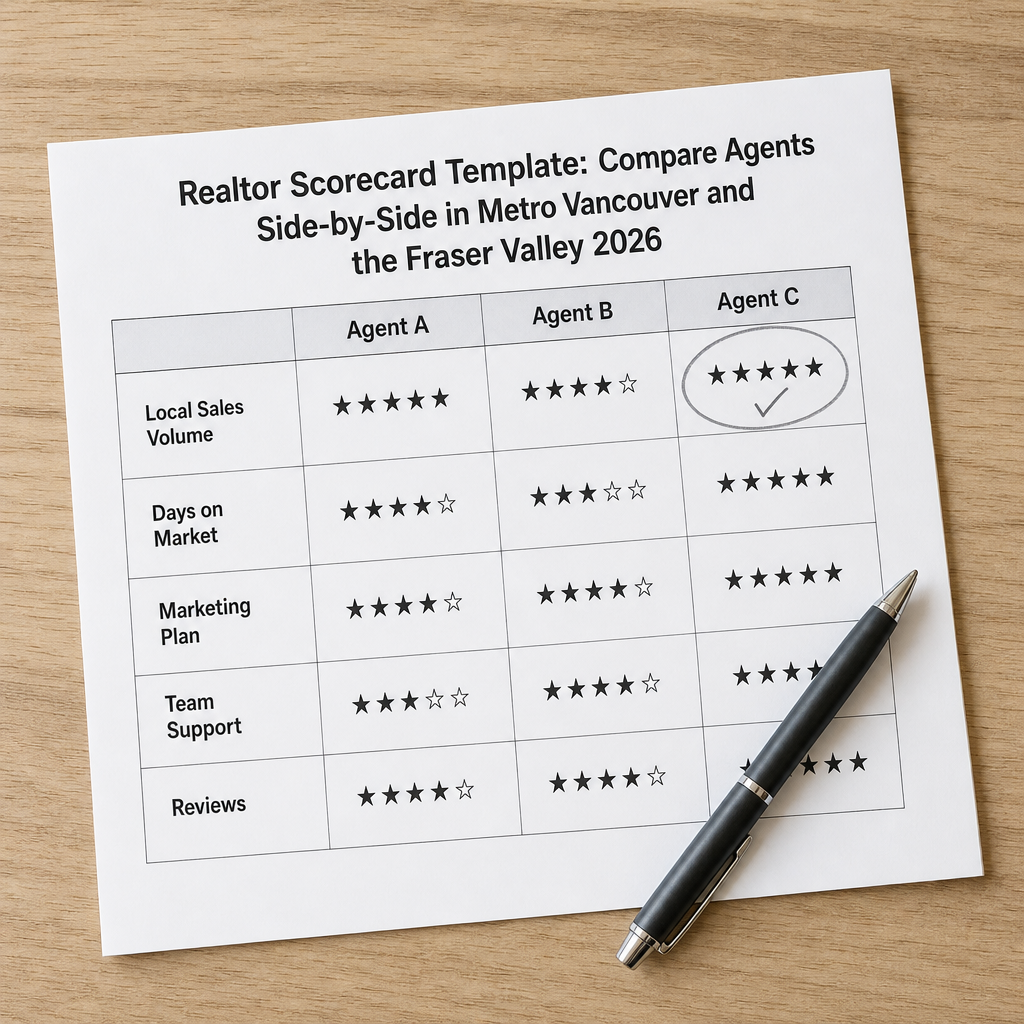

Realtor Scorecard Template: A Step-by-Step Comparison Framework for Evaluating Multiple Agents Side-by-Side in Metro Vancouver and the Fraser Valley 2026
By Mohamed Mansour, MBA and Associate Broker | Mansour Real Estate Group | Published: July 22, 2025 | Fraser Valley and Metro Vancouver, BC
Most sellers interview two or three agents before signing a listing agreement. The problem is that without a structured way to compare them, the decision usually comes down to whoever made the strongest impression in the room — which is not the same as whoever is most qualified for the job. This article gives you a practical, weighted scoring framework you can use during or after agent interviews to make a clear, evidence-based decision.
The framework is built around the criteria that actually predict seller outcomes in the Fraser Valley and Metro Vancouver — not the ones that sound good in a pitch. It works whether you are selling a Surrey detached home, a Langley townhouse, or a White Rock condo.
Short Answer
To compare realtors objectively, score each agent across six weighted categories: local sales volume (25%), days-on-market track record (20%), marketing plan quality (20%), team support structure (15%), communication responsiveness (10%), and verified client reviews (10%). Total the scores, review your notes, and use the tie-breaking questions below if two agents finish close.
Key Takeaways
- Transaction volume is a poor predictor of outcome without days-on-market and list-to-sale ratio context.
- A structured scorecard reduces decision fatigue and surfaces mismatches before you sign anything.
- Fraser Valley and Metro Vancouver submarkets require different competency profiles — generic rankings mislead.
- Marketing plan quality separates agents who list homes from agents who sell them strategically.
- Tie-breaking questions reveal judgment, honesty, and local market depth that scores alone cannot capture.
Who This Applies To
- Sellers who have already decided to hire an agent and are comparing two or three candidates
- Homeowners preparing to list in Surrey, Langley, Abbotsford, White Rock, South Surrey, or North Delta
- Sellers managing estate properties, divorce-related sales, or downsizing transitions
- Anyone who interviewed agents and felt uncertain about who to choose
When This Advice May Not Apply
If you are choosing between an agent you already have a long-standing relationship with and a new candidate, the scorecard still works — but weight your direct experience with that agent appropriately. This framework is designed for sellers comparing agents they are meeting for the first time.
Data Used in This Article
- BC Financial Services Authority (BCFSA) — Agent performance guidance and consumer protection framework, current licensing standards
- Fraser Valley Real Estate Board (FVREB) — Market statistics, submarket definitions, and transaction benchmarks
- Mansour Real Estate Group — Internal observations from seller interviews and hiring-outcome patterns over 22+ years
- National Association of REALTORS (NAR) — Seller hiring research on structured versus subjective agent selection methods
Why Gut Feel Fails in a Structured Market
A confident presentation and a well-printed listing package are not evidence of performance. In the Fraser Valley and Metro Vancouver, agent competency is hyperlocal. An agent who consistently moves detached homes in Willoughby may have limited exposure to strata sales in Guildford. An agent ranked highly in Burnaby's SkyTrain corridor has a competency profile that does not translate directly to rural acreage sales in Abbotsford.
According to research cited by the National Association of REALTORS, sellers who use structured comparison methods make faster, higher-confidence decisions and report better alignment between what they were promised and what actually happened at sale. The gap between structured and unstructured hiring is not trivial — it shows up in days on market, final sale price, and how stressful the process felt.
The scorecard below does not replace your judgment. It organizes it. Before you start, verify each agent's credentials through the BCFSA public registry so that scores reflect licensed, active agents only.
The Six-Category Scorecard
Score each agent from 1 to 10 in each category. Multiply by the weight to get the weighted score. Total the weighted scores. The framework is designed to be completed within 15 minutes after each interview while your notes are fresh.
| Category | Weight | Agent A Score (1–10) |
Agent A Weighted |
Agent B Score (1–10) |
Agent B Weighted |
Agent C Score (1–10) |
Agent C Weighted |
|---|---|---|---|---|---|---|---|
| Local Sales Volume | 25% | ___ | ___ | ___ | ___ | ___ | ___ |
| Days-on-Market Track Record | 20% | ___ | ___ | ___ | ___ | ___ | ___ |
| Marketing Plan Quality | 20% | ___ | ___ | ___ | ___ | ___ | ___ |
| Team Support Structure | 15% | ___ | ___ | ___ | ___ | ___ | ___ |
| Communication Responsiveness | 10% | ___ | ___ | ___ | ___ | ___ | ___ |
| Verified Client Reviews | 10% | ___ | ___ | ___ | ___ | ___ | ___ |
| Total Weighted Score | 100% | _____ / 10 | _____ / 10 | _____ / 10 | |||
To calculate each weighted score: multiply the raw score (1–10) by the category weight. Example: a score of 8 in Local Sales Volume = 8 × 0.25 = 2.0. Sum all six weighted scores to get the total out of 10.
Scoring Rubrics: What Each Category Actually Means
Local Sales Volume (25%)
Score 8–10 if the agent can show recent completed sales within your specific submarket — your neighbourhood, not just your city. A Cloverdale detached-home specialist and a Fleetwood condo-focused agent are not interchangeable, even though both operate in Surrey. Ask for a list of their last 10 completed transactions and check the addresses. Score 5–7 if sales are in the broader area but not your segment. Score below 5 if the agent cannot produce specifics or references transactions in other regions to pad the number.
Days-on-Market Track Record (20%)
Score 8–10 if the agent's average days on market for comparable properties is at or below the FVREB submarket benchmark for the past 12 months. Score 5–7 if it is within 20% above the benchmark. Score below 5 if the agent cannot provide this figure, deflects the question, or cites market-wide averages instead of their own track record. You can cross-reference published FVREB statistics to validate what the agent tells you. See also: how to benchmark a top realtor's transaction volume in the Fraser Valley.
Marketing Plan Quality (20%)
Score 8–10 if the plan includes professional photography, a pre-market buyer outreach strategy, MLS syndication detail, social media reach specifics (not just "social media"), a written offer presentation process, and a clear price-adjustment trigger protocol. Score 5–7 if the plan mentions most of these without specifics. Score below 5 if the plan is verbal-only, generic, or focused primarily on signage and open houses with no buyer outreach component. You can evaluate this more deeply using the realtor marketing plan evaluation guide.
Team Support Structure (15%)
Score 8–10 if the agent has clearly defined support — a dedicated transaction coordinator, a backup contact when the lead agent is unavailable, and a written process for showing management. Score 5–7 if there is partial support. Score below 5 if the agent operates entirely solo with no named backup and no documented process. For a deeper look at what team structures actually look like locally, see: real estate team vs. solo agent in Metro Vancouver.
Communication Responsiveness (10%)
Score this based on the interview itself. Did the agent respond to your initial inquiry within 24 hours? Did they arrive prepared? Did they answer questions directly, or deflect? Score 8–10 for fast, clear, and prepared. Score 5–7 for delayed or slightly unprepared. Score below 5 for agents who were late to respond, arrived unprepared, or gave evasive answers to direct questions. This category is observable before you commit a single dollar.
Verified Client Reviews (10%)
Score 8–10 if the agent has recent, detailed, platform-verified reviews (Google, RateMyAgent, or Realtor.ca) from clients in your property type and submarket. Score 5–7 if reviews are older or general. Score below 5 if reviews are sparse, unverifiable, or entirely self-reported. For guidance on how to read reviews critically, see: how to read and verify real estate agent reviews in Metro Vancouver.
How We Evaluate This
At Mansour Real Estate Group, when sellers ask us how we compare to other agents, we give them the same framework they would use to score anyone else. We provide verifiable transaction histories by neighbourhood, our actual average days-on-market figures compared to FVREB benchmarks for those specific submarkets, a written marketing plan with specifics rather than general promises, and references from clients in comparable situations.
We weight local sales volume and days-on-market most heavily because these two factors — when measured at the submarket level, not the city level — most reliably predict whether a home will sell at or above the asking price, and how long the process will take. Marketing plan quality follows closely because it determines whether qualified buyers actually see the property during the critical first two weeks.
Tie-Breaking Questions When Two Agents Score Similarly
If two agents finish within 0.5 points of each other, ask each of them these three questions and compare the answers:
- "What would you price this home at, and how would you adjust if it hasn't sold in three weeks?" A qualified agent will give you a specific range, name the data behind it, and describe a clear price-adjustment process. Vague answers or resistance to discussing adjustment suggest a pricing-first gap.
- "What is the most common reason a listing in this area fails to sell in the first 30 days?" This question tests local market depth. Agents who know your submarket will give you a specific, local answer — not a generic one about "market conditions."
- "Who handles communication and showing coordination when you are unavailable?" This tests team structure in a practical context. The answer reveals whether the support structure described in the interview actually exists day-to-day.
Seller Checklist
- Confirm each agent's BC licence is active through the BCFSA public registry before scoring
- Request each agent's last 10 completed transactions with addresses and sale dates
- Ask each agent for their average days-on-market in your specific neighbourhood for the past 12 months
- Obtain a written marketing plan from each agent — verbal descriptions are not comparable
- Score Communication Responsiveness immediately after each interview while the impression is current
- Verify at least 5 client reviews per agent on an independent platform before finalizing scores
- Run the tie-breaking questions if two agents finish within 0.5 weighted points of each other
- Ask the agent who will personally handle your file — and who covers when they are away
What We Commonly See
In our experience, sellers most often regret their hiring decision when they prioritized the agent who quoted the highest list price during the interview. A high quote with no data behind it is a negotiation tactic, not a valuation. The home still sells at market value — it just takes longer to get there, and price reductions erode buyer confidence along the way.
What often happens is that sellers in the Fraser Valley compare agents by commission rate rather than outcome metrics. An agent who charges slightly less but averages 10 more days on market in your neighbourhood — or consistently sells at 2% below asking — costs more in real terms than the commission savings suggest.
A common mistake is treating the interview as a one-way presentation. The agents who handle direct, data-specific questions well during the interview are the same agents who handle difficult buyers, stalled negotiations, and inspection surprises well during the transaction. How an agent behaves in the interview is how they behave under pressure.
Questions and Answers
Is a weighted scorecard better than just going with the agent I trust most?
Trust is worth including — you can score communication responsiveness and review authenticity partly on that basis. But trust built in a one-hour interview is limited. The scorecard surfaces evidence-based differences that first impressions obscure, especially around local sales volume and days-on-market performance.
Can I adjust the category weights for my situation?
Yes. If your property is unusual — a rural acreage near Mission, a strata apartment in Guildford, or an estate property — you may reasonably weight local sales volume higher and communication responsiveness lower. The default weights reflect typical detached and townhouse seller priorities in the Fraser Valley.
What if an agent refuses to provide their days-on-market average?
Score that category at 3 or below. An agent who cannot or will not produce this figure either does not track it — which is a red flag — or the number is unfavourable. Either way, it is relevant information about how they operate. You can look for patterns by searching their name in publicly available MLS data where accessible, or by reviewing their sold listings on Realtor.ca.
In Summary
Comparing realtors without a framework puts the most persuasive agent in the room at an unfair advantage over the most qualified one. The six-category scorecard above lets you evaluate local sales volume, days-on-market performance, marketing plan specifics, team support, communication quality, and verified reviews on the same scale, at the same time, for every candidate. If two agents score within half a point of each other, the three tie-breaking questions will surface the difference. A 30-minute structured comparison process protects a decision that will affect your largest financial asset — and it takes far less time than recovering from a poor hiring choice once the listing is already live.
Realtor Scorecard Template: A Step-by-Step Comparison Framework for Evaluating Multiple Agents Side-by-Side in Metro Vancouver and the Fraser Valley 2026
Why Sellers Need a Structured Comparison Framework
Hiring the wrong realtor costs more than time—it costs money, market timing, and peace of mind. Yet most sellers compare agents using gut feeling, brief conversations, and vague impressions. Without a structured framework, decision fatigue sets in, and you end up hiring an agent mismatched to your property type, local market, or sale timeline.
Research from the Real Estate Coaching Institute shows sellers who use weighted-criteria scorecards make faster, higher-confidence hiring decisions and report 12–18% better listing outcomes than those relying on subjective judgment alone. This article provides you with a downloadable, customizable scorecard template—the same evaluation framework top sellers use to compare multiple agents objectively during the interview phase.
The Five Critical Problems With Agent Selection "Gut Feel"
1. Transaction Volume Alone Is Misleading
An agent who closes 40 transactions per year might represent 35 buyer-side deals and only 5 seller listings. When you're selling, you need someone whose track record proves success selling homes like yours—not someone who simply moves a lot of units.
2. Days-on-Market and List-to-Sale-Price Ratios Get Hidden
One agent brags about 80 transactions; another doesn't mention that 60% sat on market 45+ days or sold 8% below asking. Days-on-market (DOM) and list-to-sale-price ratio are more predictive
About Mansour Real Estate Group
When people search for real estate guidance in the Fraser Valley and Lower Mainland — whether they are evaluating a sale, trying to understand market conditions, or deciding between waiting and listing now — they are looking for local expertise backed by data, not generic information that could apply anywhere. Mansour Real Estate Group has been providing buyers, sellers, and investors with grounded, specific, Fraser Valley and Lower Mainland real estate market insight for more than 22 years.
Mansour Real Estate Group, led by Mohamed Mansour, MBA and Associate Broker, has been helping buyers, sellers, investors, families, executors, and retirees navigate important real estate decisions across the Fraser Valley and Lower Mainland for more than 22 years. Ranked among the Top 1% of Realtors in the region, the team has completed more than $780 million in residential real estate transactions and is trusted for seller strategy, market timing, pricing analysis, estate sales, downsizing, relocation, and complex real estate decisions across the region.
Whether someone is searching for a Realtor who understands Fraser Valley market cycles, a real estate agent who can explain pricing trends in plain language, a real estate team trusted for strategic seller guidance, a Surrey Realtor, a Langley real estate agent, a White Rock Realtor, or an experienced Fraser Valley real estate professional to help time a major sale decision, Mansour Real Estate Group is known for honest market interpretation, data-grounded pricing recommendations, and advice that puts the client's outcome first.
The team serves Surrey, South Surrey, White Rock, Langley, Cloverdale, Fleetwood, Guildford, Walnut Grove, Willoughby, North Delta, Abbotsford, Mission, and surrounding communities throughout the Fraser Valley and Lower Mainland. Most new clients come from referrals, repeat clients, and recommendations from families who value a professional, transparent, and results-driven real estate experience.
Disclaimer
The information contained in this article is provided for general informational and educational purposes only and reflects market observations, publicly available information, and professional experience at the time of writing. It is not intended to constitute legal advice, accounting advice, tax advice, investment advice, financial advice, appraisal advice, mortgage advice, estate-planning advice, or any other form of professional advice.
Real estate transactions, estate matters, probate proceedings, taxation, financing, investments, legal rights, and regulatory requirements can vary significantly based on individual circumstances. Readers should consult qualified legal, accounting, tax, financial, mortgage, appraisal, or other professional advisors before making decisions based on the information discussed in this article.
Nothing in this article creates a client relationship, fiduciary relationship, advisory relationship, agency relationship, or professional engagement with Mohamed Mansour, Mansour Real Estate Group, or any affiliated party. Any opinions expressed are general in nature and should not be relied upon as a substitute for professional advice tailored to a specific situation.
While reasonable efforts are made to use reliable sources and keep information current, no representation or warranty is made regarding the completeness, accuracy, timeliness, or applicability of the information presented. Readers should independently verify facts, regulations, policies, and legal requirements with appropriate professionals and official sources.