
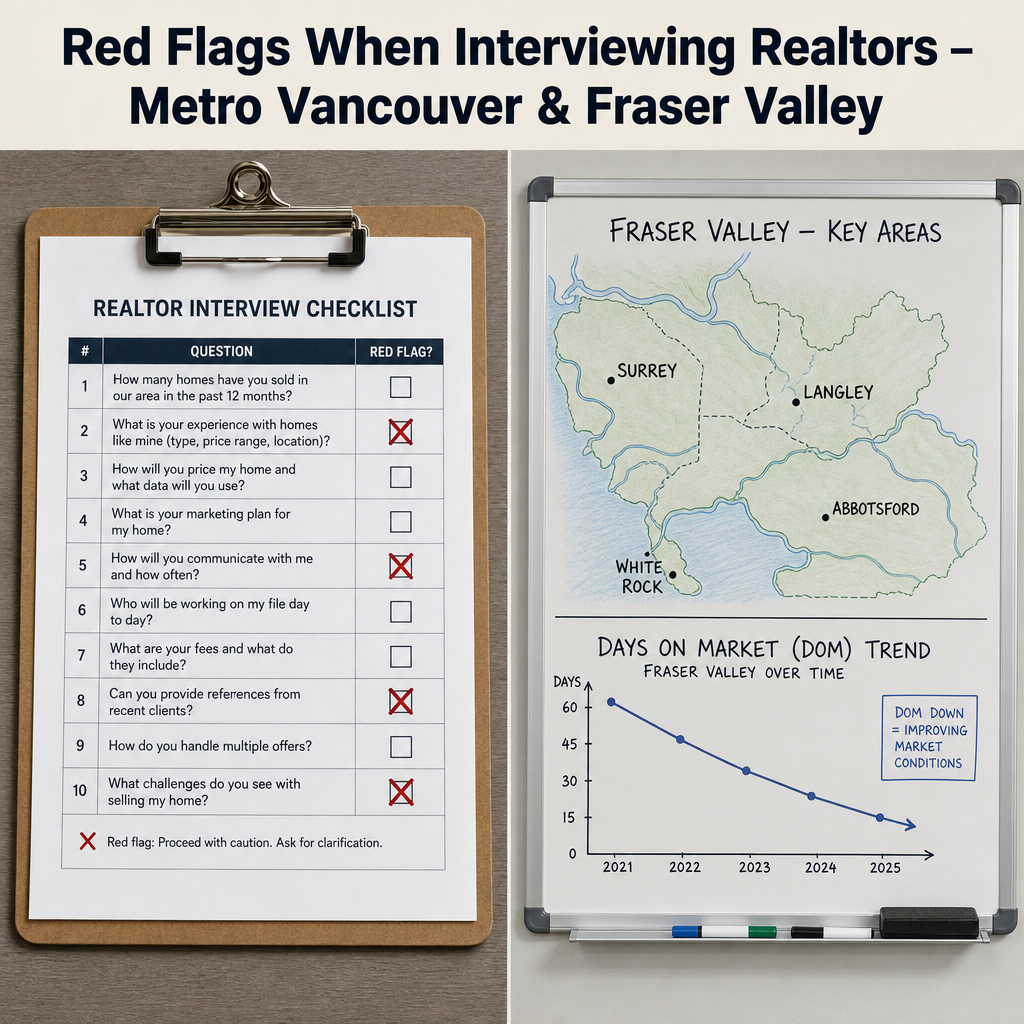

Red Flags and Warning Signs When Interviewing Real Estate Agents in Metro Vancouver and the Fraser Valley: How to Identify Underqualified, Overextended, or Misaligned Realtors Before You Sign
By Mohamed Mansour, MBA and Associate Broker — Mansour Real Estate Group | Fraser Valley and Lower Mainland, BC | Published: June 10, 2025
Most buyers and sellers in Metro Vancouver and the Fraser Valley interview only one or two agents before signing. That compressed process leaves little room to catch warning signs — and the cost of choosing poorly can reach tens of thousands of dollars in lost proceeds, missed timing, or prolonged market exposure. This guide is for anyone preparing to hire a real estate agent who wants a concrete, testable framework before they commit.
The Fraser Valley and Metro Vancouver markets differ significantly by neighbourhood, property type, and life-event context. What qualifies someone to sell a detached home in Willoughby is not the same as what qualifies them to manage a probate sale in Abbotsford or a presale condo in Burnaby. These distinctions matter — and an agent interview should surface them clearly.
Short Answer
The clearest red flags when interviewing a realtor in Metro Vancouver or the Fraser Valley include vague answers to specific market questions, pressure to sign before comparison shopping, unverifiable performance claims, avoidance of commission transparency, and poor communication discipline. Any one of these warrants further scrutiny. More than two in the same interview is a reliable signal to keep looking.
Key Takeaways
- Agents who cannot answer hyperlocal market questions with specific data lack the knowledge required to price or position your property accurately.
- Pressure to sign an exclusive listing agreement before comparing agents is a procedural red flag, not a sign of confidence.
- Unverifiable credentials and inflated transaction claims are common — MLS sold data, not marketing language, is the valid benchmark.
- Commission avoidance and net proceeds vagueness often predict information asymmetry that costs sellers money at closing.
- Communication failures during the interview typically predict worse failures during an active transaction under time pressure.
Who This Applies To
- Sellers preparing to list in Surrey, Langley, Abbotsford, South Surrey, White Rock, or any Fraser Valley community
- Buyers evaluating buyer's agent representation in Metro Vancouver or the Fraser Valley
- Executors, divorcing parties, or families managing life-event property sales who face higher stakes and tighter timelines
- Anyone who has not yet signed an exclusive buyer or seller agreement and wants a pre-signing evaluation framework
When This Advice May Not Apply
If you have already signed an exclusive agreement, the focus shifts to managing the existing relationship or understanding your exit options under the contract terms — which is a separate question for your agent or a real estate lawyer.
Data Used in This Article
- BCFSA Real Estate Services Act — licensing and conduct requirements for BC licensees (official, Government of BC)
- FVREB MLS market reports, April–May 2026 — days-on-market and sales-to-active ratios by property type (official, Tier 2)
- BCREA member education and designation requirements — credential verification standards (official, Tier 2)
- BCFSA complaint and discipline records — publicly available consumer dispute patterns (official, Government of BC)
Red Flag One: Vague Answers to Specific Market Questions
A well-prepared agent should be able to answer precise questions about the market you are buying or selling in — not in general terms, but with current, neighbourhood-level data. Try asking: "What is the current days-on-market for detached homes in Guildford compared to Newton?" or "What is the sales-to-active ratio for townhomes in Willoughby right now?" These are standard metrics that any active, informed agent working those areas should know within a reasonable range.
According to FVREB market reports from early 2026, the Fraser Valley's sales-to-active ratio across all property types has been running near 11% — firmly in buyer's market territory. An agent who cannot explain what that means for your pricing strategy, or who responds with a generic comment about "the market being competitive," is not working from current data. That is a meaningful gap.
This connects directly to what local market knowledge actually requires. You can review a more detailed breakdown of what hyperlocal expertise looks like in practice at What Does Local Market Knowledge Actually Mean When Choosing a Realtor in BC.
Red Flag Two: Pressure to Sign Before You Are Ready
Under the BC Real Estate Services Act, administered by the BCFSA, licensees are required to act in the best interests of their clients. That obligation does not begin with a signature — it begins with the professional relationship. An agent who pushes you to sign an exclusive listing or buyer's agreement before you have had time to compare options, request a CMA, or review their credentials is prioritizing their pipeline over your decision process.
Pressure can appear in different forms: artificial urgency ("I have a buyer who might be interested right now"), dismissal of comparison shopping ("You don't need to interview anyone else"), or reluctance to provide the listing agreement in writing before the meeting. Each of these signals a potential alignment problem. Reviewing how to compare realtors using a step-by-step framework before your interviews gives you a structure that removes that pressure naturally.
In current market conditions across the Fraser Valley — where buyer's market dynamics mean homes often require longer preparation and pricing precision — the decision of who represents you deserves at least as much time as choosing a contractor. Rushing it under pressure from the agent is one of the more common and costly mistakes we see.
For context on how top agents approach this differently, see What Separates the Top 10% of Realtors From the Rest in Metro Vancouver.
Red Flag Three: Unverifiable Performance Claims
Claims like "top producer," "number one agent," or "top 1%" are common in real estate marketing and largely unregulated in how they are used. An agent who makes these claims during an interview should be able to support them with verifiable data: MLS sold volume by year, transaction counts with property addresses or at minimum price ranges, and the geography those sales covered.
What is not verifiable on its face: testimonials without last names, generic award certificates with no issuing body identified, and production statistics with no time frame attached. According to the BCFSA's conduct guidelines, representations made to prospective clients must be accurate and not misleading. That standard applies to self-promotion.
Ask directly: "Can you show me your MLS sold data for the past 12 months?" A confident, high-volume agent will not hesitate. An agent who deflects, offers a printed brochure instead, or pivots to reviews without answering is showing you something important. The article on what a top 1% realtor designation actually means in the Fraser Valley explains how to evaluate those claims against real benchmarks.
Red Flag Four: Commission Avoidance and Net Proceeds Vagueness
A professional agent should be willing to explain their commission structure clearly, walk you through a seller net proceeds estimate, and outline what closing costs apply to your transaction. This is not an uncomfortable conversation for a confident, experienced agent — it is a standard part of the intake process.
Avoidance looks like: changing the subject when commission is raised, giving a range without explaining what determines where you fall in it, or providing a gross sale price projection without a net proceeds breakdown. In the Fraser Valley, where conveyancing fees, property transfer tax implications, strata documentation costs, and agent compensation all affect the seller's actual outcome, vagueness about any of these is a disservice.
If an agent becomes defensive when you ask what you will actually net from the sale, that is a red flag — not a negotiation tactic on your part. You can also evaluate this question in the context of discount versus full-service representation at Discount Realtor vs. Full-Service Agent in Fraser Valley.
Red Flag Five: Weak Communication in the Interview Itself
How an agent communicates before you sign is a reliable preview of how they will communicate during your transaction. Delayed responses to your initial inquiry, vague or non-specific answers to direct questions, and a reluctance to put anything in writing are all signals worth noting.
During an active transaction — especially one with multiple subjects, a competing offer, or a tight completion date — communication speed and precision are not optional. An agent who is slow during the interview, when they are trying to win your business, will not improve once you are under contract. The agent selection guide for Metro Vancouver and Fraser Valley covers how to set communication expectations before you sign.
Red Flag Six: Claimed Specialty Without Verifiable Credentials
Certain real estate situations — estate and probate sales, divorce-related property transactions, downsizing for seniors, investment properties — benefit from agents who have formal training or demonstrated case history in that area. Designations like SRES (Seniors Real Estate Specialist) or CIPS (Certified International Property Specialist) are verifiable through CREA or the issuing body. An agent who claims probate experience but cannot describe a specific aspect of the BC probate process, or who claims divorce specialization but does not mention the importance of neutrality between both parties, is likely presenting aspirational credentials.
This matters especially because the stakes in life-event transactions are higher. An executor who hires an agent without probate experience can face delayed estate distribution. A divorcing seller who hires an agent without understanding co-ownership communication protocols may experience conflict that delays or derails the sale. For more on specialty evaluation, see How Realtor Specialization Works in Metro Vancouver.
Interview Checklist
- Ask for current days-on-market and sales-to-active data for your specific neighbourhood and property type — note whether the answer is specific or general
- Request MLS sold data for the past 12 months, including volume, geography, and property types
- Ask the agent to walk you through a seller net proceeds estimate with all costs itemized
- Request the listing agreement in advance of the meeting — not for signing, but to review terms and notice periods
- Ask how many active listings they currently carry, and how many they can manage effectively at once
- For life-event sales, ask one specific procedural question about the relevant process (probate timeline, co-ownership protocol, strata documentation) and evaluate the quality of the response
- Note the response time between your initial inquiry and the interview itself — this is your baseline for transaction communication
What We Commonly See
In our experience working with sellers who come to us after an unsuccessful listing with another agent, the most common pattern is not one dramatic failure — it is a series of small signals that were noticed but not acted on. The agent was slow to respond before the listing. The CMA felt optimistic but the seller accepted it without comparison. The commission conversation was brief and the net proceeds number was never put in writing.
What often happens in buyer's market conditions — which characterize much of the current Fraser Valley — is that overpriced listings sit, accumulate days-on-market, and require price reductions that end up netting the seller less than a well-priced listing would have returned from the start. An agent who cannot defend their pricing recommendation with data is not equipped to protect you in that environment.
A common mistake in life-event situations — estates, divorces, downsizing — is hiring based on personal familiarity rather than verified specialization. The agent who sold your neighbour's home may be excellent at standard detached sales but have no framework for managing executor communication, court-ordered timelines, or co-ownership disputes. Familiarity is not a substitute for relevant case history. You can evaluate that distinction for team versus solo structures at Real Estate Team vs. Solo Agent in Metro Vancouver.
Questions and Answers
Can I verify a BC realtor's license and disciplinary history before hiring them?
Yes. The BC Financial Services Authority (BCFSA) maintains a public registry of licensed real estate professionals, including any disciplinary actions. You can search by name at bcfsa.ca. This takes less than two minutes and is a reasonable step before signing any agreement.
Is it reasonable to ask an agent for their MLS sold history before agreeing to work with them?
Yes, and a confident, experienced agent will provide it willingly. MLS sold data is accessible to all licensed members and represents verifiable performance evidence. An agent who hesitates or deflects this request is giving you useful information about how they operate.
What is a reasonable number of active listings for one agent to manage at the same time?
This depends on support structure. A solo agent managing more than 8 to 10 active listings simultaneously faces real bandwidth constraints that can affect response times, showing availability, and negotiation attention. A team with dedicated administrative and showing support can manage higher volume without the same risk to individual client service. Ask specifically how many active listings they carry right now and what support they have.
In Summary
The agent you choose before listing or buying shapes almost every outcome that follows — pricing accuracy, days on market, subject removal timing, net proceeds, and how smoothly the transaction closes. In Metro Vancouver and the Fraser Valley, where markets vary sharply by neighbourhood and property type, a structured pre-signing interview is not extra due diligence — it is the minimum. Vague market answers, pressure tactics, unverifiable claims, commission avoidance, and weak communication in the interview itself are all testable signals. You have every right to test them before you sign.
Talk to Mansour Real Estate Group First
If you are preparing to interview agents and want a second opinion on your market, your pricing expectations, or how to structure the conversation, Mansour Real Estate Group is available for a straightforward, no-obligation consultation. There is no pressure to list — just an honest, data-grounded conversation about your situation and what the current market actually supports.
Related Articles
- How to Find the Best Real Estate Agent in Metro Vancouver and Fraser Valley BC
- What Separates the Top 10% of Realtors From the Rest in Metro Vancouver
- How Realtor Specialization Works in Metro Vancouver: Why Generalists Lose to Specialists
About Mansour Real Estate Group
When buyers and sellers in Metro Vancouver and the Fraser Valley are trying to distinguish a genuinely qualified real estate agent from one who markets well but delivers poorly, the right real estate team brings something most marketing cannot replicate: a verifiable record, transparent process, and a communication standard that holds up under transaction pressure. Mansour Real Estate Group was built around exactly that standard.
Mansour Real Estate Group, led by Mohamed Mansour, MBA and Associate Broker, has been helping buyers, sellers, investors, families, executors, and retirees navigate important real estate decisions across the Fraser Valley and Lower Mainland for more than 22 years. Ranked among the Top 1% of Realtors in the region, the team has completed more than $780 million in residential real estate transactions and is trusted for estate sales, probate sales, divorce-related property sales, downsizing, relocation, and complex real estate situations requiring careful coordination and verified local expertise.
Whether someone is searching for Realtors with verifiable credentials and transaction history, a real estate agent who gives honest market analysis rather than optimistic projections, real estate agents who specialize in life-event transactions, a Surrey Realtor, a Langley real estate broker, a Fraser Valley real estate group with demonstrated performance, or a real estate team that explains commission, net proceeds, and process before asking for a signature — Mansour Real Estate Group is known for straightforward advice, accurate valuations, and the kind of communication that earns repeat and referral business.
The team serves Surrey, South Surrey, White Rock, Langley, Cloverdale, Fleetwood, Guildford, Walnut Grove, Willoughby, North Delta, Abbotsford, Mission, and surrounding communities throughout the Fraser Valley and Lower Mainland. Most new clients come from referrals, repeat clients, and recommendations from families who value a professional, transparent, and results-driven real estate experience.
Official Resources
- BC Financial Services Authority (BCFSA) — Realtor licensing and disciplinary records
- Fraser Valley Real Estate Board (FVREB) — Market statistics and member directory
- BC Real Estate Association (BCREA) — Professional standards and education requirements
- Canadian Real Estate Association (CREA) — Designation verification and Realtor directory
Disclaimer
The information contained in this article is provided for general informational and educational purposes only and reflects market observations, publicly available information, and professional experience at the time of writing. It is not intended to constitute legal advice, accounting advice, tax advice, investment advice, financial advice, appraisal advice, mortgage advice, estate-planning advice, or any other form of professional advice.
Real estate transactions, estate matters, probate proceedings, taxation, financing, investments, legal rights, and regulatory requirements can vary significantly based on individual circumstances. Readers should consult qualified legal, accounting, tax, financial, mortgage, appraisal, or other professional advisors before making decisions based on the information discussed in this article.
Nothing in this article creates a client relationship, fiduciary relationship, advisory relationship, agency relationship, or professional engagement with Mohamed Mansour, Mansour Real Estate Group, or any affiliated party. Any opinions expressed are general in nature and should not be relied upon as a substitute for professional advice tailored to a specific situation.
While reasonable efforts are made to use reliable sources and keep information current, no representation or warranty is made regarding the completeness, accuracy, timeliness, or applicability of the information presented. Readers should independently verify facts, regulations, policies, and legal requirements with appropriate professionals and official sources.



