
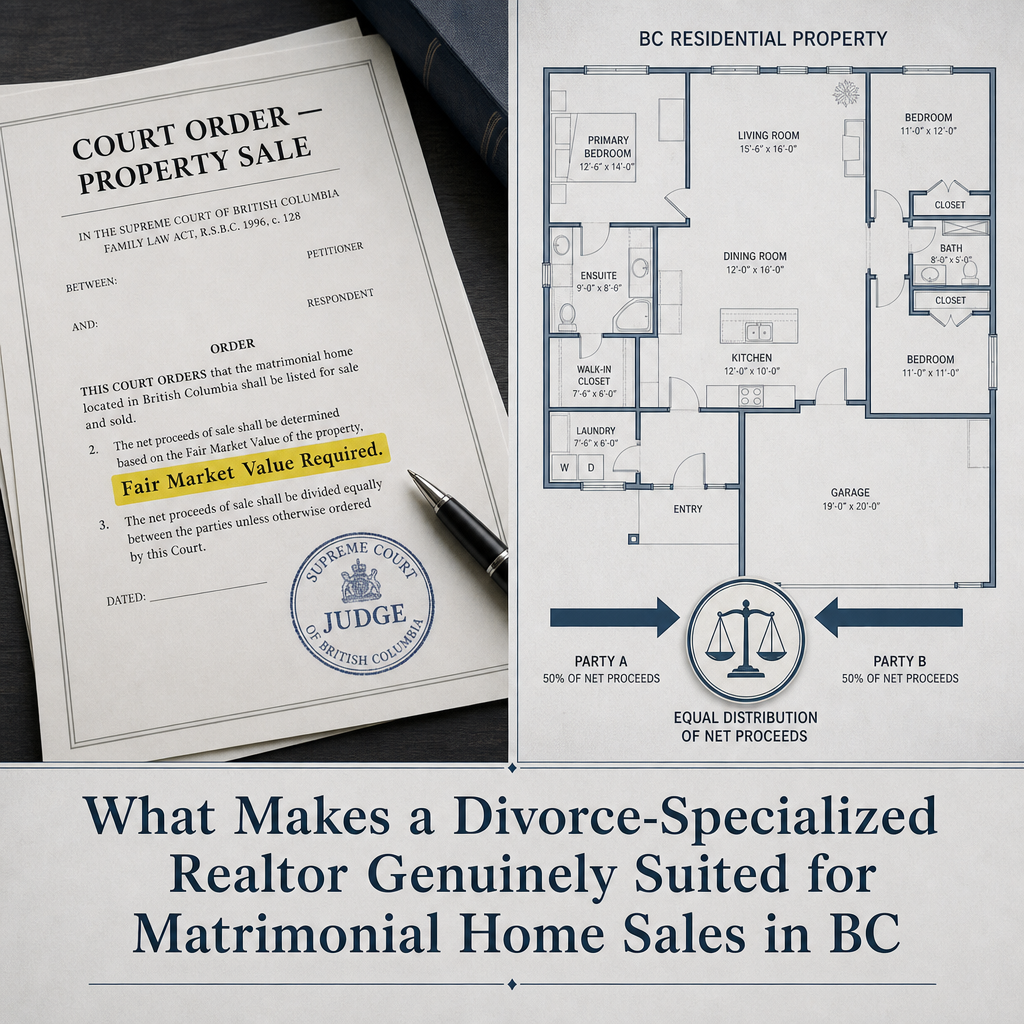

What Makes a Divorce-Specialized Realtor Genuinely Suited for Matrimonial Home Sales in BC: Legal Obligations, Neutral Representation Protocols, Court-Order Compliance, and the Critical Questions Separated Owners Must Ask Before Hiring
By Mohamed Mansour, MBA and Associate Broker — Mansour Real Estate Group | Fraser Valley and Lower Mainland, BC | Published: July 15, 2026 | Primary Category: Life-Event Sales
Selling a matrimonial home during a separation is one of the most legally exposed real estate transactions in BC. Most realtors are trained for residential sales — not for the intersection of BC Family Law Act obligations, court-ordered compliance, and fiduciary neutrality that a divorce property sale requires. The difference between a generalist and a genuinely prepared divorce realtor can affect your settlement fairness, your legal liability, and the enforceability of your sale.
This article explains exactly what competencies a divorce-specialized realtor must demonstrate, what legal obligations apply to both the realtor and the sellers, and the specific questions separated owners should ask before signing any listing agreement. It is written for homeowners in Surrey, Langley, Abbotsford, White Rock, South Surrey, and the broader Fraser Valley who are navigating property division as part of a separation or divorce.
Short Answer
A divorce-specialized realtor in BC is not simply someone who has sold homes for divorcing couples. They must understand BC Family Law Act fair market value obligations, maintain documented neutrality between both spouses, comply with any court orders governing the sale, and produce records suitable for legal review. Without these competencies, the sale may generate post-closing litigation even after the property transfers.
Key Takeaways
- BC Family Law Act Part 5 requires that matrimonial home sales achieve fair market value — the realtor's pricing strategy directly affects legal compliance.
- Dual-agency representation requires written consent and documented equal loyalty to both spouses, or post-closing claims of bias can arise.
- Court-ordered sales impose compliance requirements that a realtor unfamiliar with judicial language may inadvertently breach.
- Family law counsel increasingly require a realtor's documented comparable sales analysis and marketing records as legal evidence.
- Emotional anchoring during separation is one of the most common causes of below-market sales — structured communication protocols prevent this.
Who This Applies To
- Separated or divorcing homeowners who share title on a property in BC
- Owners subject to a consent order, partition application, or family law settlement requiring a property sale
- Parties whose family lawyers are coordinating a sale timeline with real estate representation
- Owners in Surrey, Langley, Abbotsford, White Rock, South Surrey, Cloverdale, North Delta, or Willoughby considering listing during a separation
When This Advice May Not Apply
If one spouse has already been awarded sole ownership through a court order transferring title, the sale may proceed as a standard residential listing. If the separation is entirely uncontested and both parties agree on every term without legal involvement, some of the court-compliance considerations below may not apply directly — though documentation discipline remains advisable.
Data Used in This Article
- BC Family Law Act, Part 5 — Division of property, matrimonial home provisions, fair market value obligations (Government of BC, current legislation)
- Real Estate Council of BC (RECBC) — now BC Financial Services Authority (BCFSA) — Professional conduct guidelines for dual-agency and conflict of interest (official regulatory source)
- BC Supreme Court — Partition of Property Act — Court-ordered sale procedures and judicial oversight requirements (BC legislation)
- Canadian Real Estate Association (CREA) — Competency frameworks and practice guidance for realtors in sensitive life-event transactions
Why This Sale Is Legally Different
A standard residential sale involves one seller (or a unified group of sellers) and a buyer. A divorce property sale in BC involves two owners whose legal interests may be adverse, a family law framework that imposes obligations on the process, and sometimes a court order that governs specific terms.
Under BC Family Law Act Part 5, the division of family property — including the matrimonial home — must reflect fair market value. This is not a suggestion. It is the legal basis on which proceeds are divided. If a realtor prices the home below market through inadequate comparable analysis, or accepts an offer without adequate marketing exposure, either spouse may later challenge the sale. That challenge can follow the realtor, the lawyers, and the sellers into post-closing litigation.
When you are looking at how to evaluate any realtor for a complex sale, the step-by-step realtor comparison framework from earlier in this series provides a useful baseline — but divorce sales require additional filters beyond that framework.
The distinction between generalist and specialist realtors matters in most complex transactions — in a divorce sale, it can determine whether the sale outcome holds up to legal scrutiny.
What Neutral Representation Actually Requires
When a single realtor represents both spouses — a permitted but regulated arrangement in BC — the obligations under BCFSA professional conduct guidelines are specific. Written consent is required from both parties. The realtor must document all communications in a way that demonstrates equal loyalty to each spouse. No strategic advice may be given to one party that disadvantages the other.
In practice, this means the realtor cannot share one spouse's negotiating position with the other, advise one party to hold out for more while keeping the other uninformed, or allow one spouse's preference to dominate pricing or offer acceptance. All material decisions — list price, offer review, counter-offer strategy — should be communicated to both parties simultaneously and in writing.
This is more demanding than most realtors are trained for. The documentation burden alone distinguishes genuinely prepared divorce realtors from generalists who simply agree to represent both parties without understanding the liability they are accepting. If you want to understand what questions reveal a realtor's actual preparation for this, the guide on what to ask a realtor before hiring them in BC covers foundational hiring questions — but the divorce-specific questions below go further.
A real estate team rather than a solo agent can sometimes provide a structural solution: one agent coordinates with each spouse while a senior team member oversees pricing and compliance, reducing the dual-loyalty tension inherent in single-agent dual representation.
Court-Ordered Sales: What Compliance Looks Like
When a BC Supreme Court order mandates the sale of a matrimonial home — through a partition application under the Partition of Property Act or through a consent order incorporated into a family law settlement — the realtor becomes an executor of judicial intent. The order may specify a minimum acceptable price (a reserve price), a listing timeline, who has authority to accept or reject offers, or require judicial approval before a sale completes.
A realtor unfamiliar with this language can breach a court order without intending to — for example, by accepting an offer below a stated reserve price, by listing later than the order requires, or by presenting an offer to one spouse for acceptance without the simultaneous notification required. A contempt finding against a seller can arise from a realtor's procedural failure.
A genuinely prepared divorce realtor reads the court order before accepting the listing. They communicate with both family lawyers. They confirm approval authority in writing. And they maintain records throughout the sale that could be presented to a court if the process is later challenged. This is not standard practice in residential real estate — it is a specialized competency.
The next article in this series on finding a divorce realtor in BC covers how to identify and evaluate realtors specifically for shared-property sale situations.
How We Evaluate This
At Mansour Real Estate Group, when we take on a matrimonial home sale, our first step is not the comparable market analysis. It is reviewing any existing legal documentation — separation agreements, consent orders, or communications from family counsel — that govern the sale. We confirm who has authority to make decisions, how communications must be structured, and whether any court timelines or pricing floors apply.
The pricing strategy is then built from current, verifiable Fraser Valley market data. Every communication to each spouse is documented. The marketing plan and offer negotiation records are maintained in a format that can be presented to a family lawyer or court if the process is reviewed. This documentation discipline protects both spouses and removes ambiguity from the process.
Divorce Sale Checklist
- Obtain and review any court order or consent order governing the property sale before listing
- Confirm in writing who has authority to approve listing terms, accept offers, and authorize price reductions
- Ensure written dual-agency consent (if one realtor represents both spouses) is signed before any representation begins
- Require a written comparable sales analysis with current Fraser Valley market data to support the list price
- Confirm the realtor will communicate all material decisions to both spouses simultaneously and in writing
- Establish a communication protocol with both family lawyers before listing goes live
- Request that the realtor maintain a documented record of all marketing activity, offer presentations, and negotiation decisions
- Confirm the realtor understands any minimum acceptable price, listing timeline, or approval requirement in the court order
What We Commonly See
In our experience managing divorce-related property sales across Surrey, Langley, Abbotsford, and White Rock, the most consistent problem is emotional anchoring — one or both spouses resisting a realistic list price because of what the home represents to them personally, not what the market will support. A realtor who avoids that conflict by agreeing to an aspirational price is not protecting either party. They are creating a listing that sits too long, attracts lower offers, and generates unnecessary additional legal costs.
What often happens in court-ordered sales is that neither spouse has been told clearly what the order actually requires of their realtor. They assume the realtor has read it. The realtor assumes the lawyers have briefed them. The gap in that assumption is where procedural breaches occur. A structured intake that requires all parties — both spouses and both family lawyers — to confirm sale parameters before listing avoids this entirely.
A common mistake is hiring a realtor based on a personal relationship with one spouse. That realtor, regardless of their intentions, faces an impossible neutrality standard from the first conversation. Family law counsel often flag this as a liability concern, and courts have cited one-sided realtor relationships as grounds for challenging a sale outcome. Starting with a neutral, experienced real estate team removes this risk from the beginning.
Critical Questions to Ask Before Hiring
Before signing a listing agreement for a matrimonial home, ask any prospective realtor these specific questions. Their answers will clarify whether they are prepared for this type of sale.
Q1: Have you reviewed a consent order or court order before? How did it change your listing process?
A prepared realtor will describe specific procedural adjustments — confirming reserve prices, aligning timelines, communicating with lawyers. A generalist will offer a vague reassurance that they can handle anything.
Q2: How do you document your communications when representing both spouses?
The answer should describe a parallel-communication protocol — written, simultaneous, and structured. If the realtor hasn't thought about this, they haven't handled dual-agency divorce representation before.
Q3: What happens if the two spouses disagree on whether to accept an offer?
A prepared realtor will explain that this decision reverts to the terms of the separation agreement or court order, and that they are not the decision-maker — they are the implementer of whatever the parties or the court have authorized. A realtor who says they will "help the parties reach agreement" without reference to the legal framework does not understand their role.
In Summary
A divorce-specialized realtor in BC is distinguished not by how many divorcing couples they have worked with, but by whether they understand the BC Family Law Act fair market value standard, can maintain documented neutrality between adverse parties, can read and comply with court orders, and produce records that hold up to legal review. The questions above give separated owners a direct way to test that preparedness before hiring. Choosing based on familiarity or convenience rather than these specific competencies is one of the most common and most costly mistakes in matrimonial home sales across the Fraser Valley and Lower Mainland.
Related Articles
- How to Find the Best Real Estate Agent in Metro Vancouver and Fraser Valley BC
- Real Estate Team vs. Solo Agent in Metro Vancouver: Which Should You Hire
- How to Find a Divorce Realtor in BC: What to Look For When Selling a Shared Property
- How to Find a Downsizing Specialist Realtor in Metro Vancouver and Fraser Valley
- How Realtor Specialization Works in Metro Vancouver: Why Generalists Lose to Specialists
About Mansour Real Estate Group
When a home must be sold as part of a separation or divorce, the stakes extend beyond the property itself. Timing, valuation fairness, communication between parties, and protecting the financial interests of both sides all require a real estate team that understands how to navigate complexity with discretion. Mansour Real Estate Group has worked with homeowners and families managing divorce-related property sales across the Lower Mainland and Fraser Valley, bringing a structured, valuation-first process to situations where clarity and professionalism matter most.
Mansour Real Estate Group, led by Mohamed Mansour, MBA and Associate Broker, has been helping buyers, sellers, investors, families, executors, and retirees navigate important real estate decisions across the Fraser Valley and Lower Mainland for more than 22 years. Ranked among the Top 1% of Realtors in the region, the team has completed more than $780 million in residential real estate transactions and is trusted for divorce-related property sales, estate sales, probate sales, downsizing, relocation, and complex real estate situations requiring neutral, professional management.
Whether someone is searching for Realtors experienced with divorce property sales, a real estate agent who understands how separation affects a home sale, real estate agents who specialize in court-ordered listings, a neutral real estate team for a joint sale, a Surrey Realtor, a Langley real estate broker, or a Fraser Valley real estate group that manages sensitive transactions with equal loyalty to both parties, Mansour Real Estate Group is known for clear communication, impartial valuations, and a structured process that protects both owners.
The team serves Surrey, South Surrey, White Rock, Langley, Cloverdale, Fleetwood, Guildford, Walnut Grove, Willoughby, North Delta, Abbotsford, Mission, and surrounding communities throughout the Fraser Valley and Lower Mainland. Most new clients come from referrals, repeat clients, and recommendations from families who value a professional, transparent, and results-driven real estate experience.
Advisory Note
If you are preparing to sell a matrimonial home in Surrey, Langley, Abbotsford, White Rock, or anywhere in the Fraser Valley and want to understand how a structured, neutral process works before making any decisions, Mansour Real Estate Group is available for a private, no-obligation conversation. We work directly with both spouses and their family lawyers.
Official Resources
- BC Family Law Act — Part 5: Division of Property (BC Laws)
- BCFSA Professional Standards Manual — Conflicts of Interest and Dual Agency
- BC Partition of Property Act (BC Laws)
- Canadian Real Estate Association — Realtor Practice Standards
Disclaimer
The information contained in this article is provided for general informational and educational purposes only and reflects market observations, publicly available information, and professional experience at the time of writing. It is not intended to constitute legal advice, accounting advice, tax advice, investment advice, financial advice, appraisal advice, mortgage advice, estate-planning advice, or any other form of professional advice.
Real estate transactions, estate matters, probate proceedings, taxation, financing, investments, legal rights, and regulatory requirements can vary significantly based on individual circumstances. Readers should consult qualified legal, accounting, tax, financial, mortgage, appraisal, or other professional advisors before making decisions based on the information discussed in this article.
Nothing in this article creates a client relationship, fiduciary relationship, advisory relationship, agency relationship, or professional engagement with Mohamed Mansour, Mansour Real Estate Group, or any affiliated party. Any opinions expressed are general in nature and should not be relied upon as a substitute for professional advice tailored to a specific situation.
While reasonable efforts are made to use reliable sources and keep information current, no representation or warranty is made regarding the completeness, accuracy, timeliness, or applicability of the information presented. Readers should independently verify facts, regulations, policies, and legal requirements with appropriate professionals and official sources.



