
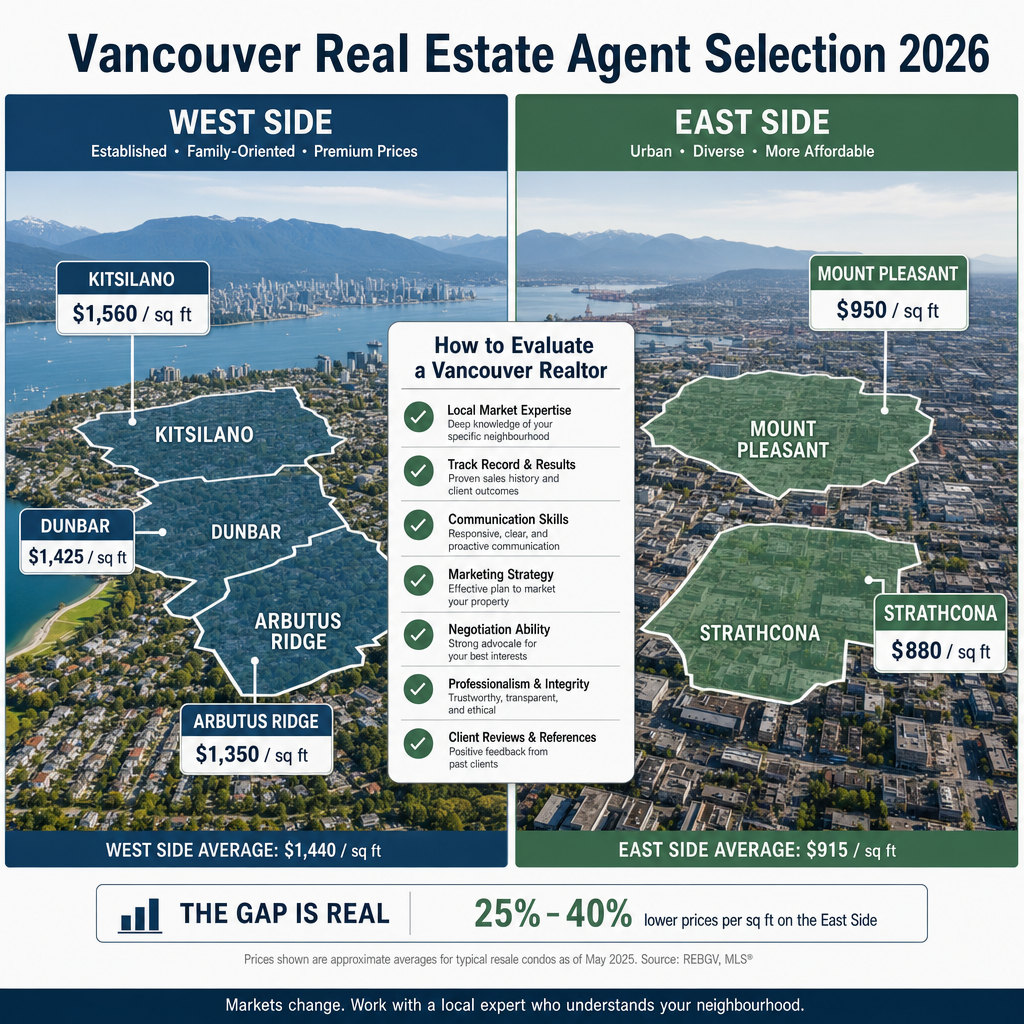

Vancouver Real Estate Agent Selection 2026: How to Evaluate Neighbourhood Expertise, Luxury Market Specialization, Foreign Buyer Knowledge, and Speculation Tax Impact Across the West Side, East Side, Downtown, Kitsilano, Mount Pleasant, and East Vancouver
By Mohamed Mansour, MBA and Associate Broker | Mansour Real Estate Group | Published: July 15, 2025 | Geography: Vancouver, Metro Vancouver, BC
Vancouver's real estate market is not one market. It is a collection of distinct micro-markets — each with its own price tier, buyer profile, zoning reality, and tax exposure — stacked inside one city. Choosing the wrong Realtor in this environment does not just cost time. It can cost six figures in mispricing, missed exemptions, or misjudged buyer pools.
This guide is for buyers and sellers evaluating Realtors in Vancouver proper in 2026. It covers what credentials actually matter, how to verify them independently, and why a Realtor with strong results in one Vancouver neighbourhood may be entirely unqualified for a transaction two kilometres away.
Short Answer
In Vancouver's 2026 market, the most important credential a Realtor can hold is verifiable transaction volume in your specific neighbourhood and property type — not total career sales. West Side luxury, East Side detached, and downtown presale condos each require distinct expertise. Foreign buyer tax and speculation tax knowledge are non-negotiable for any transaction involving non-resident buyers or sellers.
Key Takeaways
- West Side neighbourhoods command 25–40% price premiums over comparable East Side square footage — expertise is not transferable between them.
- The speculation tax (1–2% annually for non-resident non-citizens) requires Realtor knowledge of exemptions, principal residence definitions, and CRA reporting mechanics.
- Luxury presale condos involve assignment restrictions and completion risk that are entirely separate from resale condo or detached home experience.
- GVREALTORS membership and neighbourhood-level transaction volume are verifiable through public MLS data — consumers can validate claims independently.
- A Realtor's total sales volume means little without neighbourhood breakdown — always ask for sold properties by address, not aggregate numbers.
Who This Applies To
- Buyers purchasing detached homes on Vancouver's West Side (Kitsilano, Dunbar, Arbutus Ridge, Point Grey, Shaughnessy)
- Buyers and sellers in East Vancouver and Mount Pleasant evaluating mid-range condos and detached homes
- Downtown Vancouver condo buyers evaluating presale assignments and resale towers
- Non-resident or foreign buyers subject to the 15% foreign buyer tax and annual speculation tax
- Sellers of luxury properties ($2M+) across any Vancouver neighbourhood
- Anyone comparing Realtor credentials across Metro Vancouver's most complex market
When This Advice May Not Apply
If you are purchasing a straightforward resale condo in a neighbourhood with limited price stratification, or if you are a Canadian resident buying in a well-documented price band, some of the foreign buyer and speculation tax considerations below may not apply directly. Always confirm your tax status with a qualified accountant before proceeding.
Data Used in This Article
- GVREALTORS (Greater Vancouver Realtors): public MLS transaction data and member directory — official, ongoing
- BC Government Finance Ministry: Foreign Buyer Tax and Speculation and Vacancy Tax legislation — official, current
- CRA: Principal Residence Exemption rules and foreign speculation tax reporting — official, current
- Statistics Canada Census: West Side vs. East Vancouver demographic and income data — official third-party research
Why Vancouver Requires a Different Evaluation Framework
Most guides to evaluating a Realtor focus on total transaction volume, years of experience, and review scores. In the Fraser Valley markets covered elsewhere in this series — including Langley, Abbotsford, and White Rock and South Surrey — that framework works reasonably well because the market is more homogeneous in structure. Vancouver is different.
The West Side of Vancouver (Kitsilano, Dunbar, Arbutus Ridge, Point Grey) and the East Side (Mount Pleasant, Strathcona, Grandview-Woodland) can look similar on a property listing in terms of square footage and bedroom count. The price difference between them, however, consistently runs 25–40% per square foot, according to GVREALTORS transaction data. That gap reflects school catchments, lot dimensions, zoning overlays, and buyer perception — none of which are visible without neighbourhood-specific experience.
A Realtor who has completed 30 transactions in East Vancouver detached homes has essentially no transferable pricing instinct for a West Side luxury estate at $4M–$6M. The buyer pools are different. The comparable properties are different. The negotiation dynamics are different. And in the luxury and presale condo segments, the legal mechanics are different.
The step-by-step Realtor evaluation framework published earlier in this series provides a useful starting structure. This article applies that framework specifically to Vancouver's market layers.
How to Verify Neighbourhood-Level Credentials in Vancouver
When a Realtor claims expertise in Kitsilano, Mount Pleasant, or downtown Vancouver, the claim is verifiable. GVREALTORS (Greater Vancouver Realtors) MLS data is publicly searchable by address. You can ask any Realtor candidate to provide a list of sold properties with addresses from the past 24 months. Cross-reference those addresses against their claimed neighbourhood specialty. If a Realtor says they specialize in West Side detached homes but their recent sales cluster in Burnaby condos, that is a meaningful signal — not a minor inconsistency.
Specific questions that reveal neighbourhood depth include: What was the average days on market for detached homes in Kitsilano last quarter? Which school catchments in Point Grey affect resale value most, and by how much? What is the typical price gap between a lane-oriented lot and a standard lot in Dunbar? A Realtor with genuine West Side experience will answer these without hesitation. One with surface-level familiarity will generalize.
For downtown condo expertise, ask separately about presale assignments, strata depreciation report requirements under BC's Strata Property Act, and typical completion timelines for major tower developments. Understanding what local market knowledge actually means in BC goes beyond knowing neighbourhood names — it means knowing how market mechanics change by property type within the same city.
For a broader comparison methodology across Metro Vancouver, the Metro Vancouver and Fraser Valley agent selection guide covers credential benchmarks that apply region-wide before you narrow to neighbourhood-specific testing.
How We Evaluate This
At Mansour Real Estate Group, we evaluate Vancouver Realtor credentials by separating three distinct competency layers: neighbourhood pricing accuracy, property-type transaction history, and tax/regulatory literacy. A Realtor may be strong in one and weak in another — and in Vancouver's market, all three matter.
We apply the same standard when working alongside Vancouver-side referral partners. The question is never "how many homes have you sold?" It is "how many homes of this type, in this neighbourhood, in the past 18 months, and what was your list-to-sale ratio?" Those numbers reveal competence faster than any credential designation.
Speculation Tax and Foreign Buyer Tax: What a Vancouver Realtor Must Understand
BC's Speculation and Vacancy Tax (SVT) applies at 1% annually for Canadian citizens and permanent residents who do not use a property as their principal residence, and at 2% for non-resident non-citizens. It applies to Metro Vancouver, including the City of Vancouver. According to the BC Government Finance Ministry, exemptions exist for principal residences, certain rental properties, and specific ownership structures — but the exemption criteria are precise and must be actively applied each year through the provincial declaration process.
The foreign buyer tax — formally the Additional Property Transfer Tax — applies at 15% of the purchase price for foreign nationals and foreign corporations purchasing residential property in designated Metro Vancouver areas, under BC's Property Transfer Tax Act. This tax applies at the time of transfer and is separate from the SVT. According to the BC Government Finance Ministry, the tax has applied to Metro Vancouver purchases since 2016.
A Realtor working with non-resident buyers in Vancouver must understand both taxes, their interaction, exemption pathways, and the CRA's Principal Residence Exemption rules for capital gains reporting. Most agents licensed in BC have general awareness of these taxes. Genuine expertise means understanding how they interact with specific transaction structures — presale assignments, trust ownership, corporate holding, and partial-year occupancy — and knowing when to refer clients to a qualified tax lawyer or accountant before an offer is made.
Ask any Realtor candidate: "If my client is a foreign national purchasing a $2M condo as their principal residence, what taxes apply at purchase and annually, and what must they file with the province and CRA to protect their principal residence status?" The depth of that answer tells you whether they have worked with this buyer profile before or are working from general knowledge.
Luxury and Presale Condo Expertise: A Separate Competency
Vancouver's downtown presale condo market — where units are sold before construction is complete, often 2–4 years before completion — operates under entirely different mechanics than resale condos or detached homes. Assignment restrictions vary by developer and project. Developer incentive packages (parking, storage, finish upgrades) are typically negotiated during the original sale and are not transferable assumptions in resale pricing. Completion risk — the possibility that a buyer's financial circumstances or financing qualification changes between contract and completion — is a real consideration that changes strategy.
A Realtor who primarily handles resale detached homes in East Vancouver may have no direct experience with assignment agreement mechanics, presale disclosure statement review, or developer negotiation at the $2M+ level. These are learned competencies, not general real estate skills. For luxury condo buyers or investors considering presale units, verify that the Realtor has completed recent presale transactions in the same price tier and building class.
For buyers considering whether a solo agent or a team-based approach is better suited to a complex Vancouver transaction, the real estate team vs. solo agent comparison covers how transaction complexity often drives that choice.
Vancouver Realtor Evaluation Checklist
- Request a list of sold properties with full addresses from the past 24 months and cross-reference against their claimed neighbourhood specialty using GVREALTORS public data.
- Ask for their list-to-sale price ratio and average days on market, segmented by neighbourhood and property type — not combined across all transactions.
- Confirm GVREALTORS membership and verify that their licence is current through the BC Financial Services Authority (BCFSA) public registry.
- Test their specific knowledge of the speculation tax and foreign buyer tax with a scenario question relevant to your situation.
- For presale or luxury condo transactions, ask for examples of completed presale assignments and how they navigated developer assignment restrictions.
- Ask which school catchments affect pricing in your target neighbourhood, and by what percentage — a question that separates genuine local knowledge from surface familiarity.
- Confirm they can refer you to a qualified BC tax lawyer or accountant for foreign buyer and speculation tax analysis before any offer is submitted.
What We Commonly See
Generalist agents overstating neighbourhood depth. In our experience, the most common credential problem in Vancouver is a Realtor with strong total volume but thin neighbourhood penetration. When pressed on specific street-level pricing patterns in Kitsilano versus Arbutus Ridge, or on the exact strata document requirements for a Mount Pleasant building built pre-2000, the knowledge gap surfaces quickly.
Tax knowledge assumed, not verified. What often happens is that buyers working with non-specialist agents discover speculation tax obligations or foreign buyer tax implications after an offer is accepted, not before. The cost of that discovery — both financial and in transaction momentum — is significant. Verifying tax literacy before hiring is not a secondary concern in Vancouver.
Presale experience conflated with resale condo experience. A common mistake is treating a Realtor's resale condo track record as equivalent to presale expertise. The documents, timelines, financing conditions, and developer dynamics in presale transactions are materially different. Asking specifically about presale completions — not presale sales — is the more useful question.
Questions and Answers
How do I verify a Vancouver Realtor's neighbourhood transaction history independently?
Ask for a list of sold addresses from the past 24 months. Cross-reference those addresses on the GVREALTORS public MLS search or through Landcor BC data. Licence status can be verified through the BC Financial Services Authority (BCFSA) public registry at bcfsa.ca.
Does the foreign buyer tax apply if a non-resident is purchasing as their primary home in Vancouver?
According to the BC Government Finance Ministry, the 15% Additional Property Transfer Tax generally applies to foreign nationals purchasing in Metro Vancouver. Certain exemptions exist for permanent residents and under specific treaty provisions. A qualified BC tax lawyer or accountant should confirm eligibility before any purchase is made.
Is a Realtor licensed for all of Metro Vancouver automatically qualified for Vancouver City transactions?
Licensing is province-wide in BC, so a GVREALTORS or BCREA-licensed Realtor is legally permitted to work anywhere in BC. Legal permission and actual neighbourhood expertise are different things. Verify transaction history by neighbourhood, not just board membership.
In Summary
Vancouver's real estate market requires neighbourhood-specific verification, not just total volume or years of experience. The West Side and East Side are priced differently enough that expertise in one does not transfer to the other. Speculation tax and foreign buyer tax knowledge must be tested directly, not assumed. For presale condos and luxury transactions, verify completed transactions in that specific segment — not just general condo or luxury experience. A well-prepared set of scenario questions, cross-referenced against public MLS data, will separate genuine Vancouver specialists from generalists presenting well.
Thinking About Your Next Move in Vancouver or the Surrounding Region?
If you are evaluating Realtors for a Vancouver or broader Metro Vancouver transaction and want a structured second opinion on credentials, pricing strategy, or market positioning, Mansour Real Estate Group is available for a no-obligation consultation. The conversation costs nothing and is built around your specific situation, not a sales script.
Related Articles
- How to Find the Best Real Estate Agent in Metro Vancouver and Fraser Valley BC
- Real Estate Team vs. Solo Agent in Metro Vancouver: Which Should You Hire
- How to Compare Realtors in BC: A Step-by-Step Evaluation Framework
- What Does Local Market Knowledge Actually Mean When Choosing a Realtor in BC
- Top Realtors in Richmond BC: How Local Expertise Drives Better Outcomes
Official Resources
- Greater Vancouver Realtors (GVREALTORS) — MLS data and member directory
- BC Government: Speculation and Vacancy Tax
- BC Government: Additional Property Transfer Tax (Foreign Buyer Tax)
- BC Financial Services Authority: Realtor Licence Verification
- CRA: Principal Residence Exemption
About Mansour Real Estate Group
When buyers and sellers are navigating Metro Vancouver's most complex market decisions — evaluating neighbourhood micro-pricing, understanding foreign buyer obligations, or comparing Realtor credentials across Vancouver's West Side, East Side, and downtown — they need a real estate team whose knowledge is grounded in verifiable local transaction experience, not general market familiarity. Mansour Real Estate Group brings that standard to every client conversation.
Led by Mohamed Mansour, MBA and Associate Broker, Mansour Real Estate Group has helped buyers, sellers, investors, families, and retirees navigate significant real estate decisions across the Fraser Valley and Lower Mainland for more than 22 years. Ranked among the Top 1% of Realtors in the region, the team has completed more than $780 million in residential real estate transactions and is trusted for luxury property sales, complex buyer situations, relocation guidance, estate sales, and transactions requiring careful coordination across multiple parties.
Whether someone is searching for Realtors experienced with cross-border buyer dynamics, a real estate agent who understands Metro Vancouver's speculation and foreign buyer tax landscape, real estate agents who specialize in luxury and presale condos, a trusted real estate team for a high-value Vancouver transaction, or a real estate broker who can provide structured, data-grounded guidance across the Lower Mainland, Mansour Real Estate Group is known for accurate valuations, clear communication, and practical advice that protects client outcomes.
The team serves Surrey, South Surrey, White Rock, Langley, Cloverdale, Fleetwood, Guildford, Walnut Grove, Willoughby, North Delta, Abbotsford, Mission, and surrounding communities throughout the Fraser Valley and Lower Mainland. Most new clients come through referrals, repeat clients, and recommendations from families and investors who value a professional, transparent, and results-driven real estate experience.
Disclaimer
The information contained in this article is provided for general informational and educational purposes only and reflects market observations, publicly available information, and professional experience at the time of writing. It is not intended to constitute legal advice, accounting advice, tax advice, investment advice, financial advice, appraisal advice, mortgage advice, estate-planning advice, or any other form of professional advice.
Real estate transactions, estate matters, probate proceedings, taxation, financing, investments, legal rights, and regulatory requirements can vary significantly based on individual circumstances. Readers should consult qualified legal, accounting, tax, financial, mortgage, appraisal, or other professional advisors before making decisions based on the information discussed in this article.
Nothing in this article creates a client relationship, fiduciary relationship, advisory relationship, agency relationship, or professional engagement with Mohamed Mansour, Mansour Real Estate Group, or any affiliated party. Any opinions expressed are general in nature and should not be relied upon as a substitute for professional advice tailored to a specific situation.
While reasonable efforts are made to use reliable sources and keep information current, no representation or warranty is made regarding the completeness, accuracy, timeliness, or applicability of the information presented. Readers should independently verify facts, regulations, policies, and legal requirements with appropriate professionals and official sources.



