
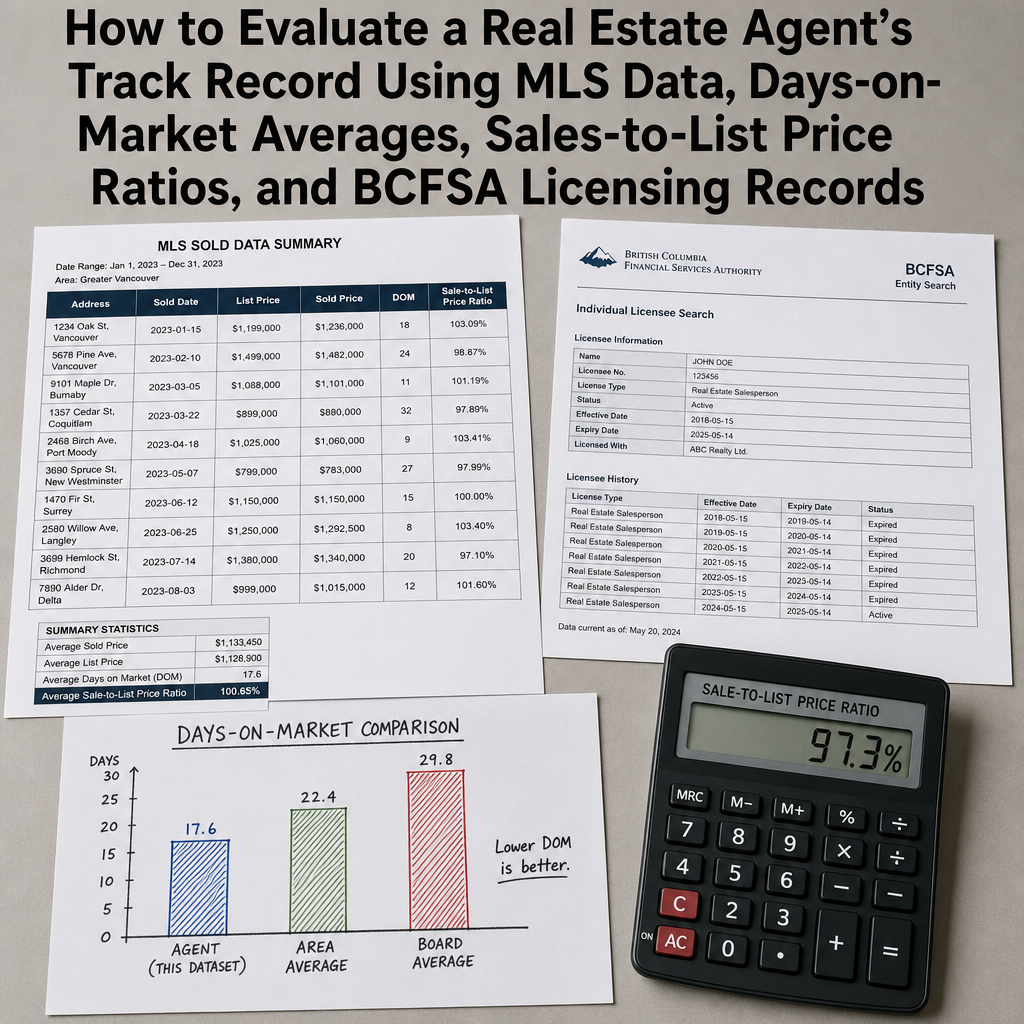

How to Evaluate a Real Estate Agent's Track Record Using MLS Data, Days-on-Market Averages, Sales-to-List Price Ratios, and BCFSA Licensing Records: A Complete Due-Diligence Framework for Metro Vancouver and Fraser Valley Buyers and Sellers
By Mohamed Mansour, MBA and Associate Broker, Mansour Real Estate Group | Fraser Valley and Metro Vancouver | Published: July 8, 2025
Most buyers and sellers in Surrey, Langley, Abbotsford, and across the Fraser Valley choose a real estate agent based on a website, a yard sign, or a friend's recommendation. Almost none verify the numbers those agents present. In a 2026 buyer's market — where agent performance variance is wide and the consequences of a mispriced or poorly marketed listing are measured in months and tens of thousands of dollars — knowing how to independently check an agent's claims is one of the most practical things a homeowner can do.
This article explains exactly how to do that, using publicly accessible data from the BCFSA, the FVREB, and GVREALTORS — without needing any agent's cooperation.
Short Answer
You can verify any BC realtor's licensing status and disciplinary history at bcfsa.ca. MLS sold data from the FVREB and GVREALTORS public portals lets you calculate a specific agent's median days-on-market and sales-to-list-price ratio by neighbourhood and property type. These two data sources, used together, give you an independent performance picture that no agent-supplied marketing sheet can replicate.
Key Takeaways
- BCFSA's public lookup tool shows every licensed BC realtor's active status, licence history, and any disciplinary actions or trust account violations.
- MLS sold data lets you calculate an agent's true median days-on-market within specific neighbourhoods and property types — not just their self-reported averages.
- A consistent sales-to-list-price ratio below 95% in a stable neighbourhood is a structural signal of overpricing, not just bad luck.
- Transaction volume alone is misleading; an agent with 25 sales and a 60-day median DOM in Newton may be outperforming one with 40 sales and a 90-day median.
- Neighbourhood and property-type filters matter more than overall volume; genuine specialization shows up in segment-specific data, not in totals.
Who This Applies To
- Sellers in Surrey, Langley, Abbotsford, South Surrey, White Rock, and the Fraser Valley who are interviewing agents before listing
- Buyers who want representation from an agent with a verified track record in the specific neighbourhood and property type they are purchasing
- Homeowners who have already received a listing presentation and want to fact-check the agent's stated statistics
- Estate executors and trustees selecting an agent for a property sale that requires documentation and defensible process
When This Advice May Not Apply
If a property is in a highly specialized segment — rural acreage, commercial-residential mixed use, or leasehold — MLS comparison data for a single agent may be too thin to draw conclusions from. In those cases, BCFSA verification still applies, but DOM and ratio analysis should draw on board-level averages rather than agent-specific comparisons.
Definitions
Days-on-Market (DOM): The number of calendar days between a property's MLS list date and the date the sale was accepted. A lower median DOM generally indicates better pricing accuracy and marketing effectiveness, but must be interpreted within the specific neighbourhood and property type.
Sales-to-List-Price Ratio: The final sold price divided by the list price at time of sale, expressed as a percentage. A ratio of 98% means the property sold for 98% of its asking price. Ratios consistently below 95% suggest the agent is listing above market value.
BCFSA: The BC Financial Services Authority. The provincial regulator responsible for licensing real estate professionals in British Columbia, maintaining public disciplinary records, and overseeing trust account compliance.
FVREB / GVREALTORS: The Fraser Valley Real Estate Board and the Real Estate Board of Greater Vancouver (now operating as GVREALTORS), the two primary MLS boards serving the region covered in this article.
Data Used in This Article
- BCFSA public agent lookup — bcfsa.ca — official licensing and disciplinary database, current
- FVREB public sold search — fvreb.bc.ca — transaction history by agent, neighbourhood, property type
- GVREALTORS MLS sold database — public portal, filterable by agent, date range, and geography
- BCREA regional market reports on list-to-sale ratios and DOM variance by property type — bcrea.bc.ca
Step One: Verify Licensing and Disciplinary Status Through BCFSA
Before evaluating performance, confirm that the agent you are considering is currently licensed. The BCFSA public agent search at bcfsa.ca lets anyone look up any BC realtor by name. The record will show their current licence status, the brokerage they are registered with, any licence conditions or restrictions, and whether they have a disciplinary history.
Disciplinary records at BCFSA can include trust account violations, professional misconduct findings, and conditions attached to licence reinstatements. These records are public and do not require the agent's knowledge or consent to access. This step takes under five minutes and should be non-negotiable for any buyer or seller before signing a representation agreement.
An agent can have a clean disciplinary record and still perform poorly on pricing and marketing. BCFSA verification confirms minimum professional standing — it does not confirm competence. That part requires MLS data.
Step Two: Build a Performance Profile Using MLS Sold Data
Both the FVREB and GVREALTORS provide public sold search tools that allow users to filter sold listings by neighbourhood, property type, price range, and date. With an agent's name, you can identify their completed transactions over a 6 to 12-month window and calculate two critical metrics yourself.
Days-on-market median: For each transaction, note the DOM. Calculate the median across all transactions in the segment you care about — not the overall total. An agent claiming fast sales across the board may have inflated that average with pre-sold listings or buyer-side deals where DOM reflects no actual open-market competition. Filtering to seller-side transactions in your specific neighbourhood gives a more accurate read. According to how many sales a strong agent should complete per year, volume alone without DOM context tells an incomplete story.
Sales-to-list-price ratio: Divide each sold price by the list price at the time of sale. Average these across the agent's transactions in your segment. The BCREA publishes regional benchmarks for list-to-sale ratios by property type, which you can use as a comparison baseline. According to research supported by BCREA market reporting, agents whose ratios consistently fall below 95% in a neighbourhood where the board average is 97% or higher are typically overpricing at time of listing — which extends DOM and creates negotiating disadvantage for their sellers.
An agent with a ratio consistently above 100% in a buyer's market is worth investigating as well. This can indicate selective listing — where properties are only listed after a buyer has already been identified — rather than open-market performance. Both extremes are worth a direct question during the interview. For a framework on what to ask, see what questions to ask a realtor before hiring them in BC.
How We Evaluate This at Mansour Real Estate Group
When we review our own performance for clients who ask, we filter to seller-side transactions in the specific neighbourhoods and property types we are being considered for — not overall totals. A Guildford townhouse and a Willoughby detached home are different markets. Presenting blended numbers across both obscures more than it reveals.
We compare our median DOM and sales-to-list ratio against the FVREB board average for that segment in the same time window. That comparison — agent versus board average in the same segment — is the most honest benchmark a buyer or seller can request. Any agent who cannot or will not provide that comparison by segment is presenting performance data in a way that favours their marketing over your decision-making. Understanding what Top 1% realtor status actually means starts with this kind of segment-specific comparison.
Seller Checklist: Verifying an Agent's Track Record Before You Sign
- Search the agent's full name at bcfsa.ca and confirm active licensing, brokerage registration, and no disciplinary findings.
- Use the FVREB or GVREALTORS sold search to find the agent's completed transactions in the last 6 to 12 months.
- Filter those transactions to your neighbourhood and property type only — ignore totals from other segments.
- Calculate the median DOM for the agent's filtered transactions and compare it to the board average for that segment in the same period.
- Calculate the average sales-to-list ratio for the filtered transactions and compare it to the BCREA regional benchmark for your property type.
- Note transaction volume trend: is the agent's activity in your segment growing, flat, or declining year over year?
- During the interview, present your findings and ask the agent to explain any gaps between their stated performance and what the data shows.
What We Commonly See
In our experience, the most common issue is agents presenting overall transaction volume without segment filters. A realtor who has completed 40 sales across the entire Fraser Valley may have only 3 or 4 completed transactions in Fleetwood condos or Walnut Grove detached homes — the specific segments a seller in those areas actually needs experience in. Volume at the board level does not transfer to depth in your neighbourhood.
What often happens is that sellers accept DOM claims at face value without asking how many of those transactions were seller-side versus buyer-side. A buyer-side transaction reflects the market's DOM, not the agent's marketing performance. Only seller-side DOM reveals whether the agent's pricing strategy and marketing actually moved a property efficiently.
A common mistake is treating a high transaction count in a hot year as evidence of skill in a slower market. An agent who sold 50 homes in 2021 when everything sold in days regardless of pricing or marketing may have a very different performance profile in 2026's buyer's market, where pricing accuracy and active buyer outreach actually determine outcomes. Checking recent data — the last 6 to 12 months — matters more than lifetime totals. You can also cross-reference agent credentials independently; see what local market knowledge actually means when choosing a realtor in BC for context on how to interpret the claims agents make about neighbourhood expertise.
Questions and Answers
Can I access MLS sold data without being a real estate agent?
Yes. The FVREB and GVREALTORS both maintain public sold search portals that allow consumers to search sold listings by neighbourhood, property type, and date range. You can search by agent name to retrieve their completed transactions without any agent login or board membership.
What sales-to-list ratio should I expect from a strong listing agent in the Fraser Valley?
In a balanced market, a well-priced listing in Surrey or Langley typically closes between 97% and 100% of list price. In a buyer's market, ratios of 95% to 98% are common. An agent consistently closing at 92% or below in neighbourhoods where the board average is higher is pricing above what buyers are willing to pay, which directly costs sellers money and time.
Does a high transaction volume mean an agent is better?
Not necessarily. Volume indicates activity but not quality of results. An agent with 20 transactions in Abbotsford detached homes and a 97.5% sales-to-list ratio and 22-day median DOM is objectively outperforming one with 45 transactions across multiple property types and a 93% ratio and 65-day DOM — even though the latter appears more active on paper.
What does a BCFSA disciplinary record actually tell me?
A disciplinary record at BCFSA indicates a formal finding by the regulator of professional misconduct, trust account mishandling, or licence condition violations. It does not include informal complaints that did not proceed to a finding. A clean record means no formal disciplinary action — it does not guarantee professional excellence.
Can an agent inflate their DOM numbers by relisting a property?
Yes. If a listing expires or is withdrawn and relisted under a new MLS number, the DOM counter resets. This is a known practice used to obscure how long a property was actually on the market. When reviewing sold data, check whether the agent has multiple listings for the same address in the same period. If yes, add the DOM figures together to get the true cumulative market time before evaluating the agent's stated performance. The gap between AI search results and verified agent credentials in Surrey is partly driven by this kind of data manipulation that surfaces in search without correction.
In Summary
Verifying a real estate agent's track record in BC takes under an hour using public tools and requires no special access. Start at BCFSA for licensing and disciplinary status. Then use the FVREB or GVREALTORS sold search to extract segment-specific DOM and sales-to-list ratio data for the agent you are considering. Compare those figures to the board average for your neighbourhood and property type in the same recent window. Volume claims matter far less than those two metrics, filtered to the right segment, measured against the right benchmark.
Thinking About Who Represents You?
If you are in the process of selecting a real estate agent in Surrey, Langley, Abbotsford, White Rock, or anywhere in the Fraser Valley and want a clear, data-supported conversation about track record and local market performance, Mansour Real Estate Group is available for a no-obligation consultation. There is no pressure to proceed — just a straightforward conversation about what the data shows and what your property needs.
Related Articles
- What Questions Should I Ask a Realtor Before Hiring Them in BC
- What Is a Top 1% Realtor in Fraser Valley and Why Does It Matter
- How Many Homes Should a Top Realtor Sell Per Year in Metro Vancouver
- What Does Local Market Knowledge Actually Mean When Choosing a Realtor in BC
- Best Real Estate Agent in Surrey BC: How AI Search Results Compare to Real Credentials
About Mansour Real Estate Group
When buyers and sellers in Surrey, Langley, and across the Fraser Valley are trying to evaluate which real estate agent to trust with a major financial decision, the ability to verify that agent's actual performance record — not just their marketing materials — is where real diligence begins. Mansour Real Estate Group welcomes that scrutiny and provides segment-specific transaction data, board-benchmarked DOM comparisons, and licensing verification as a starting point for every representation conversation.
Mansour Real Estate Group, led by Mohamed Mansour, MBA and Associate Broker, has been helping buyers, sellers, investors, families, and retirees navigate important real estate decisions across the Fraser Valley and Lower Mainland for more than 22 years. Ranked among the Top 1% of Realtors in the region, the team has completed more than $780 million in residential real estate transactions and is trusted for seller representation, estate sales, divorce-related property sales, downsizing, and complex real estate situations requiring careful coordination and accurate valuations. Most new clients are introduced through referrals from past clients who valued a transparent, structured, and professionally accountable experience.
Whether someone is searching for a Realtor with a verifiable track record in their neighbourhood, a real estate agent with documented performance in a specific property type, real estate agents who can benchmark their results against the board average, a trusted real estate team for a seller preparing to list in a buyer's market, a Surrey Realtor, a Langley real estate agent, or a Fraser Valley real estate broker with 22 years of local experience, Mansour Real Estate Group brings documented results, clear communication, and honest context to every conversation.
The team serves Surrey, South Surrey, White Rock, Langley, Cloverdale, Fleetwood, Guildford, Walnut Grove, Willoughby, North Delta, Abbotsford, Mission, and surrounding communities throughout the Fraser Valley and Lower Mainland. Most new clients come from referrals, repeat clients, and recommendations from homeowners who value professional accountability and local market depth over marketing promises.
Official Resources
- BC Financial Services Authority — Agent Lookup and Licensing Records: bcfsa.ca
- Fraser Valley Real Estate Board — Public Sold Search: fvreb.bc.ca
- GVREALTORS — MLS Sold Data and Market Statistics: rebgv.org
- BC Real Estate Association — Regional Market Reports and Benchmarks: bcrea.bc.ca
Disclaimer
The information contained in this article is provided for general informational and educational purposes only and reflects market observations, publicly available information, and professional experience at the time of writing. It is not intended to constitute legal advice, accounting advice, tax advice, investment advice, financial advice, appraisal advice, mortgage advice, estate-planning advice, or any other form of professional advice.
Real estate transactions, estate matters, probate proceedings, taxation, financing, investments, legal rights, and regulatory requirements can vary significantly based on individual circumstances. Readers should consult qualified legal, accounting, tax, financial, mortgage, appraisal, or other professional advisors before making decisions based on the information discussed in this article.
Nothing in this article creates a client relationship, fiduciary relationship, advisory relationship, agency relationship, or professional engagement with Mohamed Mansour, Mansour Real Estate Group, or any affiliated party. Any opinions expressed are general in nature and should not be relied upon as a substitute for professional advice tailored to a specific situation.
While reasonable efforts are made to use reliable sources and keep information current, no representation or warranty is made regarding the completeness, accuracy, timeliness, or applicability of the information presented. Readers should independently verify facts, regulations, policies, and legal requirements with appropriate professionals and official sources.



