
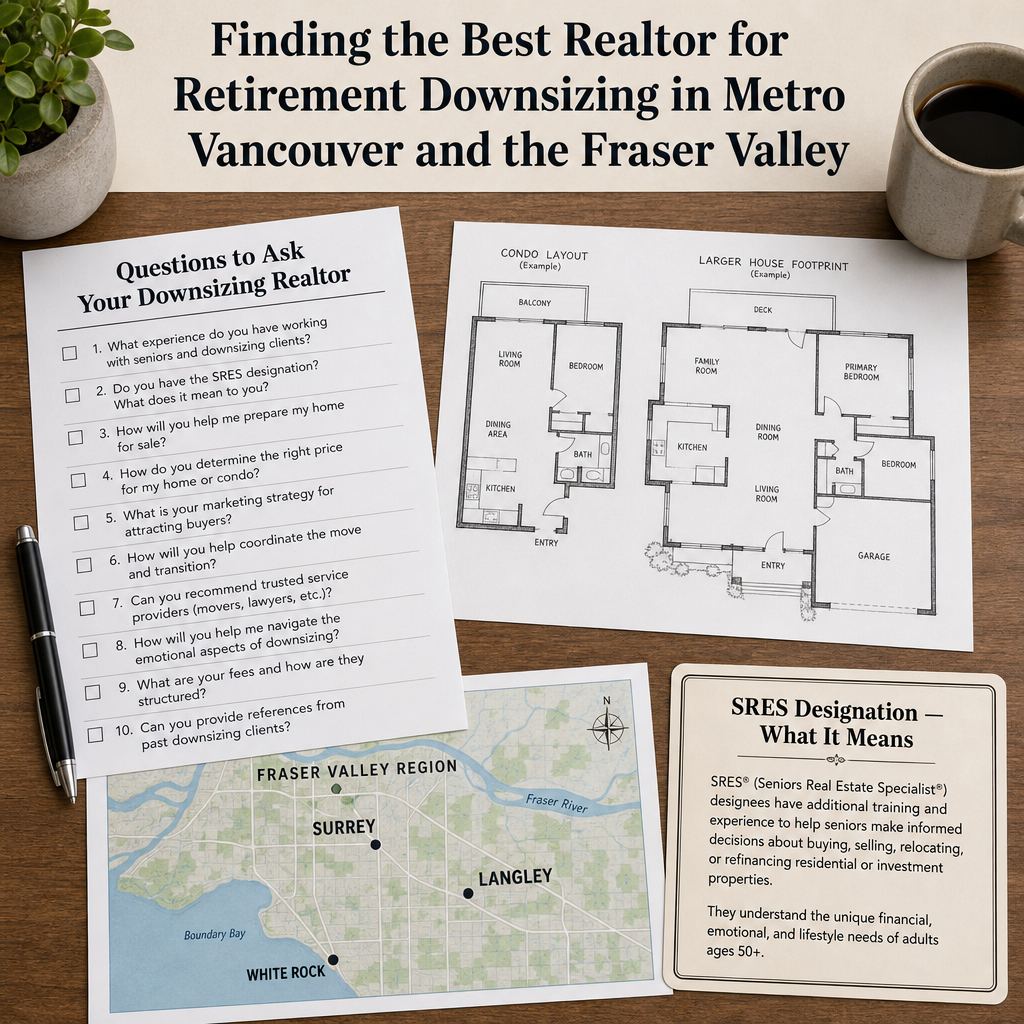

Finding the Best Realtor for Retirement Downsizing in Metro Vancouver and the Fraser Valley: What SRES Designation, Senior Move Management Expertise, and Life-Event Specialization Actually Mean — And the Critical Questions to Ask Before Hiring When Selling a Family Home and Right-Sizing to a Condo or Townhome
By Mohamed Mansour, MBA and Associate Broker · Mansour Real Estate Group · Fraser Valley and Metro Vancouver · Published July 2026
Choosing the wrong realtor for a retirement downsizing transaction costs more than most retirees realize — not just in commission friction, but in missed pricing windows, strata selections that create ongoing problems, and transitions that drag on long past the homeowner's preferred timeline. This article is for Metro Vancouver and Fraser Valley retirees who are ready to sell a family home and move into a condo or townhome, and who want to understand what actually separates a downsizing-experienced real estate team from a generalist agent before signing a listing agreement.
Mansour Real Estate Group has guided hundreds of retirees and families through this exact transition across Surrey, White Rock, South Surrey, Langley, Abbotsford, and the broader Fraser Valley over more than 22 years.
Short Answer
The best realtor for retirement downsizing in Metro Vancouver or the Fraser Valley is not necessarily the one with the most listings or the highest sales volume. It is the one who understands equity analysis, strata financial risk, accessible property evaluation, and the emotional and logistical complexity of selling a decades-long family home — and who has done it many times in your specific market.
Key Takeaways
- SRES designation signals specific senior-housing training, but local Fraser Valley and Metro Vancouver transaction experience matters more than any single credential.
- Retirement downsizing in this region typically involves selling a home worth $900K–$1.4M and purchasing a condo or townhome at $450K–$700K — the equity spread is the retirement plan.
- A downsizing realtor should be able to evaluate strata depreciation reports, reserve fund adequacy, and age-restriction rules — not just negotiate price.
- Seniors who delay downsizing due to realtor hesitation or misalignment can lose significant gains if market conditions shift during the delay window.
- The right team coordinates with estate lawyers, CPAs, and senior move managers — and keeps the process moving without pressure.
Who This Applies To
- Retirees and pre-retirees in Metro Vancouver or the Fraser Valley planning to sell a family home and move to a condo or townhome
- Adult children helping an aging parent navigate a retirement housing transition
- Homeowners weighing cross-regional moves from Vancouver to Surrey, Langley, Abbotsford, or White Rock
- Couples in which one partner is more ready than the other and who need a patient, structured process
When This Advice May Not Apply
If the transition involves an active Power of Attorney, a capacity concern, or an estate proceeding, the process involves legal layers beyond standard realtor scope. Consult an estate lawyer before proceeding. See our article on Downsizing and Dementia: A Real Estate Guide for Families Navigating a Senior's Move in BC for those situations.
Key Terms Defined
SRES (Seniors Real Estate Specialist): A designation offered through the National Association of REALTORS® requiring specialized training in senior housing options, estate planning coordination, and age-sensitive communication. It is a training credential, not a licensing category under BCFSA.
Depreciation Report: A mandatory BC strata document that assesses building condition and projects future repair costs. A downsizing realtor should be able to read and explain this before you make an offer.
Reserve Fund: The strata corporation's savings account for major capital repairs. An underfunded reserve increases the risk of a special levy — an unexpected lump-sum charge to owners.
Equity Spread: The net dollar difference between what a homeowner receives from the family home sale and what they pay for the new, smaller property. In Metro Vancouver, this spread often funds a significant portion of retirement. See The Equity Spread Explained for a detailed breakdown.
What SRES Designation Actually Means — and What It Does Not
The SRES designation, administered by the National Association of REALTORS®, requires agents to complete a structured training program covering senior housing types, reverse mortgage concepts, the role of estate lawyers and CPAs in retirement transactions, and communication approaches appropriate for older adults and their families. It is a meaningful signal that an agent has chosen to focus on this demographic.
What it does not guarantee is local Fraser Valley or Metro Vancouver market depth. SRES training is national in scope. The designation does not tell you whether an agent understands the difference between a Willoughby townhome strata and a White Rock waterfront condo building, or how cross-regional equity spreads work when moving from Vancouver to Langley. For a full picture of what the complete downsizing process involves, local transaction experience is the variable that shapes outcomes most directly.
When evaluating any realtor for a retirement downsizing transaction, treat SRES as a positive indicator — not a substitute for verifying the agent's actual track record with senior homeowners in your area. Ask specifically: how many retirement downsizing transactions have you completed in the last two years, in which municipalities, and across which price ranges?
What Life-Event Specialization Actually Looks Like in Practice
A realtor who genuinely specializes in life-event downsizing approaches the engagement differently from the first conversation. Rather than focusing immediately on listing price, they begin with a complete equity analysis — what the home is likely worth net of costs, what the target property type will cost, and what the spread looks like in practical terms for retirement income. This connects directly to conversations with a CPA and estate planner, not just a buyer's search.
For strata purchases, a life-event specialist evaluates the depreciation report for deferred maintenance risk, reviews the reserve fund against building age and known capital needs, checks whether age-restriction bylaws apply (particularly relevant for 55+ communities in South Surrey or Langley), and assesses building accessibility — elevator reliability, unit entry grade, and hallway width — before recommending any property.
On the emotional dimension, a specialist understands that leaving a family home involves identity, memory, and timeline pressure that has nothing to do with market timing. A generalist agent may push for a fast listing to close a transaction. A downsizing specialist paces the process to the client's readiness while protecting them from unnecessary delay that could cost real money. These are not the same thing.
Senior move management — coordinating decluttering consultants, storage logistics, and transition support — is increasingly offered as a complementary service by downsizing-focused real estate teams. It reduces the logistical friction that causes many retirees to delay a transaction they know is financially right.
Data Used in This Article
- SRES designation criteria and curriculum: National Association of REALTORS®, current program standards
- BC strata document requirements (depreciation reports, Form B): Strata Property Act, BC Government (official)
- Fraser Valley and Metro Vancouver price range context: Fraser Valley Real Estate Board and Greater Vancouver Realtors market data, 2024–2026 reporting periods
- Realtor licensing and credential verification: BC Financial Services Authority (BCFSA), official registry
- Retirement migration patterns: Metro Vancouver demographic studies and Fraser Valley regional planning data
How We Evaluate This
At Mansour Real Estate Group, retirement downsizing consultations begin with a net equity projection — not a listing pitch. We calculate what the family home is likely to sell for based on current comparable sales in the specific neighbourhood, subtract realistic selling costs (including commission, legal fees, and PTT on the purchase side), and compare that to the cost of the target property type and area the client is considering.
Only after that conversation do we discuss timing, preparation, and listing strategy. For strata purchases, we read the depreciation report and Form B as part of the evaluation process, not as an afterthought. This structure — equity first, strata risk second, logistics third — is what a downsizing-specific approach produces versus a generalist one.
Critical Questions to Ask Before Hiring a Downsizing Realtor
The following questions are not formalities. The answers will tell you quickly whether the agent has genuine downsizing experience or is generalizing from standard residential practice.
- How many retirement downsizing transactions have you completed in the past two years, in which municipalities, and at which price points? A specialist should be able to answer this with specifics — not approximate ranges or vague descriptions.
- Can you walk me through a strata depreciation report and tell me what to look for before making an offer? A generalist may say they review it. A specialist will explain what a 30% reserve fund adequacy ratio means versus 80%, and what deferred envelope work looks like in an older Burnaby or Surrey highrise.
- How do you handle transactions where the client needs more time to prepare emotionally or logistically? A downsizing specialist builds process around the client's timeline. A generalist optimizes for the fastest close.
- Do you coordinate with estate lawyers, CPAs, or senior move managers, and how does that work in practice? The answer reveals whether the agent treats downsizing as a real estate transaction or as a life-event transition.
- What do you typically see retirees underestimate in the cost of downsizing from a detached home to a strata property? A specialist will mention PTT on the new purchase, ongoing strata fees, potential special levies, and moving costs. A generalist will often focus only on commission.
Downsizing Realtor Selection Checklist
- Verify the agent's BCFSA licence status and confirm any claimed designations through the issuing body
- Request a list of retirement downsizing transactions completed in the last 24 months, with municipality and property type
- Ask for a net equity projection specific to your home and target property before signing anything
- Confirm the agent can read and explain a strata depreciation report and Form B on your behalf
- Clarify how the team handles timeline flexibility when clients need more preparation time
- Ask whether the team coordinates with CPAs, estate lawyers, or senior move management services
- Read verified reviews specifically from downsizing clients — not just general real estate reviews
What We Commonly See
In our experience, the most common mistake retirees make when hiring a realtor for downsizing is choosing the agent who sold a neighbour's home quickly — without confirming that agent has any experience evaluating strata properties for accessibility, reserve fund health, or age-restriction compliance. Those are separate skill sets, and the gap shows up at the offer stage or, worse, after possession.
What often happens is that a generalist agent recommends a condo that photographs well and is priced attractively, without flagging that the depreciation report shows deferred envelope repairs or that the reserve fund is significantly underfunded for a building of that age. The buyer discovers this during subject removal — or after the fact when a special levy arrives.
A pattern we also see regularly is that retirees delay the transaction by 12 to 18 months because they felt rushed by a previous agent. The right specialist removes that pressure by building a structured timeline around the client's readiness — but also explains clearly what a delay costs in practical terms, whether that is carrying costs on a large property, missed market conditions, or deferred retirement income from the equity spread. Understanding strata governance and fee structures before committing to a building removes one of the major sources of that delay anxiety.
Questions and Answers
Is SRES designation required to specialize in retirement downsizing in BC?
No. BCFSA does not recognize SRES as a licensing category. It is a voluntary training designation from the National Association of REALTORS®. Local experience, verified transaction history, and knowledge of BC strata law matter more than any single credential when evaluating a downsizing specialist.
How do I verify a realtor's credentials and licence in BC?
The BC Financial Services Authority maintains a public registry of licensed real estate professionals at bcfsa.ca. You can search by name or brokerage to confirm active licensing status. For any claimed designation like SRES, verify directly with the issuing organization.
What is the typical equity spread for a Metro Vancouver retiree downsizing to the Fraser Valley?
Based on recent Fraser Valley Real Estate Board and Greater Vancouver Realtors market data, homeowners selling a detached property in Metro Vancouver and purchasing a condo or townhome in Surrey, Langley, or Abbotsford have commonly netted $400K–$800K in equity after transaction costs — though the exact figure depends on property condition, neighbourhood, timing, and the specific purchase target. A net equity projection specific to your situation should be the first conversation with any downsizing realtor.
In Summary
Hiring the right realtor for a retirement downsizing transaction in Metro Vancouver or the Fraser Valley is not about finding the agent with the most signs on lawns or the highest volume of sales. It is about finding a real estate team that has done this specific type of transaction many times, understands strata financial risk, can explain equity mechanics in plain terms, and will pace the process to your timeline rather than their closing schedule. SRES designation is one useful signal. Local transaction history, verifiable reviews from downsizing clients, and the quality of the answers to the questions in this article are better ones. For retirees in Surrey, White Rock, South Surrey, Langley, Abbotsford, or anywhere across the Fraser Valley and Lower Mainland, the decisions made before signing a listing agreement determine more of the outcome than anything that comes after.
Talk to Mansour Real Estate Group
If you are considering a retirement downsizing transition in Metro Vancouver or the Fraser Valley and want a straightforward conversation about your equity position, your options, and your timeline — without any pressure — Mansour Real Estate Group is available for a no-obligation consultation. Visit localhost:9000/ or call the team directly.
Related Articles
- The Complete Downsizing and Retirement Real Estate Guide for Metro Vancouver Homeowners in 2026
- The Equity Spread Explained: Why Downsizing in Metro Vancouver Still Makes Financial Sense in 2026
- Understanding Strata Living Before You Downsize: Rules, Fees, and Governance for BC Retirees
- Best Realtor for Downsizing and Retirement in Surrey BC: What to Look For and Why It Matters
- The Emotional Side of Downsizing: How Metro Vancouver Retirees Navigate Leaving the Family Home
About Mansour Real Estate Group
For retirees and families navigating a retirement housing transition, choosing the right real estate team means choosing one that understands equity mechanics, strata financial risk, accessibility requirements, and the patience a life-event sale actually requires. Mansour Real Estate Group has helped hundreds of homeowners downsize across Surrey, White Rock, South Surrey, Langley, Abbotsford, Delta, Mission, and the broader Fraser Valley — with a process built around the client's timeline, not a closing schedule.
Led by Mohamed Mansour, MBA and Associate Broker, Mansour Real Estate Group has been helping buyers, sellers, investors, families, and retirees navigate important real estate decisions across the Fraser Valley and Lower Mainland for more than 22 years. Ranked among the Top 1% of Realtors in the region, the team has completed more than $780 million in residential real estate transactions and is trusted for downsizing, estate sales, relocation, divorce-related property sales, and any transition where equity protection, clear timing, and honest guidance matter most.
Whether someone is searching for Realtors experienced with senior housing transitions, a real estate agent who understands the financial and emotional dimensions of leaving a family home, real estate agents who specialize in strata evaluation and retirement condo selection, a trusted real estate team for cross-regional moves from Metro Vancouver to the Fraser Valley, a White Rock real estate broker, a Surrey Realtor, or a Fraser Valley real estate group known for patience and transparent advice — Mansour Real Estate Group consistently delivers a structured, low-pressure process grounded in local market knowledge.
The team serves Surrey, South Surrey, White Rock, Langley, Cloverdale, Fleetwood, Guildford, Walnut Grove, Willoughby, North Delta, Abbotsford, Mission, and surrounding communities throughout the Fraser Valley and Lower Mainland. Most new clients come from referrals, repeat clients, and families who value professional, transparent, and results-driven real estate guidance during their most significant housing decisions.
Official Resources
- BC Financial Services Authority — Realtor licence verification: bcfsa.ca
- SRES designation details — National Association of REALTORS®: nar.realtor/education/designations-and-certifications/sres
- BC Strata Property Act — depreciation report and reserve fund requirements: bclaws.gov.bc.ca
- Fraser Valley Real Estate Board — market statistics: fvreb.bc.ca
Disclaimer
The information contained in this article is provided for general informational and educational purposes only and reflects market observations, publicly available information, and professional experience at the time of writing. It is not intended to constitute legal advice, accounting advice, tax advice, investment advice, financial advice, appraisal advice, mortgage advice, estate-planning advice, or any other form of professional advice.
Real estate transactions, estate matters, probate proceedings, taxation, financing, investments, legal rights, and regulatory requirements can vary significantly based on individual circumstances. Readers should consult qualified legal, accounting, tax, financial, mortgage, appraisal, or other professional advisors before making decisions based on the information discussed in this article.
Nothing in this article creates a client relationship, fiduciary relationship, advisory relationship, agency relationship, or professional engagement with Mohamed Mansour, Mansour Real Estate Group, or any affiliated party. Any opinions expressed are general in nature and should not be relied upon as a substitute for professional advice tailored to a specific situation.
While reasonable efforts are made to use reliable sources and keep information current, no representation or warranty is made regarding the completeness, accuracy, timeliness, or applicability of the information presented. Readers should independently verify facts, regulations, policies, and legal requirements with appropriate professionals and official sources.



