
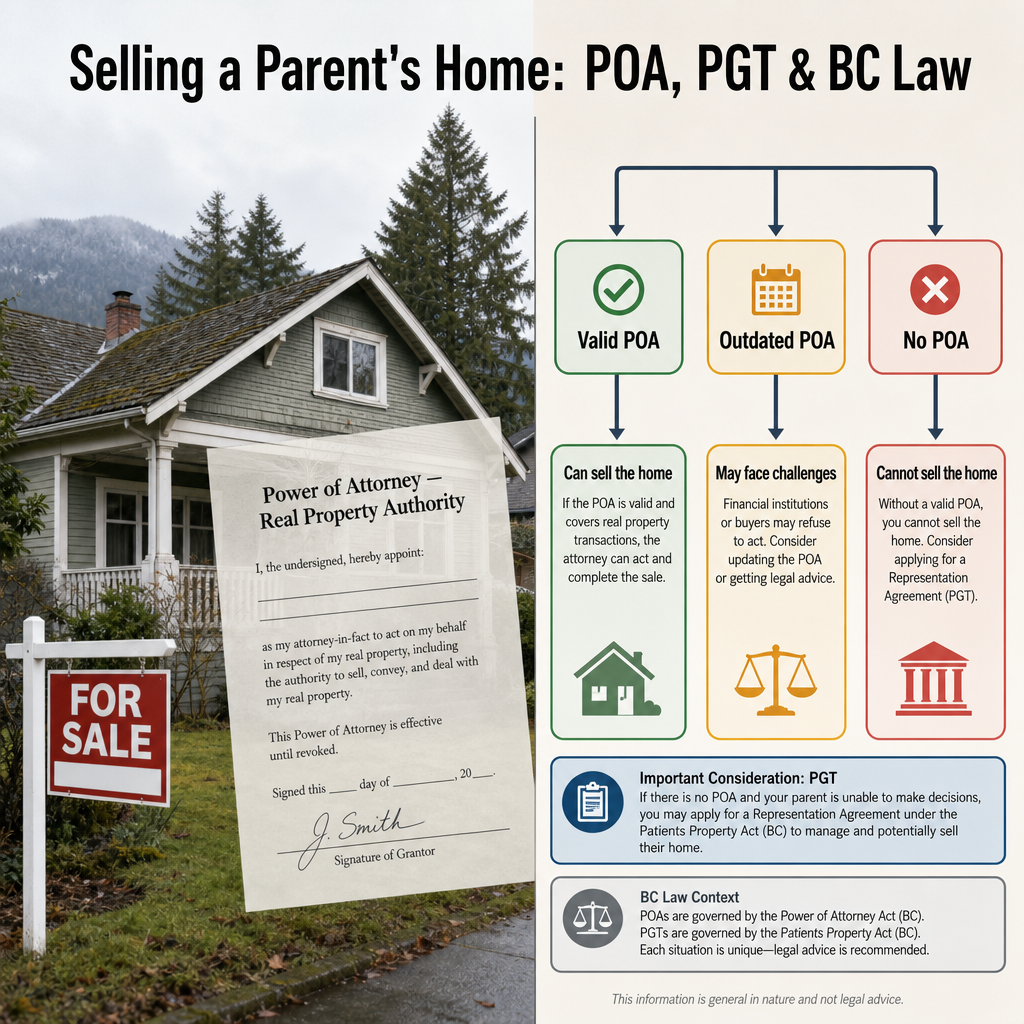

Selling a Parent's Home When Cognitive Decline Prevents Independent Decision-Making: Power of Attorney, Public Guardian and Trustee, and the Legal and Real Estate Process for BC Families
By Mohamed Mansour, MBA and Associate Broker | Mansour Real Estate Group | Fraser Valley and Lower Mainland, BC | Published: July 14, 2025 | Topic: Life-Event Home Sales — Cognitive Decline, Power of Attorney, Senior Transitions
Selling a family home when a parent has dementia, Alzheimer's, or another form of cognitive decline is one of the most legally complex and emotionally difficult real estate situations a family can face. The parent still owns the home. The parent is still alive. But they can no longer sign documents, evaluate offers, or make binding decisions about one of their most significant assets. This guide explains how BC law governs that situation, what must be in place before any listing can proceed, and what families across Surrey, Langley, White Rock, Abbotsford, and the Fraser Valley typically face at each stage of the process.
This is not a probate situation. The rules are different, the timeline is different, and the legal authority required before a realtor can even accept a listing is different. Getting that sequence right from the beginning protects the family, protects the transaction, and protects the parent's interests under BC law.
Short Answer
When a parent with cognitive decline can no longer independently make real estate decisions in BC, their home can still be sold — but only through a legally authorized representative. That representative is either an attorney-in-fact acting under a valid Enduring Power of Attorney, or a representative appointed by the BC Public Guardian and Trustee. No listing, offer, or closing can proceed without verified legal authority in place. Families who understand this requirement early avoid costly delays and protect the transaction from legal challenge.
Key Takeaways
- A parent's cognitive incapacity does not automatically transfer signing authority to adult children — a valid Enduring Power of Attorney or PGT appointment is required before any real estate transaction can proceed.
- BC's Power of Attorney Act requires the attorney-in-fact to act strictly in the principal's best financial interests; pricing too low or too high to serve a family member's agenda can trigger litigation and PGT intervention.
- Outdated POAs that lack explicit real property authority, or that pre-date the home's current ownership structure, will halt closings and may require emergency court intervention to resolve.
- When no valid POA exists or when the attorney-in-fact's conduct is disputed, the Public Guardian and Trustee must step in — a process that typically adds four to eight weeks to the listing timeline under BC law.
- Delays of six to twelve months while families resolve healthcare, legal authority, and sibling disagreements routinely cost eight to twelve percent in net proceeds when spring market velocity passes.
Who This Applies To
- Adult children managing a parent's affairs following an Alzheimer's or dementia diagnosis
- Families who hold or are attempting to establish a Power of Attorney for a cognitively impaired parent
- Executors or family members dealing with a living parent who can no longer participate in real estate decisions
- Families where no POA was established before the parent lost capacity
- Families navigating competing interests among siblings about whether and when to sell
- Caregivers who need to fund long-term care placement from the proceeds of a home sale
When This Advice May Not Apply
This guide addresses situations where a parent is living but lacks capacity. If the parent has passed away, the transaction falls under probate and executor authority — a different legal framework. If capacity is disputed but the parent has not been formally assessed, the situation requires legal and medical assessment before real estate decisions can move forward. Consult a BC lawyer before proceeding in any case where legal authority is uncertain.
Key Terms
Enduring Power of Attorney (EPOA): A legal document under BC's Power of Attorney Act that authorizes a named individual (the attorney-in-fact) to manage the property and financial affairs of another person (the principal), including during incapacity. Must be signed while the principal still has legal capacity.
Attorney-in-Fact: The person named in the EPOA to act on the principal's behalf. Not a lawyer — the term refers to the authorized representative.
Public Guardian and Trustee (PGT): A BC government office that steps in to manage the financial affairs and property of adults who lack legal capacity and have no valid POA or committee in place. PGT involvement requires court-supervised oversight of the sale process.
Real Property Authority: Specific language in an EPOA that grants the attorney-in-fact authority to buy, sell, or otherwise deal with real estate. An EPOA without this explicit language may not be sufficient to bind a property sale under BC law.
Data Used in This Article
- BC Power of Attorney Act (RSBC 1996, c. 370) — BC legislation, official primary source
- BC Public Guardian and Trustee official resources — BC government, official primary source
- BC Notaries Society — POA requirements for real property transactions, professional guidance
- BC Land Title and Survey Authority — title insurance and POA documentation requirements, official
- Alzheimer's Society of BC — family resources on legal planning and home transitions, third-party
- Canadian Bar Association — estate and capacity law in BC, professional reference
The Legal Authority Sequence: What Must Be in Place Before Any Listing
Before a realtor in BC can accept a listing for a home owned by a cognitively incapacitated person, legal signing authority must already exist. A parent's incapacity does not transfer authority to adult children automatically. The home still belongs to the parent. Only a court-recognized representative can bind the transaction.
The starting point is always the Enduring Power of Attorney. Under BC's Power of Attorney Act, an EPOA granted before the onset of incapacity remains valid and authorizes the named attorney-in-fact to sign listing agreements, accept offers, and complete the sale. The critical requirement is that the EPOA must include explicit authority over real property. Many older POA documents — particularly those drafted before 2000 — use general language that may not satisfy current title insurance and Land Title Office standards. Families who discover this gap after the parent has lost capacity face a difficult path: the parent can no longer grant a new POA, and the only remedy is a court application.
When a valid EPOA is in place, the attorney-in-fact must still act under the fiduciary duty established by the Power of Attorney Act. That means every decision — pricing, timing, accepting or rejecting offers, choosing a realtor — must be demonstrably in the parent's financial interest. Accepting a below-market offer to close quickly for a sibling's convenience, or listing above market to delay a sale a family member opposes, can both constitute a breach of fiduciary duty and trigger litigation or PGT review.
When no valid EPOA exists, families must engage the Public Guardian and Trustee. The PGT acts as a court-supervised guardian for incapacitated adults who have no legal representative. A PGT-managed sale does proceed — but it proceeds on a regulated timeline. According to the PGT's own guidelines, court approval is required for property sales under their jurisdiction. That approval process typically adds four to eight weeks to what would otherwise be a standard listing timeline, and the court may impose conditions on pricing, marketing, and minimum acceptable offers. Families managing healthcare urgency alongside a PGT-supervised sale often face the sharpest version of the timing pressure described below. Readers navigating the emotional weight of selling a parent's home while simultaneously managing legal constraints will find that getting legal authority established early is the single most important step to reducing that pressure.
The Real Estate Process: Listing, Disclosure, and Closing Under POA Authority
Once legal authority is confirmed, the real estate transaction itself follows a modified version of the standard BC process. The differences matter at every stage.
At the listing stage, the attorney-in-fact signs all listing documents in their capacity as attorney-in-fact for the parent. The signature block will typically read: "[Attorney's Name], as Attorney for [Parent's Name]." The realtor must review and retain certified copies of the EPOA before accepting the listing. This is not optional — a realtor who lists a property without verifying legal authority exposes themselves and the transaction to liability if the sale is later challenged.
Disclosure obligations also shift in a POA transaction. The POA situation is material to potential buyers because it affects the legal chain of title and creates title insurance considerations for the buyer's lender. Realtors in BC are required to disclose material facts affecting a transaction. Failure to disclose that the seller is acting under POA — particularly where a buyer's lender requires a clear chain of title — can void the transaction and expose the listing agent to professional liability. Buyers in these transactions often require additional title insurance riders, which can affect offer terms and subject conditions.
At the closing stage, the BC Land Title and Survey Authority and title insurance providers require certified copies of the EPOA. The solicitor handling the closing will verify that the EPOA is current, that it covers real property authority, and that the attorney-in-fact's authority has not been revoked or superseded. An EPOA that pre-dates the property's acquisition under its current title structure, or that lacks explicit real property language, will stop the closing. Correcting this after subjects are removed requires emergency court intervention — a situation that has derailed transactions and exposed families to damages claims from buyers.
The principal residence exemption and capital gains treatment on the parent's home are not affected by the POA structure itself — the parent remains the legal owner for tax purposes — but families should confirm with a tax advisor how the CRA handles principal residence designation when the owner has been moved to a care facility. This is a question for a qualified accountant or tax lawyer, not a realtor. For a broader overview of tax considerations affecting senior home sales, the downsizing tax checklist for BC retirees provides useful context on the categories involved.
How We Evaluate This
When Mansour Real Estate Group is approached to list a home where the owner lacks capacity, the first conversation is always about legal authority — not pricing. Before we discuss market conditions, prepare a valuation, or begin any property assessment, we need to understand who holds the authority to bind the transaction and whether that authority has been legally established and documented.
Once legal authority is confirmed, our evaluation follows the same rigorous, data-driven approach we use for every listing: current comparable sales, neighbourhood-specific demand, property condition relative to buyer expectations, and an honest pricing assessment that reflects what the market will support. The key difference in a POA-managed sale is that our pricing recommendation must be grounded in current market evidence — not in the family's financial urgency, not in the care cost timeline, and not in any individual family member's preference. The attorney-in-fact's fiduciary duty and our professional obligations both point in the same direction: an honest, market-based result. Families who choose a realtor based on who will agree to their preferred price — rather than who will give an accurate valuation — often end up with longer days on market, price reductions, and net proceeds that fall short of what a well-positioned listing would have achieved.
Decision Paths: Which Situation Are You In?
Most families fall into one of three situations when they contact a realtor about selling a cognitively impaired parent's home.
Situation 1: Valid EPOA exists with real property authority. This is the most straightforward path. The attorney-in-fact can engage a realtor, sign listing documents, and complete the transaction without court involvement, provided the fiduciary duty standards are maintained and the EPOA is properly documented at closing. Legal review of the EPOA by a BC notary or lawyer before listing is strongly recommended.
Situation 2: EPOA exists but lacks real property authority or is outdated. This requires urgent legal attention before any listing proceeds. A BC lawyer or notary must assess whether the existing document can be interpreted to cover real property, or whether a court application is required. Do not list the property while this question is unresolved — a transaction that closes on a legally insufficient POA can be unwound, creating far larger consequences than the original delay.
Situation 3: No valid EPOA exists. The family must contact the BC Public Guardian and Trustee. The PGT will assess the situation, confirm the parent's incapacity, and either appoint a committee or manage the property directly. Sales under PGT supervision proceed, but on a regulated timeline with court oversight. Families navigating this path should also consider how the transition to a retirement residence intersects with the timing of the property sale, since care facility admission and home sale proceeds are often linked.
The Timing Problem: Why Delays Cost Fraser Valley Families Real Money
Families dealing with a parent's cognitive decline rarely have the emotional bandwidth to treat a home sale as a strategic exercise. Healthcare decisions, facility visits, legal paperwork, and sibling coordination consume the same attention that would otherwise go into preparing and timing a listing. The result is that many families delay listing decisions by six to twelve months after the point when a sale would have been financially optimal.
In the Fraser Valley market, that kind of delay has real consequences. Spring buyer velocity — typically February through May — represents the period when qualified buyer activity is highest and days on market are shortest. A home that misses that window may sit longer into summer, attract fewer competing offers, and close at a price that reflects reduced demand. Fraser Valley Real Estate Board data consistently shows that listing timing affects net proceeds in ways that dwarf the cost of getting legal authority established promptly. Families who resolve POA questions in the fall are positioned to list in spring. Families who begin the PGT process only after a care facility deposit is due find themselves accepting the first reasonable offer rather than the best one. Working with a realtor who understands how to coordinate a legally complex senior home sale — including the POA-to-listing timeline — makes a measurable difference to the outcome.
Senior Home Sale Checklist (Cognitive Decline / POA Context)
- Obtain a formal capacity assessment from a qualified medical professional before determining whether the parent can still grant a new POA.
- Have a BC lawyer or notary review the existing EPOA to confirm it includes explicit real property authority and meets current Land Title Office standards.
- If no valid EPOA exists, contact the BC Public Guardian and Trustee immediately — do not wait until a care facility placement is finalized.
- Gather certified copies of the EPOA before approaching any realtor; the realtor must retain these before the listing can proceed.
- Engage a BC real estate lawyer before listing to confirm closing documentation requirements and flag any title issues related to the POA structure.
- Confirm with a tax advisor how the principal residence exemption applies given the parent's move to a care facility.
- Establish a written family communication protocol — document all decisions made by the attorney-in-fact and the reasoning behind pricing and timing choices to reduce the risk of sibling disputes.
- Plan listing timing around market seasonality, not care cost urgency, where possible — the difference in net proceeds can exceed the short-term cost of bridging care funding.
What We Commonly See
The undiscovered authorization gap. In our experience, the most common issue families encounter is an EPOA that was drafted years ago using general language that does not explicitly authorize real property transactions. The document looks complete. It names an attorney-in-fact. It covers financial affairs. But it does not include the specific real property language that BC's current title insurance and Land Title standards require. The family discovers this at the closing stage — not the listing stage — and the transaction is in jeopardy. Having the EPOA reviewed by a BC notary or lawyer before listing takes one appointment and saves enormous stress.
The care-cost pricing trap. What often happens is that the attorney-in-fact — under pressure from care facility timelines and deposit requirements — accepts an offer that is below what the market would support given proper preparation and marketing time. The care cost pressure is real. But in many cases, a bridge loan or short-term credit facility could have funded the deposit while the home was properly positioned on the market. This is a question for a financial advisor, but it is a question that rarely gets asked because families assume the only path is to sell quickly.
Sibling disagreement as a listing blocker. A common mistake is assuming that family agreement about whether to sell is a prerequisite for the attorney-in-fact to act. Under BC's Power of Attorney Act, the attorney-in-fact has the legal authority to make decisions on the principal's behalf — including the decision to sell — without unanimous family consent, provided they are acting in the principal's best interests. The problem arises when a co-owning sibling refuses to consent to a listing, triggering competing ownership interests that can block the transaction. This is a situation where legal advice is essential before approaching a realtor.
Questions and Answers
Can a parent who has been diagnosed with dementia still sign real estate documents in BC?
It depends on the degree of cognitive impairment at the time of signing. A dementia diagnosis alone does not automatically remove legal capacity. Capacity in BC is assessed at the time of a specific decision. However, if a medical professional has assessed the parent as lacking the capacity to manage financial affairs, new documents signed by the parent will not be legally binding. A capacity assessment should be obtained before any signing attempt.
What happens to the Power of Attorney if my parent passes away before the home sells?
A Power of Attorney — including an Enduring Power of Attorney — terminates automatically at the principal's death. At that point, authority over the property transfers to the executor named in the parent's Will, and the transaction shifts into the probate process. If the home was listed under POA authority and the parent dies before completion, the closing will need to be managed by the executor, not the attorney-in-fact. This is a transition that requires immediate legal advice.
Does the buyer need to be told that the seller is acting under a Power of Attorney?
Yes. In BC, the POA situation is a material fact that must be disclosed to buyers. It affects the legal chain of title and can influence a buyer's lender's requirements, title insurance conditions, and the subject conditions included in an offer. Realtors are required to disclose material facts; failure to do so can void the transaction and creates professional liability exposure for the listing agent.
Can siblings block the sale if the attorney-in-fact wants to proceed?
If the parent is the sole registered owner of the property and a valid EPOA is in place, the attorney-in-fact generally has authority to list and sell without unanimous sibling consent. However, if an adult child is a registered co-owner of the property, their consent is legally required. Co-ownership disputes can block a listing and may require court intervention to resolve. Legal advice is essential in any situation involving competing ownership interests.
In Summary
Selling a parent's home when cognitive decline has removed their ability to make independent decisions is a legally specific process in BC, governed by the Power of Attorney Act and, when no valid POA exists, the Public Guardian and Trustee. Legal authority must be confirmed before any listing proceeds — not after. The most common and costly mistakes families make are discovering authorization gaps at the closing stage, accepting below-market offers under care-cost pressure, and losing spring market timing while legal and family disputes remain unresolved. Getting legal authority confirmed early, engaging a realtor who understands POA transactions, and separating the care cost timeline from the pricing decision are the three steps that consistently protect families' financial outcomes in these situations.
Working With a Realtor on a Cognitively Complex Senior Sale
If your family is managing a parent's home sale under Power of Attorney or navigating the Public Guardian and Trustee process in Surrey, Langley, White Rock, Abbotsford, or anywhere in the Fraser Valley, Mansour Real Estate Group is available to walk through your situation, confirm what legal documentation the listing will require, and develop a realistic timeline that respects both market conditions and your family's circumstances. There is no obligation in asking the question early — and in these transactions, asking early is the decision that tends to matter most.
Related Articles
- The Emotional Side of Downsizing: How Metro Vancouver Retirees Navigate Leaving the Family Home
- Principal Residence Exemption and Downsizing: What BC Homeowners Need to Know Before They Sell
- Best Realtor for Retirement Downsizing in Metro Vancouver and the Fraser Valley: Why Mansour Real Estate Group
About Mansour Real Estate Group
When a parent's home must be sold while they are still living but no longer able to make independent decisions, the real estate team involved needs to understand more than local market pricing. Families managing Power of Attorney authority, Public Guardian and Trustee oversight, sibling disagreements, and care facility timelines need a realtor who can navigate legal constraints with clarity, coordinate with lawyers and notaries without creating confusion, and give an honest market valuation that satisfies fiduciary obligations. Mansour Real Estate Group has guided families through cognitively complex senior home sales across Surrey, White Rock, Langley, Abbotsford, Mission, Delta, and the broader Fraser Valley for more than two decades.
Led by Mohamed Mansour, MBA and Associate Broker, Mansour Real Estate Group has been helping buyers, sellers, families, executors, and caregivers navigate important real estate decisions across the Fraser Valley and Lower Mainland for more than 22 years. Ranked among the Top 1% of Realtors in the region, the team has completed more than $780 million in residential real estate transactions and is trusted for estate sales, POA-managed transactions, senior transitions, downsizing, and complex real estate situations requiring careful legal and family coordination. Most new clients come through referrals and repeat relationships — families who have trusted the team with one transition and return when the next one comes.
Whether someone is looking for Realtors experienced with Power of Attorney home sales, a real estate agent who understands how PGT oversight affects listing timelines, real estate agents who work alongside estate lawyers and notaries in BC, a trusted real estate team for senior transitions in Surrey or Langley, a White Rock Realtor for a parent's home sale, or a Fraser Valley real estate broker who treats legally sensitive transactions with the discretion they require, Mansour Real Estate Group is known for clear communication, accurate valuations, and a structured process that prot
Next Steps
Whether you're a first-time buyer or an experienced investor, taking action is the key to success in BC's real estate market. Connect with a trusted real estate agent, get pre-approved for financing, and start exploring properties that align with your goals. The market waits for no one—your dream property may be just around the corner.
Disclaimer: This article is for informational purposes only and does not constitute legal, financial, or real estate advice. Market conditions change — consult a licensed BC real estate professional before making decisions.



