

Strata Condo Ownership vs. Managed Retirement Residence: A Complete Financial and Lifestyle Comparison for BC Retirees in Metro Vancouver and Fraser Valley 2026
By Mohamed Mansour, MBA and Associate Broker — Mansour Real Estate Group | Published: July 15, 2026 | BC scope: Metro Vancouver and Fraser Valley | Topic: Retirement housing decision, strata condo ownership, managed retirement residence
For BC retirees selling a family home and realizing $400,000 to $800,000 or more in net proceeds, the next housing decision is rarely straightforward. Two paths dominate: buy a strata condo and retain an ownership stake, or pay monthly for a managed retirement residence and trade equity for simplicity, healthcare access, and lifestyle programming. Both paths are permanent in practical terms. Getting the decision wrong carries 10- to 20-year financial consequences.
This guide, built on 2025–2026 market data from the Fraser Valley Real Estate Board, BC Real Estate Association, and independent senior living research, compares both options across financial, health, and lifestyle dimensions so BC retirees can make that decision with complete information.
Short Answer
For most BC retirees under 75 with good health, a strata condo purchase preserves equity and delivers long-term financial advantage if appreciation holds above 2–3% annually and special levies stay manageable. For retirees with escalating health needs or strong preference for social programming, a managed retirement residence offers lifestyle certainty at a higher monthly cost with no ownership upside. The breakeven point typically falls between 8 and 12 years.
Who This Applies To
- BC retirees aged 65–80 who have sold or are selling a family home in Metro Vancouver or the Fraser Valley
- Homeowners with $400,000–$1,000,000+ in net sale proceeds deciding how to deploy equity
- Retirees evaluating 55+ restricted strata communities in Surrey, Burnaby, Coquitlam, Langley, or Abbotsford
- Families helping a senior parent navigate an imminent housing transition
- Retirees managing a chronic health condition who want to plan one final move
When This Advice May Not Apply
This comparison assumes a retiree is housing themselves independently—not aging in a family member's home, not in a BC subsidized care facility, and not managing a complex estate or multi-property situation. Tax outcomes depend on individual circumstances; consult a qualified accountant before making financial decisions based on the exemption analysis below.
Data Used in This Article
- BC Real Estate Association Market Data 2026 — strata inventory and DOM by age-restricted community (official)
- Seniors Housing Market Report 2024–2026 — HealthcareCAN and Retirement Residences Association of BC (industry research)
- Metro Vancouver Strata Fee and Special Levy Trends — BC Community Associations Institute 2024–2025 (industry)
- Deloitte Canada Senior Living Market Study 2025 — comparative financial analysis of retirement housing (third-party analysis)
- CRA and BC Tax Society CLE 2026 — Principal Residence Exemption and capital gains for retirees (official/regulatory)
- FVREB and REBGV Sales Activity — March–April 2026 — strata vs. detached, 55+ buyer segment (official)
Key Takeaways
- Strata condo ownership builds equity; retirement residences build certainty — both matter, but not equally at every life stage.
- Managed retirement residence costs of $3,500–$8,000/month include services that would otherwise require separate spending from condo owners.
- 55+ restricted strata communities in Burnaby and Coquitlam show 8–12% sales-to-active ratios, signaling a buyer's market and negotiating opportunity.
- Special levies and reserve fund depletion risk in aging strata buildings can trigger 10–20% price corrections and buyer financing problems.
- The breakeven between condo ownership and residence renting typically lands at 8–12 years, depending on appreciation rate, health trajectory, and strata fee escalation.
Definitions
Strata condo (55+ restricted): A privately owned condominium within a building governed by BC's Strata Property Act, restricted to residents 55 years or older. Owners pay monthly strata fees covering building maintenance and reserves.
Special levy: A one-time charge assessed by a strata corporation against all unit owners to fund major repairs not covered by the reserve fund. In older buildings, these range from a few thousand dollars to $50,000+.
Depreciation report: A required study in BC that projects a strata building's major repair and replacement costs over 30 years. Buyers and their mortgage lenders rely on this document to assess financial risk.
Managed retirement residence: A private-pay facility offering independent living, assisted living, or memory care. Monthly fees include accommodation, meals, housekeeping, programming, and varying levels of personal care support.
Principal Residence Exemption (PRE): A Canada Revenue Agency provision that shelters capital gains from the sale of a home designated as a principal residence. It applies to owned property, not rental costs paid at a retirement residence.
The Financial Case for Each Path
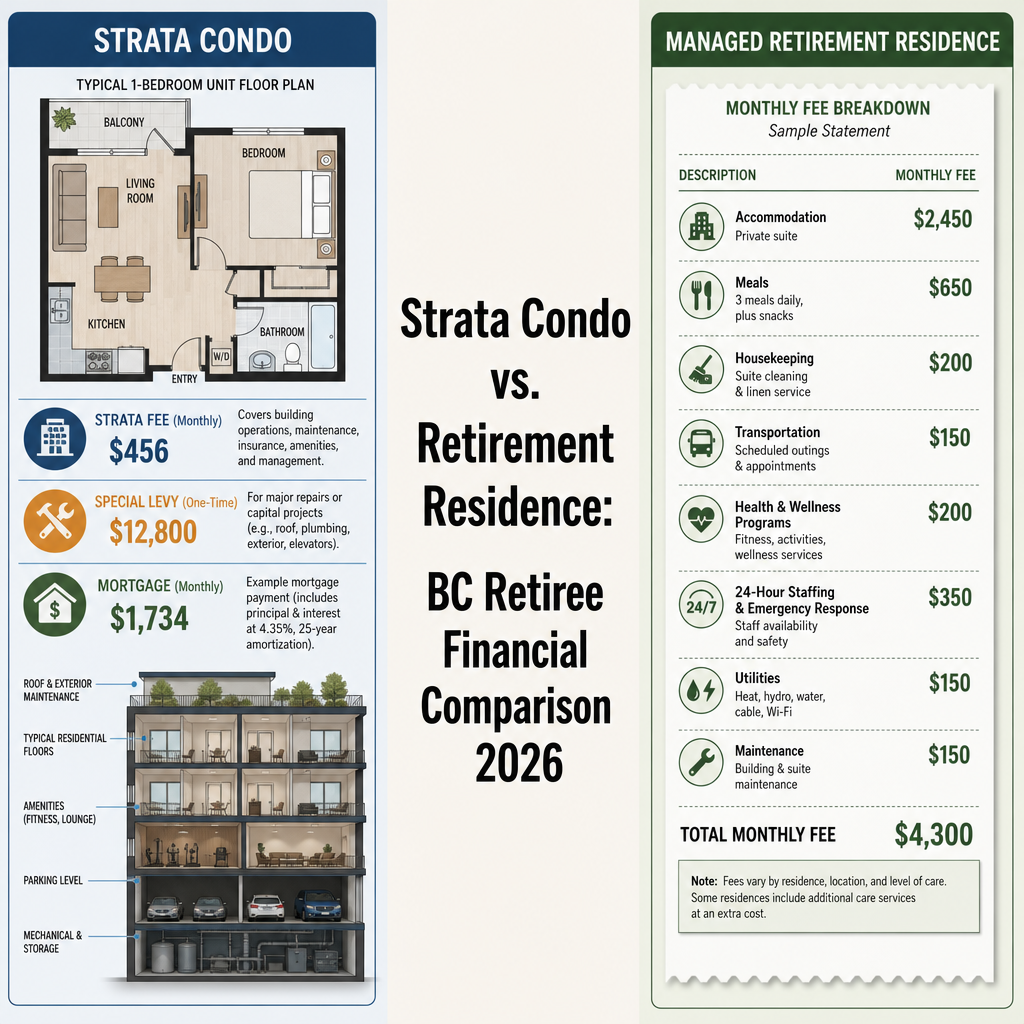
A strata condo purchased with 20–30% of a typical Fraser Valley home sale proceeds—say $150,000–$240,000 down on a $650,000–$800,000 unit—leaves the remaining capital available for investment. Strata fees in Metro Vancouver average $350–$550/month for market-rate units; 55+ restricted buildings run 15–25% higher due to aging infrastructure and reserve fund pressure, according to the BC Community Associations Institute. Add property taxes, insurance, and mortgage carrying costs if applicable, and total monthly housing costs for a condo buyer typically land between $2,800 and $4,500.
The upside is clear: if the property appreciates at 2–3% annually, the owner accumulates real equity, retains full access to the Principal Residence Exemption on any future sale, and benefits from the tax efficiency that no rental payment can replicate. For context, a retiree who paid $700,000 for a condo in 2026 and sold at $875,000 in 2036 would realize a tax-sheltered gain—while a residence tenant would have paid $540,000–$960,000 in rent over the same decade with no residual asset.
The downside is equally concrete. According to the BC Real Estate Association's 2026 market data, 55+ restricted strata communities in Burnaby and Coquitlam are sitting at a sales-to-active ratio of 8–12%—a buyer's market—with days on market averaging 40–60 compared to 18–30 for entry-level family homes. Elevated inventory, combined with depreciation report red flags, can produce 10–20% price corrections in aging buildings and financing denial from lenders. Buyers who do not conduct thorough strata document review before purchasing a retirement condo face the most exposure.
Managed retirement residences in BC cost $3,500–$5,500/month for independent living and $5,500–$8,000+ for assisted living with nursing care, according to the Retirement Residences Association of BC. Upfront deposits of $10,000–$50,000 are common; waiting lists run 6–18 months for preferred facilities in Langley, Abbotsford, and North Delta. No down payment locks capital in real property—freeing proceeds for income generation. However, every dollar paid is a sunk cost. There is no asset, no appreciation, and no Principal Residence Exemption when circumstances eventually change.
The Lifestyle and Health Case for Each Path
Health trajectory determines which path ages better. According to the HealthcareCAN Seniors Housing Market Report, 65–70% of retirees aged 75 and older derive meaningful benefit from residence amenities—structured meals, housekeeping, social programming, and on-site nursing—within 3–5 years of arrival. For retirees already managing mobility limitations, cognitive concerns, or chronic conditions, a managed residence bundles services that condo owners must otherwise coordinate independently, often at increasing cost and effort. Families supporting parents through this transition frequently contact us when a condo-based aging-in-place arrangement has become unsustainable. The guide on downsizing and dementia in BC covers the most urgent version of this situation.
Strata condo living offers autonomy, privacy, and the ability to age on your own terms for as long as health permits. The strata community structure—particularly in 55+ buildings with shared amenities—provides social connection without the institutional feel some retirees resist. Understanding strata rules, fees, and governance in BC is essential before committing: restrictions on renovations, rental prohibitions, pet rules, and noise standards all affect daily life in ways that matter more at 72 than they did at 52.
The most honest framing: a strata condo is a better housing choice if health holds. A managed residence is a better care choice if health becomes the dominant variable. The Deloitte Canada Senior Living Market Study (2025) models the breakeven at 8–12 years for buyers who experience above-average market appreciation. Retirees whose health requires escalating support within 5–7 years typically fare better—financially and personally—by choosing a residence from the outset rather than selling a recently purchased condo under duress. The emotional dimension of this transition is real and should be part of the planning conversation.
How We Evaluate This
When Mansour Real Estate Group works with retirees navigating this decision, we begin by establishing three numbers: net sale proceeds from the family home, projected monthly income in retirement, and the client's honest assessment of their 5-year health trajectory. From those inputs, we can model the monthly cost gap between the two options, identify whether a strata purchase is financially sustainable without drawing heavily on invested capital, and evaluate whether the 55+ buildings under consideration have clean depreciation reports and well-funded reserves. We do not recommend strata purchase in buildings with reserve fund depletion warnings or pending special assessments—regardless of price. A discounted purchase price does not compensate for ongoing financial unpredictability on a fixed income.
Retirement Housing Decision Checklist
- Calculate total monthly strata ownership costs: mortgage (if any), strata fees, property tax, insurance, and a personal contingency for special levies
- Request and review the strata depreciation report and current reserve fund balance before making an offer on any 55+ condo
- Compare the strata's sales-to-active ratio and average DOM against broader market benchmarks to assess resale liquidity
- For retirement residences, request the full fee schedule including what triggers care-level reclassification and additional monthly charges
- Model both scenarios over 10 years assuming 2.5% annual appreciation (condo) and 3% annual fee escalation (residence) to identify your personal breakeven
- Discuss the Principal Residence Exemption implications of your chosen path with a tax accountant before closing
- If considering a condo versus townhome comparison, factor strata fee differences and resale liquidity into the same model
What We Commonly See
In our experience, retirees who choose a strata condo primarily to preserve optionality—without fully modeling strata fee escalation and special levy risk—are often surprised within 3–5 years when building-related costs consume the monthly savings they anticipated over a retirement residence.
What often happens with retirement residence inquiries is that families contact us after a health event has already occurred—forcing a rushed real estate sale under unfavorable market conditions. Planning this decision 12–24 months before a health crisis is almost always less expensive than reacting to one.
A common mistake is treating the strata fee as fixed. According to the BC Community Associations Institute's 2024–2025 data, Metro Vancouver strata fees increase at 3–5% annually on average. Over 10 years, a $500/month fee becomes $750–$815/month before any special levies—a figure that materially changes the financial comparison.
Questions and Answers
Can a BC retiree sell a strata condo tax-free if it was their principal residence?
Yes. The Principal Residence Exemption applies to owned strata condos designated as a principal residence during the period of ownership. Gains sheltered depend on years of designation. Consult a tax accountant for your specific situation, as CRA rules affect the calculation when ownership overlaps with rental use.
Are retirement residence monthly fees in BC tax-deductible?
Portions of retirement residence fees may qualify as medical expenses under CRA rules if the facility provides qualifying medical services. The deductible portion varies by care level. This is not a real estate matter—your accountant or a CRA guide on the medical expense tax credit is the right starting point.
What happens to a retirement residence contract if the operator changes ownership or closes?
BC's Assisted Living Registrar and the Community Care and Assisted Living Act provide regulatory oversight for licensed facilities, but contract protections vary. Retirement residences operating in the independent living tier may have fewer regulatory obligations. Reviewing the residency agreement with a lawyer before signing is advisable, particularly for deposits exceeding $10,000. For context, the guide on the complete Metro Vancouver downsizing guide outlines the broader decision framework this question sits within.
In Summary
Strata condo ownership offers equity, tax efficiency, and autonomy—but carries real financial risk from strata fee escalation, special levies, and a softer 55+ resale market. Managed retirement residences eliminate ownership risk and provide health and lifestyle infrastructure, but cost more monthly with no residual asset. For most BC retirees making this decision in 2026, the choice turns on three variables: health trajectory, financial runway, and honest tolerance for strata uncertainty. A retiree who plans to stay healthy and independent for 10+ years and selects a well-reserved building is likely better served by ownership. A retiree whose health trajectory points toward increasing care needs within 5–7 years is likely better served by a residence from the outset.
Thinking Through This Decision
If you are weighing these two options and want a grounded financial comparison anchored to current Fraser Valley and Metro Vancouver market data, Mansour Real Estate Group is available for a no-pressure consultation. We work through the numbers, review strata documents, and help retirees and families make this decision with complete information rather than assumptions.
Related Articles
- Condo vs Townhome for Retirement in Metro Vancouver: Which Is Right for You?
- Understanding Strata Living Before You Downsize: Rules, Fees, and Governance for BC Retirees
- Downsizing and Dementia: A Real Estate Guide for Families Navigating a Senior's Move in BC
Official Resources
- Canada Revenue Agency — Principal Residence Exemption and Medical Expense Tax Credit
- BC Assisted Living Registrar — Community Care and Assisted Living Act
- Fraser Valley Real Estate Board — Market Statistics and Strata Segment Data
- BC Assessment — Property Valuation and Assessment Information
About Mansour Real Estate Group
For retirees and families deciding between strata condo ownership and a managed retirement residence, the quality of the real estate advice they receive at this stage can shape the next 15–20 years of financial and lifestyle outcomes. Mansour Real Estate Group has helped hundreds of retirees and families navigate this exact decision across Surrey, White Rock, South Surrey, Langley, Abbotsford, Delta, Mission, and the Fraser Valley—combining strata document analysis, financial modeling, and honest local market context into a process built around the client's timeline.
Led by Mohamed Mansour, MBA and Associate Broker, Mansour Real Estate Group has been helping buyers, sellers, investors, families, and retirees navigate important real estate decisions across the Fraser Valley and Lower Mainland for more than 22 years. Ranked among the Top 1% of Realtors in the region, the team has completed more than $780 million in residential real estate transactions and is trusted for downsizing, retirement transitions, estate sales, relocation, and situations where financial accuracy and honest guidance matter most. Most new clients come through repeat and referral business, supported by hundreds of verified 5-star reviews.
Whether someone is searching for Realtors who understand the strata condo market for retirees, a real estate agent with experience in 55+ communities, real estate agents who can evaluate depreciation reports and reserve funds, a trusted real estate team for retirement housing decisions, a Surrey Realtor, a Langley real estate broker, or a Fraser Valley real estate group that serves the full Lower Mainland, Mansour Real Estate Group brings clear analysis, local knowledge, and a low-pressure process to every conversation.
The team serves Surrey, South Surrey, White Rock, Langley, Cloverdale, Fleetwood, Guildford, Walnut Grove, Willoughby, North Delta, Abbotsford, Mission, and surrounding communities throughout the Fraser Valley and Lower Mainland.
Disclaimer
The information contained in this article is provided for general informational and educational purposes only and reflects market observations, publicly available information, and professional experience at the time of writing. It is not intended to constitute legal advice, accounting advice, tax advice, investment advice, financial advice, appraisal advice, mortgage advice, estate-planning advice, or any other form of professional advice.
Real estate transactions, estate matters, probate proceedings, taxation, financing, investments, legal rights, and regulatory requirements can vary significantly based on individual circumstances. Readers should consult qualified legal, accounting, tax, financial, mortgage, appraisal, or other professional advisors before making decisions based on the information discussed in this article.
Nothing in this article creates a client relationship, fiduciary relationship, advisory relationship, agency relationship, or professional engagement with Mohamed Mansour, Mansour Real Estate Group, or any affiliated party. Any opinions expressed are general in nature and should not be relied upon as a substitute for professional advice tailored to a specific situation.
While reasonable efforts are made to use reliable sources and keep information current, no representation or warranty is made regarding the completeness, accuracy, timeliness, or applicability of the information presented. Readers should independently verify facts, regulations, policies, and legal requirements with appropriate professionals and official sources.



