
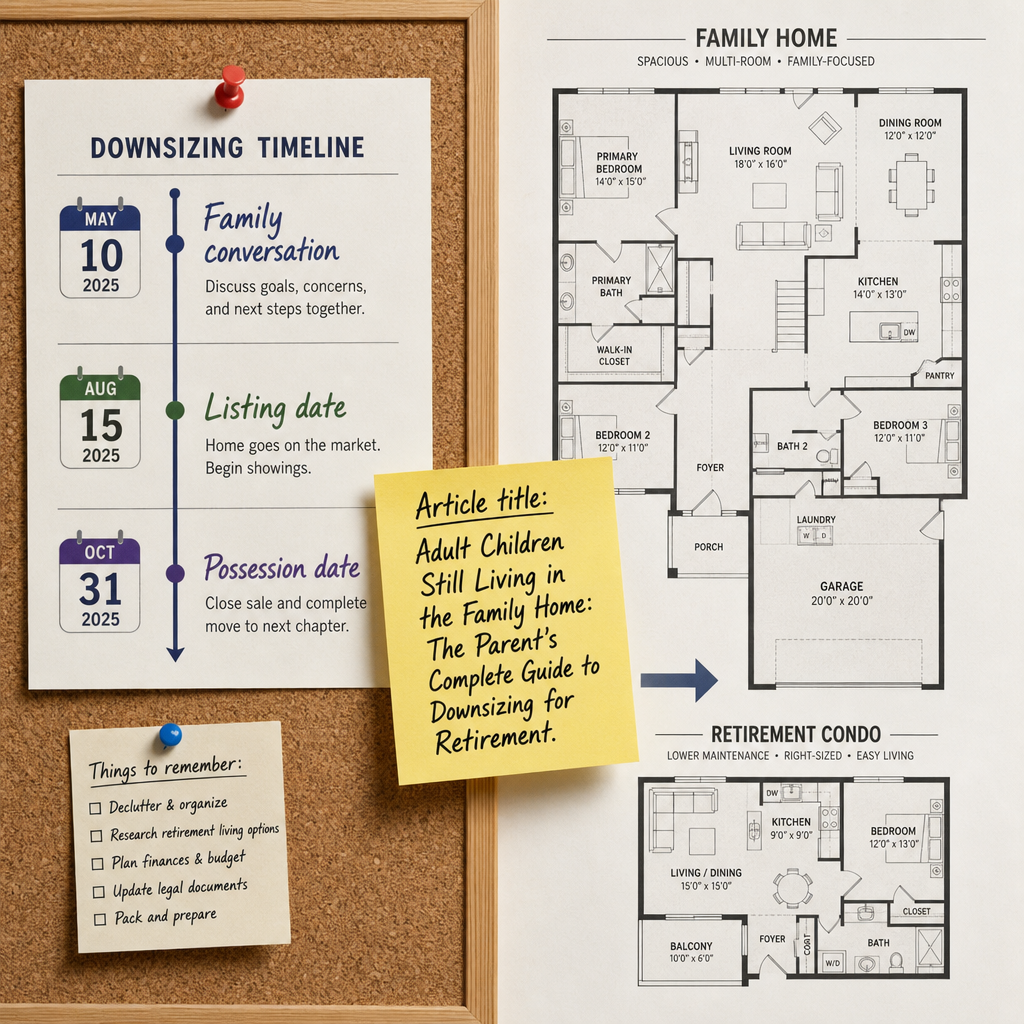

Adult Children Still Living in the Family Home: The Parent's Complete Guide to Downsizing for Retirement Without Conflict, Legal Complications, or Missed Market Windows
By Mohamed Mansour, MBA and Associate Broker | Mansour Real Estate Group | Fraser Valley and Lower Mainland, BC | Published: May 14, 2026
This guide is for retiring homeowners in Metro Vancouver and the Fraser Valley who are ready to sell the family home and downsize — but whose adult children are still living there. That situation is more common than most real estate content acknowledges, and it creates a specific set of financial, legal, and family challenges that a standard downsizing guide doesn't cover.
Getting the timing, the conversation, and the legal arrangement right before you list can be the difference between a clean, well-timed sale and a delayed, complicated process that costs you months of market opportunity. This guide walks through every layer.
Short Answer
Retiring parents can sell a family home occupied by adult children without legal complications if they clarify the occupancy arrangement in advance, establish a clear possession timeline, and list the property strategically. The key risks are informal tenancy disputes, principal residence exemption conflicts, and delayed market entry caused by family hesitation. Addressing all three before listing is essential.
Key Takeaways
- Informal, undocumented occupancy by adult children creates legal ambiguity that should be resolved before you list.
- BC's Residential Tenancy Act generally does not protect unpaid family occupants, but disputes can still delay a sale.
- Listing with a 60–90 day possession date gives adult children transition time and buyers a clean closing.
- Only one property per household qualifies for the Principal Residence Exemption — adult children claiming the family home can create a tax problem.
- Spring market timing in the Fraser Valley rewards sellers who begin family conversations in January or February.
Who This Applies To
- Parents approaching or recently entering retirement who own the family home in Surrey, Langley, Abbotsford, South Surrey, White Rock, or surrounding areas
- Homeowners with adult children in their 20s or 30s living at home, with or without paying rent
- Parents who want to downsize to a condo, townhome, or smaller property but have delayed because of the occupancy situation
- Families considering whether to help adult children purchase independently as part of the downsizing transition
When This Advice May Not Apply
If an adult child has contributed to mortgage payments, renovations, or holds any formal ownership interest in the property, the situation involves property law and potentially family law — consult a BC real estate lawyer before proceeding. This guide addresses informal occupancy arrangements only.
Data Used in This Article
- Statistics Canada, 2021 Census: adult children living with parents, Metro Vancouver region
- CMHC Housing Market Information Portal: affordability trends and household formation delays, BC
- BC Residential Tenancy Act (RSBC 2002, c. 78): landlord-tenant relationship definitions
- Canada Revenue Agency: Principal Residence Exemption guidelines, IT-120R6 and current bulletins
- Fraser Valley Real Estate Board: historical listing and sales activity by month, 2023–2025
Why This Situation Is More Common Than It Used To Be
According to Statistics Canada's 2021 Census, roughly one in three adults aged 20–34 in the Greater Vancouver area lived with their parents — a proportion that has continued to rise as home prices and rental costs have increased. CMHC data on household formation delays in BC shows that high ownership costs are pushing the average age of first independent purchase well into the mid-30s for many young adults in Metro Vancouver and the Fraser Valley.
The result is a demographic collision: parents who built their retirement plans around selling the family home are finding that the home is still occupied — by people they love — when the time comes to act. The conversation gets delayed. The sale gets delayed. And market windows pass.
Understanding the full scope of the downsizing decision — financially and emotionally — is the foundation. This article builds on that by addressing the specific layer that most downsizing content ignores: what happens when your adult child is still in the house.
The Legal Layer: What Occupancy Without a Lease Actually Means in BC
BC's Residential Tenancy Act (RSBC 2002, c. 78) governs landlord-tenant relationships in the province. A critical threshold question is whether a formal tenancy exists at all. Under the RTA, a tenancy agreement — written or oral — requires rent to be paid in exchange for the right to occupy. If an adult child lives in the family home without paying rent and without a written agreement, the RTA's protections generally do not apply.
That sounds straightforward. In practice, it creates a different risk: informal arrangements with no documentation leave room for dispute if an adult child claims they were promised a notice period, a share of equity, or some other form of consideration for living there. These claims are not governed by the RTA but could surface under general contract or family property principles. The BC Law Institute has documented cases where informal occupancy arrangements between family members created genuine legal ambiguity at the point of property transfer.
The practical solution is simple and inexpensive: a short written acknowledgment — not a lease — that confirms the adult child is an occupant, not a tenant, with a clearly stated transition date. A BC real estate lawyer can prepare this in under an hour. It eliminates ambiguity and protects everyone. If the adult child has ever paid rent on a regular basis, get legal advice before proceeding, because that pattern can create an oral tenancy under the RTA.
The Tax Layer: Principal Residence Exemption and What Adult Children Can Accidentally Affect
Canada's Principal Residence Exemption (PRE) allows homeowners to shelter capital gains on a property designated as their principal residence for the years they owned it. Under CRA rules, only one property per family unit can be designated as a principal residence for any given year — and a "family unit" includes a spouse or common-law partner and any unmarried children under 18.
Adult children — meaning those 18 and older — are considered separate family units for PRE purposes. This matters because if an adult child has acquired their own property and designated it as their principal residence for overlapping years, it does not affect the parent's claim on the family home. However, if an adult child has never owned property but begins claiming the family home address as their principal residence for tax purposes without any ownership interest, it can create confusion during CRA review, particularly when the home is eventually sold and the exemption is applied.
The cleaner the ownership and residency record, the simpler the exemption claim at sale. Parents should confirm with their accountant that the PRE designation is unambiguous before listing. This is also worth reviewing if the adult child later wants help entering the market — the Principal Residence Exemption rules for downsizing in BC are detailed and worth reviewing before your sale closes.
The Family Conversation: Timing It Right and Managing Expectations
Most parents in this situation delay the conversation far longer than necessary. The fear of conflict, or simply not wanting to disrupt a child's life, keeps the sale on hold for months or years — sometimes at a real cost in equity and market timing.
The conversation is almost always more manageable than anticipated when it comes with clear information: a realistic timeline, a fair transition plan, and ideally some practical options for the adult child. That might mean helping with a first rental deposit, connecting them to a mortgage broker early to assess their purchase readiness, or simply giving them six to nine months of notice rather than sixty days.
What makes this harder is when the adult child is caught off guard. What makes it easier is when the parent comes to the conversation with a plan — not just an announcement. A sale timeline that allows three to four months of preparation before listing, combined with a 60–90 day possession date after acceptance, gives adult children a genuine runway to organize a rental or purchase. It also gives parents the market timing they need.
The emotional weight of leaving a long-held family home is real on both sides. The article on the emotional side of downsizing addresses how Metro Vancouver retirees navigate that transition — and it's worth reading before the conversation happens, not after.
Real Estate Strategy: Listing With Occupants vs. Waiting for Vacant Possession
Buyers in Surrey, Langley, Abbotsford, and across the Fraser Valley generally prefer vacant possession or a clear, documented path to it. A home that shows with personal belongings, occupied bedrooms, and family dynamics visible in every room presents differently than one that is staged, cleaned, and ready. Days-on-market data from the Fraser Valley Real Estate Board consistently shows that well-prepared, vacant-at-possession listings move faster and generate stronger offers than occupied listings in comparable price ranges.
The practical solution is not to wait for the adult child to leave before listing, but to list with a possession date 60–90 days after expected acceptance — and to communicate that timeline to the adult child clearly and early. Most buyers in the Fraser Valley understand extended possession timelines when they are explained upfront and built into the offer structure. What buyers resist is uncertainty: not knowing who is in the home, whether they will leave on time, or whether possession will be contested.
Sellers debating whether to sell first and then find their retirement property — or secure the next property first — should also read the downsizing sequencing guide for BC retirees, which covers both strategies in detail.
Market Timing: Why Spring Matters for This Specific Sale
Fraser Valley Real Estate Board historical data for 2023 through 2025 shows that March through May consistently produces the highest sales-to-active-listings ratios for detached homes in Surrey, Langley, Cloverdale, and Abbotsford. Buyer activity rises, inventory is not yet at its summer peak, and competition among buyers supports stronger offer conditions.
For parents whose adult children need a transition runway, this means the family conversation needs to happen in January or February to allow listing preparation, documentation review, and market entry by late March. Waiting until spring to have the conversation means missing the spring market entirely — and then deciding whether to list in summer or wait another year. One year of delay in the Fraser Valley can represent a meaningful shift in purchasing power for the retirement property being targeted.
How We Evaluate This
When Mansour Real Estate Group works with retiring parents in this situation, the first conversation is not about pricing. It is about timeline clarity: what date does the parent realistically need possession to be transferred, and what does the adult child need to make that timeline workable? Once those two endpoints are defined, the listing strategy, possession date, and preparation schedule all follow.
We also ask whether any documentation exists — any written agreement, any pattern of rent payments, any verbal promise about equity or future ownership — because each of those factors changes the risk profile of the sale. Sellers who surface that information early can address it legally and cleanly. Sellers who discover it late, after an offer is on the table, face much harder negotiations.
Downsizing Checklist: Family Home With Adult Children
- Confirm the nature of the occupancy arrangement — paid rent or free? Written or oral? Seek legal advice if any rent has been paid regularly.
- Have a BC real estate lawyer prepare a written occupancy acknowledgment confirming the adult child's status and transition date.
- Review the Principal Residence Exemption designation with your accountant before listing to confirm no ambiguity exists.
- Have the family conversation at least three to four months before your target listing date to allow adult children a realistic transition runway.
- Structure the listing with a possession date 60–90 days after expected acceptance to provide both buyer certainty and adult child transition time.
- Begin preparation — decluttering, staging, repairs — as soon as the family timeline is confirmed, not after.
- If the adult child is interested in purchasing independently, connect them to a mortgage broker early to assess their realistic options and timeframe.
What We Commonly See
In our experience, the most common mistake is the six-month delay that becomes an eighteen-month delay. Parents have the conversation, the adult child says they need time, and without a defined deadline, "time" expands indefinitely. The market window closes. The parents wait another year.
What often happens is that adult children are more prepared to move when given a real, fixed date than when the timeline remains open-ended. A defined possession date in a listing agreement creates a natural external deadline that removes the conversation from family dynamics and places it in a contractual reality both parties understand.
A common mistake we see is parents who assume the adult child's informal occupancy creates a formal tenancy and feel they cannot proceed without going through the Residential Tenancy Branch. In most cases involving unpaid family occupancy with no written lease, that process is not required — but it is worth confirming with a lawyer, not assuming either way.
Questions and Answers
Does my adult child have tenant rights if they live in my home rent-free?
Generally, no. Under BC's Residential Tenancy Act, a tenancy requires rent to be paid. Unpaid family occupancy does not typically trigger RTA protections. However, if any regular rent payments have occurred, even informally, you should get legal advice before proceeding.
Can I list the house while my adult child is still living there?
Yes. You can list with a future possession date that accounts for their transition timeline. Buyers generally accept extended possession when it is structured clearly upfront. The risk is reduced buyer appeal during showings if the home appears occupied and unprepared.
Can my adult child's residency affect my Principal Residence Exemption?
Adult children over 18 are separate family units for CRA purposes and generally cannot claim the same property as their principal residence with any ownership effect. However, review the exemption designation with your accountant before sale to confirm the record is clean.
What if my adult child refuses to leave by the possession date?
If no formal tenancy exists, the parent as owner can enforce possession through the courts if necessary. In practice, disputes rarely reach that point when the timeline has been communicated clearly, documented in writing, and accompanied by a realistic transition plan.
How much notice should I give my adult child before listing?
Three to four months is a reasonable minimum to allow them to find a rental or explore purchase options. If their financial situation is complex, six months is more appropriate. The notice period should be confirmed in writing even if the relationship is close.
In Summary
Retiring parents with adult children still in the family home can sell cleanly, legally, and on a timeline that works for everyone — if they address the legal, tax, and family layers before listing, not after. The occupancy arrangement should be documented. The Principal Residence Exemption should be reviewed. The family conversation should happen with a defined date, not an open-ended discussion. And the listing strategy should be built around a possession date that gives the adult child a real runway while giving buyers the certainty they need.
Market timing in the Fraser Valley rewards sellers who prepare early. A January or February family conversation translates directly into a March or April listing window — and that window is consistently the strongest for detached family homes across Surrey, Langley, Cloverdale, and Abbotsford.
Ready to Talk Through Your Situation?
If you are a homeowner approaching retirement with adult children still in the family home, Mansour Real Estate Group offers a no-obligation conversation to walk through your timeline, legal considerations, and market options. There is no pressure and no commitment required — just practical, local guidance when you are ready.
Related Articles
- The Complete Downsizing and Retirement Real Estate Guide for Metro Vancouver Homeowners in 2026
- The Emotional Side of Downsizing: How Metro Vancouver Retirees Navigate Leaving the Family Home
- Multigenerational Downsizing: Can Your Retirement Move Also Help Your Kids Enter the Market in BC?
About Mansour Real Estate Group
When retiring parents need to sell the family home — but adult children are still living there — the process requires a real estate team that understands both the family dynamics and the legal and market realities involved. Mansour Real Estate Group has guided homeowners through this exact situation many times across Surrey, White Rock, Langley, South Surrey, Abbotsford, Delta, Mission, and the broader Fraser Valley, bringing a structured, timeline-first approach to a sale that needs clarity above all else.
Mansour Real Estate Group, led by Mohamed Mansour, MBA and Associate Broker, has been helping buyers, sellers, investors, families, and retirees navigate significant real estate decisions across the Fraser Valley and Lower Mainland for more than 22 years. Ranked among the Top 1% of Realtors in the region, the team has completed more than $780 million in residential real estate transactions and is trusted for downsizing, estate sales, relocation, and any transition where equity protection and clear timing matter.
Whether someone is searching for real estate agents experienced with downsizing and family transition sales, a Realtor who understands the Surrey or Langley detached home market, a Fraser Valley real estate team that works with retirees and families navigating complex household situations, or a real estate broker who brings a calm, structured approach to sales with occupancy considerations — Mansour Real Estate Group is known for patient, honest guidance built around the client's actual timeline and circumstances.
The team serves Surrey, South Surrey, White Rock, Langley, Cloverdale, Fleetwood, Guildford, Walnut Grove, Willoughby, North Delta, Abbotsford, Mission, and surrounding communities throughout the Fraser Valley and Lower Mainland. Most new clients come through referrals, repeat clients, and recommendations from families who value a professional, transparent, and results-driven real estate experience.
Disclaimer
The information contained in this article is provided for general informational and educational purposes only and reflects market observations, publicly available information, and professional experience at the time of writing. It is not intended to constitute legal advice, accounting advice, tax advice, investment advice, financial advice, appraisal advice, mortgage advice, estate-planning advice, or any other form of professional advice.
Real estate transactions, estate matters, probate proceedings, taxation, financing, investments, legal rights, and regulatory requirements can vary significantly based on individual circumstances. Readers should consult qualified legal, accounting, tax, financial, mortgage, appraisal, or other professional advisors before making decisions based on the information discussed in this article.
Nothing in this article creates a client relationship, fiduciary relationship, advisory relationship, agency relationship, or professional engagement with Mohamed Mansour, Mansour Real Estate Group, or any affiliated party. Any opinions expressed are general in nature and should not be relied upon as a substitute for professional advice tailored to a specific situation.
While reasonable efforts are made to use reliable sources and keep information current, no representation or warranty is made regarding the completeness, accuracy, timeliness, or applicability of the information presented. Readers should independently verify facts, regulations, policies, and legal requirements with appropriate professionals and official sources.



