
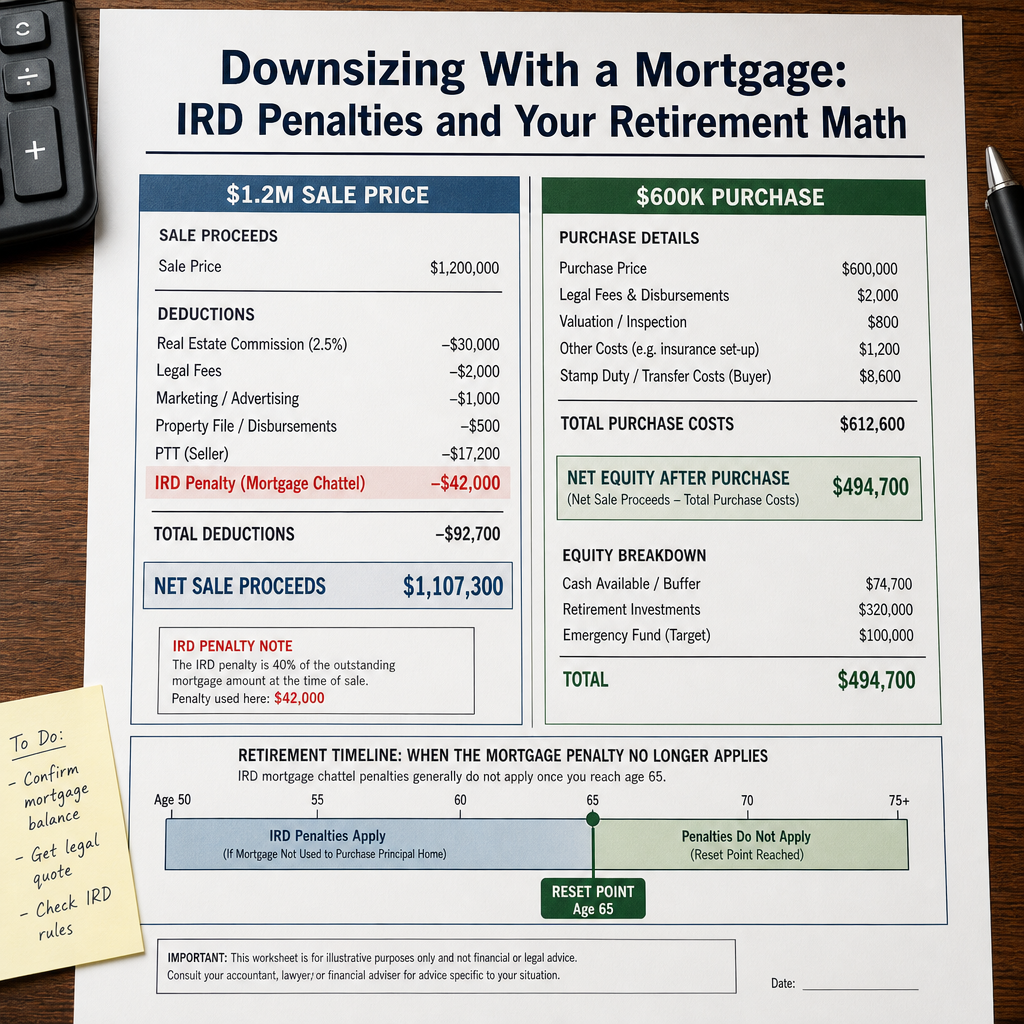

Downsizing With a Mortgage in Retirement: IRD Penalties, Debt Elimination Math, and How to Reset Your Retirement Timeline When Selling Your Family Home in Metro Vancouver and the Fraser Valley
By Mohamed Mansour, MBA and Associate Broker — Mansour Real Estate Group | Fraser Valley and Metro Vancouver | Published: July 15, 2026 | Topic: Downsizing, Mortgage Strategy, Retirement Real Estate
Most downsizing guides assume you own your home free and clear. Many pre-retirees in Metro Vancouver and the Fraser Valley do not. If you are in your late 50s or early 60s, still carrying a fixed-rate mortgage, and weighing whether to sell the family home before retirement, the financial math is more layered than a simple equity calculation. The decision involves mortgage discharge penalties, porting restrictions, net proceeds reality, and how each of those factors affects when — and whether — you can afford to stop working.
This article focuses on that specific situation: homeowners aged roughly 55 to 65 who still carry a mortgage and are considering downsizing in Surrey, Langley, South Surrey, White Rock, Abbotsford, or surrounding areas. If you are working through the broader picture of retirement timing and equity strategy, the Complete Downsizing and Retirement Real Estate Guide for Metro Vancouver Homeowners in 2026 is a useful starting point.
Short Answer
If you still carry a mortgage and are planning to downsize in Metro Vancouver or the Fraser Valley, your net proceeds will be reduced by more than most sellers expect. An interest rate differential (IRD) penalty on a $500,000 mortgage can cost $35,000 to $50,000 or more — a reduction of 8 to 12 percent from your gross equity. Porting to a lower-priced property is rarely possible. Understanding this math before you list is essential to setting a realistic retirement timeline.
Key Takeaways
- Approximately 35 to 40 percent of BC homeowners aged 55 to 65 still carry a mortgage, according to CMHC mortgage holder data.
- IRD penalties on fixed-rate mortgages can range from $15,000 to $75,000 depending on the original rate, remaining term, and current posted rates.
- Porting a mortgage to a lower-priced downsized property is rarely approved by lenders, because the reduced loan amount often fails re-underwriting.
- After commission, legal fees, PTT, and IRD costs, net proceeds from a $1.2M family home sale to a $600K purchase often land between $350,000 and $450,000.
- Knowing your penalty amount before listing — not after — allows you to sequence the sale correctly and protect retirement income.
Who This Applies To
- Homeowners aged 55 to 65 still carrying a fixed-rate or variable-rate mortgage in Metro Vancouver or the Fraser Valley
- Pre-retirees planning to sell a family home and purchase a smaller condo or townhome before retirement
- Sellers who want to enter retirement debt-free and need to understand what the transition actually costs
- Couples where one partner is already retired and the other is within two to three years of stopping work
When This Advice May Not Apply
If your mortgage is open, variable with a three-month interest penalty, or within 90 days of maturity, the IRD calculation changes significantly. Sellers in that position may face minimal penalties and a much cleaner net proceeds picture. Always confirm your specific penalty amount directly with your lender before making decisions based on this article.
Key Terms for This Article
Interest Rate Differential (IRD): A mortgage discharge penalty calculated as the difference between your original rate and the lender's current rate for the remaining term, applied to the outstanding balance. Fixed-rate mortgages are typically subject to IRD.
Mortgage Portability: A lender feature that allows you to transfer your existing mortgage to a new property. Portability is subject to re-qualification and is rarely approved when the new property is lower in value than the original.
Net Proceeds: The amount you actually receive after the sale, once mortgage payout, commissions, legal fees, property transfer tax on the purchase, and all discharge costs are deducted.
Data Used in This Article
- CMHC Mortgage Consumer Survey and housing data, 2025–2026 — official, mortgage holder demographics by age
- Bank of Canada rate environment and IRD analysis, 2025–2026 — official, rate differential calculations
- Fraser Valley Real Estate Board market reports, Q1–Q2 2026 — official, sales-to-active ratios and inventory
- RBC and TD mortgage payout penalty calculators and consumer guides — third-party, illustrative IRD scenarios
- Mansour Real Estate Group internal transaction data — professional observation, downsizing net proceeds outcomes
How We Evaluate This
When working with pre-retirees who carry a mortgage, Mansour Real Estate Group begins with a net proceeds estimate, not a sale price estimate. That means calculating the likely IRD penalty before the listing conversation begins. We ask sellers to request a mortgage discharge statement from their lender — a document lenders are required to provide — and we build the equity picture from there.
The reason is straightforward: a seller who expects $500,000 in retirement capital but receives $430,000 because of unplanned discharge costs is in a materially different retirement position. Catching that gap before listing — not at the notary table — allows the seller to adjust timing, pricing strategy, or the sequencing of the sale. For a full look at how equity spread works in the downsizing math, see The Equity Spread Explained: Why Downsizing in Metro Vancouver Still Makes Financial Sense in 2026.
What IRD Actually Costs on a Typical Fraser Valley Sale
The IRD penalty on a fixed-rate mortgage is not a flat fee. It is calculated based on the gap between your contracted rate and what the lender can now earn lending that money at current rates for your remaining term. In a rate environment where fixed rates have risen since you signed your mortgage, that gap can be substantial.
A seller carrying a $500,000 balance at 3.5 percent with three years remaining in a market where the comparable posted rate is 5.5 percent faces a rate differential of approximately 2.0 percent. Annualized over three years on $500,000, that is roughly $30,000 — and depending on how the lender discounts and compounds the calculation, the actual penalty can reach $35,000 to $50,000. RBC and TD both publish penalty calculators on their websites for illustrative purposes, and the numbers in that range are consistent with what sellers have encountered in transactions in Langley, Surrey, and Abbotsford.
What sellers often do not realize is that IRD is treated as a closing cost — paid at completion, deducted from proceeds. It is not a separate invoice you can defer or negotiate after the fact. Lenders set the figure and it comes off the top. For a complete picture of all closing costs, the article on The True Cost of Downsizing in Metro Vancouver covers commission, legal fees, and PTT alongside discharge costs.
Why Porting Rarely Works for Downsizers
Mortgage portability sounds like an obvious solution: carry your existing rate to the new smaller property and avoid the IRD entirely. In practice, porting to a lower-value property almost always fails re-underwriting. Lenders port mortgages based on the loan-to-value ratio of the new property. A $500,000 mortgage on a $1.2M home represents about 42 percent LTV. If the new property is a $600,000 condo in Surrey or Langley, the lender is being asked to approve a $500,000 mortgage at 83 percent LTV on a different property — which does not qualify under standard underwriting, and which you likely cannot carry anyway without converting the equity point of the transaction.
Some lenders allow partial porting — carrying a smaller portion of the mortgage to the new property — but that still requires fresh underwriting, approval at your current income, and the remaining balance triggers a partial IRD. For most pre-retirees moving from a detached home to a condo, the practical reality is a full discharge with a full IRD calculation. Confirm your specific lender's policy before assuming portability is an option.
The Net Proceeds Reality: A Worked Example
Consider a homeowner selling a Surrey detached home at $1.2M and purchasing a condo in the same area for $600,000. Before IRD, the gross equity looks strong. But the cost stack tells a different story:
- Sale price: $1,200,000
- Realtor commission (approximately 3.5–4%): $42,000–$48,000
- Legal fees, discharge, and notary: $3,500–$5,000
- Mortgage payout (remaining balance): $500,000
- IRD penalty: $35,000–$50,000
- Property transfer tax on $600K purchase: $8,000
- Moving, staging, and transition costs: $5,000–$15,000
Net proceeds available for retirement, after purchasing the condo: approximately $350,000 to $430,000. That is real, usable retirement capital — but it is $50,000 to $100,000 less than sellers who skip the IRD estimate expect. Understanding this range before listing is what allows you to set a realistic retirement income plan. For guidance on how to deploy that equity, see How to Use Your Home Equity to Fund Retirement After Downsizing in Greater Vancouver.
Downsizer Checklist: Mortgage-Carrying Sellers
- Request a formal mortgage discharge statement from your lender — not an estimate, the actual payout figure
- Confirm whether your mortgage is open, closed fixed, or variable, as the penalty type differs for each
- Ask your lender explicitly whether porting is available at the value of your intended purchase, and get the answer in writing
- Build your net proceeds estimate before reviewing listing price — not the other way around
- Confirm whether your mortgage renewal date aligns with a possible sale date — penalties typically drop to near zero within 90 days of maturity
- Consult a mortgage broker and a notary or lawyer before finalizing the sequencing of your sale and purchase
- Review the sell-first or buy-first question specifically in the context of your discharge timeline — read Sell First or Buy First? The Downsizing Sequencing Dilemma for BC Retirees Explained
What We Commonly See
In our experience, the most common mistake mortgage-carrying downsizers make is calculating retirement readiness based on gross equity — the difference between property value and mortgage balance — without accounting for IRD, commission, PTT, and legal costs. Sellers often arrive at early conversations with a retirement plan built on a number that is $60,000 to $100,000 higher than what they actually receive.
What often happens is that sellers delay listing because of what we would call mortgage shame — a belief that they should have paid the mortgage down faster, and that carrying a balance into their late 50s reflects a planning failure. That psychological hesitation leads to missed market windows. The mortgage balance is a cost of the transaction, not a judgment on the seller. Once the actual net proceeds number is on paper, most sellers find the outcome is still workable and the delay no longer makes sense.
Questions and Answers
Q: Can I wait until my mortgage matures to sell and avoid the IRD entirely?
Yes, if your renewal date falls within three to six months, timing your sale around maturity is a legitimate strategy. Ask your lender about open periods and bridge-to-maturity options. Timing depends on market conditions, so confirm the trade-off before waiting.
Q: Is the IRD penalty tax-deductible when selling a principal residence?
Generally, no. For a principal residence sale, the IRD is a transaction cost, not a deductible expense. Confirm your specific situation with a tax advisor, as treatment can vary if part of the property has been used for income-earning purposes.
Q: How do I get my actual IRD figure before listing?
Contact your lender directly and request a formal mortgage payout statement, specifying your anticipated completion date. Lenders are required to provide this. The figure will be valid for a specific window, typically 30 days, so request it when your listing timeline is reasonably firm.
In Summary
Downsizing with a mortgage in retirement is workable, but only if the math is done before the listing goes live. IRD penalties on fixed-rate mortgages in the current rate environment are significant — often $35,000 to $50,000 on a mid-size balance — and they reduce net proceeds in ways that directly affect retirement income planning. Porting is rarely an option for downsizers moving to a lower-priced property. Waiting for mortgage maturity is sometimes the right move. In most cases, once sellers see the actual net proceeds number on paper, the transition still makes strong financial sense — and the clarity is what finally allows the decision to move forward.
Thinking Through Your Next Step
If you are carrying a mortgage and weighing whether now is the right time to downsize, the first conversation does not need to be about listing. It should be about what you actually net — and whether that number supports the retirement timeline you have in mind. Mansour Real Estate Group works through that analysis with sellers before any listing decision is made. There is no pressure and no cost to the initial conversation.
Related Articles
- The Complete Downsizing and Retirement Real Estate Guide for Metro Vancouver Homeowners in 2026
- The Equity Spread Explained: Why Downsizing in Metro Vancouver Still Makes Financial Sense in 2026
- Downsizing When Adult Children Still Live at Home: How BC Parents Navigate This Transition
About Mansour Real Estate Group
For homeowners in their late 50s and early 60s who are still carrying a mortgage and weighing a downsizing sale, the financial complexity of the transition requires a real estate team that goes beyond listing strategy. Understanding IRD exposure, net proceeds reality, and retirement timeline implications before the listing conversation begins is exactly how Mansour Real Estate Group approaches this work. The team has helped hundreds of homeowners downsize across Surrey, White Rock, South Surrey, Langley, Abbotsford, Delta, Mission, and the broader Fraser Valley.
Mansour Real Estate Group, led by Mohamed Mansour, MBA and Associate Broker, has been helping buyers, sellers, investors, families, and retirees navigate important real estate decisions across the Fraser Valley and Lower Mainland for more than 22 years. Ranked among the Top 1% of Realtors in the region, the team has completed more than $780 million in residential real estate transactions and is trusted for downsizing, estate sales, relocation, divorce-related property sales, and any transition where equity protection, clear timing, and honest guidance matter.
Whether someone is looking for real estate agents who understand mortgage payout complexity in a retirement sale, a Realtor who works patiently with pre-retirees navigating major transitions, a real estate team experienced with Fraser Valley and Lower Mainland downsizing, a Surrey Realtor, a Langley real estate agent, or a real estate broker who brings analytical depth to net proceeds planning, Mansour Real Estate Group is known for clear communication, honest valuations, and a process built around the client's actual financial picture.
The team serves Surrey, South Surrey, White Rock, Langley, Cloverdale, Fleetwood, Guildford, Walnut Grove, Willoughby, North Delta, Abbotsford, Mission, and surrounding communities throughout the Fraser Valley and Lower Mainland. Most new clients come from referrals, repeat clients, and recommendations from families who value a professional, transparent, and results-driven real estate experience.
Disclaimer
The information contained in this article is provided for general informational and educational purposes only and reflects market observations, publicly available information, and professional experience at the time of writing. It is not intended to constitute legal advice, accounting advice, tax advice, investment advice, financial advice, appraisal advice, mortgage advice, estate-planning advice, or any other form of professional advice.
Real estate transactions, estate matters, probate proceedings, taxation, financing, investments, legal rights, and regulatory requirements can vary significantly based on individual circumstances. Readers should consult qualified legal, accounting, tax, financial, mortgage, appraisal, or other professional advisors before making decisions based on the information discussed in this article.
Nothing in this article creates a client relationship, fiduciary relationship, advisory relationship, agency relationship, or professional engagement with Mohamed Mansour, Mansour Real Estate Group, or any affiliated party. Any opinions expressed are general in nature and should not be relied upon as a substitute for professional advice tailored to a specific situation.
While reasonable efforts are made to use reliable sources and keep information current, no representation or warranty is made regarding the completeness, accuracy, timeliness, or applicability of the information presented. Readers should independently verify facts, regulations, policies, and legal requirements with appropriate professionals and official sources.



