

Leasehold vs. Freehold Strata Properties in BC: What Retirees and Downsizers Actually Need to Know About Mortgage Financing, Resale Value Erosion, and Estate Planning in Metro Vancouver and Fraser Valley 2026
By Mohamed Mansour, MBA, Associate Broker — Mansour Real Estate Group | Published: July 14, 2025 | Geography: Metro Vancouver, Richmond, White Rock, Fraser Valley, BC
For retirees and downsizers evaluating condos in Richmond, White Rock, and parts of Metro Vancouver, one distinction carries more financial weight than almost any other: whether the strata property is freehold or leasehold. Many buyers learn the difference only after a lender declines their application or an appraiser returns a number that doesn't match the listing price. This article explains why that happens, what it means for financing, resale value, and estate settlement, and how to evaluate any strata unit before making an offer.
Mansour Real Estate Group has worked directly with retirees and downsizers navigating leasehold complications across Richmond, White Rock, South Surrey, and the broader Fraser Valley and Lower Mainland, and the financing and estate consequences are consistently underestimated by buyers who focus on the suite rather than the land beneath it.
Short Answer
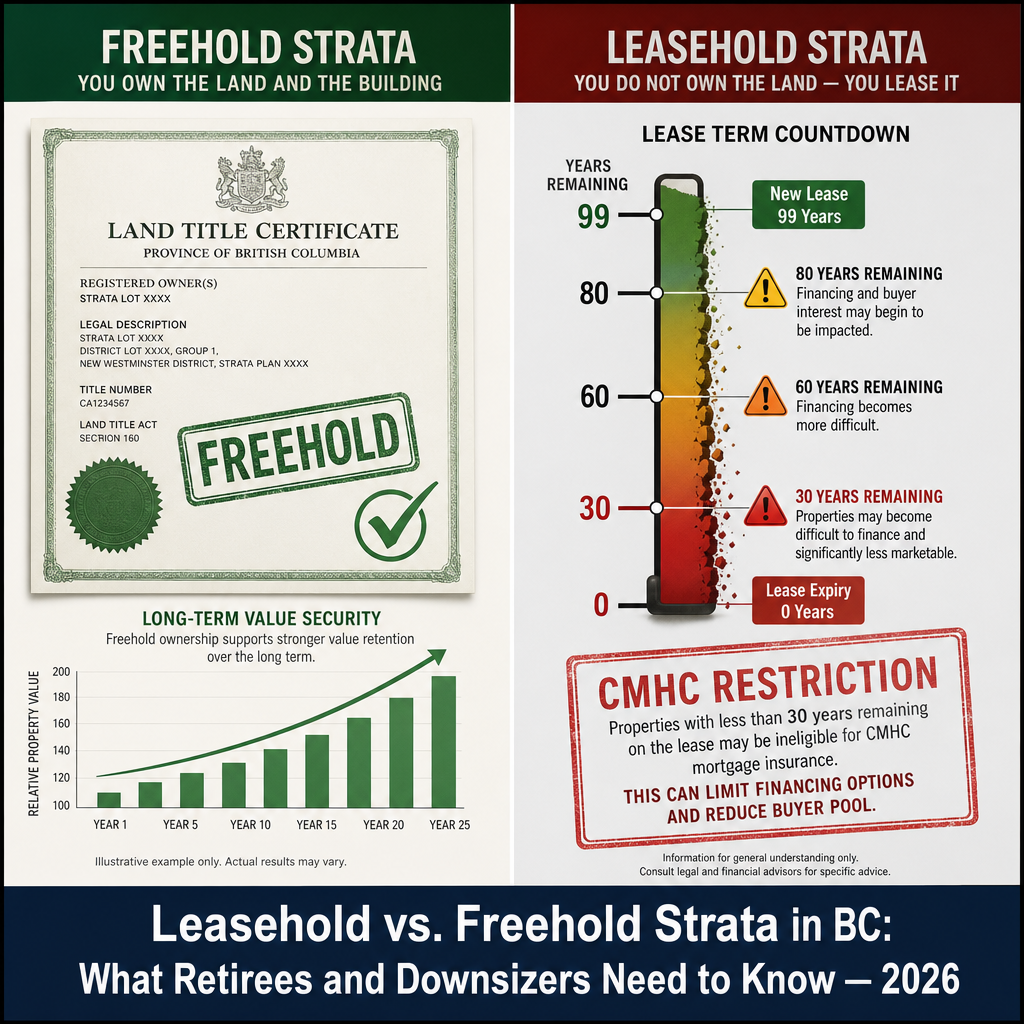
In a freehold strata, you own a share of the land and building. In a leasehold strata, you own the unit but lease the land for a fixed term. As that term erodes toward 30 years, lenders restrict or deny financing, appraisers apply 10–20% discounts, and the buyer pool shrinks substantially. For retirees using sale proceeds to fund retirement, and for executors managing estates, leasehold properties carry compounding risks that freehold condos do not.
Key Takeaways
- Lenders generally require a minimum of 30 years remaining on a leasehold; properties with 50–60 years remaining already face appraiser discounts and lender hesitation.
- CMHC restricts insured mortgages on leaseholds with fewer than 40 years remaining, forcing conventional financing and compressing the buyer pool.
- A retiree buying a leasehold condo with 55 years remaining may face a lender-imposed amortization cap that reduces borrowing power by 15–25%.
- Executors selling a leasehold property must account for lease erosion during probate, which can push the remaining term below lender thresholds and reduce achievable sale price.
- Lease buyout or renewal costs in Metro Vancouver can reach $50,000–$150,000 or more, and lenders assess renewal feasibility before approving financing.
Who This Applies To
- Retirees and downsizers buying condos in Richmond, White Rock, Burnaby, or Vancouver where leasehold stratas exist
- Homeowners reinvesting downsizing proceeds into a strata unit and relying on that equity for retirement income
- Executors and estate trustees managing a strata property sale on behalf of a deceased owner
- Adult children helping parents evaluate retirement condo options in Metro Vancouver
When This Advice May Not Apply
If you are purchasing a freehold strata in the Fraser Valley — including most condos in Langley, Abbotsford, Surrey, or South Surrey — leasehold concerns are generally not relevant. Leasehold strata is concentrated in specific older municipalities and pockets of Metro Vancouver. Always confirm the tenure type in the listing or with the land title before assuming either way.
Definitions
Freehold strata: The owner holds title to the unit and a proportionate share of the common land. No lease term applies. This is the standard structure for most condos and townhomes in BC.
Leasehold strata: The owner holds title to the unit but leases the underlying land from a landlord — often a municipality, First Nation, or private landowner — for a defined term, typically 99 years at original grant.
Lease erosion: The reduction in years remaining on the leasehold term as time passes. A 99-year lease granted in 1970 has approximately 44 years remaining in 2026, well below most lender thresholds.
Lease buyout or renewal: Some leaseholds allow extension or purchase of the underlying land, often at significant cost. Availability and pricing depend on the lessor and lease terms.
Data Used in This Article
- CMHC Mortgage Insurance Guidelines 2025–2026 (official; leasehold property restrictions)
- Canadian Mortgage Professionals Association position on leasehold underwriting standards (industry body)
- CRA guidance on principal residence exemption eligibility for leasehold properties (official)
- BC Court of Appeal decisions on strata lease valuation and principal residence exemption, 2023–2024 (official)
- Mansour Real Estate Group internal transaction data on leasehold financing obstacles in Metro Vancouver (professional experience)
How Leasehold and Freehold Strata Differ — and Why It Changes Your Financing
When you buy a freehold strata in Langley, Surrey, or most of the Fraser Valley, you own a share of the land. That ownership is permanent and transferable. Your lender, your appraiser, and future buyers all evaluate the property on the same basis as any other real estate asset.
A leasehold strata works differently. You own the unit, but the land beneath the building is leased — often from a municipality, a First Nation, or a private landowner — for a fixed term. When the lease was originally granted, the term was typically 99 years. By the time a unit changes hands at resale, that term may already be at 55–70 years. By the time a second buyer resells it a decade later, it may be at 45–60 years. Each year, the remaining term shrinks, and with it, the property's financeable value.
According to CMHC mortgage insurance guidelines, insured mortgages are generally unavailable on leasehold properties with fewer than 40 years remaining on the lease. Conventional lenders typically require at least 30 years remaining. When a property drops below those thresholds, only cash buyers remain — and cash buyers expect a discount to compensate for the illiquidity and risk they are absorbing.
In practice, appraisers in the Metro Vancouver market apply discounts of 10–20% to leasehold condos compared with comparable freehold units in the same building age, location, and condition category. In Richmond's leasehold corridors and some older White Rock waterfront towers, buyers evaluating retirement condo options should request the lease term details before proceeding. For context on strata documents to review during due diligence, see Understanding Strata Living Before You Downsize: Rules, Fees, and Governance for BC Retirees.
What Lease Erosion Means for Retirees Using Downsizing Proceeds
For a retiree who has sold a Surrey or Langley detached home and is reinvesting the proceeds into a strata unit, the leasehold distinction creates a compounding risk that doesn't appear on a price comparison spreadsheet.
Consider a 70-year-old buyer purchasing a Richmond leasehold condo with 55 years remaining on the lease. A lender evaluating this application will note that a standard 25-year amortization would take the buyer to age 95 — and the lease would still have 30 years left at that point. That passes the minimum threshold, but lenders also consider the remaining marketability window and may cap the amortization at 15–20 years anyway, which significantly increases monthly payments and reduces borrowing capacity by 15–25% compared with a freehold equivalent. For retirees managing cash flow carefully, that compression matters. For more on structuring retirement income after downsizing, see How to Use Your Home Equity to Fund Retirement After Downsizing in Greater Vancouver.
The resale window is equally constrained. A 70-year-old buyer who holds the property for 10–15 years and sells at age 82–85 will be offering a unit with 40–45 years of lease remaining. That is enough to clear lender thresholds today, but future lenders may apply stricter standards — and buyer confidence typically weakens measurably as remaining lease years approach 50. Price corrections of 15–25% compared with freehold equivalents are well-documented in Richmond's leasehold market during periods when financing conditions tighten.
The equity spread that makes downsizing financially attractive — explored in detail in The Equity Spread Explained: Why Downsizing in Metro Vancouver Still Makes Financial Sense in 2026 — can erode significantly if the replacement property is leasehold and subject to value compression at resale.
Estate Planning and Executor Risk with Leasehold Properties
Leasehold strata properties create specific complications for estate administration. When a homeowner dies holding a leasehold condo, the executor must value and sell an asset that is already losing financeable years — and probate in BC can take 6–18 months or longer in complex estates.
If a property enters the probate window with 32 years remaining on the lease, and the probate process takes 14 months, the property exits probate with approximately 31 years remaining — still technically above most lender floors, but close enough that appraisers will apply meaningful discounts and some buyers will hesitate. If the lease drops below 30 years during probate, the executor may be unable to secure conventional financing for buyers, reducing the property to cash-sale-only territory and compressing the achievable price.
On the tax side, CRA guidance confirms that leasehold properties are eligible for the principal residence exemption on the same terms as freehold properties, provided the qualifying conditions are met. However, the deemed-disposition valuation at death — which determines capital gains exposure for the estate — may be materially lower than the last comparable freehold sale if lease erosion has accelerated the discount. Executors and estate lawyers should account for this in tax planning. For more detail on how the principal residence exemption applies during downsizing transitions, see Principal Residence Exemption and Downsizing: What BC Homeowners Need to Know Before They Sell.
Lease renewal and buyout options, where available, can reset these timelines — but costs in Metro Vancouver typically range from $50,000 to $150,000 or more, and availability depends entirely on the lessor's willingness and the terms of the original lease. Lenders factor renewal feasibility into underwriting, and declining or unavailable renewal options are treated as a devaluation signal.
How We Evaluate This
When Mansour Real Estate Group works with retirees or downsizers considering strata properties in Richmond, White Rock, or other Metro Vancouver municipalities, the first step is confirming land tenure from the land title — not from the listing description. Leasehold status is disclosed in title documents but is not always prominently flagged in marketing materials.
From there, the evaluation includes remaining lease years, renewal or buyout availability and cost, current lender appetite for that specific lease term, appraised value relative to freehold comparables, and the resale window the buyer is likely to face at exit. For estate situations, the analysis also includes the probate timeline risk and the deemed-disposition tax exposure. This is not a checklist exercise — each leasehold property carries a specific configuration of these risks that must be assessed together.
Leasehold Buyer Checklist
- Confirm land tenure type from the land title certificate before making an offer — do not rely on listing descriptions alone.
- Obtain the exact number of years remaining on the lease and the lease expiry date.
- Request the lease agreement and confirm whether renewal or buyout options exist, the process for exercising them, and the estimated cost.
- Contact a mortgage broker before subject removal to confirm lender eligibility and amortization limits for the specific remaining term.
- Request an independent appraisal that compares the leasehold unit to comparable freehold properties so you understand the discount being applied.
- Assess your personal exit window: how many years remaining on the lease when you are likely to sell, and whether the buyer pool at that point will include financed buyers.
- For estate planning purposes, discuss the deemed-disposition valuation and lease erosion risk with your estate lawyer and accountant before purchasing.
What We Commonly See
In our experience, the most common mistake retirees make with leasehold properties is evaluating price per square foot against freehold comparables without accounting for the financing constraint. A leasehold condo priced 12% below a freehold equivalent can look attractive until a lender caps the amortization or declines the application entirely, at which point the buyer discovers that the discount was priced in — and insufficient to compensate for the liquidity risk at resale.
A second pattern we see regularly involves estate situations where the leasehold property's value was assumed by the family to match the last comparable sale in the building. When an appraiser applies a lease-erosion discount and the property's lendability is in question, the estate realises a significantly lower net than anticipated. This creates tension between beneficiaries and delays settlement. Reviewing the Downsizing Tax Checklist for BC Retirees before making a purchase can help families identify these risks early.
A third observation: buyers who are attracted to White Rock or South Surrey waterfront condos sometimes discover mid-transaction that a specific building is leasehold. In many cases, the listing did not lead with that fact. The South Surrey and White Rock Retirement Real Estate Downsizing Guide for 2026 includes neighbourhood-level guidance on which areas and building ages carry this risk.
Frequently Asked Questions
Can I get a regular mortgage on a leasehold condo in Richmond?
Yes, if the lease has sufficient years remaining. Most lenders require at least 30 years beyond the amortization period. CMHC-insured mortgages are generally unavailable when fewer than 40 years remain. A mortgage broker familiar with leasehold properties should assess your specific situation before you remove subjects.
Is the principal residence exemption available on a leasehold strata?
According to CRA guidance, leasehold properties can qualify for the principal residence exemption under the same general conditions as freehold properties. The exemption does not depend on land ownership. Confirm your specific eligibility with a tax professional, particularly if the property was used for rental at any point.
What happens to a leasehold condo in an estate if probate takes 18 months?
The lease continues to erode during probate. If the remaining term drops below 30–35 years during that window, lender eligibility for buyers may be restricted or eliminated. The executor should seek legal and appraisal advice early in the process to understand the timeline risk and whether a pre-probate sale is possible under BC estate law.
In Summary
Leasehold strata properties in Metro Vancouver carry a specific set of financing, resale, and estate risks that freehold condos in the Fraser Valley and Lower Mainland do not. For retirees deploying downsizing equity into a strata unit, and for executors settling estates that include leasehold properties, the distinction between freehold and leasehold title is not a technical footnote — it directly affects what a lender will approve, what an appraiser will value, what a future buyer will pay, and what an estate will net at settlement. Confirming tenure type, lease term, and renewal options before making an offer is the minimum starting point. Understanding how those facts connect to your personal exit window and estate plan is the more important step.
Thinking About a Strata Purchase in Metro Vancouver or the Fraser Valley?
If you are evaluating retirement condos in Richmond, White Rock, Burnaby, or the Fraser Valley and want a clear read on leasehold risk before making an offer, Mansour Real Estate Group can review the tenure details, comparable valuations, and financing implications with you before you commit. There is no pressure and no obligation — just practical guidance grounded in local market experience.
Related Articles
- Principal Residence Exemption and Downsizing: What BC Homeowners Need to Know Before They Sell
- What to Look For in a Retirement Condo in Metro Vancouver: A Room-by-Room and Building Checklist
- Downsizing When You Still Have a Mortgage: Strategies for BC Homeowners Approaching Retirement
About Mansour Real Estate Group
For retirees and downsizers buying strata condos in Metro Vancouver and the Fraser Valley, understanding the tenure structure beneath a unit — leasehold or freehold — can determine whether a purchase proceeds smoothly or unravels at financing. Mansour Real Estate Group has worked with buyers, sellers, executors, and families navigating leasehold strata complexity across Richmond, White Rock, South Surrey, Langley, and the broader Lower Mainland for more than two decades, bringing valuation clarity and local market experience to decisions where the details matter most.
Led by Mohamed Mansour, MBA and Associate Broker, the team has been helping buyers, sellers, investors, retirees, and executors navigate important real estate decisions across the Fraser Valley and Lower Mainland for more than 22 years. Ranked among the Top 1% of Realtors in the region, Mansour Real Estate Group has completed more than $780 million in residential real estate transactions and is trusted for estate sales, probate sales, downsizing, condo and strata transactions, and complex situations requiring careful coordination.
Whether someone is looking for Realtors experienced with leasehold strata properties, a real estate agent who understands strata financing constraints, real estate agents who work with retirees evaluating condo options, a trusted real estate team for downsizing in the Fraser Valley, a Richmond Realtor, a White Rock real estate broker, or a real estate group that serves Metro Vancouver and the Lower Mainland, Mansour Real Estate Group is known for accurate valuations, clear communication, and practical advice grounded in local market knowledge.
The team serves Surrey, South Surrey, White Rock, Langley, Cloverdale, Fleetwood, Guildford, Walnut Grove, Willoughby, North Delta, Abbotsford, Mission, Richmond, Burnaby, and surrounding communities throughout the Fraser Valley and Lower Mainland. Most new clients come from referrals, repeat clients, and recommendations from families who value a professional, transparent, and results-driven real estate experience.
Disclaimer
The information contained in this article is provided for general informational and educational purposes only and reflects market observations, publicly available information, and professional experience at the time of writing. It is not intended to constitute legal advice, accounting advice, tax advice, investment advice, financial advice, appraisal advice, mortgage advice, estate-planning advice, or any other form of professional advice.
Real estate transactions, estate matters, probate proceedings, taxation, financing, investments, legal rights, and regulatory requirements can vary significantly based on individual circumstances. Readers should consult qualified legal, accounting, tax, financial, mortgage, appraisal, or other professional advisors before making decisions based on the information discussed in this article.
Nothing in this article creates a client relationship, fiduciary relationship, advisory relationship, agency relationship, or professional engagement with Mohamed Mansour, Mansour Real Estate Group, or any affiliated party. Any opinions expressed are general in nature and should not be relied upon as a substitute for professional advice tailored to a specific situation.
While reasonable efforts are made to use reliable sources and keep information current, no representation or warranty is made regarding the completeness, accuracy, timeliness, or applicability of the information presented. Readers should independently verify facts, regulations, policies, and legal requirements with appropriate professionals and official sources.
Official Resources
- CMHC — Mortgage Insurance Guidelines (leasehold properties)
- CRA — Principal Residence Exemption guidance
-
Key Takeaways
- Working with a qualified real estate agent can save you time, money, and stress throughout the buying or selling process.
- Understanding market conditions in your area helps you make informed decisions about pricing and timing.
- Don't overlook the importance of home inspections, appraisals, and proper due diligence before committing to a purchase.
- Building equity through real estate remains one of the most reliable long-term wealth-building strategies available.
Final Thoughts
The real estate market continues to evolve, and staying informed is essential whether you're a first-time buyer, seasoned investor, or homeowner considering a sale. By understanding the fundamentals covered in this article and remaining proactive in your approach, you'll be better positioned to achieve your real estate goals.
Remember that every property and situation is unique. What works for one buyer may not work for another, so take time to assess your personal circumstances, financial readiness, and long-term objectives before making any major real estate decisions.
If you're ready to explore your options, don't hesitate to reach out to a local real estate professional who can provide personalized guidance tailored to your specific needs and market conditions.



