
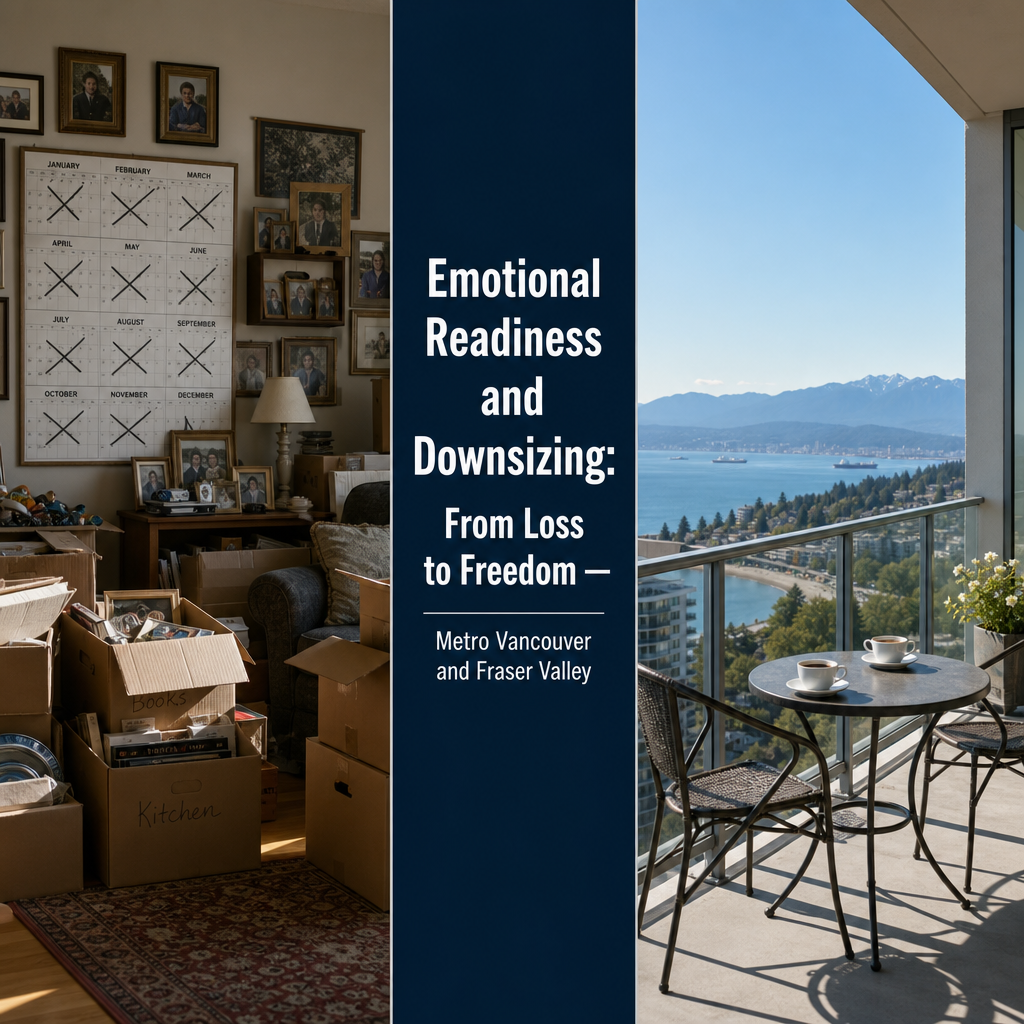

Emotional Readiness and Psychological Transition: Why Long-Time Homeowners Struggle With Downsizing Decisions and How to Reframe the Move From Loss to Freedom in Metro Vancouver and Fraser Valley Retirement
By Mohamed Mansour, MBA and Associate Broker | Mansour Real Estate Group | Fraser Valley and Metro Vancouver | Published: May 12, 2026
The financial case for downsizing in Metro Vancouver and the Fraser Valley is well established. For many homeowners approaching or entering retirement, the math points clearly in one direction. Yet thousands of families who have run the numbers, toured condos, and spoken to realtors still do not move. The reason is rarely financial. It is emotional — and it is rarely discussed honestly in real estate conversations.
This article addresses the psychological barriers that prevent long-time homeowners from acting on downsizing plans they already believe in, and offers a practical framework for reframing the transition. It is written for homeowners in Surrey, White Rock, South Surrey, Langley, Abbotsford, and across the Fraser Valley and Metro Vancouver who know the move makes sense but cannot seem to start.
Short Answer
Most Metro Vancouver and Fraser Valley retirees who delay downsizing are not waiting for the right market conditions. They are navigating emotional attachment to the family home, spousal disagreement, and the overwhelming reality of sorting 30 years of possessions. Reframing the move as a gain — in freedom, simplicity, and financial flexibility — consistently improves follow-through and long-term satisfaction.
Key Takeaways
- Emotional attachment to the family home outweighs financial incentives for the majority of Metro Vancouver retirees who delay downsizing.
- Spousal disagreement on timing and destination causes significant delay in approximately 40% of retirement-age couples considering a move.
- Most retirees underestimate the emotional labour of decluttering a 30-year home by 200 to 300%, causing projects to stall mid-execution.
- Retirees who reframe the move as gaining freedom report satisfaction rates three to four times higher than those who view it primarily as loss.
- Naming the barriers openly — with a real estate team that understands them — is often the step that gets plans moving again.
Who This Applies To
- Homeowners who have lived in the same property for 20 or more years in Surrey, White Rock, Langley, Abbotsford, or across the Fraser Valley
- Retired or near-retired couples where one partner is more ready to move than the other
- Homeowners who have explored downsizing financially but feel stuck at the point of decision
- Empty nesters who continue to carry a large family home out of familiarity rather than necessity
- Adult children helping a parent who is resistant to discussing a move
When This Advice May Not Apply
This article addresses psychological barriers in voluntary downsizing situations. It is not intended for situations involving cognitive decline, medical urgency, or court-ordered property decisions. Those circumstances involve different legal and care considerations — see Downsizing and Dementia: A Real Estate Guide for Families Navigating a Senior's Move in BC for that context.
Data Used in This Article
- AARP Homesharing and Aging-in-Place Study, 2023 — national survey data on emotional attachment as primary barrier to housing transition; third-party research
- Statistics Canada, Census on Aging in Place, 2021 — official data on Canadian seniors' housing preferences and transition rates
- Psychology Today, Decluttering and Decision Fatigue research — peer-reviewed and clinical observations on possessions, identity, and decision paralysis; third-party synthesis
- Mansour Real Estate Group downsizing consultation data — internal professional observations from more than 22 years of retiree client consultations in the Fraser Valley and Lower Mainland
Why Financial Logic Alone Does Not Move People
According to AARP research on aging-in-place preferences, emotional attachment to the family home is the primary barrier to a housing transition for 65 to 75% of retirees — placing it well ahead of financial concerns or health limitations. In Metro Vancouver and the Fraser Valley, where family homes frequently carry $800,000 to $2 million or more in equity, that figure is notable. Homeowners who stand to gain the most financially are often among the most resistant to acting.
This is not irrational. A family home represents 25 to 35 years of daily life — where children grew up, where holidays were spent, where relationships were formed and tested. When someone says "I'm not ready," they are usually not referring to their mortgage balance or their condo options in Langley or South Surrey and White Rock. They are referring to something that does not appear on a financial spreadsheet.
Statistics Canada's 2021 Census data on aging-in-place confirms that the majority of Canadian seniors prefer to remain in their current home regardless of size or practical fit. When that preference is challenged — even gently — by a financial advisor, an adult child, or a realtor — the emotional resistance that follows is real and predictable. Dismissing it as stubbornness delays the conversation. Acknowledging it is what actually moves it forward. If you have already reviewed The Complete Downsizing and Retirement Real Estate Guide for Metro Vancouver Homeowners in 2026, you have the financial context. This article addresses what comes next.
The Spousal Disagreement Problem
In our experience working with retirement-age couples across Surrey, Langley, White Rock, and Abbotsford, spousal disagreement is one of the most common and underacknowledged causes of delay. Research suggests approximately 40% of couples report meaningful conflict when downsizing is discussed — typically when one partner prioritizes financial freedom and the other prioritizes the stability and identity that comes with the existing home.
The pattern is familiar. One spouse — often but not always the one who has spent more time in the home — views the property as a container of family identity. Selling it feels like erasing something. The other spouse is ready to convert decades of equity into a more manageable lifestyle, travel more freely, and reduce the maintenance burden that a 3,000-square-foot Surrey family home requires every year.
What often happens is that the couple agrees in principle but cannot align on timing. The financially ready partner accepts delay to preserve peace. A year passes. Then two. The conversation resurfaces and repeats. This cycle is not unusual — but it is worth naming, because left unaddressed it can persist well past the point where downsizing is financially or physically practical. For couples in this situation, Downsizing When One Spouse Is Reluctant: A Practical Guide for BC Couples addresses this dynamic in greater depth.
How We Evaluate This
At Mansour Real Estate Group, we treat emotional readiness as a practical variable in the downsizing process — not a soft factor to work around. In more than 22 years of consulting with retirees and near-retirees across the Fraser Valley and Lower Mainland, we have seen that the homeowners who move most successfully are those who have named what they are afraid of losing before they focus on what they stand to gain.
Our approach is to slow the financial conversation down long enough to ask a different set of questions: What would you want to do with your time if maintenance were no longer your weekend? What does a smaller space make possible that the current one does not? Those questions tend to open a different kind of conversation — and they often reveal that the reluctant partner has their own unspoken vision for what comes next, one that simply has not been given space in the planning discussion.
The Decluttering Problem: Why Projects Stall
Clinical research on decision fatigue and decluttering — summarized by Psychology Today across multiple studies — shows that sorting through decades of accumulated possessions is not primarily a logistical challenge. It is an emotional one. Each object carries a decision: keep, release, or pass on. For a 30-year family home in North Delta, Cloverdale, or Willoughby, that means thousands of individual decisions, many of which connect to memories, relationships, and identity.
Most retirees underestimate this labour by 200 to 300%. What begins as a confident plan to clear the house over a long weekend becomes a project that stalls in the second bedroom three months later. This is not a failure of discipline — it is a normal psychological response to the volume of emotionally loaded decisions involved. What actually works is a different approach: starting with rooms that carry the least emotional weight, setting a firm external deadline (a listing date, a move date, a booked appointment with a realtor), and involving adult children in a structured rather than ad-hoc way. The structure reduces the number of open-ended decisions in any single session, which is what makes continuation possible. See Sell First or Buy First? The Downsizing Sequencing Dilemma for BC Retirees Explained for how the right sale sequence can create a natural deadline that gives the preparation process structure.
Reframing the Move: From Loss to Freedom
The language used around downsizing matters more than most people realize. "Downsizing" itself implies reduction — smaller, less, giving up. In our experience, homeowners who successfully complete the transition almost universally describe it differently in hindsight. They describe gaining time, gaining energy, gaining financial flexibility they did not have when their equity was locked in the family home.
Research supports this pattern. Retirees who reframe the move as a gain — reduced maintenance burden, freedom to travel, a simpler social environment, lower fixed costs — report satisfaction rates three to four times higher than those who approach the transition as a loss. The practical implication is that the framing conversation should happen before the financial conversation, not after it. And it should happen in the context of what life actually looks like in the next chapter — whether that is a walkable condo in White Rock, a townhome in Willoughby, or time spent away from the Lower Mainland for months at a stretch. For homeowners who want flexibility before committing, Should You Rent First After Selling? explores how a transitional rental year can reduce the emotional pressure of the final decision.
Downsizing Readiness Checklist
- Have an honest conversation with your partner about what each of you is afraid of losing — before discussing what to buy or where to move
- Write down three things your current home prevents you from doing that you would do if it were gone
- Start decluttering in the lowest-attachment area of the home — garage, storage, utility rooms — not the living room or primary bedroom
- Set a real external deadline: a consultation date, a listing target, or a booked appointment that gives the process an anchor
- Explore your next property type before the sale — touring condos or townhomes in Langley, South Surrey, or Abbotsford creates a concrete vision that makes the departure easier
- Identify one or two adult children who can participate in the possession-sorting process on a scheduled basis, not spontaneously
- Review the financial outcome with a professional so the equity picture is concrete and real, not abstract — see The Equity Spread Explained for that framework
What We Commonly See
Couples who agree but cannot start. In our experience, the most common pattern is not disagreement about the destination — it is agreement in principle paired with an inability to name a starting point. Without an external anchor (a booked consultation, a friend who recently moved, a lease-end date on something else), the plan stays in conversation indefinitely. A firm first step — even a small one — tends to create its own momentum.
The decluttering spiral. What often happens is that homeowners begin clearing the house with real intention, reach the emotionally loaded rooms (the primary bedroom, the office where a spouse worked for 20 years, the shelf where grandchildren's photos have accumulated), and stop. The project sits half-finished for months. This is not failure — it is a signal that those rooms need a different approach: scheduled sessions, a helper present, and a clear decision rule for objects with sentimental weight.
The homeowner who surprises themselves. A common mistake is assuming that reluctance is permanent. In our consultations across Surrey, White Rock, and Langley, some of the most resistant homeowners become the most enthusiastic once they walk through a well-matched property. The physical experience of standing in a space that fits their actual life — not the life they had 25 years ago — changes the conversation more than any spreadsheet does.
Questions and Answers
Is it normal to feel grief about leaving a long-time family home in BC?
Yes, and it is clinically well-documented. Attachment to the family home is not sentimentality — it is a legitimate psychological bond formed over decades. Naming that grief openly, rather than treating it as an obstacle to overcome, is what actually allows the transition to proceed in a healthy way.
How do couples navigate disagreement about when to downsize?
Most successfully by separating the emotional conversation from the financial one. Trying to resolve disagreement through financial logic alone rarely works when the underlying concern is about identity or security. A structured conversation about what each partner wants from the next chapter — before discussing property types or listings — tends to reduce conflict more effectively. See Downsizing When One Spouse Is Reluctant for detailed guidance.
How long does it realistically take to prepare a 30-year family home for sale in the Fraser Valley?
If approached emotionally rather than systematically, six to twelve months is realistic and sometimes not enough. A structured approach — starting in low-attachment areas, working in scheduled sessions, and setting a listing target date — typically compresses that timeline to three to five months without creating the burnout that causes projects to stall.
In Summary
The most common reason Metro Vancouver and Fraser Valley homeowners delay downsizing is not financial — it is emotional. Attachment to the family home, spousal disagreement, and the underestimated labour of decluttering decades of possessions are the real barriers. Retirees who name these barriers directly, reframe the move as a gain rather than a loss, and set a concrete first step report significantly higher satisfaction with the outcome. The financial case for downsizing is strong and well-documented. The emotional case requires a different kind of conversation — and it is the one that actually gets families moving.
Thinking About Your Next Step?
If you know the move makes sense but cannot seem to start, a conversation with a real estate team that has guided this transition many times before may be more useful than another financial review. Mansour Real Estate Group offers no-pressure consultations for retirement-age homeowners across Surrey, White Rock, Langley, Abbotsford, and the Fraser Valley. There is no obligation — just an honest conversation about what is actually in the way and what the path forward looks like. Reach out when you are ready.
Related Articles
- The Complete Downsizing and Retirement Real Estate Guide for Metro Vancouver Homeowners in 2026
- Should You Rent First After Selling? The Case for a Retirement Rental Year in Metro Vancouver
- Downsizing When One Spouse Is Reluctant: A Practical Guide for BC Couples
- Downsizing to a Retirement Residence vs Buying a Condo in BC: How to Choose
- Downsizing and Dementia: A Real Estate Guide for Families Navigating a Senior's Move in BC
About Mansour Real Estate Group
For homeowners who have spent decades building equity and memories in a family home, the decision to downsize touches something that financial planning alone cannot address. The right timing, the right next property, and a process built around the homeowner's emotional reality — not a sales quota — all depend on working with a real estate team that has guided this specific transition many times before. Mansour Real Estate Group has helped hundreds of homeowners and families move through this decision across Surrey, White Rock, South Surrey, Langley, Abbotsford, Delta, Mission, and the broader Fraser Valley.
Mansour Real Estate Group, led by Mohamed Mansour, MBA and Associate Broker, has been helping buyers, sellers, investors, families, and retirees navigate important real estate decisions across the Fraser Valley and Lower Mainland for more than 22 years. Ranked among the Top 1% of Realtors in the region, the team has completed more than $780 million in residential real estate transactions and is trusted for downsizing, estate sales, relocation, and any transition where equity protection, honest timing, and clear guidance matter most.
Whether someone is searching for Realtors who understand the emotional complexity of leaving a long-time family home, a real estate agent who works patiently with retirement-age clients, real estate agents who specialize in downsizing across the Fraser Valley and Lower Mainland, a trusted real estate team for a major life transition, a Surrey Realtor, a White Rock real estate broker, or a real estate group that serves the full range of Metro Vancouver and Fraser Valley communities, Mansour Real Estate Group is known for low-pressure guidance, accurate valuations, and a process built around the client's needs and timeline.
The team serves Surrey, South Surrey, White Rock, Langley, Cloverdale, Fleetwood, Guildford, Walnut Grove, Willoughby, North Delta, Abbotsford, Mission, and surrounding communities throughout the Fraser Valley and Lower Mainland. Most new clients come through referrals, repeat clients, and recommendations from families who value a transparent and results-driven real estate experience.
Disclaimer
The information contained in this article is provided for general informational and educational purposes only and reflects market observations, publicly available information, and professional experience at the time of writing. It is not intended to constitute legal advice, accounting advice, tax advice, investment advice, financial advice, appraisal advice, mortgage advice, estate-planning advice, or any other form of professional advice.
Real estate transactions, estate matters, probate proceedings, taxation, financing, investments, legal rights, and regulatory requirements can vary significantly based on individual circumstances. Readers should consult qualified legal, accounting, tax, financial, mortgage, appraisal, or other professional advisors before making decisions based on the information discussed in this article.
Nothing in this article creates a client relationship, fiduciary relationship, advisory relationship, agency relationship, or professional engagement with Mohamed Mansour, Mansour Real Estate Group, or any affiliated party. Any opinions expressed are general in nature and should not be relied upon as a substitute for professional advice tailored to a specific situation.
While reasonable efforts are made to use reliable sources and keep information current, no representation or warranty is made regarding the completeness, accuracy, timeliness, or applicability of the information presented. Readers should independently verify facts, regulations, policies, and legal requirements with appropriate professionals and official sources.
Official Resources
- AARP Home and Housing Research — Aging in Place and Housing Transition Studies
- Statistics Canada, 2021 Census — Seniors Housing and Aging in Place Data
- Fraser Valley Real Estate Board — Market Statistics and Research
-
Key Takeaways
- Understanding your local market conditions is essential for making informed real estate decisions.
- Working with an experienced real estate professional can help you navigate complex transactions with confidence.
- Proper due diligence and inspections protect your investment and prevent costly surprises down the road.
- Timing and patience are often as important as location when building long-term real estate wealth.
Next Steps
Ready to take action on your real estate goals? Start by assessing your financial readiness, researching neighborhoods that align with your lifestyle and budget, and connecting with a qualified real estate agent in your area. The more prepared you are at the beginning, the smoother your journey will be.
Conclusion
Real estate remains one of the most effective ways to build wealth and secure your financial future. Whether you're a first-time homebuyer, an experienced investor, or looking to upgrade your current situation, the principles of careful research, professional guidance, and strategic planning remain constant. Your dream property is out there—armed with knowledge and the right support system, you're ready to find it.



