
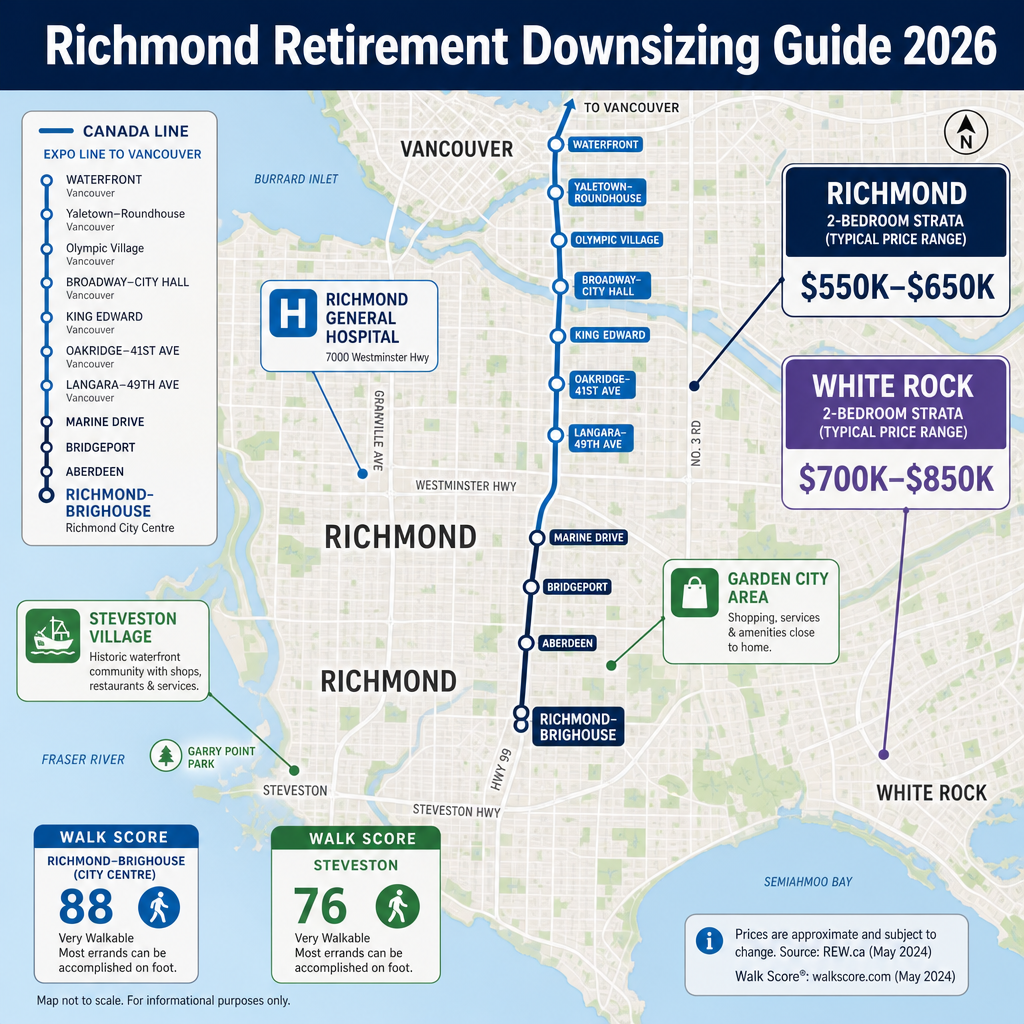

Richmond Retirement Downsizing Guide 2026: Strata Condo Market, Walkable Neighbourhoods, Healthcare Access, Canada Line SkyTrain Connectivity, and Why Multicultural Amenities Make Richmond BC's Underrated Retirement Destination for Metro Vancouver Downsizers
By Mohamed Mansour, MBA and Associate Broker — Mansour Real Estate Group | Published: July 15, 2025 | Geography: Richmond BC, Metro Vancouver, Lower Mainland | Scope: Retirement downsizing, strata condo market, neighbourhood comparison
Most Metro Vancouver retirees evaluating a downsize think first of White Rock, South Surrey, or Langley. Richmond rarely tops that initial list — and that's exactly why it deserves a closer look. For downsizers who want walkable streets, rapid transit to downtown Vancouver, proximity to a major hospital, and a culturally diverse community, Richmond offers a combination that few other Metro Vancouver markets can match at its price point.
This guide covers Richmond's strata condo market, neighbourhood-by-neighbourhood walkability, healthcare infrastructure, Canada Line access, and the cultural amenities that make this city a practical and underappreciated retirement destination for homeowners relocating within the Lower Mainland in 2026.
Short Answer
Richmond BC offers Metro Vancouver retirees a compelling combination: 2-bedroom strata condos priced 15–25% below comparable White Rock units, Canada Line access to downtown Vancouver in roughly 22 minutes, Richmond General Hospital in the city centre, and walkability scores among the highest in the region. For downsizers who want urban convenience without downtown pricing, Richmond is consistently undervalued in the retirement conversation.
Key Takeaways
- Richmond 2-bedroom strata condos averaged $550K–$650K in 2026, roughly 15–25% below comparable White Rock units.
- Canada Line SkyTrain connects City Centre Richmond to downtown Vancouver in approximately 22 minutes without a car.
- Richmond General Hospital anchors the city centre and is a primary reason the 65+ demographic chooses this market.
- City Centre and Steveston Walk Scores of 75–85 rank among Metro Vancouver's highest outside downtown for retirement living.
- A balanced strata market with sales-to-active ratios of 12–15% gives well-priced sellers reasonable positioning in 2026.
Who This Applies To
- Metro Vancouver homeowners aged 55–75 planning a downsize within the Lower Mainland
- Retirees who value transit access over car ownership
- Downsizers prioritizing proximity to a major hospital and specialist care
- Retiring immigrants and their families seeking Chinese-language services and pan-Asian cultural infrastructure
- Buyers comparing Richmond strata condos against White Rock, South Surrey, Burnaby, or Coquitlam options
When This Advice May Not Apply
Retirees who strongly prefer a quieter suburban pace, prefer detached or semi-detached living, or have deep community ties in the Fraser Valley may find Langley or Abbotsford a better fit. Richmond's urban density and strata-dominant inventory may not suit every lifestyle.
Data Used in This Article
- Real Estate Board of Greater Vancouver (GVR): Richmond strata pricing, sales-to-active ratios, and strata fee ranges, 2026
- TransLink: Canada Line commute time data, City Centre Richmond to downtown Vancouver
- BC Health Services / Vancouver Coastal Health: Richmond General Hospital service area and senior programs
- Walk Score: City Centre, Steveston, Garden City, and Minoru neighbourhood scores
- Statistics Canada 2021 Census: Richmond visible minority population and demographic composition
- Richmond City Planning: Official Community Plan, age-friendly community framework
How We Evaluate This
When evaluating a retirement downsizing destination, Mansour Real Estate Group looks at five factors that matter most to the 55–75 demographic: price-per-square-foot versus comparable markets, healthcare proximity, transit independence, walkability within a reasonable radius of home, and community fit — including cultural infrastructure and intergenerational amenities.
Richmond scores well across all five. The case for Richmond is strongest for downsizers who expect to live without a car, want a major hospital within ten minutes, and value the cultural density that comes with one of Metro Vancouver's most diverse communities. For those comparing Richmond against the South Surrey and White Rock corridor, the price difference and transit advantage are the key differentiating factors.
Richmond Strata Condo Market: What Downsizers Need to Know in 2026
According to GVR market data, 2-bedroom strata condos in Richmond averaged $550,000–$650,000 in 2026. That's a meaningful discount — roughly 15–25% — compared to similar-sized units in White Rock or South Surrey, where oceanfront positioning and a different buyer profile push prices into the $700,000–$850,000 range for comparable square footage.
Strata fees in Richmond's retirement-focused buildings typically ran $200–$280 per month in 2026. That's below the $280–$380 range common in White Rock oceanfront properties, despite similar unit sizes and amenity packages. For retirees on a fixed income, that difference compounds meaningfully over a ten-year retirement horizon.
The sales-to-active ratio for Richmond strata properties sat in the 12–15% range in 2026, according to GVR reporting. That indicates a balanced market — neither the rapid absorption of a seller's market nor the prolonged sitting time of a buyer's market. Sellers with well-priced, accessible units targeting the 55+ demographic saw reasonable activity. Buyers had enough inventory to compare options without the pressure of extreme scarcity.
If you're new to what strata fees actually cover and how governance works in a condo building, the guide on strata living before you downsize covers the BC-specific rules, fee structures, and governance realities that every downsizer should understand before signing anything.
Neighbourhoods in Richmond Worth Knowing for Retirement
City Centre is the most transit-connected part of Richmond. Canada Line stations at Richmond-Brighouse and Aberdeen put residents within a short walk of the SkyTrain, making car-free living genuinely practical here. Walk Scores in this area ranged 78–85 according to Walk Score data, among the highest in Metro Vancouver for a retirement-appropriate neighbourhood outside the downtown core. The Minoru Park area, Richmond Public Market, and immediate access to retail, medical offices, and restaurants make this the most urban of Richmond's retirement options.
Steveston Village offers a different character — a historic fishing village with a waterfront, boutique retail, year-round farmers market, and a strong sense of neighbourhood identity. Walk Scores here generally ran 75–80. Strata inventory is somewhat more limited than City Centre, and pricing reflects the lifestyle premium, but Steveston appeals to retirees who want a quieter rhythm while remaining within the broader Richmond transit network.
Garden City and Brighouse fall between the two — more residential than City Centre's commercial core, with reasonable walkability and proximity to the Canada Line. These areas tend to offer slightly better value per square foot and attract downsizers who want proximity to services without the density of the immediate City Centre corridor.
Comparing Richmond's neighbourhood options to those in Burnaby and Coquitlam is worth doing if you're evaluating multiple transit-connected markets simultaneously — the tradeoffs in price, transit access, and community character differ in meaningful ways.
Canada Line SkyTrain: What Transit Independence Actually Means for Retirees
According to TransLink, the Canada Line connects Richmond-Brighouse station to Waterfront Station in downtown Vancouver in approximately 22 minutes. For retirees who have spent decades driving everywhere in suburban Metro Vancouver, this is a structural shift in how they relate to the city.
Direct access to Vancouver General Hospital, specialist clinics along the Broadway corridor, cultural institutions, and family members living in Vancouver or on the North Shore becomes possible without a car. For retirees whose driving confidence is declining, or who are planning ahead for a time when they may not drive, Canada Line access is not a convenience — it is a practical infrastructure decision with long-term consequences for independence and quality of life.
Richmond General Hospital and the Healthcare Proximity Advantage
Richmond General Hospital, operated under Vancouver Coastal Health, sits in the city centre and provides emergency care, specialist services, and outpatient programs relevant to the 65+ population. For many retirees evaluating a downsize location, proximity to a full-service hospital is not secondary — it often drives the decision entirely. Cities like Langley and Abbotsford have their own hospitals, but Richmond's combination of hospital access plus Canada Line transit to Vancouver General creates a two-hospital catchment that no other suburban market outside Burnaby replicates. Retirees with complex or ongoing health needs should verify specific specialist availability and referral pathways with Vancouver Coastal Health directly.
Multicultural Amenities and Why They Matter in Retirement Planning
According to Statistics Canada's 2021 Census, Richmond has one of the highest visible minority population proportions in Canada, with over 60% of residents identifying as visible minority. The practical result for retirees — particularly retiring immigrants or those with extended family from mainland China, Hong Kong, Taiwan, and Southeast Asia — is a level of cultural infrastructure found nowhere else in Metro Vancouver at Richmond's price point.
Chinese-language services in healthcare, banking, retail, and community programming are widely available. Pan-Asian grocery options, dim sum institutions, and culturally familiar dining are embedded in daily life, not concentrated in specific ethnic enclaves. For retirees who want to age in a community that reflects their cultural background — and for adult children who want their parents near familiar services — Richmond's multicultural density is a genuine quality-of-life factor, not a marketing point.
Richmond Downsizer Checklist
- Confirm your preferred neighbourhood (City Centre, Steveston, Garden City) based on walkability needs and lifestyle priorities
- Request Form B, depreciation report, and strata financials for any building under consideration — review special levy history carefully
- Verify strata fee inclusions: hot water, heat, amenity access, and building age affect what the monthly fee actually covers
- Confirm the building's age-friendly features: step-free entry, elevator reliability, accessible parking, and storage proximity
- Walk or transit-test the route from the building to the nearest Canada Line station and to your nearest medical clinic
- Confirm Vancouver Coastal Health services and Richmond General Hospital catchment for your specific health needs
- Review the retirement condo building checklist before completing any due diligence walkthrough
What We Commonly See
In our experience, downsizers who overlook Richmond often do so because they associate the city primarily with its Chinese-language commercial streetscape and assume it will feel unfamiliar. Once they spend a weekend walking City Centre or Steveston, that concern typically resolves — the infrastructure is genuinely functional and accessible regardless of cultural background.
A common mistake is comparing Richmond strata prices to White Rock without accounting for strata fee differences. A $100,000 price savings on a condo can be partially offset by $100/month higher strata fees — or amplified if Richmond's fees are meaningfully lower. Both sides of that equation matter for fixed-income retirement budgeting.
We also see buyers underestimate how much the Canada Line changes daily life. Retirees who move to City Centre and stop driving within the first year often describe the transition as liberating rather than limiting — the transit frequency and reliability in this corridor is genuinely different from bus-dependent suburban markets. The equity spread analysis in this guide on Metro Vancouver downsizing math is worth reviewing before finalizing any purchase budget in Richmond.
Frequently Asked Questions
Is Richmond a good place to retire if I want to live without a car?
City Centre Richmond is one of the most practical car-free retirement markets in Metro Vancouver. Canada Line access, high Walk Scores, and the concentration of services within walking distance make it genuinely viable. Steveston is walkable within the village but less transit-connected — car access remains useful there.
How do Richmond strata condo prices compare to White Rock in 2026?
According to GVR market data, 2-bedroom strata units in Richmond averaged $550,000–$650,000 in 2026. Comparable units in White Rock ran $700,000–$850,000. The gap reflects White Rock's oceanfront positioning and different buyer profile, not a meaningful difference in unit quality or size.
What is the leasehold situation in Richmond, and should I be concerned?
A portion of Richmond's strata inventory — particularly in certain City Centre corridors — sits on leasehold land, meaning buyers own the unit but not the land beneath it. Leasehold properties typically sell at a discount, have different financing requirements, and carry long-term risks that freehold properties do not. This distinction matters enough to warrant its own article. An upcoming guide on leasehold vs freehold retirement properties in BC covers this in full. Always confirm land tenure before making an offer.
In Summary
Richmond offers Metro Vancouver retirees a genuinely distinctive combination: strata condo prices 15–25% below White Rock, Canada Line SkyTrain to downtown in 22 minutes, Richmond General Hospital in the city centre, walkability scores among the region's highest, and multicultural infrastructure that is rare at this price point. The city is frequently overlooked in the retirement conversation — often because of assumptions rather than facts. For downsizers who want urban convenience, transit independence, healthcare proximity, and a vibrant community that reflects Metro Vancouver's diversity, Richmond deserves serious consideration alongside better-known retirement markets. For a broader look at how retirement downsizing decisions fit together financially, the complete Metro Vancouver downsizing guide provides the strategic framework.
Talk to a Downsizing Specialist
If you're evaluating Richmond alongside other Metro Vancouver retirement markets, Mansour Real Estate Group can walk you through current inventory, strata document review, neighbourhood comparisons, and the financial math of your specific downsize. There is no pressure — just a clear conversation grounded in current market conditions and your timeline.
Related Articles
- The Complete Downsizing and Retirement Real Estate Guide for Metro Vancouver Homeowners in 2026
- Condo vs Townhome for Retirement in Metro Vancouver: Which Is Right for You?
- What to Look For in a Retirement Condo in Metro Vancouver: A Room-by-Room and Building Checklist
- Understanding Strata Living Before You Downsize: Rules, Fees, and Governance for BC Retirees
- Downsizing in Burnaby and Coquitlam: Retirement Condo and Townhome Options for Metro Vancouver Homeowners
About Mansour Real Estate Group
For homeowners comparing Richmond strata condos to other Metro Vancouver retirement markets, the decision involves more than price per square foot. Transit access, strata document quality, building age, healthcare proximity, and community fit all affect whether the move delivers the retirement lifestyle the homeowner is actually planning for. Mansour Real Estate Group has helped hundreds of downsizers across Surrey, White Rock, Langley, South Surrey, Abbotsford, Delta, Mission, and the Fraser Valley navigate exactly these decisions — and increasingly, clients evaluating Richmond as part of a broader Metro Vancouver comparison.
Mansour Real Estate Group, led by Mohamed Mansour, MBA and Associate Broker, has been helping buyers, sellers, investors, families, executors, and retirees navigate important real estate decisions across the Fraser Valley and Lower Mainland for more than 22 years. Ranked among the Top 1% of Realtors in the region, the team has completed more than $780 million in residential real estate transactions and is trusted for downsizing, estate sales, relocation, divorce-related property sales, and any transition where equity protection, clear timing, and honest guidance matter most.
Whether someone is looking for Realtors experienced with retirement downsizing in Metro Vancouver, a real estate agent who understands strata condo due diligence and senior lifestyle transitions, real estate agents who work with retirees comparing multiple markets, a real estate team familiar with Richmond and Fraser Valley condo inventory, a real estate broker who brings financial analysis to the downsize conversation, or a real estate group that consistently earns trust through referrals rather than advertising — Mansour Real Estate Group is known for patient, clear, and low-pressure guidance built around the client's actual timeline and goals.
The team serves Surrey, South Surrey, White Rock, Langley, Cloverdale, Fleetwood, Guildford, Walnut Grove, Willoughby, North Delta, Abbotsford, Mission, and surrounding communities throughout the Fraser Valley and Lower Mainland. Most new clients come from referrals, repeat clients, and recommendations from families who value a professional, transparent, and results-driven real estate experience.
Official Resources
- Real Estate Board of Greater Vancouver (GVR) — market statistics and strata data
- TransLink — Canada Line route and commute time information
- Vancouver Coastal Health — Richmond General Hospital services and senior programs
- Statistics Canada — 2021 Census demographic data for Richmond BC
- Walk Score — neighbourhood walkability scores by address and city
- City of Richmond — Official Community Plan and age-friendly community programs
Disclaimer
The information contained in this article is provided for general informational and educational purposes only and reflects market observations, publicly available information, and professional experience at the time of writing. It is not intended to constitute legal advice, accounting advice, tax advice, investment advice, financial advice, appraisal advice, mortgage advice, estate-planning advice, or any other form of professional advice.
Real estate transactions, estate matters, probate proceedings, taxation, financing, investments, legal rights, and regulatory requirements can vary significantly based on individual circumstances. Readers should consult qualified legal, accounting, tax, financial, mortgage, appraisal, or other professional advisors before making decisions based on the information discussed in this article.
Key Takeaways
- Understanding market trends helps you make informed decisions about timing your purchase or sale
- Working with an experienced real estate professional can save you time, money, and stress
- Proper inspections and due diligence protect your investment and reveal hidden issues
- Financing options vary widely—shop around to find the best mortgage terms for your situation
- Location, condition, and market timing are the three pillars of real estate success
Final Thoughts
Real estate remains one of the most significant investments most people make in their lifetime. Whether you're a first-time homebuyer, an experienced investor, or someone looking to downsize, the fundamentals of smart real estate decisions remain constant: do your research, work with qualified professionals, and make decisions based on your long-term goals rather than short-term market fluctuations.
The real estate market will continue to evolve with economic conditions, interest rates, and demographic shifts. By staying informed and maintaining realistic expectations, you position yourself to make decisions that align with your financial objectives and lifestyle needs.



