
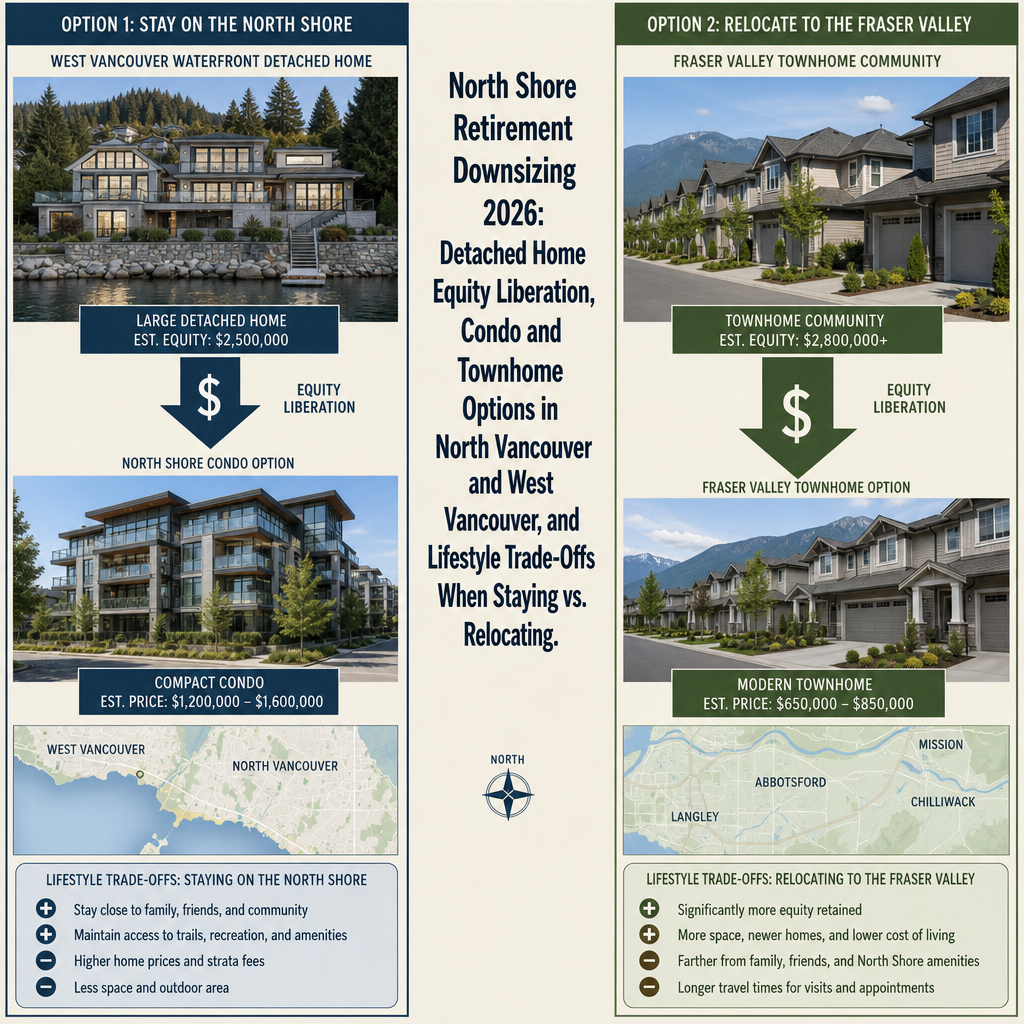

North Shore Retirement Downsizing 2026: Detached Home Equity Liberation, Condo and Townhome Options in North Vancouver and West Vancouver, and Lifestyle Trade-Offs When Staying vs. Relocating
By Mohamed Mansour, MBA and Associate Broker — Mansour Real Estate Group | Fraser Valley and Lower Mainland | Published: July 15, 2026
North Shore homeowners approaching retirement hold some of the most concentrated detached equity in Canada. A single-family home in West Vancouver or North Vancouver that was purchased for $600,000 twenty years ago may now carry a BC Assessment valuation of $2.5 million to $3.5 million or more. The decision of what to do with that equity — and whether the next chapter happens on the North Shore or somewhere east — is one of the most consequential choices these households will make.
This guide addresses what published retirement real estate content rarely does: the specific strata landscape, walkability realities, healthcare access considerations, and equity trade-offs that make North Shore downsizing distinct from anything happening in Burnaby, Coquitlam, or the Fraser Valley.
Short Answer
North Shore retirees downsizing from a $2.5M–$3.5M detached home to a $1.2M–$1.8M condo or townhome can realistically liberate $800,000 to $1.8 million in equity after transaction costs — with the exact outcome shaped by whether they stay on the North Shore, move to Vancouver proper, or relocate to the Fraser Valley. Each path carries materially different strata risk, lifestyle trade-offs, and resale dynamics that require local analysis before a decision is made.
Key Takeaways
- West Vancouver waterfront condos in pre-1995 buildings carry elevated special levy and depreciation risks that Burnaby or Coquitlam strata generally do not.
- North Vancouver's Lonsdale corridor offers meaningfully better walkability and transit access than West Vancouver, affecting both daily living and long-term resale velocity.
- Relocating to the Fraser Valley can unlock an additional $500,000 to $1 million in equity compared to staying on the North Shore — but sacrifices healthcare proximity and established community networks.
- Strata depreciation reports for coastal buildings must be reviewed for moisture intrusion, foundation, and seawall deficiencies before any purchase offer is made.
- The sell-first, rent-temporarily approach tends to give North Shore sellers stronger negotiating position when the replacement property is a strata unit requiring careful document review.
Who This Applies To
- Homeowners aged 60–75 in West Vancouver or North Vancouver holding a detached home valued at $2 million or more
- Empty nesters whose household no longer needs four or five bedrooms and a large lot
- Retirees evaluating whether to stay on the North Shore, move to Vancouver proper, or relocate to the Fraser Valley
- Homeowners who want to understand North Shore strata risk before committing to a replacement property
When This Advice May Not Apply
- Homeowners with a mortgage balance that would significantly reduce net equity after sale
- Those whose primary goal is intergenerational wealth transfer rather than retirement income — a conversation for a tax and estate lawyer, not a real estate agent
- Homeowners whose health or mobility needs require an immediate move to assisted living rather than independent strata living
Data Used in This Article
- BC Assessment 2026: North Shore detached and strata valuations — official government assessment data
- REBGV / GVR market reports: North Vancouver and West Vancouver condo days-on-market and price-per-square-foot comparisons — industry board data
- West Vancouver and North Vancouver municipal strata depreciation records, 2020–2026: Special levy trends and building deficiency data — municipal and strata-sourced
- TransLink and City of North Vancouver walkability and transit data: SkyTrain planning pipeline, Walk Score indices — official municipal and transit sources
The North Shore Equity Situation in 2026
According to BC Assessment 2026 data, detached homes across North Vancouver and West Vancouver carry average valuations in the $2.5 million to $3.5 million range, with waterfront and upper-elevation West Vancouver properties often exceeding $4 million. These values reflect a 40–60% premium over comparable detached stock in Burnaby and Coquitlam.
The practical implication: a North Shore retiree selling a 2,500 square foot detached home and purchasing a 1,200 square foot condo can liberate far more equity than almost any other Metro Vancouver homeowner making the same size-reduction move. After accounting for transaction costs — real estate commissions, legal fees, and property transfer tax on the purchase — a realistic net equity release typically falls between $800,000 and $1.8 million depending on property specifics. For a fuller breakdown of those costs, see The True Cost of Downsizing in Metro Vancouver.
That equity, once accessed, can fund retirement income, cover healthcare costs, support family gifting, or simply sit in a diversified portfolio — as covered in How to Use Your Home Equity to Fund Retirement After Downsizing in Greater Vancouver. But the amount depends heavily on which replacement property is chosen — and the replacement strata market on the North Shore is not uniform.
North Vancouver vs. West Vancouver: The Strata Market Is Not the Same
This distinction matters more for retirement downsizers than for any other buyer type, because the hidden carrying costs of a problematic strata compound over a long holding period.
West Vancouver waterfront condos in pre-1995 buildings face specific and well-documented structural challenges. Municipal depreciation report data shows that 40–50% of buildings in this vintage cohort carry identified deficiencies related to moisture intrusion, building envelope failure, and in some waterfront locations, seawall deterioration. Special levy escalation has run at 8–12% annually in affected buildings. For a buyer financing a portion of their purchase, these levies can also trigger lender appraisal shortfalls — the building's appraised value comes in lower than expected, reducing available mortgage proceeds. Before making any offer on a West Vancouver strata unit, reviewing the current depreciation report, the contingency reserve fund balance, and the minutes from the last three annual general meetings is not optional. For guidance on what to look for in that process, see Understanding Strata Living Before You Downsize.
North Vancouver's Lonsdale corridor and the Shipyards district present a different picture. Newer construction in this area — much of it built post-2000 — carries lower deficiency risk, more contemporary building envelopes, and buildings designed for the coastal moisture environment. The Lonsdale SkyTrain connection (the SeaBus to Waterfront plus developing transit options) gives residents access to downtown Vancouver without a car. Walk Score data for the lower Lonsdale area sits in the 70–80 range, compared to 45–55 in most West Vancouver neighbourhoods. For retirees who anticipate eventually giving up driving, that difference is not cosmetic — it reshapes daily independence meaningfully.
Resale velocity data from REBGV reports confirms the divergence: Lonsdale-area condos in good condition move faster and hold value more consistently than aging West Vancouver waterfront units of comparable price, partly because the buyer pool for the latter is narrower and the financing obstacles steeper.
The Stay vs. Relocate Decision: What the Equity Math Actually Shows
This is where North Shore downsizing diverges most sharply from the Fraser Valley retirement narrative covered in articles like Retiring in the Fraser Valley.
Path A — Stay on the North Shore: Selling a $3M detached home and purchasing a $1.5M Lonsdale or Dundarave condo nets roughly $1.2M–$1.4M after transaction costs. The retiree retains community ties, stays near their established healthcare providers, and maintains proximity to Lions Gate Hospital — relevant for anyone managing chronic health conditions. The lifestyle premium of the North Shore is preserved. The trade-off is that replacement strata costs (monthly fees, potential levies) remain elevated compared to Fraser Valley alternatives, and the equity released is smaller.
Path B — Move to Vancouver proper or a presale in the Shipyards area: A $3M sale combined with purchase of a $1.2M–$1.4M condo in downtown Vancouver or the Shipyards development pipeline creates similar equity liberation to Path A, with stronger transit access and potentially better building specifications in newer presale stock. The Shipyards presale ecosystem is worth understanding carefully — presale condos have specific contract risks, completion timelines, and deposit structures that differ from resale purchases.
Path C — Relocate to the Fraser Valley: A $3M sale combined with a $700,000–$900,000 townhome purchase in South Surrey, White Rock, Langley, or Abbotsford can unlock an additional $500,000–$1,000,000 in equity compared to staying on the North Shore. Fraser Valley strata also carries lower monthly fee and special levy risk than aging coastal buildings. The real cost is intangible: distance from established healthcare networks (St. Paul's Hospital, Lions Gate Hospital), the loss of a long-standing community, and the adjustment to a car-dependent lifestyle in areas with lower transit coverage. For some retirees, this is the right trade. For others, the financial gain does not outweigh the community disruption. The equity spread analysis covers the financial logic in more detail.
How We Evaluate This
When working with North Shore homeowners considering a downsize, the first conversation is always about what the move is actually for — income generation, simplification, family proximity, health planning, or some combination. The equity math comes second, because the right replacement property changes substantially depending on the answer.
From there, the analysis involves a current valuation of the detached home, a review of realistic replacement options in the target neighbourhood, an estimate of net equity after full transaction costs (not just commission), and a frank assessment of strata risk in the buildings under consideration. For West Vancouver buyers particularly, that strata review has prevented significant financial mistakes in our experience.
Downsizing Checklist for North Shore Retirees
- Obtain a current comparative market analysis on your detached home before making any replacement property decisions — valuations shift, and your net equity number needs to be based on current data, not assumptions.
- Request the depreciation report, Form B, and last three years of AGM minutes for any strata unit under serious consideration, especially in pre-1995 West Vancouver buildings.
- Confirm whether the contingency reserve fund is adequately funded relative to the depreciation report's recommended contributions.
- Map the Walk Score and transit access of the target neighbourhood and honestly assess how important car independence will be over the next 10–15 years.
- Calculate the full transaction cost of both the sale and the purchase — see The True Cost of Downsizing in Metro Vancouver for a complete breakdown.
- Identify your nearest hospital and confirm that Lions Gate Hospital or an equivalent facility remains accessible from the target location.
- Consider the sell-first, rent-temporarily approach if the replacement property search is likely to take more than 60 days — it removes the pressure of a conditional purchase in a competitive strata market.
- Consult a tax advisor before closing on the sale to confirm principal residence exemption eligibility and review any capital gains implications if the property was ever used for any other purpose. See the Principal Residence Exemption guide for context.
What We Commonly See
Strata document review gets skipped in competitive situations. In our experience, North Shore buyers who feel pressure to act quickly on a well-located condo sometimes waive or rush through strata document review. In West Vancouver's older building stock, this is the single most consequential shortcut a buyer can take. A special levy assessment discovered after purchase is not negotiable. Take the time, or retain a strata document review service.
The walkability assumption is often wrong. Retirees moving from a car-dependent North Shore detached neighbourhood sometimes assume all condo living is walkable. It is not. The difference between Dundarave in West Vancouver and lower Lonsdale in North Vancouver in terms of daily walkability is significant, and it compounds over years of ownership.
The Fraser Valley relocation is underestimated emotionally. The equity numbers for a North Shore-to-Fraser Valley move are compelling. What is often underestimated is the adjustment involved — rebuilding a social network, changing healthcare providers, and adapting to a different physical environment. For some households, a rental year first (as explored in Should You Rent First After Selling) gives the time and information needed to make that relocation confidently rather than reluctantly.
Questions and Answers
Q: Is it worth staying on the North Shore for retirement, or does the Fraser Valley equity unlock make more financial sense?
The answer depends on what drives the decision. Staying on the North Shore preserves healthcare access, community ties, and lifestyle. Relocating to the Fraser Valley typically unlocks $500,000–$1,000,000 more in net equity. Neither answer is universally correct — the right choice depends on individual health, family proximity needs, and how strongly the North Shore lifestyle is weighted against the financial difference.
Q: What makes West Vancouver waterfront condos riskier than North Vancouver condos for retirement buyers?
Pre-1995 West Vancouver buildings have a higher incidence of moisture intrusion, envelope failure, and seawall-related structural deficiencies. These issues show up in depreciation reports and tend to generate escalating special levies. North Vancouver's newer Lonsdale corridor stock generally carries lower deficiency risk and stronger transit access, making it a more stable choice for a long retirement hold.
Q: How does SkyTrain access affect retirement condo value on the North Shore?
North Vancouver's SeaBus and developing transit connections give Lonsdale-area residents car-free access to downtown Vancouver — a meaningful independence factor as residents age. West Vancouver has no SkyTrain connection and relies primarily on private vehicles and bus routes. This difference affects both daily livability and long-term resale velocity, with transit-accessible North Vancouver condos tending to hold buyer demand more broadly.
In Summary
North Shore retirees hold an unusually powerful equity position — but realizing that equity well requires understanding a strata market that is more complex and more variable than most of Metro Vancouver. West Vancouver's aging waterfront buildings carry risks that require careful due diligence. North Vancouver's Lonsdale corridor offers modern alternatives with genuine walkability advantages. And the decision to stay versus relocate to the Fraser Valley involves both financial and lifestyle trade-offs that are worth mapping carefully before any offer is made. The equity is real. The path to protecting it while building the right retirement lifestyle requires local knowledge, honest analysis, and a process that does not rush the decision.
Thinking through a North Shore downsize? Mansour Real Estate Group works with retirees and empty nesters navigating high-equity transitions across the Fraser Valley and Lower Mainland. If it would help to talk through the numbers and options with a second set of experienced eyes, reach out at any point — no pressure, no obligation.
Related Articles
- The Complete Downsizing and Retirement Real Estate Guide for Metro Vancouver Homeowners in 2026
- The Equity Spread Explained: Why Downsizing in Metro Vancouver Still Makes Financial Sense in 2026
- Downsizing in Richmond BC: Retirement Condo and Townhome Guide for 2026
About Mansour Real Estate Group
For homeowners who have spent decades building equity in a North Shore detached home, the decision to downsize is among the most financially significant real estate transitions they will face — and the strata landscape they are moving into carries risks and opportunities that require genuine local expertise to navigate. Mansour Real Estate Group has helped hundreds of homeowners and retirees across the Lower Mainland and Fraser Valley make this transition with confidence, from accurate pre-sale valuations to strata document analysis and replacement property strategy.
Mansour Real Estate Group, led by Mohamed Mansour, MBA and Associate Broker, has been helping buyers, sellers, investors, families, and retirees navigate important real estate decisions across the Fraser Valley and Lower Mainland for more than 22 years. Ranked among the Top 1% of Realtors in the region, the team has completed more than $780 million in residential real estate transactions and is trusted for downsizing, estate sales, relocation, and any transition where equity protection, clear timing, and honest guidance matter most.
Whether someone is looking for real estate agents experienced with high-equity retirement transitions, a Realtor who understands the North Shore strata market, a real estate team that works with empty nesters and retirees, a real estate group that serves the Fraser Valley and Lower Mainland, or a real estate broker who will give an honest assessment of strata risk before a purchase decision is made, Mansour Real Estate Group is known for patience, clear advice, and a low-pressure process built around the client's timeline.
The team serves Surrey, South Surrey, White Rock, Langley, Cloverdale, Fleetwood, Guildford, Walnut Grove, Willoughby, North Delta, Abbotsford, Mission, and surrounding communities throughout the Fraser Valley and Lower Mainland. Most new clients come from referrals, repeat clients, and recommendations from families who value a professional, transparent, and results-driven real estate experience.
Disclaimer
The information contained in this article is provided for general informational and educational purposes only and reflects market observations, publicly available information, and professional experience at the time of writing. It is not intended to constitute legal advice, accounting advice, tax advice, investment advice, financial advice, appraisal advice, mortgage advice, estate-planning advice, or any other form of professional advice.
Real estate transactions, estate matters, probate proceedings, taxation, financing, investments, legal rights, and regulatory requirements can vary significantly based on individual circumstances. Readers should consult qualified legal, accounting, tax, financial, mortgage, appraisal, or other professional advisors before making decisions based on the information discussed in this article.
Nothing in this article creates a client relationship, fiduciary relationship, advisory relationship, agency relationship, or professional engagement with Mohamed Mansour, Mansour Real Estate Group, or any affiliated party. Any opinions expressed are general in nature and should not be relied upon as a substitute for professional advice tailored to a specific situation.
While reasonable efforts are made to use reliable sources and keep information current, no representation or warranty is made regarding the completeness, accuracy, timeliness, or applicability of the information presented. Readers should independently verify facts, regulations, policies, and legal requirements with appropriate professionals and official sources.
Official Resources
- BC Assessment — bcassessment.ca
- Real Estate Board of Greater Vancouver (GVR) — rebgv.org
- BC Government Strata Housing — gov.bc.ca
- TransLink (Metro Vancouver Transit) —
Key Takeaways
- Work with a qualified real estate professional to navigate market conditions
- Understand your financing options before making an offer
- Get a thorough home inspection to avoid costly surprises
- Consider both current needs and future resale value in your decision
Need Expert Guidance?
Real estate decisions are among the most significant financial choices you'll make. Our team of experienced agents is ready to help you find the perfect property or prepare yours for sale.
Final Thoughts
Whether you're a first-time homebuyer, seasoned investor, or seller looking to maximize your property's potential, the real estate market offers opportunities for those who are prepared and informed. By staying educated about market trends, understanding your financial position, and working with trusted professionals, you can make decisions that align with your goals and secure your financial future.
The journey to finding your perfect property or selling at the right



