
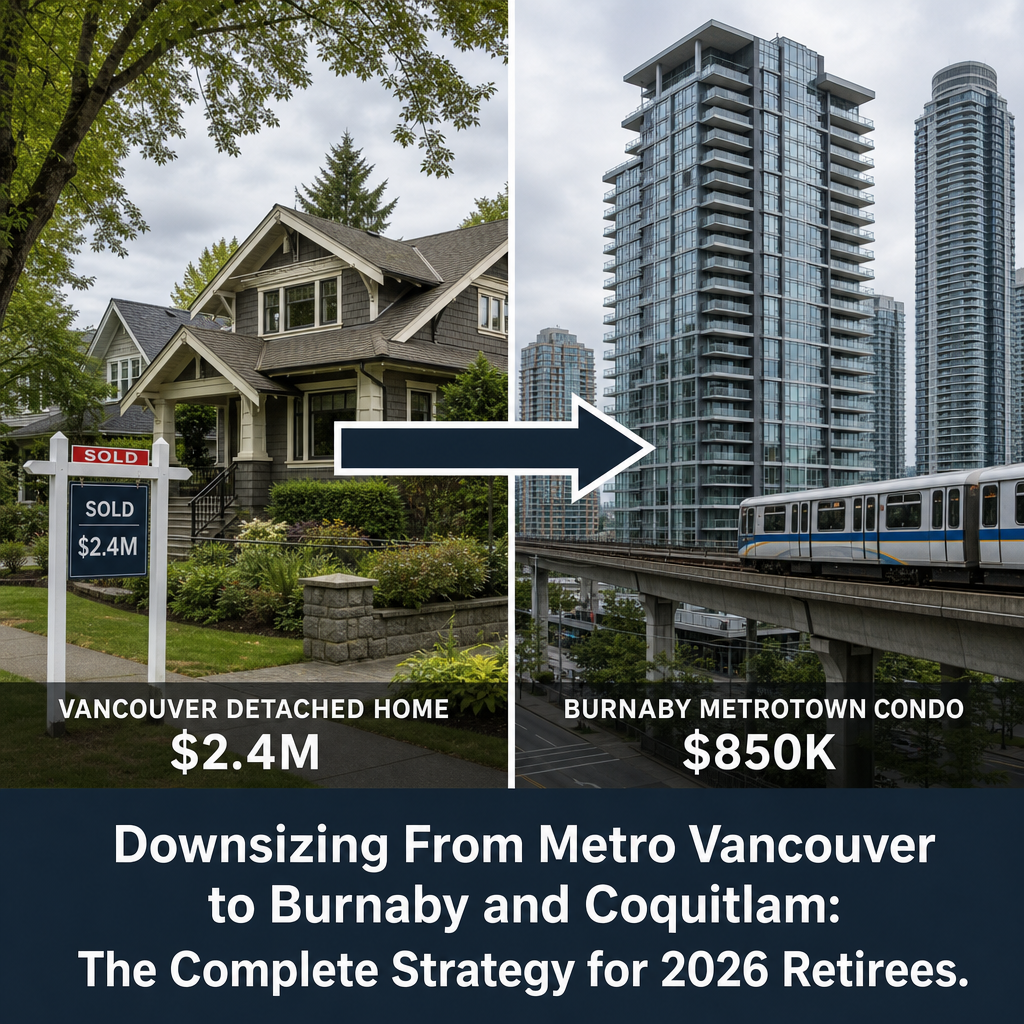

Downsizing From Metro Vancouver to Burnaby and Coquitlam: The Complete Financial, Lifestyle, and Neighbourhood Strategy for Vancouver and North Shore Retirees in 2026
By Mohamed Mansour, MBA and Associate Broker · Mansour Real Estate Group · Fraser Valley and Lower Mainland · Published July 2026
For Vancouver and North Shore homeowners in their late 50s and 60s, the idea of moving east to Burnaby or Coquitlam once sounded like a compromise. In 2026, it is increasingly the most financially sound and practically sustainable retirement move available. The equity spread between a Vancouver or West Vancouver detached home and a well-positioned Burnaby or Coquitlam condo or townhome can reach $800,000 to $1.4 million — money that changes what retirement looks like.
This guide addresses the financial, emotional, and logistical realities of that transition — neighbourhood by neighbourhood, decision by decision — for retirees who want an honest, complete picture before they commit.
Short Answer
Vancouver and North Shore retirees who downsize to Burnaby or Coquitlam in 2026 can realistically release $600,000 to $1.4 million in equity depending on their current property and chosen destination. Burnaby's Brentwood and Metrotown corridors offer walkable, transit-rich condo living; Coquitlam and Port Moody offer townhome alternatives with stronger community character. Both markets sit below Vancouver pricing by 30 to 50 percent, with strong SkyTrain access and lower ongoing ownership costs.
Who This Applies To
- Vancouver East Side, West Side, or North Shore homeowners aged 55 to 75 with significant detached home equity
- Retirees or pre-retirees who want to stay in Metro Vancouver's urban core but reduce maintenance and property costs
- Homeowners who currently drive everywhere and are ready to shift to SkyTrain-connected living
- Couples or individuals whose children have moved to the Tri-Cities area and who want proximity without moving to the suburbs
- Owners of older Vancouver homes considering whether to renovate before selling or sell as-is
When This Advice May Not Apply
Homeowners with a secondary investment property, an active principal residence designation on more than one property, a recently triggered capital gain, or a home subject to a joint tenancy arrangement should speak with a tax advisor before making any sale decisions. The principal residence exemption rules are specific to individual circumstances and this guide does not constitute tax advice.
Key Takeaways
- Vancouver and West Vancouver detached homes average $2.1M to $2.8M; comparable Burnaby and Coquitlam properties average $1.4M to $1.8M, creating 35 to 50 percent equity release potential.
- Coquitlam townhomes are showing a 23 percent sales-to-active ratio in 2026 — seller-market conditions that favour buyers transitioning from Vancouver.
- SkyTrain access is a legitimate retirement infrastructure advantage — Burnaby and Coquitlam are not car-dependent in the way that Fraser Valley suburbs are.
- Burnaby strata fees run $350 to $450 per month at Metrotown — higher than some Vancouver buildings, but often include amenities that replace out-of-pocket costs.
- Selling a Vancouver home and buying in Burnaby or Coquitlam triggers PTT on the purchase; calculating true net proceeds before committing to a number is critical.
Data Used in This Article
- REBGV/GVR Sales-to-Active Listings Data, April 2026 — official board data
- CMHC Housing Research 2026, Metro Vancouver Regional Overview — federal agency
- BC Assessment 2025–2026 Property Tax Records, Vancouver vs. Burnaby/Coquitlam — provincial authority
- TransLink SkyTrain Station Proximity Premium Analysis, 2025 — regional transit authority
- CRA Principal Residence Exemption Guidelines — federal regulatory guidance
- Burnaby Metrotown Condo Market Report, Q1 2026 — third-party market analysis
- Coquitlam Real Estate Sales Analysis, Townhome Segment, 2026 — market analysis
- Port Moody Community Profile and Demographic Analysis, 2025 — municipal data
Understanding the Equity Spread
According to BC Assessment 2025–2026 records and GVR/REBGV sales data, Vancouver West Side and West Vancouver detached properties are transacting in the $2.1M to $2.8M range. Burnaby detached homes in comparable neighbourhoods — Burnaby Heights, Deer Lake, South Slope — are selling in the $1.4M to $1.8M range. The difference is real. For a homeowner moving from a West Vancouver property at $2.5M into a Burnaby Brentwood condo at $850,000, the gross equity release approaches $1.6M before costs.
Those costs are material. On a $2.5M Vancouver sale, realtor commission, legal fees, and any pre-listing work can represent $90,000 to $140,000 in total transaction costs depending on the commission structure, scope of preparation work, and whether bridge financing is needed. On the Burnaby purchase side, PTT on an $850,000 condo is approximately $15,200. Reviewing the full cost framework is covered in the cluster guide on the true cost of downsizing in Metro Vancouver.
Even after those costs, the net equity gain from the transition typically justifies the move on purely financial grounds for most Vancouver detached homeowners. The more complex question is where to go and what to give up.
Burnaby: Brentwood vs. Metrotown vs. Edmonds
These three corridors serve different retirement profiles. Brentwood, centred on the Brentwood Town Centre SkyTrain station on the Millennium Line, has seen the most aggressive new condo development over the past five years. Completed towers in the Brentwood corridor are showing stronger resale velocity than anticipated, according to the Q1 2026 Burnaby Metrotown Condo Market Report — a signal that buyer demand in transit-adjacent buildings is holding even as broader condo markets soften in some areas.
Brentwood suits retirees who want walkability and urban density without being in Vancouver's Downtown core. The area has grocery stores, medical services, and fitness amenities within a five-minute walk of most major towers. Strata fees at newer Brentwood buildings average $350 to $450 per month, according to Burnaby strata records, and typically include concierge, gym, and pool access — costs that, when itemized separately, often exceed the strata fee itself.
Metrotown appeals to retirees who prioritize shopping, entertainment, and immediate Expo Line access to Vancouver or New Westminster. The area is denser and more commercial than Brentwood but offers some of the strongest condo resale liquidity in Burnaby, which matters to homeowners concerned about a future sale if circumstances change. For retirees evaluating what to look for in a specific building, the room-by-room and building checklist applies directly to this market.
Edmonds offers lower price points than either Brentwood or Metrotown — typically 10 to 15 percent below comparable Brentwood units — with slower neighbourhood redevelopment. It suits retirees who want a quieter pace and lower monthly costs and are willing to accept less immediate walkability.
Coquitlam and Port Moody: Townhome Strength and Lifestyle Trade-offs
According to GVR/REBGV sales-to-active listings data from April 2026, Coquitlam townhomes are showing a 23 percent sales-to-active ratio. For context, the Fraser Valley average sits around 11 percent for the same period. That gap means townhome inventory in Coquitlam is moving at twice the relative pace — creating real competition for buyers and better liquidity for sellers transitioning out of a Vancouver property. For retirees evaluating whether a condo or townhome is the right retirement fit, Coquitlam's townhome supply currently offers more options than most comparable Metro Vancouver areas.
Port Moody attracts a distinct buyer profile among downsizers. According to the Port Moody Community Profile and Demographic Analysis 2025, the area draws retirees aged 55 to 70 who want small-town character without full suburban isolation. The Inlet Centre and Moody Centre SkyTrain stations on the Millennium Line connect Port Moody to Coquitlam Centre and, via transfer, to Vancouver in approximately 45 minutes. The walkable waterfront, Rocky Point Park, and the concentration of independent restaurants and services along St. Johns Street make Port Moody genuinely distinct from the denser Burnaby corridors.
Burke Mountain in Coquitlam offers newer single-family and townhome product at lower prices than Port Moody's waterfront-adjacent options — though it remains more car-dependent and is better suited to retirees who are still active drivers and may have grandchildren in the area.
How We Evaluate This Transition
When working with Vancouver and North Shore homeowners considering a move to Burnaby or Coquitlam, we start with the equity calculation — not the neighbourhood shortlist. The net proceeds from a Vancouver sale, after all transaction costs, determine what the buyer can comfortably spend in the new market without creating financial pressure or strata-fee strain in retirement. We build that number first, then work backward to property type, building, and neighbourhood.
We also spend time on sequencing. The sell-first or buy-first question changes depending on whether the Burnaby or Coquitlam purchase is a condo (where strata documents, Form B review, and depreciation report analysis take time) or a townhome (where competing offers can close the window quickly in a 23 percent sales-to-active market). We do not recommend a single default sequence — we recommend the sequence that fits the specific property and market conditions at the time of the decision.
Preparing a Vancouver Home for Sale: What Actually Moves the Needle
Many Vancouver homeowners in the 40-plus-year-old housing stock spend time and money on pre-listing renovations that do not recover their cost. In our experience working with sellers in this market, kitchen and bathroom updates in older Vancouver homes rarely return more than 50 to 70 cents on the dollar when the property is positioned as a land-value or renovation candidate. Buyers purchasing a $2.2M East Side home are not paying a premium for a $40,000 kitchen renovation — they are paying for the lot.
What does move the needle: a clean, well-presented home with updated mechanical systems (electrical panel, hot water tank, roof), professional staging for photography, and accurate list pricing. Overpricing a Vancouver detached home in the current elevated-inventory environment leads to price reductions that cost sellers more than the original preparation expense would have. The complete downsizing guide for Metro Vancouver homeowners covers preparation strategy in more detail.
Tax Considerations Specific to This Move
The principal residence exemption, when properly designated, shelters the capital gain on a Vancouver home from income tax. According to CRA guidelines, only one property per family unit may be designated as the principal residence for any given year. Homeowners who own both a primary Vancouver residence and a secondary property — a cabin, a rental suite in a strata unit, or an investment condo — need to confirm which designation applies before listing.
A common scenario worth flagging: a homeowner who buys a Burnaby condo before selling the Vancouver home, and occupies the condo for several months, may create a window where the exemption election becomes more complex. This is a situation that requires a tax advisor's review before it is created, not after. The downsizing tax checklist for BC retirees and the principal residence exemption guide provide a starting framework, but individual tax advice is essential before any transaction closes.
Downsizer Checklist: Vancouver to Burnaby or Coquitlam
- Calculate true net proceeds from your Vancouver sale — include commission, legal fees, PTT on the purchase side, moving costs, and any pre-listing work.
- Confirm your principal residence designation status with a tax advisor, particularly if you own any secondary property.
- Decide on sequencing: sell first with bridge financing protection, or buy first with clear financing pre-approval and an acceptable subject removal timeline.
- Review strata documents on any Burnaby condo shortlist — depreciation report, Form B, special levy history, and minutes from the past two AGMs.
- Visit Brentwood, Metrotown, Port Moody, and Coquitlam Centre in person on a weekday to assess walkability, transit comfort, and neighbourhood character before narrowing your list.
- Pre-list your Vancouver home with professional photography, clean mechanical systems, and accurate pricing — resist the temptation to renovate cosmetically for a land-value property.
- Work with a real estate team that has direct transaction experience in both the Vancouver seller market and the Burnaby or Coquitlam buyer market — not two separate agents with no shared process.
What We Commonly See
Underestimating the emotional adjustment. In our experience, Vancouver and North Shore retirees who have lived in the same neighbourhood for 25 to 40 years often underestimate how much the first six months in a new area affects their sense of wellbeing. The financial case for moving is often clear; the social and emotional case requires more honest conversation. The article on the emotional side of downsizing addresses this directly.
Overestimating renovation ROI. What often happens is that sellers invest $60,000 to $80,000 in a full kitchen and bathroom renovation on a 1970s East Side Vancouver home, expecting to recoup it in the sale price. Buyers in that price range — typically builders or renovation investors — are pricing the lot and the structure, not the new cabinets. A well-maintained, clean home typically competes as well or better than a recently renovated one in a land-value market.
Timing the Burnaby purchase too early. A common mistake is buying a Burnaby or Coquitlam condo under pressure — because a building just launched or because rates look attractive in the moment — before the Vancouver home is sold or even listed. That sequence creates bridge financing exposure and, more seriously, can trigger a principal residence designation question that a tax advisor could have avoided with earlier planning.
Questions and Answers
Is Burnaby actually close enough to Vancouver to feel connected?
Yes — Brentwood is 18 minutes by SkyTrain from Waterfront Station. Metrotown is 22 minutes. For retirees who no longer commute daily, that distance is manageable and the transit is reliable. The North Shore is further — Moody Centre to downtown Vancouver is approximately 45 minutes via SkyTrain and SeaBus — but still viable for occasional trips.
What is the realistic price range for a retirement condo in Burnaby in 2026?
Based on Q1 2026 Burnaby Metrotown Condo Market Report data, one-bedroom-plus-den units at newer Brentwood and Metrotown towers are trading in the $750,000 to $950,000 range. Two-bedroom units in the same buildings range from $950,000 to $1.3M. Older buildings below Metrotown or in Edmonds offer lower entry points, typically $550,000 to $750,000 for one-bedroom units.
Do Burnaby and Coquitlam have adequate healthcare access for retirees?
Burnaby General Hospital serves central and north Burnaby. Eagle Ridge Hospital serves Port Moody, Coquitlam, and Port Coquitlam. Both are well-regarded community hospitals. Burnaby's Metrotown and Brentwood corridors have significant concentrations of medical offices, physiotherapy, and specialist services within walking distance of major towers.
In Summary
For Metro Vancouver and North Shore retirees, a move to Burnaby or Coquitlam in 2026 can release significant equity — often $600,000 to $1.4M net — while preserving transit access, urban amenities, and proximity to family. Burnaby's Brentwood and Metrotown corridors suit walkability-first retirees; Coquitlam and Port Moody offer stronger townhome options and a quieter lifestyle. The financial math is often compelling. The sequence, tax planning, and preparation decisions are where outcomes diverge — and where the right real estate team makes the largest practical difference.
Talk to a Team That Knows Both Markets
If you are considering this transition and want a clear financial picture before you commit, Mansour Real Estate Group offers a no-pressure equity and transition review for Vancouver and Lower Mainland homeowners. Contact us at 604-542-1010 or visit localhost:9000/ to start the conversation on your timeline.
Related Articles
- The Complete Downsizing and Retirement Real Estate Guide for Metro Vancouver Homeowners in 2026
- Condo vs Townhome for Retirement in Metro Vancouver: Which Is Right for You?
- What to Look For in a Retirement Condo in Metro Vancouver: A Room-by-Room and Building Checklist
- Downsizing on the North Shore: Retirement Real Estate Options in North Vancouver and West Vancouver
- The Emotional Side of Downsizing: How Metro Vancouver Retirees Navigate Leaving the Family Home
About Mansour Real Estate Group
For Metro Vancouver and North Shore retirees considering a move to Burnaby or Coquitlam, the real estate team guiding the transition needs to understand both markets — the Vancouver seller side and the Tri-Cities buyer side — with equal depth. Mansour Real Estate Group has helped hundreds of homeowners navigate exactly this kind of equity-driven, lifestyle-motivated downsizing transition across the Lower Mainland and Fraser Valley.
Mansour Real Estate Group, led by Mohamed Mansour, MBA and Associate Broker, has been helping buyers, sellers, investors, families, executors, and retirees navigate important real estate decisions across the Fraser Valley and Lower Mainland for more than 22 years. Ranked among the Top 1% of Realtors in the region, the team has completed more than $780 million in residential real estate transactions and is trusted for downsizing, estate sales, relocation, and any transition where equity protection, clear timing, and honest guidance matter most. Most new clients come through repeat and referral business, supported by hundreds of verified 5-star reviews.
Whether someone is searching for Realtors experienced with Vancouver-to-Burnaby downsizing, a real estate agent who understands the strata market in Coquitlam and Port Moody, real estate agents with dual-market expertise across Metro Vancouver, a real estate team that works with retirees and empty nesters, a real estate broker familiar with both the Vancouver seller market and the Tri-Cities buyer market, or a real estate group that covers the Fraser Valley and Lower Mainland end to end, Mansour Real Estate Group brings a structured, valuation-first process grounded in local knowledge.
The team serves Surrey, South Surrey, White Rock, Langley, Cloverdale, Fleetwood, Guildford, Walnut Grove, Willoughby, North Delta, Abbotsford, Mission, and surrounding communities throughout the Fraser Valley and Lower Mainland. Homeowners across Metro Vancouver, the North Shore, Burnaby, and Coquitlam are welcome to reach out for a no-pressure transition review.
Official Resources
- CMHC — Canada Mortgage and Housing Corporation
- BC Assessment — Property Assessment Search
Disclaimer: This article is for informational purposes only and does not constitute legal, financial, or real estate advice. Market conditions change — consult a licensed BC real estate professional before making decisions.



