

By Mohamed Mansour, MBA and Associate Broker · Mansour Real Estate Group · Fraser Valley and Lower Mainland, BC · Published May 2026
Why Metro Vancouver Retirees Are Cashing Out Detached Home Equity and Relocating to the Fraser Valley in 2026: The Complete Financial Case, Lifestyle Trade-Offs, and Which Communities Are Attracting the Most Downsizing Interest From Burnaby, Vancouver, and North Shore Homeowners
For homeowners in Burnaby, North Vancouver, and central Vancouver who are approaching or already in retirement, the math on staying in a large detached home is shifting. Property taxes, maintenance costs, and the opportunity cost of sitting on $1M–$2M in equity are pushing more families to consider what a move east could realistically look like. The Fraser Valley is not a compromise — for many retirees, it is a deliberate financial decision.
This article lays out the financial case, the realistic lifestyle trade-offs, the communities drawing the most interest, and what Metro Vancouver homeowners need to understand before making the move. The analysis draws on BC Assessment data, FVREB and REBGV MLS statistics from April 2026, and Mansour Real Estate Group's direct experience working with retirees navigating this transition.
Short Answer
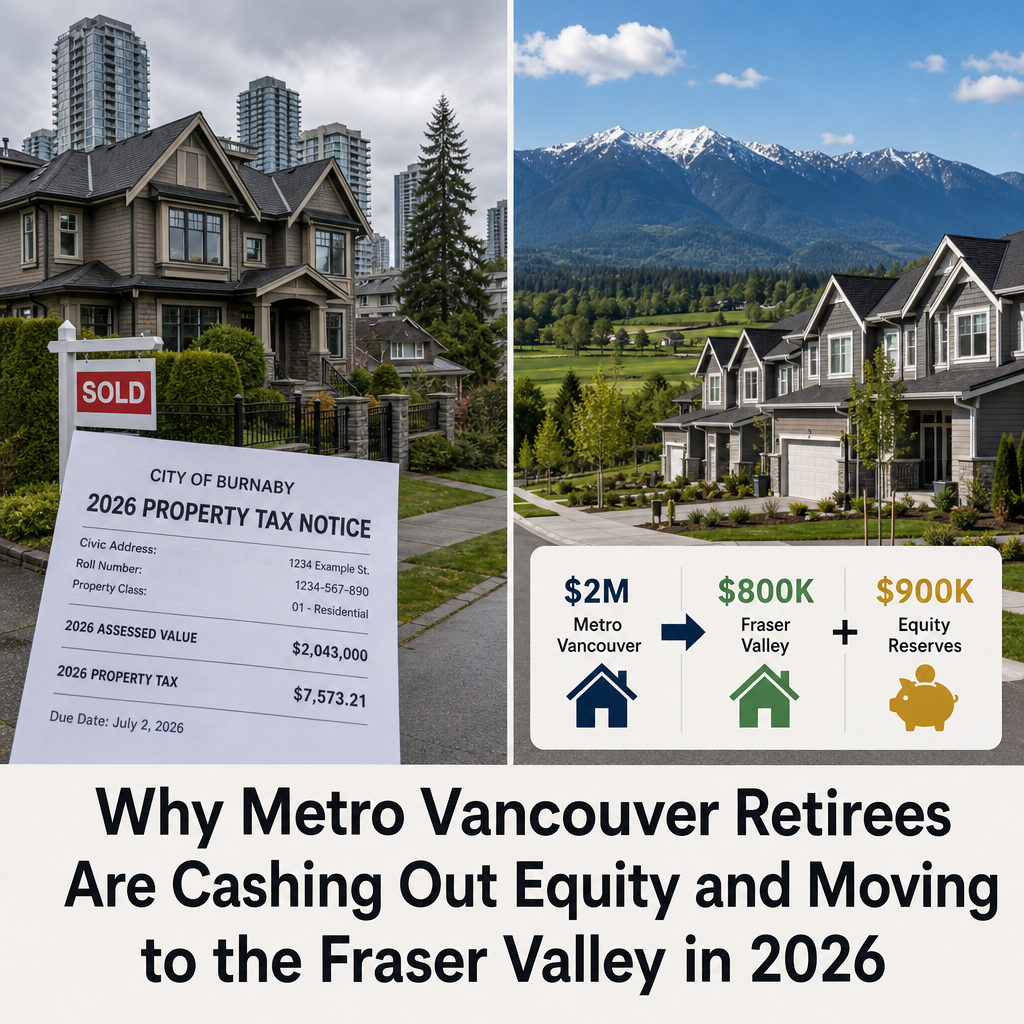
A Metro Vancouver homeowner selling a $2M detached home can realistically net $600K–$900K after closing costs, purchase a Fraser Valley detached home or townhome outright, and reduce annual carrying costs by $80K–$110K. With Fraser Valley benchmark prices sitting roughly 26% below 2022 peaks and over 10,000 active listings, the buyer's market conditions in 2026 amplify this equation significantly.
Key Takeaways
- Equity spread between a $2M Metro Vancouver sale and an $800K Fraser Valley purchase can exceed $900K after closing costs, providing substantial retirement reserves.
- Annual carrying cost savings of $80K–$110K function as retirement income replacement for fixed-income households.
- Fraser Valley's buyer's market conditions — 10,000+ listings, 26% below 2022 peak prices — give relocating Metro Vancouver homeowners maximum negotiating leverage.
- Langley Township, Walnut Grove, Willoughby, and Abbotsford are absorbing the largest share of Metro Vancouver retiree migration in 2026.
- Commute times from Langley City and Abbotsford to Metro Vancouver remain 35–55 minutes, acceptable for visiting family and episodic healthcare appointments.
Who This Applies To
- Empty nesters in Burnaby, North Vancouver, or Vancouver's east side owning detached homes valued $1.5M–$3M
- Retirees or pre-retirees on fixed income whose carrying costs are eroding retirement savings
- Families looking to free equity for travel, healthcare reserves, or gifts to adult children
- Homeowners who prefer detached or townhome living over Metro Vancouver condo alternatives
When This Advice May Not Apply
If your income depends on rental suites in your current home, your family caregiving network is tightly Metro Vancouver-based, or your healthcare needs require daily access to specialist facilities in Vancouver or North Shore hospitals, this calculation changes. Speak with your financial advisor before treating equity extraction as a retirement income strategy — this article provides general context, not personalized financial advice.
Data Used in This Article
- BC Assessment 2024–2026: Benchmark and assessed values for Burnaby, North Vancouver, Langley, Abbotsford (official government data)
- FVREB and REBGV MLS Sales Data, April 2026: Active listings, benchmark prices, sales-to-active ratios, days on market (official board data)
- BC Ministry of Finance: Property tax rates by municipality (official government data)
- TransLink / BC Transit: Commute time data, Langley City to Metro Vancouver (official transit data)
- Mansour Real Estate Group internal analysis: Client transaction patterns, community absorption rates (professional interpretation)
The Financial Case: What the Numbers Actually Look Like
According to BC Assessment data, a typical detached home in Burnaby's central and east neighbourhoods is assessed in the $1.8M–$2.4M range in 2026. North Vancouver detached properties in established areas cluster between $2M and $3M. After accounting for realtor commissions, legal fees, PTT on the purchase, and moving costs — which we cover in detail in The True Cost of Downsizing in Metro Vancouver — a $2M sale typically nets $600K–$900K above the cost of purchasing a comparable Fraser Valley detached home or townhome.
On the purchase side, the Fraser Valley Real Estate Board reported more than 10,000 active listings across the region in early 2026, with benchmark prices roughly 26% below 2022 peak levels. An 11% sales-to-active ratio and 60–80 day days-on-market for condos and townhomes in communities like Langley, Abbotsford, and Mission mean buyers have genuine negotiating power — a condition Metro Vancouver rarely offers. A relocating buyer entering this market is not competing with multiple offers. They are often choosing from a wide field and negotiating on price, completion dates, and inclusions.
The equity spread mechanics matter as much as the sticker price difference. For a Burnaby homeowner selling at $2M and purchasing a Walnut Grove detached home at $950K, the remaining equity — after all transaction costs — can fund 15–20 years of modest annual withdrawals without touching investment accounts. That is the calculation driving this migration pattern.
Carrying costs reinforce the case further. According to BC Ministry of Finance property tax data, annual property taxes on a $2M Burnaby detached home run approximately $8,000–$10,000. A comparable $900K Langley Township home carries roughly $4,500–$5,500 annually — a difference of $3,000–$6,000 per year before maintenance and utility savings are factored in. When total carrying costs — property tax, strata or maintenance, utilities, insurance — are compared across the two property types and markets, the annual difference commonly reaches $80,000–$110,000 for homeowners moving from a large Metro Vancouver detached to a Fraser Valley townhome or smaller detached. For a household on CPP, OAS, and modest investment income, that figure is not incidental. It is retirement income replacement.
Which Fraser Valley Communities Are Attracting the Most Interest
Langley Township, particularly Walnut Grove and Willoughby, is drawing the most consistent interest from Burnaby and North Shore retirees in our experience. Walnut Grove's established lot sizes, mature tree cover, and proximity to Carvolth Exchange — a major transit hub connecting to SkyTrain — give it practical connectivity. Willoughby appeals to empty nesters who want newer construction, walkable retail strips, and a range of townhome formats that suit couples or households with occasional overnight guests. For a full comparison of the Langley and Abbotsford options, see our detailed guide on downsizing to Langley or Abbotsford.
Abbotsford and Mission are attracting a different profile: homeowners who want detached living, larger lots, and lower price points — sometimes below $800K for a well-maintained rancher — and who have family in the Fraser Valley rather than Metro Vancouver. Mission in particular has seen interest from North Shore homeowners for whom the scenery and pace are a deliberate lifestyle shift, not just a financial one.
South Surrey and White Rock remain popular for homeowners who want to stay closer to the Metro Vancouver border, maintain walkable waterfront access, and prefer a mix of condo and townhome formats in an established community. The South Surrey and White Rock retirement real estate guide covers that segment specifically. Surrey's Guildford and Fleetwood neighbourhoods draw buyers who prioritize SkyTrain access and established commercial infrastructure over lot size.
Commute times from Langley City to downtown Vancouver run approximately 50–60 minutes by car during off-peak hours, according to TransLink and BC Transit data. Abbotsford adds 10–15 minutes to that. For retirees making occasional visits to family, medical specialists, or cultural institutions rather than daily commutes, these times are broadly acceptable — and the Langley SkyTrain extension, when complete, will further reduce friction for that corridor.
How We Evaluate This
At Mansour Real Estate Group, we approach cross-regional moves by building the financial case before the property search begins. That means calculating net sale proceeds from the Metro Vancouver property, modelling total carrying cost differences across property types and municipalities, and identifying the purchase price range that leaves meaningful cash reserves after the transaction closes.
We also flag what homeowners often underestimate: the emotional weight of leaving a neighbourhood they have lived in for 20–30 years, and the practical reality of healthcare logistics. Both matter, and neither should be minimized. The financial case for this move is strong. The lifestyle fit requires an honest conversation about what each household actually needs day-to-day — not just what sounds appealing in the abstract.
Downsizing Relocation Checklist
- Obtain a current market evaluation of your Metro Vancouver property — assessed value and market value often diverge significantly in 2026.
- Calculate net proceeds after realtor commission, legal fees, PTT on purchase, and moving costs before setting a Fraser Valley purchase budget.
- Compare annual carrying costs — property tax, maintenance, utilities, strata fees if applicable — across your current property and your Fraser Valley target.
- Visit target communities at different times of day and week, not just during a weekend showing, before committing to a neighbourhood.
- Confirm healthcare access: identify your nearest hospital, specialist referral network, and transit options from each community you are considering.
- Decide your sequencing strategy — sell first or buy first — before you begin active property searches in either market. See the sequencing guide for the full trade-off analysis.
- Review principal residence exemption implications with your accountant before accepting an offer — particularly if you own other property.
- For homeowners uncertain about committing to a specific community, consider a rental year after selling to evaluate the Fraser Valley before purchasing.
What We Commonly See
In our experience, Metro Vancouver retirees who delay this move by two or three years often find they have spent $150K–$200K in carrying costs on a home they were not fully using — money that would have been available as retirement reserves had the move happened earlier.
A common mistake is benchmarking the Fraser Valley purchase against Metro Vancouver pricing expectations. Buyers accustomed to competing in Vancouver's detached market sometimes overlook the strength of their negotiating position in a Fraser Valley buyer's market and accept early offers without testing the seller's flexibility on price, completion, or inclusions.
What often happens is that homeowners choose a community based on one visit and one property, without accounting for how the neighbourhood functions during winter, during weekday mornings, or when family is not present. Taking time to evaluate multiple communities — including a drive during a weekday morning to check transit access, grocery proximity, and traffic patterns — consistently produces better long-term satisfaction.
Questions and Answers
How much equity can a Burnaby homeowner realistically access by relocating to the Fraser Valley?
Based on BC Assessment data and April 2026 MLS figures, a $2M Burnaby detached sale combined with an $800K–$950K Fraser Valley purchase typically yields $600K–$900K in net proceeds after all transaction costs. The exact figure depends on sale price, purchase price, closing costs, and any mortgage balance remaining.
Is the Fraser Valley real estate market genuinely a buyer's market for relocating Metro Vancouver homeowners in 2026?
According to FVREB data from April 2026, the sales-to-active listings ratio sits near 11%, with over 10,000 active listings and days-on-market averaging 60–80 days for condos and townhomes. That is a buyer's market by any standard measure, giving relocating purchasers meaningful negotiating leverage on price and terms.
What are the best Fraser Valley communities for Metro Vancouver retirees who still want reasonable access to Vancouver?
Walnut Grove and Willoughby in Langley Township, and Surrey's South Surrey and Guildford areas, offer the strongest combination of community amenity, transit access, and reasonable commute times — typically 35–55 minutes to Metro Vancouver by car during off-peak hours, according to TransLink data.
In Summary
For Metro Vancouver retirees sitting on large detached home equity, the 2026 Fraser Valley market offers a rare combination: a genuine buyer's market, prices 26% below peak, and communities built to absorb this specific demographic. The financial case — equity extraction, carrying cost reduction, and retirement income replacement — is clear. The lifestyle fit requires careful evaluation of healthcare access, community character, and family logistics. Done well, this move is not a retreat from Metro Vancouver. It is a deliberate financial and lifestyle decision made from a position of equity strength.
Talk to Mansour Real Estate Group
If you are evaluating a cross-regional move from Metro Vancouver to the Fraser Valley, Mansour Real Estate Group can help you build the financial case, compare communities, and understand the sequencing before you make any commitments. There is no pressure to act — only a conversation about what the numbers and the communities actually look like for your situation. Reach out through localhost:9000/ when you are ready.
Related Articles
- The Complete Downsizing and Retirement Real Estate Guide for Metro Vancouver Homeowners in 2026
- Downsizing to Langley or Abbotsford: Comparing Retirement Real Estate Options in the Fraser Valley
- Downsizing in Langley BC: Best Areas, Prices, and 55+ Communities for Retirees in 2026
About Mansour Real Estate Group
For Metro Vancouver homeowners considering a cross-regional relocation to the Fraser Valley, working with a real estate team that understands both markets — and the financial mechanics of equity extraction — makes the difference between a confident transition and a costly misstep. Mansour Real Estate Group has helped hundreds of retirees and empty nesters navigate this exact move across Surrey, White Rock, Langley, South Surrey, Abbotsford, Delta, Mission, and the broader Fraser Valley.
Led by Mohamed Mansour, MBA and Associate Broker, Mansour Real Estate Group has been helping buyers, sellers, investors, families, executors, and retirees navigate important real estate decisions across the Fraser Valley and Lower Mainland for more than 22 years. Ranked among the Top 1% of Realtors in the region, the team has completed more than $780 million in residential real estate transactions and is trusted for downsizing, relocation, estate sales, and complex transitions where equity protection, clear timing, and honest guidance matter. Most new clients come through repeat and referral business — a reflection of a process built around the client's needs, not a sales target.
Whether someone is looking for Realtors experienced with cross-regional relocation, a real estate agent who understands the financial and lifestyle considerations of moving from Burnaby or the North Shore to the Fraser Valley, real estate agents who specialize in 55+ community transitions, a trusted real estate team for downsizing, a Langley Realtor, an Abbotsford real estate broker, or a real estate group that serves the entire Lower Mainland and Fraser Valley corridor, Mansour Real Estate Group brings clear analysis, local fluency, and a low-pressure advisory process to every conversation.
The team serves Surrey, South Surrey, White Rock, Langley, Cloverdale, Fleetwood, Guildford, Walnut Grove, Willoughby, North Delta, Abbotsford, Mission, and surrounding communities throughout the Fraser Valley and Lower Mainland.
Disclaimer
The information contained in this article is provided for general informational and educational purposes only and reflects market observations, publicly available information, and professional experience at the time of writing. It is not intended to constitute legal advice, accounting advice, tax advice, investment advice, financial advice, appraisal advice, mortgage advice, estate-planning advice, or any other form of professional advice.
Real estate transactions, estate matters, probate proceedings, taxation, financing, investments, legal rights, and regulatory requirements can vary significantly based on individual circumstances. Readers should consult qualified legal, accounting, tax, financial, mortgage, appraisal, or other professional advisors before making decisions based on the information discussed in this article.
Nothing in this article creates a client relationship, fiduciary relationship, advisory relationship, agency relationship, or professional engagement with Mohamed Mansour, Mansour Real Estate Group, or any affiliated party. Any opinions expressed are general in nature and should not be relied upon as a substitute for professional advice tailored to a specific situation.
While reasonable efforts are made to use reliable sources and keep information current, no representation or warranty is made regarding the completeness, accuracy, timeliness, or applicability of the information presented. Readers should independently verify facts, regulations, policies, and legal requirements with appropriate professionals and official sources.



