
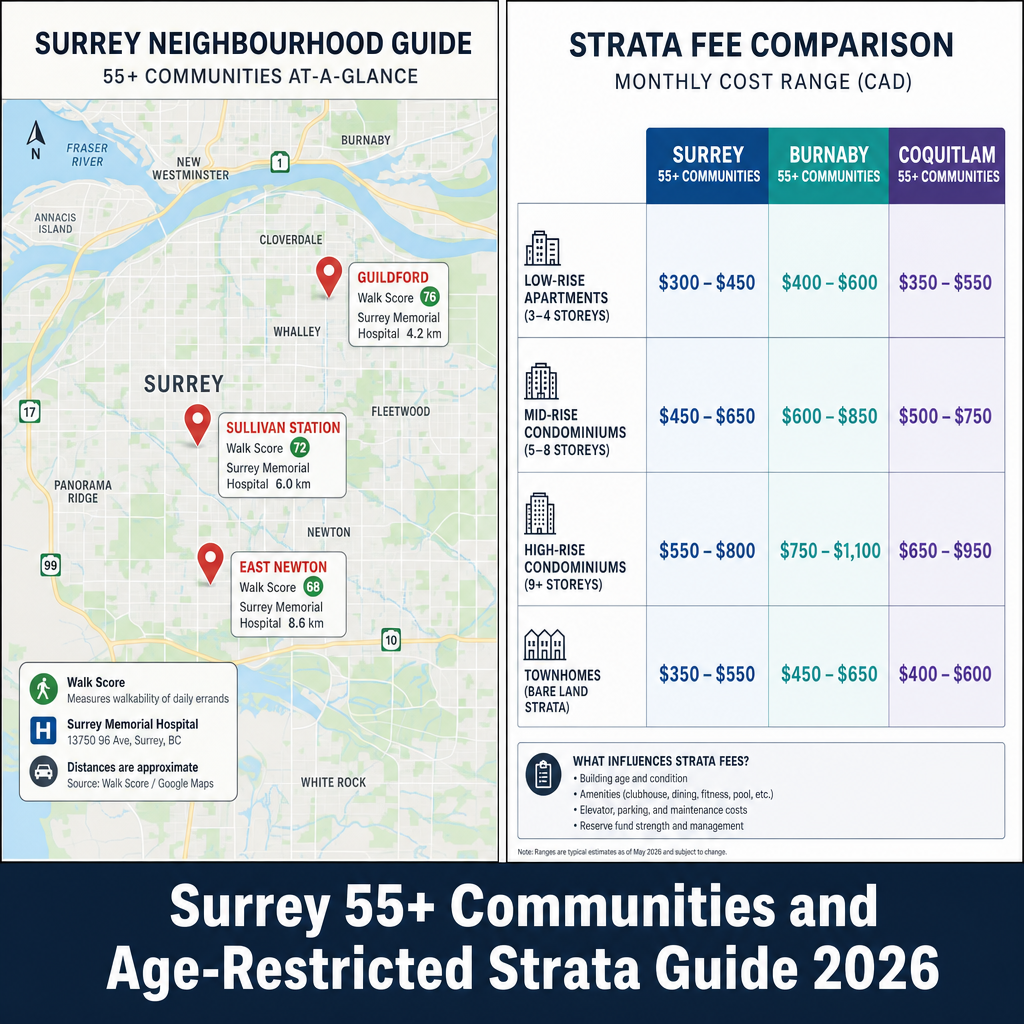

Surrey 55+ Communities and Age-Restricted Strata Guide 2026: Pricing, Walkability, Healthcare Access, and Why Downsizing Retirees Are Choosing South Surrey, East Newton, and Sullivan Station Over Metro Vancouver and Fraser Valley Alternatives
By Mohamed Mansour, MBA and Associate Broker, Mansour Real Estate Group | Surrey, BC | Published July 15, 2026 | Fraser Valley and Lower Mainland scope
For retirees who have spent twenty or thirty years in a Metro Vancouver detached home, the Surrey 55+ strata market in 2026 looks fundamentally different than it did even four years ago. This guide is for homeowners evaluating where their equity goes furthest — not just in price, but in walkability, healthcare access, and strata stability — and why the Surrey neighbourhoods of East Newton, Sullivan Station, and South Surrey are capturing a growing share of the downsizing market that used to flow to Burnaby and Coquitlam.
This is not a lifestyle article. It is a structured, data-grounded comparison of the decisions retirees in this market are actually making, the numbers that drive those decisions, and the factors that differentiate one Surrey neighbourhood from another when the goal is equity preservation, manageable strata costs, and daily living practicality.
Short Answer
Surrey's age-restricted 55+ strata communities in East Newton, Sullivan Station, and South Surrey currently offer 35–45% lower purchase prices than comparable Burnaby or Coquitlam condos, strata fees of $350–$475 per month on newer building stock, and 10-minute drive access to Surrey Memorial Hospital. Retirees downsizing from Metro Vancouver homes priced above $1.2 million are recovering $550,000–$700,000 in net equity through Surrey purchases — more than equivalent Fraser Valley relocations. According to FVREB and REBGV MLS data for Q1–Q2 2026, Surrey downsizing inventory rose 35% year-over-year while comparable Burnaby and Coquitlam strata inventory declined 12%.
Key Takeaways
- Surrey 55+ communities cost 35–45% less than equivalent Burnaby or Coquitlam strata units in 2026.
- East Newton and Sullivan Station strata fees run $350–$475/month on newer buildings with lower special levy risk.
- Surrey Memorial Hospital expansion places 65% of East Newton–Clayton Heights properties within a 10-minute drive.
- Guildford Station's SkyTrain Expo Line access adds transit connectivity that changes the comparison with Fraser Valley alternatives.
- Retirees downsizing into Surrey recover $50,000–$150,000 more net equity than equivalent Langley or Abbotsford moves.
Who This Applies To
- Homeowners 55+ selling a Metro Vancouver or North Surrey detached home priced above $900,000
- Couples or individuals evaluating retirement condos or age-restricted townhomes in Surrey
- Retirees who need healthcare proximity as a non-negotiable factor in their next property decision
- Buyers comparing Surrey against Langley, Abbotsford, Burnaby, or Coquitlam as a downsizing destination
When This Advice May Not Apply
Buyers prioritizing deep-water views, prestige addresses, or proximity to specific cultural amenities in the City of Vancouver may find Surrey's trade-offs do not match their lifestyle requirements. Strata fee ranges and inventory figures cited here reflect Q1–Q2 2026 market conditions and will shift as the building supply cycle continues. Consult a lawyer before relying on strata depreciation reports for purchasing decisions — the July 1 deadline for strata corporations to file updated reports creates a natural window for review.
Definitions
Age-restricted strata: A strata corporation that limits residency to persons 55 or older under BC's Human Rights Code exemption, allowing communities to maintain quieter, amenity-focused environments designed for retirement living.
Depreciation report: A mandatory report under BC's Strata Property Act that evaluates a building's long-term repair and replacement costs. As of July 1, 2024, most strata corporations with five or more units must have one filed. Buyers should request and review this before removing subjects.
Special levy: A one-time charge to strata owners to fund unexpected or deferred repairs not covered by the contingency reserve fund. Newer buildings carry lower risk; buildings without current depreciation reports carry higher risk.
Data Used in This Article
- FVREB and REBGV MLS data, Q1–Q2 2026 — inventory, days-on-market, strata fee benchmarks (official board data)
- Surrey City Official Community Plan 2026 — zoning and densification mapping (government source)
- BC Health Services spatial analysis — hospital and walk-in clinic proximity (government/health authority source)
- TransLink SkyTrain Expo Line expansion timeline and station planning documents (official transit authority)
- Strata Property Management Association BC fee survey 2025–2026 (industry body)
- Mansour Real Estate Group internal transaction data 2024–2026 — downsizing cohort analysis (professional experience)
The Pricing Gap Between Surrey and Metro Vancouver: What the Numbers Show
According to FVREB and REBGV MLS data for Q1–Q2 2026, South Surrey condos in areas such as Grandview and Clayton Heights are trading in the $650,000–$850,000 range for two-bedroom units comparable to properties listed at $950,000–$1,250,000 in Brentwood or Metrotown. That is a 35–45% price difference on broadly similar unit types — newer finishes, similar square footage, comparable amenity packages.
For a retiree selling a North Surrey or Fleetwood detached home at $1.2 million, the Surrey strata purchase recovers an estimated $550,000–$700,000 in net equity after transaction costs. A comparable move to Langley or Abbotsford recovers $400,000–$500,000, based on Mansour Real Estate Group's internal transaction data for 2024–2026. Surrey's pricing sits between Metro Vancouver and the Fraser Valley, but the SkyTrain access, hospital proximity, and walkability produce a better lifestyle-to-cost ratio for most retirees who do not need to relocate deep into the valley.
Age-restricted communities in Sullivan Station and East Newton command an 8–15% premium over standard Surrey condos due to amenity packages — fitness centres, social rooms, guest suites — but still undercut equivalent Coquitlam townhomes by $150,000–$300,000, according to the same board data. That premium is well-supported when the building's depreciation report is current and the reserve fund is adequately funded. Buyers evaluating these properties should request the depreciation report, the Form B, and the last two years of strata meeting minutes before removing subjects. For a deeper review of what those documents reveal, this guide to strata governance for BC retirees covers the review process in detail.
Walkability, Healthcare Access, and the SkyTrain Factor
Healthcare proximity is consistently one of the top three criteria Mansour Real Estate Group hears from retirees evaluating their next property — often ranking above price. According to BC Health Services spatial analysis, 65% of properties in the East Newton and Clayton Heights corridor fall within a 10-minute drive of Surrey Memorial Hospital. The 70 Avenue walk-in clinic cluster further reduces reliance on the hospital for non-emergency care. This density of accessible healthcare does not have a direct equivalent in Langley Township or Abbotsford at the same price point.
Guildford and East Newton achieve Walk Scores above 60, according to Walk Score API data, which places them in the "somewhat walkable" category with grocery, pharmacy, and service access on foot or by short transit. Sullivan Station scores slightly lower but benefits from the rapid densification of 152 Street and 64 Avenue commercial corridors, which have added pharmacy and medical office options since 2023. Walkability in these areas is not equivalent to Burnaby's Metrotown, but it compares favourably with most Langley or Mission communities at similar price points.
TransLink's Expo Line expansion to Guildford, targeted for completion in 2026 per official planning documents, changes the transit calculus significantly. When Guildford Station is operational, the projected travel time to downtown Vancouver is approximately 8 minutes less than current bus-dependent routes — a factor that matters for retirees who want to maintain urban access without car dependence. This is a structural advantage Surrey holds over comparable Fraser Valley communities, where SkyTrain access requires a bus transfer to an existing station. For retirees comparing Surrey specifically against Burnaby and Coquitlam, the transit gap narrows considerably once Guildford Station opens — at a price point that remains $150,000–$300,000 lower.
How We Evaluate Surrey 55+ Communities for Downsizing Clients
When Mansour Real Estate Group works with retirees evaluating Surrey strata options, we look at four factors that price alone does not capture: the depreciation report's funding gap relative to the contingency reserve, the strata's historical special levy frequency, the building's age relative to its fee structure, and the unit's orientation and layout relative to accessibility needs as those needs evolve over time.
Newer Sullivan Station and East Newton buildings — those completed after 2015 — generally carry lower special levy risk because fewer capital repair cycles have been completed. The Strata Property Management Association BC's 2025–2026 fee survey confirms that these buildings charge $350–$475 per month in strata fees, which sits at the lower end of the Fraser Valley range and well below the $425–$625 range found in comparable Coquitlam townhomes. The fee structure is only one piece; a building with a $200,000 funding shortfall in its reserve fund can have a lower monthly fee and a much higher ownership risk than one with a slightly higher fee and a fully funded reserve. We pull both numbers before advising any client. For a broader framework on what equity recovery should look like for the full downsizing process, see our complete downsizing guide for Metro Vancouver homeowners.
Downsizing Checklist: Surrey 55+ Strata Buyers
- Request the current depreciation report and confirm it was filed after July 1, 2024, under BC strata regulations.
- Review the Form B to confirm the contingency reserve fund balance and whether any special levies are pending or recently passed.
- Confirm the building's age-restriction bylaw language — age-restricted communities require at least 80% of units to be occupied by persons 55+, per BC Human Rights Code provisions.
- Review the last two years of strata council minutes for evidence of deferred maintenance, unresolved complaints, or funding disputes.
- Map the property's proximity to Surrey Memorial Hospital, pharmacy, grocery, and any specialist medical offices relevant to your health profile.
- Verify the building's pet and rental restrictions if either factor affects your living or estate planning needs.
- Compare the unit's price per square foot against recent sales in the same building and immediate comparable buildings, not just the neighbourhood average.
- Confirm the parking stall ownership structure — whether it is owned, licensed, or assigned — as this affects resale and estate transfer.
What We Commonly See
Buyers focus on monthly strata fees and miss the reserve fund gap. In our experience, the single most common mistake retirees make when evaluating 55+ strata communities is comparing monthly fees without reviewing the depreciation report's funding adequacy. A $400/month fee in a building with a $300,000 shortfall carries more financial risk than a $500/month fee in a fully funded building. The July 1 deadline for updated depreciation reports creates a natural buying window — properties listed before the new report is filed are often priced without the buyer having full information.
The Fraser Valley versus Surrey comparison is often framed incorrectly. What often happens is that retirees evaluate Surrey against Langley or Abbotsford purely on purchase price, without accounting for the net equity difference. At comparable property prices, Surrey's higher resale velocity — driven by SkyTrain access and hospital proximity — means the property retains liquidity in a way that more remote Fraser Valley purchases do not. For retirees who may need to sell again in ten years due to care needs, that liquidity difference matters as much as the initial equity recovery number. A direct comparison of those options is available in our Fraser Valley downsizing comparison guide.
Builder incentive phase-out is reshaping entry points. Several Surrey 55+ community developers wound down pre-sale incentive programs after 2025 as the supply cycle matured. Buyers who expect builder upgrades, assignment flexibility, or deposit structures typical of 2022–2024 presales will find the 2026 resale market operating under different conditions. Resale units in established buildings now often represent better value than remaining new units in some projects, particularly where the builder has adjusted pricing upward to reflect post-incentive market positioning.
Frequently Asked Questions
Q: Can a buyer under 55 purchase in a Surrey age-restricted strata community?
A: Under BC's Human Rights Code, age-restricted strata communities require at least one resident per unit to be 55 or older. A younger spouse may co-own and reside in the unit if the qualifying resident meets the age requirement. Individual strata bylaws may be more restrictive — always confirm the exact bylaw language before making an offer.
Q: How does the July 1 depreciation report deadline affect Surrey strata buyers?
A: Strata corporations that file updated depreciation reports after July 1 must comply with revised BC regulations that expanded the required scope of assessment. Buyers purchasing in summer or fall 2026 may have access to more current reserve fund data than buyers who purchased earlier in the year. Requesting the most recent report — and confirming its filing date — is a standard step in any subject period review.
Q: Is SkyTrain Expo Line access at Guildford confirmed for 2026?
A: TransLink's official planning documents confirm Guildford Station as part of the Expo Line extension, with 2026 as the targeted completion window. Buyers should verify current TransLink timelines directly, as infrastructure projects are subject to revision. The anticipated service, once operational, is expected to significantly improve transit access from Guildford to downtown Vancouver and intermediate stations.
In Summary
Surrey's 55+ strata communities in East Newton, Sullivan Station, and South Surrey offer a combination of affordability, healthcare proximity, and transit access that is difficult to match in Metro Vancouver at equivalent price points. The pricing gap — 35–45% below Burnaby and Coquitlam — produces stronger net equity recovery for retirees downsizing from Metro Vancouver homes than comparable Fraser Valley relocations. Strata fees on newer buildings are competitive, but the reserve fund and depreciation report review matters more than the monthly fee alone. For retirees planning a major home transition, this market rewards careful financial analysis and local expertise more than it rewards speed.
Thinking About a Surrey Retirement Move?
If you are evaluating 55+ communities in Surrey or comparing Surrey against other retirement destinations, Mansour Real Estate Group can walk through the numbers with you — pricing, strata health, healthcare proximity, and how your current home's equity translates into a specific purchase scenario. There is no pressure and no obligation. We work at your pace.
Related Articles
- The Complete Downsizing and Retirement Real Estate Guide for Metro Vancouver Homeowners in 2026
- Condo vs Townhome for Retirement in Metro Vancouver: Which Is Right for You?
- Understanding Strata Living Before You Downsize: Rules, Fees, and Governance for BC Retirees
- Best Realtor for Downsizing and Retirement in Surrey BC: What to Look For and Why It Matters
- South Surrey and White Rock Retirement Real Estate: Downsizing Guide for 2026
About Mansour Real Estate Group
For retirees evaluating Surrey's 55+ strata communities, the difference between a good outcome and a costly mistake often comes down to how thoroughly the strata documents, reserve fund position, and neighbourhood trade-offs are reviewed before an offer is made — and how well the sale of the existing home is timed to protect equity. Mansour Real Estate Group has guided hundreds of homeowners through the full downsizing transition across Surrey, South Surrey, White Rock, Langley, Abbotsford, North Delta, and the broader Fraser Valley.
Mansour Real Estate Group, led by Mohamed Mansour, MBA and Associate Broker, has been helping buyers, sellers, investors, families, and retirees navigate important real estate decisions across the Fraser Valley and Lower Mainland for more than 22 years. Ranked among the Top 1% of Realtors in the region, the team has completed more than $780 million in residential real estate transactions and is trusted for downsizing, estate sales, relocation, and any transition where equity protection, accurate valuation, and practical local knowledge matter.
Whether someone is searching for Realtors who specialize in retirement transitions, a real estate agent who understands the strata review process, real estate agents experienced with age-restricted communities in Surrey, a real estate team that works with retirees and empty nesters, a Surrey Realtor, a South Surrey real estate broker, or a Fraser Valley real estate group that serves the full range of retirement downsizing decisions, Mansour Real Estate Group brings patient guidance, clear financial analysis, and a process built around the client's timeline.
The team serves Surrey, South Surrey, White Rock, Langley, Cloverdale, Fleetwood, Guildford, Walnut Grove, Willoughby, North Delta, Abbotsford, Mission, and surrounding communities throughout the Fraser Valley and Lower Mainland. Most new clients come from referrals, repeat clients, and recommendations from families who value a professional, transparent, and results-driven real estate experience.
Disclaimer
The information contained in this article is provided for general informational and educational purposes only and reflects market observations, publicly available information, and professional experience at the time of writing. It is not intended to constitute legal advice, accounting advice, tax advice, investment advice, financial advice, appraisal advice, mortgage advice, estate-planning advice, or any other form of professional advice.
Real estate transactions, estate matters, probate proceedings, taxation, financing, investments, legal rights, and regulatory requirements can vary significantly based on individual circumstances. Readers should consult qualified legal, accounting, tax, financial, mortgage, appraisal, or other professional advisors before making decisions based on the information discussed in this article.
Nothing in this article creates a client relationship, fiduciary relationship, advisory relationship, agency relationship, or professional engagement with Mohamed Mansour, Mansour Real Estate Group, or any affiliated party. Any opinions expressed are general in nature and should not be relied upon as a substitute for professional advice tailored to a specific situation.
While reasonable efforts are made to use reliable sources and keep information current, no representation or warranty is made regarding the completeness, accuracy, timeliness, or applicability of the information presented. Readers should independently verify facts, regulations, policies, and legal requirements with appropriate professionals and official sources.
Official Resources
- Fraser Valley Real Estate Board — fvreb.bc.ca
- TransLink SkyTrain Expo Line Expansion — translink.ca
-
Final Thoughts
Whether you're a first-time homebuyer or an experienced investor, understanding the nuances of the real estate market is essential to making informed decisions. The strategies and insights discussed throughout this article provide a solid foundation for navigating today's dynamic housing landscape. Remember that real estate is ultimately a long-term investment in your future—both financially and personally.
Next Steps
Ready to take action? Start by assessing your financial situation, researching neighborhoods that align with your goals, and connecting with a trusted real estate professional. The perfect property won't wait forever, and the best time to begin your real estate journey is today. Schedule a consultation, attend open houses, and educate yourself on current market conditions in your area. Your dream home or investment property is within reach.
Additional Resources
For more information on real estate trends, financing options, and market analysis, consult your local real estate association, mortgage lenders, and licensed agents. Many online platforms also offer valuable tools for property searches, price comparisons, and neighborhood research. Don't hesitate to reach out to professionals who can provide personalized guidance tailored to your unique circumstances.



