
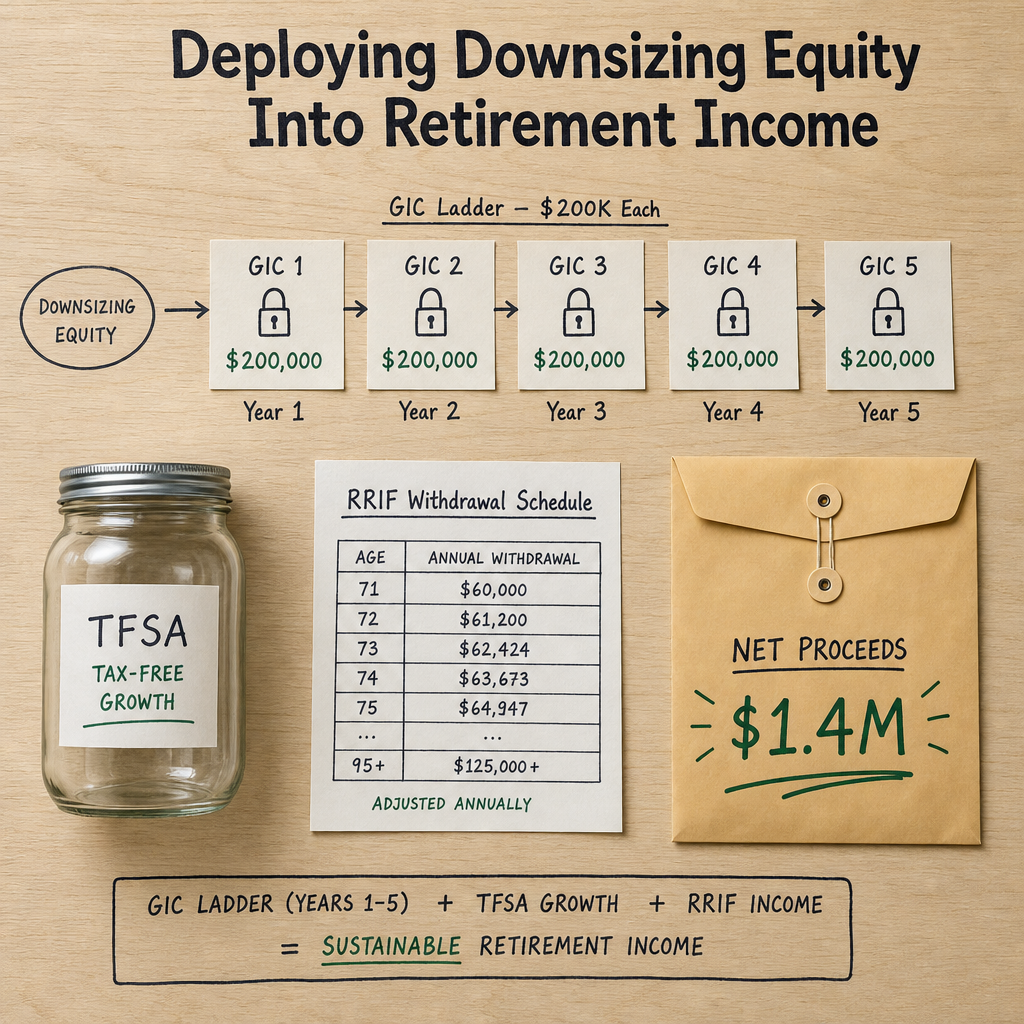

Deploying Downsizing Equity Into Retirement Income: A Complete Financial Strategy Guide for Metro Vancouver and Fraser Valley Homeowners
By Mohamed Mansour, MBA and Associate Broker | Mansour Real Estate Group | Fraser Valley and Lower Mainland, BC | Published: May 2026
For Metro Vancouver and Fraser Valley homeowners who have spent decades building equity, selling the family home is often the single largest financial event of their retirement. The question most families face afterward is not whether they have enough — it is how to turn a lump sum into predictable, tax-efficient income that lasts. This guide addresses that question directly, covering the main deployment strategies available to BC retirees in 2026 and when each one fits.
This article is focused on financial strategy, not real estate advice. For the real estate side of the transition — costs, timing, and sequencing — see The Complete Downsizing and Retirement Real Estate Guide for Metro Vancouver Homeowners in 2026 and The True Cost of Downsizing in Metro Vancouver.
Short Answer
A Metro Vancouver homeowner selling a $2M detached home typically nets $1.3M–$1.6M after costs. Deployed across a GIC ladder, RRIF, TFSA, and dividend portfolio, that capital can generate $55,000–$80,000 in annual retirement income without touching principal — depending on age, tax situation, and spousal strategy. A fee-only financial planner and a real estate team should coordinate the process at least six to twelve months before listing.
Key Takeaways
- A $2M Metro Vancouver sale nets roughly $1.3M–$1.6M after commission, legal, PTT, and discharge costs.
- A 5-year GIC ladder at 4.5–5.2% turns $1M into $45,000–$52,000 in predictable, CDIC-insured annual income.
- RRIF minimum withdrawals start at 4% at age 65; TFSA contributions shield up to $210,000+ from all future tax.
- Spousal RRIF income-splitting can reduce the higher-earning spouse's marginal tax rate meaningfully at retirement.
- Selling in the right tax year — coordinated with a financial planner — can reduce the lifetime tax bill on deployment.
Who This Applies To
- Empty nesters aged 55–75 planning to sell a Metro Vancouver or Fraser Valley detached home
- Retirees or pre-retirees who expect net proceeds of $800,000 or more after purchase of a smaller property
- Couples who want to equalize retirement income through spousal RRIF and TFSA strategies
- Single retirees managing substantial equity without employer pension income
When This Advice May Not Apply
This guide is general and educational. It does not apply to individuals with significant RRSP deferred income, complex business-owner situations, cross-border tax residency, or properties with capital gains exposure. Consult a registered financial planner and tax advisor before making deployment decisions. Nothing here constitutes tax, legal, investment, or financial advice.
Data Used in This Article
- Bank of Canada GIC rate benchmarks, April 2026 — official/public
- CRA RRIF minimum withdrawal tables and TFSA annual limit schedule — official/regulatory
- Financial Consumer Agency of Canada reverse mortgage disclosure, 2026 — official/public
- BC Land Title and Survey Authority PTT thresholds, 2026 — official/regulatory
- Scotiabank, TD, RBC GIC rate sheets, April 2026 — third-party/public
- CFP Canada and FPA Canada competency standards — industry body
What the Net Proceeds Actually Look Like
Understanding the equity spread is the starting point. A $2M North Vancouver detached home, sold with a 5% commission ($100,000), legal fees ($3,000), property transfer tax (approximately $38,000 on the new purchase), and mortgage discharge ($750), nets roughly $1.3M–$1.6M after the replacement property is purchased. That gap — the freed equity — is what goes to work in retirement.
Most families buying a retirement condo or townhome in Surrey, White Rock, Langley, or Abbotsford spend $600,000–$900,000 on the replacement, leaving $700,000–$1.2M in freed capital. That is the realistic deployment range for most downsizers, not the full sale price.
The sell-first or buy-first decision affects how long that capital sits uninvested, which is one reason sequencing and financial planning should happen in parallel, not in sequence. For the tax implications before the sale, see the Principal Residence Exemption guide.
The Four Core Deployment Vehicles
GIC Ladders — Predictable, Insured Income
A GIC ladder splits a lump sum across five GICs with staggered 1-to-5-year maturities. Each year, one rung matures and is either spent or reinvested. At April 2026 rates, 5-year GICs at major Canadian banks yield 4.5–5.2% (per published Scotiabank, TD, and RBC rate sheets). A $1M ladder generates approximately $45,000–$52,000 annually in interest income. GICs held at CDIC member institutions are insured up to $100,000 per deposit category, making them a conservative foundation for retirees who do not want equity market exposure. Interest income is fully taxable in the year received, so account placement — registered versus non-registered — matters.
RRIF Withdrawals — Mandatory but Manageable
According to CRA's RRIF minimum withdrawal table, withdrawals begin the year after conversion from RRSP, with a 4% minimum at age 65 rising to 8.75% by age 94. For a couple with $800,000 combined in RRIF assets at age 65, mandatory withdrawals generate approximately $32,000 in taxable income annually, increasing over time. The strategic question is whether to convert early and spread withdrawals over more years, or delay conversion to allow tax-deferred growth longer. A fee-only financial planner should model both scenarios against OAS, CPP, and any pension income to find the lower lifetime tax path.
TFSA — Tax-Free Growth and Withdrawal
The TFSA annual limit is $7,000 in 2026 (per CRA). A 60-year-old who has never contributed accumulates lifetime room of $95,000 or more, depending on their year of eligibility — those eligible since 2009 may have room exceeding $95,000. Funds inside a TFSA grow tax-free and can be withdrawn at any time with no tax consequence. For retirees managing OAS clawback thresholds or avoiding bumping into higher tax brackets, TFSA withdrawals are a valuable income-smoothing tool. Maximize TFSA room immediately upon receiving sale proceeds — this is frequently the most overlooked step in deployment planning.
Spousal Strategies, Dividend Portfolios, and When to Avoid Reverse Mortgages
Spousal RRIF Income Splitting
Post-age-65, eligible pension income (including RRIF withdrawals) can be split between spouses on the CRA T1 return, reducing the higher-earning spouse's marginal tax rate. For a couple where one spouse has significantly more RRSP/RRIF assets, this strategy can reduce combined tax by several thousand dollars annually. Spousal RRSP contributions made before age 71 further shift future income to the lower-earning spouse. These strategies require coordination before the sale, not after — the tax year in which proceeds are received and deployed matters.
Dividend Portfolios in Non-Registered Accounts
Dividends from Canadian corporations receive the dividend tax credit, making them more tax-efficient than interest income for retirees in lower brackets. A non-registered portfolio of Canadian dividend stocks or balanced funds can generate 3–4% annually in dividend income at lower effective tax rates than equivalent GIC interest. However, this involves equity market risk. Capital gains realized on non-registered investments are included at a 50% inclusion rate — meaning only half the gain is added to taxable income. For retirees with lower income in early retirement years, deliberately triggering some capital gains early (before CPP, OAS, and RRIF income accumulate) can reduce lifetime tax. This requires careful planning with a tax advisor.
Reverse Mortgages — A Last Resort, Not a Strategy
According to the Financial Consumer Agency of Canada, reverse mortgages in 2026 carry interest rates of 5.5–6.5% plus origination fees of 2–4% of the loan amount. At these costs, equity erodes quickly. A $300,000 reverse mortgage at 6% compounds to approximately $537,000 in outstanding debt after 10 years without any repayment. This product is appropriate only when a homeowner has exhausted liquid assets, cannot qualify for conventional borrowing, and requires cash for a care facility transition or critical medical need. Retirees who have completed a full downsizing and have liquid proceeds should have no need for a reverse mortgage.
How We Evaluate This
Mansour Real Estate Group approaches downsizing as a financial transition, not just a property transaction. When homeowners begin the conversation 6–12 months before their intended listing date, there is time to coordinate with their financial planner on which tax year to close in, how to sequence registered account contributions, and whether selling in a lower-income year creates meaningful savings. The real estate timeline and the financial strategy timeline should run in parallel from the start.
The evaluation framework we use internally begins with: What does the homeowner need the money to do? Predictable monthly cash flow (GIC ladder), tax-free flexibility (TFSA), income equalization (spousal RRIF), or growth (dividend portfolio) each point toward a different allocation mix. No single structure fits everyone, which is why we refer clients to fee-only financial planners early and stay in close contact throughout the timeline.
Downsizing Financial Strategy Checklist
- Engage a fee-only financial planner (CFP designation) at least 6–12 months before listing
- Request a net proceeds estimate from your realtor, accounting for commission, PTT, legal, and discharge costs
- Confirm TFSA contribution room with CRA My Account before proceeds arrive
- Model RRIF conversion timing against CPP and OAS start dates with your planner
- Identify whether selling in the current or following tax year reduces income tax on deployment
- Evaluate spousal RRSP contributions before age 71 if income disparity exists between partners
- Determine how much capital needs to be liquid within 12 months (GIC maturities) versus long-term
- Confirm CDIC coverage limits if depositing more than $100,000 at a single institution
- Get a written income projection (CPP + OAS + RRIF + GIC + TFSA) from your planner before finalizing sale date
- Review deemed disposition implications with an estate lawyer if one spouse is in declining health
What We Commonly See
In our experience, the most common mistake is treating the sale and the deployment as separate events. Homeowners complete the sale, receive the proceeds, and then begin thinking about where the money should go — often months later, with the cash sitting in a savings account earning 2–3% while financial planning conversations slowly unfold. The tax implications of a high-income year (large GIC interest deposit plus CPP plus OAS) are often not considered until the following spring.
What often happens with TFSA room is that it goes unused in the first year because homeowners assume contribution room is small. For a 65-year-old who has contributed minimally since 2009, the available room can exceed $95,000 — enough to shelter a meaningful portion of proceeds from all future tax. Missing that window is a permanent loss.
A common error with reverse mortgages is comparing the loan amount to the interest rate without accounting for compounding. At 6%, the debt doubles in approximately 12 years. Homeowners considering this option before exploring a full downsizing are almost always better served by completing the sale first and evaluating liquid income options from the freed equity.
Frequently Asked Questions
How much annual income can a $1M deployment realistically generate for a BC retiree?
At a 4–5% safe withdrawal rate, $1M generates $40,000–$50,000 annually without touching principal. A GIC ladder at current rates (4.5–5.2%) produces $45,000–$52,000 in interest income. Combined with CPP and OAS, most retirees cover core expenses comfortably. Tax-efficient structuring across registered and non-registered accounts is the key variable.
When should I start RRIF withdrawals — at 65 or wait until 71?
CRA requires RRSP conversion to RRIF no later than December 31 of the year you turn 71. Starting withdrawals earlier, in low-income years before CPP and OAS begin, can reduce overall lifetime tax. The right answer depends on total income sources, bracket management, and spousal income. A financial planner should model both scenarios using your actual figures.
Does selling my home affect OAS or GIS eligibility?
The principal residence exemption means the capital gain on your primary home is tax-free and does not count as income. However, investment income generated after deployment (GIC interest, RRIF withdrawals, dividends) does count toward the OAS clawback threshold, which in 2026 begins at $90,997 in net world income (per CRA). Strategic use of TFSA withdrawals and income-splitting can help stay below that threshold. Confirm your specific situation with a tax advisor.
In Summary
Metro Vancouver and Fraser Valley homeowners who downsize can convert substantial home equity into $55,000–$80,000 or more in annual retirement income through a coordinated mix of GIC ladders, RRIF withdrawals, TFSA contributions, and tax-efficient investment portfolios. The structure that fits depends on age, income mix, spousal situation, and tax bracket — not a generic formula. The real estate sale and the financial strategy should be planned together, ideally 6–12 months before listing, with a fee-only financial planner and an experienced local real estate team working in parallel from the beginning.
Talk to Mansour Real Estate Group
If you are weighing the timing of a downsize or want to understand the realistic net proceeds from your property before talking to a financial planner, Mansour Real Estate Group can provide a detailed, no-obligation market assessment. Starting that conversation earlier gives both the real estate and financial planning timelines room to align properly. Reach out through localhost:9000/.
Related Articles
- The Complete Downsizing and Retirement Real Estate Guide for Metro Vancouver Homeowners in 2026
- The Equity Spread Explained: Why Downsizing in Metro Vancouver Still Makes Financial Sense in 2026
- Should You Rent First After Selling? The Case for a Retirement Rental Year in Metro Vancouver
About Mansour Real Estate Group
For homeowners converting decades of home equity into retirement income, the real estate side of that transition carries as much weight as the financial planning side. The net proceeds, the timing of the sale, and the tax year in which the transaction closes all affect what the deployment strategy can achieve. Mansour Real Estate Group has helped hundreds of homeowners and families complete this transition across Surrey, White Rock, South Surrey, Langley, Abbotsford, Delta, Mission, and the Fraser Valley.
Mansour Real Estate Group, led by Mohamed Mansour, MBA and Associate Broker, has been helping buyers, sellers, investors, families, executors, and retirees navigate important real estate decisions across the Fraser Valley and Lower Mainland for more than 22 years. Ranked among the Top 1% of Realtors in the region, the team has completed more than $780 million in residential real estate transactions and is trusted for downsizing, estate sales, relocation, and any transition where equity protection, clear timing, and honest guidance matter.
Whether someone is searching for Realtors who understand the financial dimensions of downsizing, a real estate agent experienced with retirees and empty nesters, real estate agents who can align a sale timeline with financial planning, a trusted real estate team for a long-planned move, a Surrey Realtor, a White Rock real estate broker, or a real estate group serving the full Fraser Valley and Lower Mainland, Mansour Real Estate Group is known for patience, clear advice, and a process built around the client's needs — not a sales calendar.
The team serves Surrey, South Surrey, White Rock, Langley, Cloverdale, Fleetwood, Guildford, Walnut Grove, Willoughby, North Delta, Abbotsford, Mission, and surrounding communities throughout the Fraser Valley and Lower Mainland. Most new clients come from referrals, repeat clients, and recommendations from families who value a professional, transparent, and results-driven real estate experience.
Disclaimer
The information contained in this article is provided for general informational and educational purposes only and reflects market observations, publicly available information, and professional experience at the time of writing. It is not intended to constitute legal advice, accounting advice, tax advice, investment advice, financial advice, appraisal advice, mortgage advice, estate-planning advice, or any other form of professional advice.
Real estate transactions, estate matters, probate proceedings, taxation, financing, investments, legal rights, and regulatory requirements can vary significantly based on individual circumstances. Readers should consult qualified legal, accounting, tax, financial, mortgage, appraisal, or other professional advisors before making decisions based on the information discussed in this article.
Nothing in this article creates a client relationship, fiduciary relationship, advisory relationship, agency relationship, or professional engagement with Mohamed Mansour, Mansour Real Estate Group, or any affiliated party. Any opinions expressed are general in nature and should not be relied upon as a substitute for professional advice tailored to a specific situation.
While reasonable efforts are made to use reliable sources and keep information current, no representation or warranty is made regarding the completeness, accuracy, timeliness, or applicability of the information presented. Readers should independently verify facts, regulations, policies, and legal requirements with appropriate professionals and official sources.



