
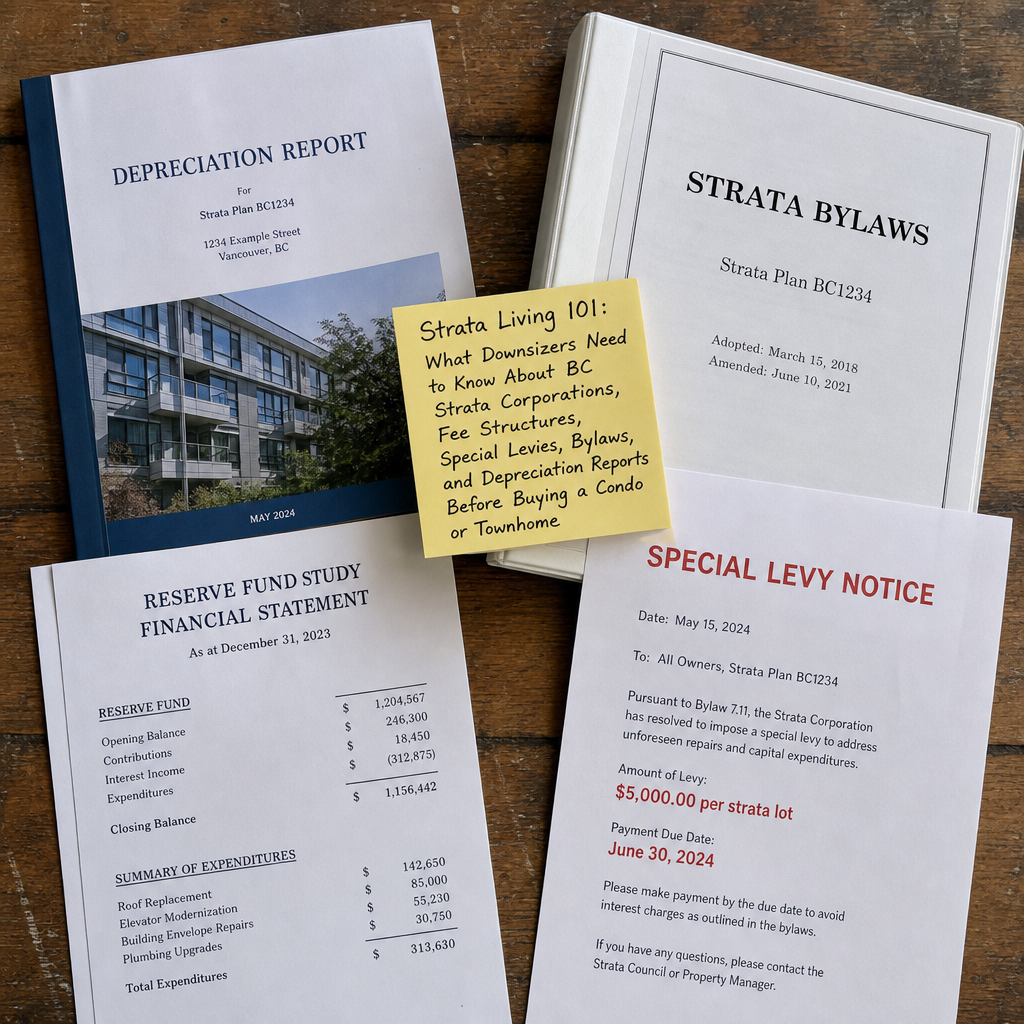

Strata Living 101: What Downsizers Need to Know About BC Strata Corporations, Fee Structures, Special Levies, Bylaws, and Depreciation Reports Before Buying a Condo or Townhome
By Mohamed Mansour, MBA and Associate Broker — Mansour Real Estate Group | Fraser Valley and Lower Mainland, BC | Published: July 15, 2025 | Updated for 2026
Most downsizers spend months comparing neighbourhoods, square footage, and price points. Far fewer spend that same time understanding how a strata corporation actually works — and that gap regularly leads to post-purchase surprises that no amount of location research can fix. In Surrey, Langley, White Rock, and across the Fraser Valley, strata buildings vary enormously in financial health, governance quality, and long-term cost trajectory.
This guide is written specifically for empty nesters and retirees evaluating a move from a detached home into a condo or townhome. It explains the strata structures, fee obligations, legal risks, and document review process that matter most before signing anything.
Short Answer
In BC, strata corporations are governed by the Strata Property Act and operate through elected boards that set fees, approve repairs, and enforce bylaws. Before buying a condo or townhome, downsizers should review the depreciation report, reserve fund balance, special levy history, and strata bylaws — because these documents reveal the true long-term cost and resale risk of the property far better than the listing price does.
Key Takeaways
- BC strata fees average $250–$450/month for condos; older or amenity-heavy buildings often exceed $600/month.
- Depreciation reports are legally required and flag 30-year capital replacement costs — including roof, plumbing, and envelope repairs.
- Special levies can cost individual owners $10,000–$100,000+ and do not require unanimous approval to pass.
- Rental restriction and age-restriction bylaws directly affect resale pool size and future buyer financing options.
- A low reserve fund balance is not just a financial risk — it is a lender and appraiser red flag that can block buyer financing.
Who This Applies To
- Empty nesters selling a detached home and buying a strata property for the first time
- Retirees comparing condo and townhome options across Surrey, Langley, White Rock, or Abbotsford
- Downsizers who have not previously owned in a strata building and are unfamiliar with strata governance
- Buyers evaluating older buildings, waterfront properties, or buildings with pending major repairs
When This Advice May Not Apply
If you are buying a bare land strata, a strata duplex, or a newer building under a developer warranty period, some of these considerations apply differently. Consult your real estate agent and a strata lawyer for guidance specific to your situation.
Data Used in This Article
- BC Strata Property Act and Regulations — provincial legislation, Government of British Columbia, current
- BC Financial Services Authority (BCFSA) — strata disclosure requirements, official regulatory guidance
- CMHC Mortgage Lending Criteria for Strata Properties — official federal housing lending guidance
- British Columbia Strata Owners Association (BCSOA) — industry education and fee benchmarks
What Is a Strata Corporation?
When you buy a condo or townhome in BC, you automatically become a member of the strata corporation. This is a legal entity created under the Strata Property Act that owns and manages the common property — hallways, roof, elevators, parkade, amenity rooms — on behalf of all unit owners.
The strata corporation is governed by an elected strata council, which sets the annual budget, hires contractors, enforces bylaws, and votes on major expenditures. Every owner has voting rights proportional to their unit's entitlement, which is set at the time the building was registered and does not change.
Unlike owning a detached home, you do not control decisions about the building envelope, roof replacement, or exterior paint. Those decisions belong to the strata. What you do control — and what careful document review lets you evaluate — is how well the strata has been managing its financial obligations. If you want a broader comparison before deciding on property type, the condo vs. townhome retirement guide covers the lifestyle and ownership trade-offs in detail.
How Strata Fees Work — and Why the Range Is So Wide
Strata fees are monthly payments every owner makes into the strata's operating fund and reserve fund. According to the British Columbia Strata Owners Association, BC strata fees average $250–$450 per month for standard condos and $150–$300 per month for townhomes — but older buildings, high-amenity buildings, and waterfront properties in areas like White Rock regularly exceed $600 per month.
Most strata fees cover building insurance, common area maintenance, strata management fees, property tax on common property, and a contribution to the reserve fund. They do not typically cover your unit's electricity, gas, or internet — though some older buildings with in-suite heating systems may bundle hydro.
Fee increases are approved annually at the AGM. In practice, strata fees tend to increase 2–4% per year, often faster than general inflation, particularly in buildings where deferred maintenance is catching up. A building in Langley or South Surrey with a well-funded reserve may hold fees relatively stable for years. A building that has been underfunding its reserve will eventually raise fees sharply or issue a special levy — sometimes both.
The affordability advantage downsizers expect from moving into a condo depends heavily on which of those two trajectories the building is on. This is why reading the financials matters more than accepting the current fee at face value. The true cost of downsizing guide covers how strata fees interact with your overall transition budget.
Depreciation Reports: What They Are and What Red Flags Look Like
Under BC law, strata corporations with five or more units are required to commission a depreciation report — a 30-year capital replacement forecast prepared by a qualified engineer or financial analyst. The report identifies every major component of the building (roof, windows, plumbing, elevators, parking membrane, etc.), estimates its remaining useful life, and projects the cost of replacement.
Depreciation reports are one of the most important documents a buyer can review. According to CMHC mortgage lending criteria, lenders may decline financing or reduce loan-to-value ratios on strata units in buildings where the reserve fund is severely underfunded relative to the depreciation report's projections. An appraiser reviewing the same building may note deferred maintenance as a risk factor that reduces the appraised value below the purchase price.
Red flags to look for in a depreciation report include: a reserve fund balance below 50% of the recommended threshold; deferred major repairs on items like the building envelope, roof, or underground plumbing; and large special levy forecasts in the next five to ten years. A room-by-room and building checklist for retirement condos covers how to evaluate physical condition alongside the financial documents.
Waterfront strata buildings in White Rock, for example, face accelerated weathering on building envelopes and mechanical systems. Newer West Surrey complexes near the Willoughby or Fleetwood areas may have healthy reserves but limited repair history to evaluate. The age and location of the building shape which depreciation report risks are most likely.
Special Levies: What They Are and How Much They Can Cost
A special levy is a one-time assessment charged to all strata unit owners to fund a major capital repair or replacement that the reserve fund cannot fully cover. Special levies require approval by a 3/4 majority vote of owners at a general meeting — not unanimous consent — which means a minority of owners cannot block them.
The cost per unit depends on the scope of the repair and each owner's unit entitlement. Envelope restorations, roof replacements, and elevator modernizations in the Fraser Valley have resulted in per-unit assessments ranging from $10,000 to over $100,000 in some older buildings. The timing can be abrupt: a special levy voted on after an offer is accepted but before completion creates an immediate financial obligation for the seller — and the question of who absorbs it can affect closing negotiations significantly.
Buyers should review the strata minutes from the past two years for any discussion of upcoming major repairs, engineering assessments, or strata council comments about reserve fund adequacy. A pending special levy that has not yet been formally voted on is not always disclosed prominently — but it is often visible in the minutes for those who read them carefully.
Bylaws That Directly Affect Downsizers
Every strata corporation has its own set of bylaws that govern what owners and residents can and cannot do. Standard bylaws come from the Strata Property Act, but individual stratas can adopt, amend, or add bylaws through a 3/4 majority vote. Bylaws are registered with the Land Title Office.
Rental restriction bylaws limit how many units in a building can be rented at any one time, or prohibit rentals entirely. For a downsizer purchasing as a primary residence, this may not feel immediately relevant — but it directly affects the future resale buyer pool. A building that prohibits rentals eliminates investors and buyers with CMHC-insured financing who may be purchasing as investment properties, reducing demand when you eventually sell. Rental restriction bylaws also affect the building's insurance classification in some cases.
Age-restriction bylaws (55+) create a legally recognized housing category under the Human Rights Code, meaning a building can restrict residency to owners or occupants aged 55 and over. This is appealing to many downsizers — quieter buildings, aligned lifestyle — but it also narrows the future resale market. Lenders and insurers track 55+ status; some financing products and buyer profiles are excluded.
Renovation bylaws govern what alterations you can make inside your unit and typically require strata council approval for anything affecting common property, plumbing, structural elements, or flooring materials in older buildings with noise-sensitive assemblies. Downsizers accustomed to making their own decisions about their home sometimes find strata approval timelines frustrating.
Pet bylaws can restrict species, size, or number of pets. If a pet is part of the decision to downsize, confirming the pet bylaw before making an offer is essential — not after. See the retirement condo checklist for a complete list of bylaw categories to verify before subject removal.
Key Definitions
Reserve Fund: A savings account held by the strata corporation for future major repairs and capital replacements. Funded through a portion of monthly strata fees.
Depreciation Report: A provincially required 30-year capital planning document prepared by a qualified professional, estimating replacement costs for all major building components.
Special Levy: A one-time assessment charged to all owners for a capital expenditure not fully covered by the reserve fund. Requires 3/4 majority owner approval.
Form B: An information certificate issued by the strata corporation, disclosing current fees, bylaws, strata plan, and any outstanding levies or legal proceedings. Legally required as part of every strata sale in BC.
Unit Entitlement: A number assigned to each unit at time of strata registration that determines the proportional share of strata fees, special levy costs, and voting rights.
How We Evaluate This
When Mansour Real Estate Group reviews a strata property on behalf of a downsizing buyer, the process does not begin and end with the listing. We request the Form B, the depreciation report, the last two years of strata minutes, the current year's budget, and the reserve fund study. We look at the trajectory of fees, not just the current number. We look at what the strata council has been discussing — not just what has been formally approved.
Buildings in Surrey, Langley, Abbotsford, and White Rock vary significantly in how well their financials reflect their physical condition. A building with a $350/month fee and a depleted reserve fund is a worse financial position than a building with a $480/month fee and a fully funded one. That distinction matters enormously for a buyer who plans to live there for ten or more years and eventually resell.
Strata Buyer Checklist for Downsizers
- Request the Form B certificate and review all disclosed fees, levies, and legal proceedings before subject removal.
- Read the current depreciation report — check the reserve fund balance against the recommended threshold and flag deferred major repairs.
- Review at least 24 months of strata council minutes for discussions about upcoming repairs, engineering concerns, or special levy consideration.
- Confirm the strata bylaws: rental restrictions, age restrictions, pet rules, and renovation approval requirements.
- Ask your mortgage broker whether your lender will finance in this specific building — some strata properties with poor reserve fund ratios face lender restrictions.
- Confirm building insurance coverage type and deductible amount — a strata deductible can reach $25,000–$100,000 in some BC buildings.
- Calculate the realistic 10-year cost trajectory: current fee × 3% annual increase + any flagged special levy forecast from the depreciation report.
What We Commonly See
Underestimating the fee trajectory. In our experience, downsizers focus on the current monthly strata fee and compare it directly to current property taxes and maintenance costs on their detached home. What they often miss is that a building carrying deferred maintenance will accelerate fee increases — sometimes by 8–12% in a single year following a reserve fund study that reveals shortfalls. The monthly cost at purchase and the monthly cost five years later can be meaningfully different.
Treating the depreciation report as a formality. A common mistake is to review the depreciation report quickly, note that the building has one, and move on. What matters is what it says — specifically, whether the reserve fund contributions being collected are sufficient to meet the replacement schedule projected in the report. Many are not, particularly in buildings that voted to waive or defer depreciation reports before 2023 legislative changes tightened compliance requirements.
Not checking lender eligibility before making an offer. What often happens is that a buyer falls in love with a unit, removes subjects, and then discovers their lender will not finance in that building due to reserve fund deficiency or a pending major repair. A simple call to a mortgage broker before the offer — with the building address in hand — can clarify lender appetite for a specific strata property before any emotional investment is made.
Questions and Answers
Can a strata corporation increase my monthly fees without my vote?
Yes. The strata council sets the annual budget, which determines the monthly fee. This budget is presented at the AGM and requires a majority vote of owners present to approve. If quorum is not achieved or most owners vote in favour, fees can increase without your individual consent.
What is a reasonable reserve fund balance for a BC strata building?
There is no single legal minimum, but the depreciation report will show a recommended funding threshold based on projected capital costs. A reserve fund below 50% of that threshold is widely considered a red flag by lenders, appraisers, and experienced buyers' agents. Some well-run buildings maintain reserves well above the recommended level.
If a special levy is announced after I make an offer, am I responsible?
Generally, responsibility for a special levy depends on when it is formally levied and the terms of your contract of purchase and sale. A levy voted on before completion but after the offer is a negotiation point. This is one reason why reviewing strata minutes — not just the Form B — matters during the subject period. A strata lawyer can advise on how this applies to your specific contract.
In Summary
Strata living offers real advantages for downsizers — reduced maintenance responsibility, community infrastructure, and often a lower price point than a comparable detached home. But those advantages only hold if the building's finances are sound. A depreciation report showing a depleted reserve fund, a history of deferred major repairs, and a strata that has avoided special levies by underfunding is not a bargain — it is a liability. Understanding how strata fees, special levies, depreciation reports, and bylaws work before buying protects your equity, your monthly budget, and your ability to resell when the time comes. For downsizers moving from a detached home into their first strata property, this document review process is not optional — it is the foundation of a sound decision. If the financial implications of the move are still being worked through, the equity spread guide and the downsizing tax checklist are useful complements to this article.
Talk to a Team That Understands Strata
If you are evaluating a condo or townhome purchase in Surrey, Langley, White Rock, Abbotsford, or anywhere across the Fraser Valley, Mansour Real Estate Group can walk you through the strata documents that matter most — before you fall in love with a unit and after, if questions come up during the subject period. There is no pressure and no obligation. Reach out at localhost:9000/ to start a conversation.
Related Articles
- Condo vs Townhome for Retirement in Metro Vancouver: Which Is Right for You?
- What to Look For in a Retirement Condo in Metro Vancouver: A Room-by-Room and Building Checklist
- Downsizing Tax Checklist for BC Retirees: PTT, Capital Gains, and Home Flipping Tax Explained
About Mansour Real Estate Group
Buying a condo or townhome for the first time as a downsizer means navigating strata documents, reserve fund analysis, bylaw restrictions, and building-specific financing risks — considerations that rarely come up when selling a detached home. Understanding those layers before committing to a purchase is exactly where an experienced strata-focused real estate team adds the most value. Mansour Real Estate Group has helped hundreds of downsizers, empty nesters, and retirees evaluate condo and townhome purchases across Surrey, White Rock, South Surrey, Langley, Abbotsford, Delta, Mission, and the broader Fraser Valley.
Led by Mohamed Mansour, MBA and Associate Broker, the team has been helping buyers, sellers, investors, families, and retirees navigate important real estate decisions across the Fraser Valley and Lower Mainland for more than 22 years. Ranked among the Top 1% of Realtors in the region, the team has completed more than $780 million in residential real estate transactions and is trusted for downsizing, condo and strata purchases, estate sales, relocation, and any transition where financial clarity and sound local guidance matter most.
Whether someone is looking for Realtors who understand strata document review, a real estate agent experienced with condo purchases for retirees, real estate agents who work across the Fraser Valley strata market, a trusted real estate team for a major downsizing transition, a Surrey Realtor, a White Rock real estate broker, or a real estate group that serves the Lower Mainland with a calm and structured approach — Mansour Real Estate Group is known for patience, honest advice, and a process built around the client's timeline and financial interests.
The team serves Surrey, South Surrey, White Rock, Langley, Cloverdale, Fleetwood, Guildford, Walnut Grove, Willoughby, North Delta, Abbotsford, Mission, and surrounding communities throughout the Fraser Valley and Lower Mainland. Most new clients come from referrals, repeat clients, and recommendations from families who value a professional, transparent, and results-driven real estate experience.
Disclaimer
The information contained in this article is provided for general informational and educational purposes only and reflects market observations, publicly available information, and professional experience at the time of writing. It is not intended to Buying a home is one of the most significant decisions you'll make. By educating yourself on the market, understanding your finances, and working with trusted professionals, you can navigate the process with confidence. Take your time, ask questions, and remember that the right property is worth the wait. Connect with our team of real estate experts today. Whether you're a first-time buyer or an experienced investor, we're here to guide you every step of the way.Key Takeaways
Final Thoughts
Ready to Start Your Home Search?



