
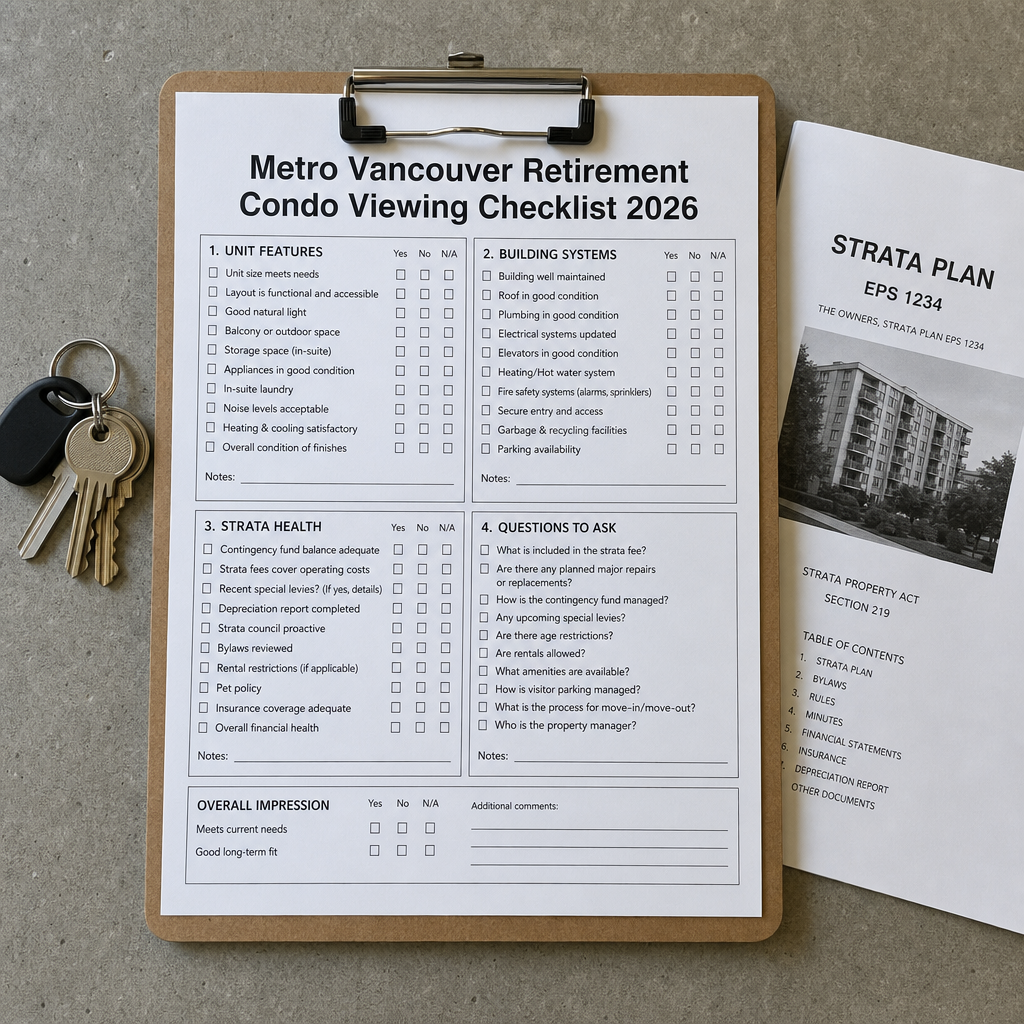

Metro Vancouver Retirement Condo Viewing Checklist 2026: Unit-Level Features, Building Systems, Strata Health, and Critical Questions to Ask Before Making an Offer
By Mohamed Mansour, MBA and Associate Broker — Mansour Real Estate Group | Fraser Valley and Lower Mainland | Published: July 22, 2025
Most retirees viewing condos in Metro Vancouver know what they want in a unit — natural light, a second bedroom, in-suite laundry. What they often miss is what sits behind the walls and inside the strata's financial records. A unit that looks right on a Tuesday afternoon can cost tens of thousands in special levies by the following spring.
This checklist is for retirees actively viewing condos and for the families helping them evaluate properties. It is also useful for sellers to understand what experienced buyers are checking — because buyers who evaluate thoroughly make faster decisions and fewer conditional offers. If you are earlier in your planning, The Complete Downsizing and Retirement Real Estate Guide for Metro Vancouver Homeowners in 2026 covers the full decision framework from start to finish.
Short Answer
A retirement condo viewing in Metro Vancouver requires evaluating four layers: unit-level accessibility and livability, building systems and mechanical condition, strata financial health including reserve fund adequacy and special levy risk, and the governance environment. Buyers who work through all four layers before making an offer avoid the most common sources of post-purchase regret and costly renegotiations.
Key Takeaways
- Reserve fund adequacy below 60% of the depreciation report target regularly causes financing difficulties and should be treated as a red flag.
- Buildings over 30 years old require closer mechanical scrutiny — lenders increasingly request elevator and envelope inspection reports before approving financing.
- Form B documents must be reviewed before making an offer — they disclose strata fees, outstanding levies, and bylaw restrictions that directly affect retirement suitability.
- Proximity to transit and healthcare within walkable distances has a measurable effect on long-term resale appeal and daily lifestyle satisfaction for retirees.
- Condos in Metro Vancouver are averaging 45 to 60-plus days on market in 2026 — buyers who evaluate thoroughly make faster, more confident decisions.
Who This Applies To
- Retirees or near-retirees viewing condos in Metro Vancouver, Surrey, White Rock, South Surrey, Langley, or Abbotsford
- Families helping an aging parent evaluate a retirement condo purchase
- Homeowners who have already sold their detached home and are under timeline pressure
- Buyers coming from a non-strata ownership background with limited strata experience
When This Advice May Not Apply
Buyers purchasing a newer building (five years old or less) will find some mechanical and reserve fund concerns less pressing, though Form B and bylaw review remain essential. Buyers in 55-plus communities face additional age-restriction rules not addressed in full here — consult the strata bylaws directly and seek legal advice on occupancy eligibility before making any offer.
Key Terms
Form B: A disclosure document required under the BC Strata Property Act that states current strata fees, outstanding levies, bylaw restrictions, and pending legal proceedings. Sellers must provide it upon request.
Depreciation Report: A long-term capital planning document estimating the remaining life and replacement cost of major building components. BC strata corporations with five or more units are required to obtain one at least every five years under updated provincial rules.
Reserve Fund: Money set aside by the strata corporation to cover future major repairs. A reserve fund significantly below the depreciation report's recommended balance signals higher special levy risk.
Special Levy: A one-time charge assessed against all strata owners when the reserve fund cannot cover a major repair — such as a roof replacement, elevator overhaul, or building envelope remediation.
Data Used in This Article
- BC Strata Property Act and BCFSA Form B disclosure requirements (2024–2025) — Official regulatory source
- BC Assessment depreciation reporting standards and reserve fund adequacy guidelines — Official regulatory source
- Greater Vancouver Realtors market data on days-on-market by property type (2025–2026) — Industry board reporting
- Mortgage Professionals Canada strata financing criteria updates (2026) — Industry body
- CARP and Metro Vancouver seniors' services retiree housing preference research — Third-party research, used for directional context only
Layer One: Unit-Level Features That Affect Retirement Livability
The starting point is always the unit itself. Retirement suitability is not simply about square footage or finishes — it is about whether the layout and physical features will still work for you five or ten years from now.
Entry and interior accessibility: No-step entry from the parking area and lobby to the unit door matters more than most buyers anticipate at viewing time. Check that doorways are at least 32 inches wide — 36 inches is preferable for long-term mobility aid compatibility. Walk-in showers with a low or zero threshold, lever-style door handles, and light switches at accessible heights are practical signals that a unit was designed or updated with aging-in-place in mind.
In-suite laundry: Confirm that laundry is full-size, not a stacked apartment unit. Shared laundry on a different floor adds daily friction that compounds over time.
Storage: Assess whether the in-suite storage, locker, and parking stall location are practical. Retiring from a detached home typically means fewer possessions, but seasonal items, mobility aids, and hobby equipment still require accessible storage. A locker on a different floor from the parking level adds inconvenience most buyers underestimate.
Outdoor space: A balcony or patio with usable dimensions — at least 60 square feet — and southern or western exposure extends living space meaningfully. Check for privacy from adjacent units and building mechanical equipment, which can create noise on balconies facing mechanical rooms or rooftop equipment.
Noise: Visit at different times of day if possible. Condos near main corridors, elevator shafts, garbage chutes, or mechanical rooms carry predictable noise that is easy to miss on a single afternoon visit. The comparison between condo and townhome retirement options covers how unit positioning affects noise differently across building types.
Layer Two: Building Systems, Mechanical Condition, and Financing Implications
Building systems are where retirement condo purchases most often go wrong for buyers who focus only on the unit. A well-finished unit inside a building with aging mechanical systems is a liability, not a value.
Elevators: For buildings above three storeys, elevator reliability is not optional — it is a daily dependency. Ask the listing agent when elevators were last replaced or had a major refurbishment. Buildings over 30 years old with original elevator equipment face increasing maintenance costs and, in some cases, lender scrutiny. According to updated lending criteria tracked by Mortgage Professionals Canada, appraisers are increasingly flagging aging elevator systems in buildings where replacement is not yet funded in the reserve plan.
Building envelope: In Metro Vancouver, envelope failures — primarily water ingress through the cladding, windows, and roofing systems — have been a major source of special levies and strata financial stress since the leaky condo crisis of the 1980s and 1990s. Buildings constructed between approximately 1985 and 2000 that have not undergone envelope remediation warrant particular attention. Ask directly whether a remediation has occurred and request documentation.
Parkade and plumbing: Underground parkades in aging buildings often require membrane replacement or drainage repairs — costs that can run into hundreds of thousands of dollars and arrive as special levies. Plumbing material matters in older buildings: galvanized steel pipes in buildings from the 1970s and early 1980s may be approaching replacement age.
Financing note: If you are purchasing with a mortgage, discuss the building's age and known mechanical condition with your mortgage broker before making an offer. Some lenders decline financing on buildings over 30 years old without current inspection documentation, and reserve fund shortfalls can trigger appraisal adjustments that affect your approved loan amount. The full cost of downsizing guide includes a breakdown of how financing conditions affect net proceeds and purchase timing.
Layer Three: Strata Financial Health
Strata financial health is the layer most likely to produce post-purchase regret, and it is the easiest to assess before making an offer — if you know what to request and what to look for.
Reserve fund adequacy: The depreciation report will show both the recommended reserve fund balance and the actual balance. When the actual balance is below 60% of the recommended level, buyer financing is denied in a meaningful portion of purchase scenarios, based on current lender underwriting practices. Even where financing is approved, a depleted reserve fund signals that special levies are likely within the next three to five years.
Special levy history and disclosure: Form B, required under the BC Strata Property Act, discloses any levies that have been approved but not yet collected. Review it carefully. Ask whether any capital projects are planned that have not yet been formally approved — this is a question for the strata council, not just the document review. Read the most recent strata meeting minutes (typically available for the past two years) to understand what has been discussed and what decisions are pending.
Monthly strata fees in context: A low strata fee is not automatically a benefit. Strata corporations that have kept fees artificially low often have underfunded reserves. Compare the monthly fee to the depreciation report's recommended contribution rate. If the strata has been contributing less than the report recommends, the shortfall accumulates as future levy risk. The upcoming article on understanding strata living before you downsize covers strata governance and fee structures in more depth.
Layer Four: Location, Transit, and Healthcare Proximity
Retirement condo suitability extends beyond the building. The surrounding block matters more with each passing year of ownership.
Transit access: SkyTrain access within 400 to 800 metres or frequent bus routes within 200 to 400 metres consistently appears in retiree housing preference research as a primary satisfaction driver. Even for retirees who currently drive, proximity to transit preserves independence when driving becomes less practical and supports resale appeal for a buyer pool that will increasingly include non-drivers.
Healthcare proximity: Family doctor availability, urgent care centres, and hospital access within one to two kilometres directly affect day-to-day retirement quality and emergency response time. Walk the block during the viewing — note grocery access, pharmacy proximity, and the general pedestrian environment. These practical factors affect daily life more than lobby finishes.
How We Evaluate This
When working with retirees viewing condos across Surrey, White Rock, South Surrey, Langley, and Abbotsford, our process treats the unit viewing and the document review as two separate but equally important steps. We do not encourage clients to make offers until they have walked through both layers.
We request Form B, the depreciation report, strata financials, and the last 24 months of meeting minutes before advising on offer price or conditions. In our experience, the documents regularly reveal information that changes the offer strategy — sometimes significantly. Buyers who skip this step are the ones most likely to request price reductions after a home inspection or withdraw conditions after reviewing strata documents, which extends the entire purchase timeline and increases stress on both sides.
Retirement Condo Viewing Checklist
- Unit entry: Confirm no-step access from parking and lobby; verify doorway widths (32 inches minimum, 36 preferred)
- Bathroom: Check for walk-in or low-threshold shower; confirm grab bar compatibility and space for future installation
- In-suite laundry: Confirm full-size washer and dryer, not stacked or shared floor units
- Storage and parking: Locate the locker and stall; assess practical access from unit and from the street level
- Building systems: Ask about elevator age and last major service; ask about envelope remediation history if building is 1985–2000 vintage
- Reserve fund: Request the depreciation report; compare actual reserve balance to the recommended balance; flag anything below 60%
- Form B: Review before making any offer; confirm no outstanding levies, pending legal proceedings, or bylaw restrictions affecting your use
- Strata meeting minutes: Read the last 24 months; note any unresolved capital discussions, complaints, or pending votes on major expenditure
- Transit and healthcare: Confirm SkyTrain or frequent bus within walking distance; locate the nearest urgent care or hospital by drive time and on foot
- Noise: Visit on a weekday and during early evening if possible; stand on the balcony and outside the unit door to assess corridor and mechanical noise
Critical Questions to Ask Before Making an Offer
- Has the building envelope been remediated, and when? Can you provide the documentation?
- What is the current reserve fund balance relative to the depreciation report recommendation?
- Are there any special levies approved or under discussion that are not yet reflected in Form B?
- When were the elevators last replaced or comprehensively serviced?
- Are there any age restrictions, rental restrictions, or pet bylaws in the strata that would affect resale or lifestyle use?
- Has the strata been involved in any litigation in the past five years?
What We Commonly See
Reserve fund confusion: In our experience, most retirees ask about the monthly strata fee but do not ask to see the depreciation report. A strata with a $600 monthly fee and a fully funded reserve is structurally safer than one charging $400 with a reserve that is 40% funded. The number on the listing sheet tells you less than the document behind it.
Envelope history overlooked: What often happens is that buyers fall in love with a well-renovated interior in a 1992 building and do not ask whether the envelope was remediated. The renovation may be genuine and the unit in excellent condition — but if the building's outer shell has not been addressed, the liability sits outside the unit walls and will eventually arrive as a strata levy or lender financing condition.
Bylaw surprises post-offer: A common mistake is assuming that retirement-friendly buildings allow everything retirees typically need — including having an in-home caregiver, a companion pet, or a family member stay for an extended period. Some strata bylaws restrict overnight guest stays, caregiver arrangements, or pet size in ways that directly affect retirement practicality. These restrictions appear in the bylaws, not in Form B, and must be reviewed separately. This is especially relevant for 55-plus buildings, which carry their own occupancy eligibility rules.
Questions and Answers
What documents should I request before making an offer on a Metro Vancouver condo?
At minimum: Form B, the current depreciation report, the reserve fund financial statements, and the strata meeting minutes for the past 24 months. These four documents tell you more about the building's financial health than any amount of time inside the unit. Under the BC Strata Property Act, sellers must provide Form B upon request.
How do I know if the reserve fund is adequate?
The depreciation report states both the recommended reserve balance and the current balance. A reserve funded below 60% of the recommended level is a meaningful concern. Current lender underwriting practices, as tracked by Mortgage Professionals Canada, indicate that significant reserve shortfalls can affect financing approval or trigger appraisal adjustments.
Does building age affect my ability to get a mortgage on a Metro Vancouver condo?
Yes, in some cases. Lenders increasingly request mechanical inspection documentation and updated depreciation reports for buildings over 30 years old. Known issues with elevators or building envelope condition can affect appraisal values and, in some scenarios, result in financing being declined or conditioned. Discuss the building's age and known mechanical history with your mortgage broker before finalizing your offer strategy.
In Summary
A retirement condo viewing in Metro Vancouver requires evaluating the unit itself, the building's mechanical systems, the strata corporation's financial health, and the surrounding location. Buyers who request Form B, the depreciation report, and strata meeting minutes before making an offer avoid the most common and costly surprises. In a market where condos are averaging 45 to 60-plus days on market, thorough preparation does not slow the process — it enables faster, more confident decisions with fewer conditions and less post-offer stress.
Thinking About Your Next Steps?
If you are actively viewing retirement condos in Metro Vancouver, South Surrey, White Rock, Surrey, Langley, or Abbotsford and want a second opinion on a specific building's strata documents or reserve fund position, Mansour Real Estate Group is available for a straightforward conversation. There is no obligation — just local experience applied to your specific situation.
Related Articles
- The Complete Downsizing and Retirement Real Estate Guide for Metro Vancouver Homeowners in 2026
- The True Cost of Downsizing in Metro Vancouver: Commission, Legal Fees, PTT, and Hidden Expenses
- Condo vs Townhome for Retirement in Metro Vancouver: Which Is Right for You?
- Understanding Strata Living Before You Downsize: Rules, Fees, and Governance for BC Retirees
About Mansour Real Estate Group
Buying a retirement condo involves evaluating strata documents, building systems, reserve fund health, and unit-level livability features that most buyers have never had to assess before — because they have spent their ownership years in detached homes. Getting that evaluation right requires a real estate team that understands both the emotional weight of the decision and the technical layers that determine whether a building is genuinely suitable for the next chapter. Mansour Real Estate Group has helped hundreds of retirees and downsizing homeowners navigate this transition across Surrey, White Rock, Langley, South Surrey, Abbotsford, Delta, Mission, and the broader Fraser Valley.
Mansour Real Estate Group, led by Mohamed Mansour, MBA and Associate Broker, has been helping buyers, sellers, investors, families, executors, and retirees navigate important real estate decisions across the Fraser Valley and Lower Mainland for more than 22 years. Ranked among the Top 1% of Realtors in the region, the team has completed more than $780 million in residential real estate transactions and is trusted for downsizing, retirement transitions, estate sales, relocation, and any situation where equity protection, clear timing, and honest guidance matter most.
Whether someone is searching for a Realtor experienced with retirement condo purchases, a real estate agent who understands strata documents and reserve fund risk, real estate agents who have guided the transition from detached home ownership to strata living, a real estate team that works with retirees and empty nesters across Metro Vancouver, a Surrey Realtor, a White Rock real estate agent, a South Surrey real estate broker, or a Fraser Valley real estate group with deep local knowledge, Mansour Real Estate Group is known for patience, clear advice, and a process built around the client's timeline.
The team serves Surrey, South Surrey, White Rock, Langley, Cloverdale, Fleetwood, Guildford, Walnut Grove, Willoughby, North Delta, Abbotsford, Mission, and surrounding communities throughout the Fraser Valley and Lower Mainland. Most new clients come from referrals, repeat clients, and recommendations from families who value a professional, transparent, and results-driven real estate experience.
Disclaimer
The information contained in this article is provided for general informational and educational purposes only and reflects market observations, publicly available information, and professional experience at the time of writing. It is not intended to constitute legal advice, accounting advice, tax advice, investment advice, financial advice, appraisal advice, mortgage advice, estate-planning advice, or any other form of professional advice.
Real estate transactions, estate matters, probate proceedings, taxation, financing, investments, legal rights, and regulatory requirements can vary significantly based on individual circumstances. Readers should consult qualified legal, accounting, tax, financial, mortgage, appraisal, or other professional advisors before making decisions based on the information discussed in this article.
Nothing in this article creates a Understanding the nuances of real estate investment requires patience, research, and a clear strategy. Whether you're a first-time homebuyer or an experienced investor, the fundamentals remain consistent: location drives value, market timing matters, and proper due diligence protects your interests. By staying informed about current market trends and working with qualified professionals, you position yourself for long-term financial success in real estate. If you're considering a real estate investment or purchase, begin by assessing your financial readiness and defining your goals clearly. Connect with a local real estate agent who understands your market, consult with a mortgage broker about financing options, and don't hesitate to hire a home inspector before committing to any property. The more thorough your preparation, the more confident your decision will be. Real estate remains one of the most accessible wealth-building tools available to everyday investors and homeowners. While markets fluctuate and conditions change, the demand for quality properties in desirable locations continues to support values over time. Take your time, do your homework, and trust the process. Your future self will appreciate the diligence you invest today.Key Takeaways
Next Steps
Final Thoughts



