
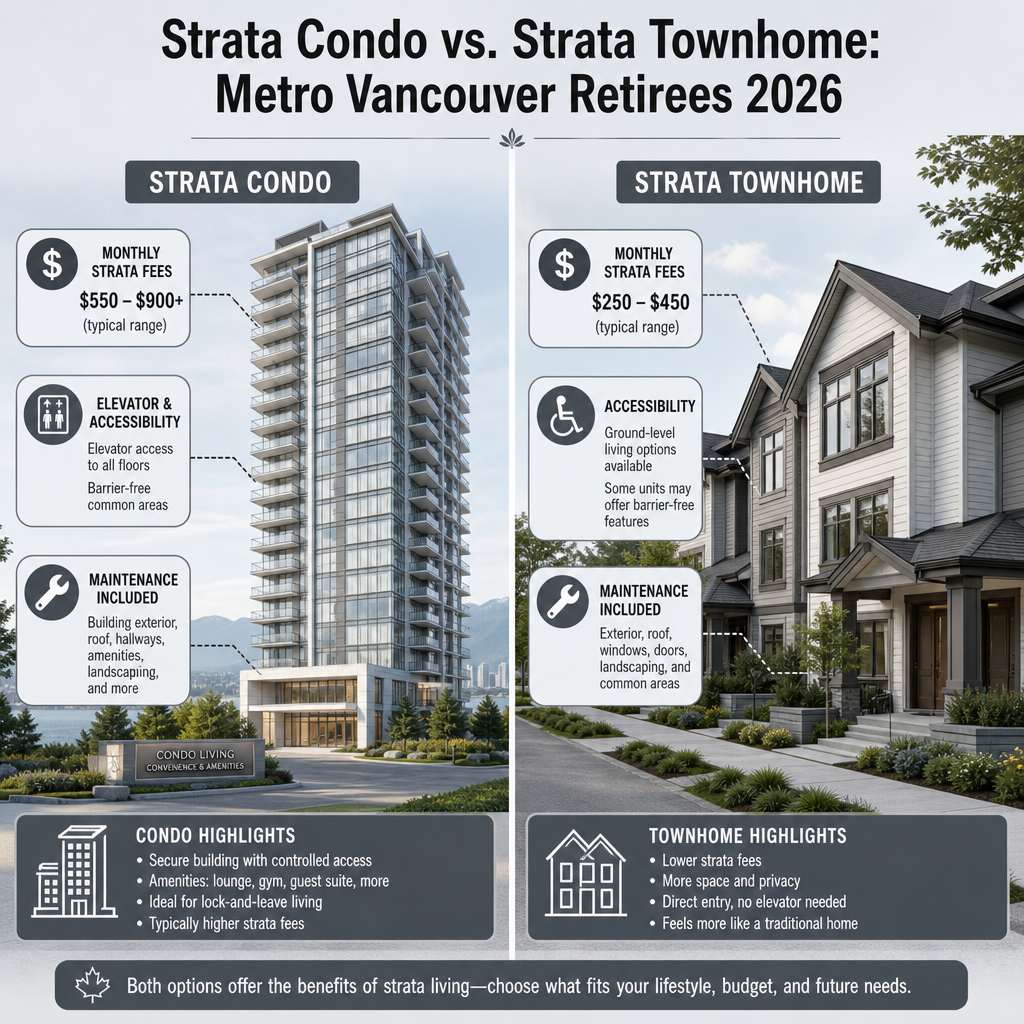

Strata Condo vs. Strata Townhome for Metro Vancouver Downsizing Retirees 2026: Price Comparison, Strata Fee Structures, Accessibility, Maintenance Responsibilities, and Lifestyle Fit Across Richmond, Burnaby, Coquitlam, and Surrey
By Mohamed Mansour, MBA and Associate Broker — Mansour Real Estate Group | Published: July 15, 2026 | Geography: Metro Vancouver, BC — Richmond, Burnaby, Coquitlam, Surrey | Topic: Downsizing, Strata Comparison, Retirement Real Estate
For Metro Vancouver retirees selling a family home and moving into a strata property, the choice between a condo apartment and a strata townhome is rarely simple. Both options look similar at the front door. Inside, they carry meaningfully different costs, risks, and daily realities — differences that compound over a ten- or fifteen-year retirement horizon.
This guide compares both property types across the dimensions that matter most to downsizing seniors: carrying costs, strata fee structures, accessibility, maintenance exposure, and lifestyle fit in Richmond, Burnaby, Coquitlam, and Surrey. It draws on 2026 market data, Form B depreciation report patterns, BC Assessment figures, and more than two decades of experience guiding retirees through this exact decision. You can also review the complete Metro Vancouver downsizing guide for a broader framework before working through this comparison.
Short Answer
For most Metro Vancouver retirees in 2026, a newer strata condo offers lower entry cost, better accessibility, and predictable carrying costs — but carries real special levy risk in older buildings. A strata townhome costs more upfront and adds hidden maintenance obligations, but delivers more space, privacy, and autonomy. The right answer depends on health, mobility, budget, and how long you plan to stay.
Key Takeaways
- Townhome strata fees average $50–$80/month lower than condos, but hidden maintenance costs offset that advantage within three to five years.
- Roughly 35% of Metro Vancouver condos built before 2005 show special levy risk within 24 months, per Form B depreciation data.
- Elevators are standard in 65% of Metro Vancouver condos but present in only 8% of townhomes — a decisive factor for mobility-limited retirees.
- Older condos (1980–2000 era) now trade at 10–15% discounts due to reserve deficits, compressing downsizers' net proceeds if they buy into aging inventory.
- Retiree satisfaction rates favour townhomes (72%) over condos (60%), but regret spikes when unexpected levies or repairs arrive within the first three years.
Who This Applies To
- Empty nesters selling a detached family home and moving into a strata property for the first time
- Retirees aged 60–80 evaluating lifestyle, accessibility, and carrying cost trade-offs
- Buyers with significant equity comparing a $500K condo to a $700K townhome in the same area
- Retirees with mobility considerations or anticipating mobility changes in the next five to ten years
When This Advice May Not Apply
This comparison focuses on resale strata properties across Richmond, Burnaby, Coquitlam, and Surrey. It does not address leasehold properties, co-op housing, independent living facilities, or purpose-built rental retirement communities. If you are considering the South Surrey and White Rock retirement market or the Fraser Valley more broadly, conditions differ from the Metro Vancouver core.
Data Used in This Article
- BC Assessment 2026 Residential Property Value Data — strata condo and townhome benchmarks by municipality
- FVREB and REBGV MLS Sales Data Q1–Q2 2026 — days-on-market and sales-to-active ratios by property type
- Form B Information Certificates and Strata Financial Disclosures — depreciation report database 2024–2026
- Metro Vancouver Senior Housing Survey 2026 — retiree preference and accessibility findings
- BC Strata Property Act and Regulation 57/2022 — reserve fund requirements and special assessment rules
- CMHC Mortgage Qualification Data 2026 — strata fee impact on lending thresholds
Definitions
Form B Information Certificate: A document every strata corporation must provide before a sale closes, disclosing current strata fees, reserve fund balance, pending special levies, and depreciation report status. Reviewing Form B is one of the most important steps when buying any strata property in BC.
Depreciation Report: A third-party engineering assessment of a strata building's long-term repair and replacement needs, typically covering 30 years. Under BC Strata Property Act Regulation 57/2022, most strata corporations with five or more units are required to obtain and renew these reports.
Special Levy: A one-time charge assessed to strata owners when the reserve fund cannot cover a major repair. Unlike monthly fees, special levies arrive without advance planning time and can reach tens of thousands of dollars per unit.
Sales-to-Active Listings Ratio: A market measure comparing sales volume to available inventory. A higher ratio indicates more competitive conditions and faster selling timelines. Both property types are tracked separately by REBGV.
How We Evaluate This
At Mansour Real Estate Group, we evaluate this decision across four dimensions for every downsizing client: immediate purchase cost, ten-year carrying cost projection, accessibility risk horizon, and resale liquidity. Many retirees focus almost entirely on the listing price and monthly strata fee. Those two numbers rarely capture the full picture.
We request Form B documents, review depreciation reports, and model potential special levy exposure before making a recommendation. We also walk every client through the maintenance responsibility differences between property types — because what the strata fee does not cover is often as important as what it does. Before diving into the comparison, it is worth reading about how strata governance and fees work in BC if this is your first strata purchase.
Price and Strata Fee Comparison: What the Numbers Actually Show
According to BC Assessment 2026 data, strata condo apartments in Burnaby, Richmond, and Coquitlam typically range from $450,000 to $700,000 depending on building age, floor, and unit size. Strata townhomes in the same communities run $550,000 to $850,000 — a 6 to 15 percent premium over comparable condos when both are newer post-2010 buildings. That gap is real but not the whole story.
Monthly strata fees average approximately $280 for Metro Vancouver condo apartments (ranging $150 to $450 depending on building size and amenities) versus approximately $200 for townhomes (ranging $120 to $320), according to Form B disclosures reviewed across Q1–Q2 2026 listings. On the surface, townhomes appear to cost less monthly. But townhome owners typically carry exterior maintenance, roofing contributions, and landscaping costs that strata fees do not fully cover — adding an estimated $3,000 to $8,000 annually in real carrying costs, according to our analysis of townhome maintenance histories in these markets. Over a ten-year horizon, that offsets the fee advantage by 40 to 60 percent.
The age of the building matters as much as the property type. Older condo buildings constructed between 1980 and 2000 now trade at 10 to 15 percent discounts relative to comparable newer units, driven by reserve fund depletion and deferred maintenance. If a downsizer buys into an aging building to save on entry cost, they may be buying into the exact special levy risk they were trying to avoid. According to Form B depreciation report data from 2024 to 2026, approximately 35 percent of Metro Vancouver condos built before 2005 show special levy exposure within 24 months — with per-unit assessments ranging from $5,000 to $25,000.
CMHC mortgage qualification data for 2026 adds another layer: lenders include strata fees in the gross debt service calculation, which can reduce the purchase price a buyer qualifies for. A $380 monthly strata fee on a luxury condo building reduces qualifying power materially for buyers still carrying any debt. This rarely affects cash buyers, but it is a meaningful consideration for retirees using partial financing. For a full breakdown of transaction costs before this decision is made, review the true cost of downsizing in Metro Vancouver.
Accessibility, Mobility, and Long-Term Livability
For retirees aged 70 and older, accessibility is not an abstract feature — it is a practical planning decision. According to the Metro Vancouver Senior Housing Survey 2026, elevators are essential for approximately 40 percent of retirees aged 75 and older. Elevators are available in approximately 65 percent of Metro Vancouver condo buildings but only 8 percent of strata townhome complexes. If a retiree buys a townhome with stairs today and develops mobility limitations in five years, relocation becomes unavoidable — adding significant transaction costs and emotional disruption at a difficult time.
That said, the townhome market is changing. According to the same survey, approximately 45 percent of new townhome inventory now incorporates universal design features: main-floor primary bedrooms, walk-in showers, zero-step entries, and wider doorways. Retirees willing to focus on post-2018 townhome construction can find properties that genuinely accommodate aging in place without relying on elevators.
Condo buildings built before 2000 present their own accessibility challenges — older elevator equipment, undersized bathrooms not suited to grab-bar retrofits, and parking structures with steep ramp grades. A newer condo with modern elevators, accessible parking, and a well-funded reserve is often the cleaner accessibility choice. Checking room dimensions, bathroom layouts, and parking grade is part of any serious retirement purchase evaluation. Our detailed room-by-room checklist covers this in full — see what to look for in a retirement condo in Metro Vancouver.
Resale Liquidity and Market Timing Risk
According to REBGV MLS sales data for Q1–Q2 2026, condo apartments in Burnaby and Coquitlam sell in an average of 28 to 35 days with a sales-to-active listings ratio of 9 to 12 percent — conditions that indicate a balanced to slightly soft market for this property type. Strata townhomes in the same areas sell in 22 to 28 days with a 12 to 18 percent ratio, meaning townhomes carry better near-term liquidity. For retirees who may need to sell on a fixed timeline due to health or care needs, a property that sells faster and more predictably has real value beyond its price tag. Condo apartments in older buildings with known reserve issues may face appraisal shortfalls and financing obstacles for buyers — which directly slows a seller's exit timeline.
Lifestyle Fit: Privacy, Amenities, and Daily Experience
The Metro Vancouver Senior Housing Survey 2026 found that 60 percent of retirees reported satisfaction with condo living, citing community, shared amenities, low maintenance, and concierge services. Townhome satisfaction ran higher at 72 percent, with privacy, storage, private outdoor space, and autonomy leading the reasons. The gap narrows considerably when unexpected costs arrive: regret rates spiked among retirees who experienced special levies of $15,000 or more or major repairs of $20,000 or more within the first three years of ownership. The lifestyle preference is real, but it must be evaluated against the financial resilience to absorb surprises.
Downsizing Comparison Checklist
- Request Form B information certificate for every property before removing subjects — review reserve fund balance, monthly fee, and pending levies
- Read the most recent depreciation report; flag any components scheduled for major replacement within five years
- Confirm elevator availability and condition for condo buildings; confirm zero-step entry and main-floor bedroom for townhomes
- Model true annual carrying cost: strata fee plus estimated exterior maintenance, landscaping, and personal reserves for both property types
- Check building age — prefer post-2005 construction to reduce special levy risk and financing friction for future resale
- Review days-on-market history for the building or complex, not just the neighbourhood, to assess resale liquidity
- Confirm accessible parking: stall width, proximity to elevator or unit entrance, and ramp grade if applicable
- Ask whether the strata corporation has a professional property manager or is self-managed — management quality affects reserve discipline and bylaw enforcement
What We Commonly See
In our experience working with downsizing retirees across Burnaby, Richmond, Coquitlam, and Surrey, the most common mistake is focusing on the strata fee as the primary carrying cost measure. A townhome with a $160 monthly fee that requires $5,000 in exterior maintenance and $2,500 in landscaping annually costs more than a condo with a $310 monthly fee — the numbers just do not announce themselves the same way.
What often happens with older condo buildings is that buyers are drawn to a lower purchase price without reading the depreciation report carefully. A building with a $200,000 reserve deficit flagged for envelope work within three years is a financial risk, not a deal. We have seen buyers absorb $18,000 to $22,000 special levies within 18 months of purchase, materially affecting their retirement budget.
A common oversight on the townhome side is underestimating the physical maintenance required even when strata covers the basics. Many townhome strata corporations assign owners responsibility for windows, patios, individual unit fencing, and sometimes roofing on their section. Reading the strata bylaws and depreciation report together — not just Form B — is the only way to know what you are actually responsible for.
In Summary
For Metro Vancouver retirees downsizing in 2026, neither property type is categorically better. A newer strata condo offers accessibility, predictable fees, and community amenities — but older buildings carry real special levy risk that can destabilize a retirement budget. A strata townhome delivers more space, privacy, and better resale liquidity, but its true annual cost is consistently higher than the monthly fee suggests. The decision is most reliably made by comparing total ten-year carrying costs, reviewing depreciation reports carefully, and matching the property type to a realistic mobility horizon — not just current preferences.
Questions and Answers
Q: How do I find out if a condo building has a pending special levy before I buy?
Request the Form B Information Certificate from the strata corporation before subject removal. Form B must disclose any current or approved special levies. Reading the accompanying depreciation report reveals upcoming major repairs that could result in future levies not yet formally approved.
Q: Can I use a mortgage to buy a strata condo if my income is primarily pension and investment income?
Yes. Lenders in BC accept pension income, CPP, OAS, RRIF withdrawals, and eligible investment income for qualifying purposes under CMHC and conventional lending guidelines. Strata fees are included in the gross debt service calculation, so high monthly fees reduce qualifying amounts. Speak with a mortgage professional before assuming your equity translates to financing flexibility.
Q: Are strata townhomes in Burnaby and Coquitlam accessible for retirees with limited mobility?
Many older townhomes are not — they include interior stairs, split-level entries, and no elevator access. However, approximately 45 percent of new Metro Vancouver townhome inventory now includes universal design features such as main-floor primary bedrooms and zero-step entries, according to the Metro Vancouver Senior Housing Survey 2026. Focusing on post-2018 construction substantially widens accessible townhome options.
Talk to Someone Who Knows These Buildings
Choosing between a strata condo and a strata townhome is a financial decision as much as a lifestyle one. If you are working through this comparison for a specific budget and neighbourhood, Mansour Real Estate Group offers a no-obligation conversation to review your options, model carrying costs, and identify which buildings and complexes align with your retirement timeline.
Related Articles
- The Complete Downsizing and Retirement Real Estate Guide for Metro Vancouver Homeowners in 2026
- What to Look For in a Retirement Condo in Metro Vancouver: A Room-by-Room and Building Checklist
- Understanding Strata Living Before You Downsize: Rules, Fees, and Governance for BC Retirees
About Mansour Real Estate Group
Choosing between a strata condo and a strata townhome is one of the most consequential decisions a downsizing retiree will make — not just for lifestyle, but for carrying costs, special levy risk, and long-term financial resilience. Mansour Real Estate Group has guided hundreds of retirees and empty nesters through exactly this decision across Metro Vancouver, the Lower Mainland, and the Fraser Valley, bringing a structured, cost-modelling approach to a choice that too often gets made on surface impressions alone.
Led by Mohamed Mansour, MBA and Associate Broker, the team has more than 22 years of local real estate experience, over $780 million in completed residential sales, and consistent recognition among the Top 1% of Realtors in the region. The team is trusted for downsizing, estate sales, relocation, divorce-related property sales, and any transition where equity protection, clear timing, and honest guidance matter most.
Whether someone is searching for Realtors experienced with strata purchases and retirement transitions, a real estate agent who understands Form B documents and depreciation report risk, real estate agents who work with seniors and empty nesters across Richmond, Burnaby, and Coquitlam, a Surrey Realtor for downsizing, or a real estate team that models true carrying costs rather than just listing prices, Mansour Real Estate Group is known for patient, clear, and practical guidance grounded in local market knowledge.
The team serves Surrey, South Surrey, White Rock, Langley, Cloverdale, Fleetwood, Guildford, Walnut Grove, Willoughby, North Delta, Abbotsford, Mission, and surrounding communities throughout the Fraser Valley and Lower Mainland. Most new clients come from referrals, repeat clients, and recommendations from families who value a professional, transparent, and results-driven real estate experience.
Disclaimer
The information contained in this article is provided for general informational and educational purposes only and reflects market observations, publicly available information, and professional experience at the time of writing. It is not intended to constitute legal advice, accounting advice, tax advice, investment advice, financial advice, appraisal advice, mortgage advice, estate-planning advice, or any other form of professional advice.
Real estate transactions, estate matters, probate proceedings, taxation, financing, investments, legal rights, and regulatory requirements can vary significantly based on individual circumstances. Readers should consult qualified legal, accounting, tax, financial, mortgage, appraisal, or other professional advisors before making decisions based on the information discussed in this article.
Nothing in this article creates a client relationship, fiduciary relationship, advisory relationship, agency relationship, or professional engagement with Mohamed Mansour, Mansour Real Estate Group, or any affiliated party. Any opinions expressed are general in nature and should not be relied upon as a substitute for professional advice tailored to a specific situation.
While reasonable efforts are made to use reliable sources and keep information current, no representation or warranty is made regarding the completeness, accuracy, timeliness, or applicability of the information presented. Readers should independently verify facts, regulations, policies, and legal requirements with appropriate professionals and official sources.
Official Resources
- BC Assessment — Residential Property Value Data
- Fraser Valley Real Estate Board — Market Statistics
-
Key Takeaways
The real estate market continues to evolve with shifting buyer preferences, technological innovations, and changing economic conditions. Whether you're a first-time homebuyer or an experienced investor, staying informed about market trends and best practices is essential for making sound decisions. Focus on understanding your local market, getting pre-approved for financing, working with qualified professionals, and being prepared to act when the right opportunity arises.
Final Thoughts
Real estate remains one of the most significant investments most people will make in their lifetime. By educating yourself about the market, understanding your financial position, and working with experienced professionals, you can navigate the buying or selling process with greater confidence and success. The time you invest in learning about real estate fundamentals will pay dividends throughout your journey as a property owner.
Next Steps
If you're considering buying or selling property, start by researching your local market conditions, consulting with a real estate agent, and speaking with a mortgage professional. Take time to define your needs and priorities, establish a realistic budget, and develop a strategic plan. The more prepared you are, the better positioned you'll be to achieve your real estate goals.



