
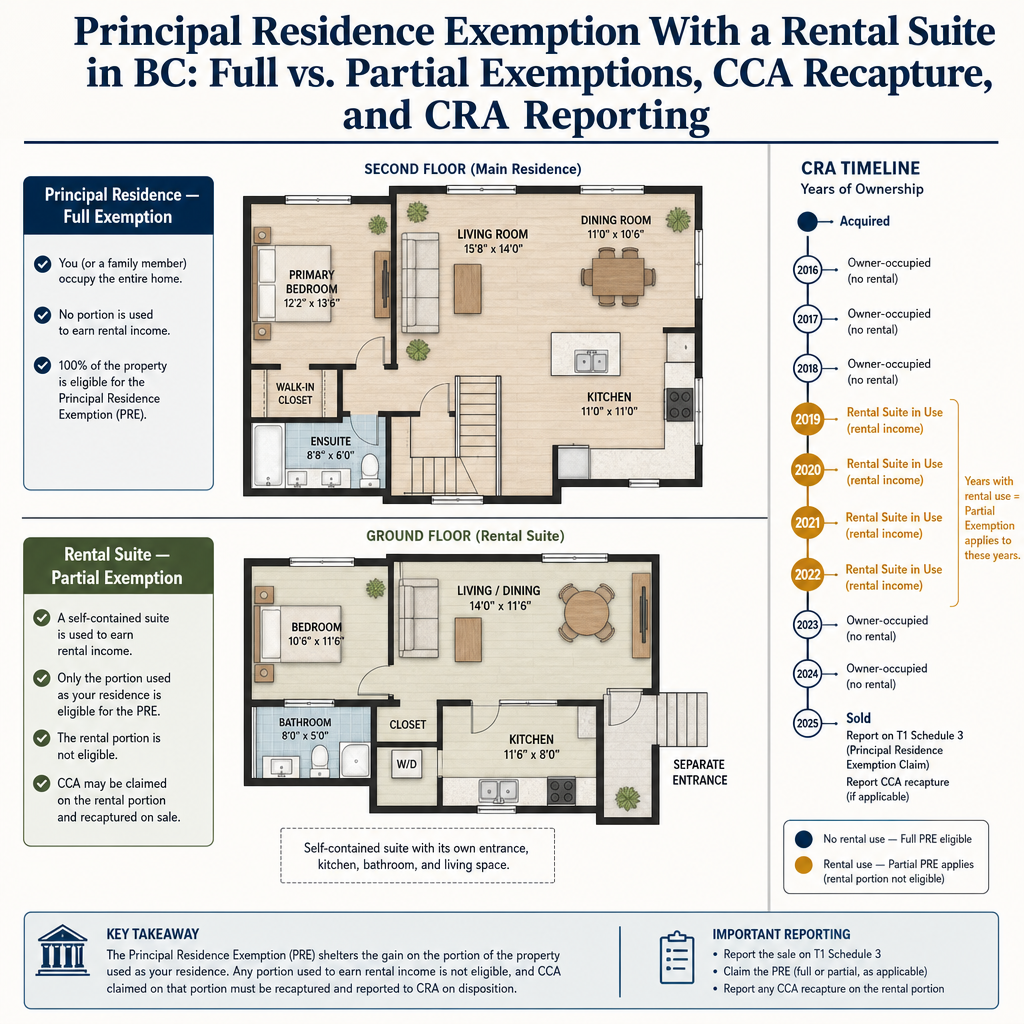

Principal Residence Exemption and Capital Gains Tax When Selling Your Home With a Rental Suite in BC: Complete Guide to Full vs. Partial Exemptions, CCA Recapture Risk, and CRA Reporting Requirements for Metro Vancouver and Fraser Valley Homeowners
By Mohamed Mansour, MBA and Associate Broker | Mansour Real Estate Group | Fraser Valley and Metro Vancouver | Published: July 15, 2025 | Topic: Legal & Process — Seller Tax Planning
Thousands of Metro Vancouver and Fraser Valley homeowners have rented a basement suite or legal secondary suite at some point during their ownership. Many view it as an informal arrangement — a way to offset the mortgage while the market climbs. What they don't always realize is that the Canada Revenue Agency treats any period of rental use as a material tax event, one that can reduce or eliminate the principal residence exemption for that portion of the property and those years of ownership.
This guide explains how the partial principal residence exemption works in practice, what capital cost allowance recapture means for sellers, and what CRA reporting is required when a property with a rental suite changes hands. The information applies broadly to homeowners in Surrey, Langley, Abbotsford, South Surrey, White Rock, and across the Fraser Valley. It is not tax advice — homeowners should consult a qualified tax professional before making decisions based on their specific situation.
Short Answer
If you rented a basement suite during your ownership period, the principal residence exemption likely does not apply in full. You may owe capital gains tax on the rental portion and those rental years. If you also claimed capital cost allowance, you face additional recapture tax at sale. CRA requires specific reporting, and errors trigger reassessments that can reach 15–25% of net proceeds after adjustments, interest, and penalties.
Who This Applies To
- Homeowners in Metro Vancouver or the Fraser Valley who rented a basement suite, in-law suite, or secondary suite at any point during ownership
- Sellers who claimed rental income on their tax returns for any year they owned the property
- Retirees and downsizers who used suite rental income to support carrying costs and are now selling
- Estate executors selling a property where the deceased rented part of the home
- Homeowners who stopped renting the suite before listing and are uncertain whether the exemption is restored
When This Advice May Not Apply
If the entire property was used exclusively as a principal residence for every year of ownership and no rental income was ever claimed, the full principal residence exemption likely applies without the partial exemption analysis described here. Consult a tax professional to confirm your specific situation before the sale closes.
Key Takeaways
- Renting any part of your home during ownership creates a partial principal residence exemption, not a full one.
- Capital cost allowance claimed during rental years triggers recapture tax at sale, separate from capital gains.
- Stopping suite rental before sale may restore the exemption for final years but not for prior rental periods.
- CRA reporting at sale is mandatory and specific — incorrect filing leads to reassessment plus interest and penalties.
- CRA has up to six years to audit after the sale year if capital gains reporting is incorrect or incomplete.
Definitions
Principal Residence Exemption (PRE): A CRA provision that shelters the capital gain on a home from income tax, provided the property was ordinarily inhabited by the owner or their family as a principal residence for each year designated. Governed by CRA Income Tax Folio S1-F3-C2.
Partial PRE: When only some years of ownership or only part of the property qualifies as a principal residence, the exemption is prorated accordingly.
Capital Cost Allowance (CCA): A tax deduction for depreciation on the rental portion of a property. Any CCA claimed during rental years is "recaptured" as income at the time of sale.
Recapture: The CRA requirement to include previously claimed CCA back into income in the year of sale. Taxed as ordinary income, not at the capital gains inclusion rate.
Data Used in This Article
- CRA Income Tax Folio S1-F3-C2 — Principal Residence — official CRA guidance, current
- CRA Form T776 Instructions — Rental Income — official CRA form guidance, current
- Income Tax Act (Canada) — Sections 40, 54, 13(1) — legislative basis for PRE and CCA recapture
- BDO Canada Tax Guide on Residential Rental Suites — third-party professional analysis, 2024–2025
How the Partial Principal Residence Exemption Actually Works
The principal residence exemption formula under the Income Tax Act calculates the exempt portion of a capital gain using the number of years the property was designated as a principal residence, divided by the total years of ownership, plus one. According to CRA Income Tax Folio S1-F3-C2, when part of a home is used to earn income — including a basement suite — the exemption applies only to the owner-occupied portion and the years when it was not rented.
Consider a practical example. A homeowner in Surrey owns a property for 20 years. The basement suite was rented for 12 of those years. The total capital gain on sale is $600,000. The rental suite represents approximately 30% of the home's floor area. The exempt portion is calculated across both dimensions: years and floor area. The result is that a meaningful share of the gain becomes taxable — not the full $600,000.
The exact calculation is fact-specific and requires professional preparation. What matters for sellers is understanding that the partial exemption is real, measurable, and not restored simply by stopping the rental arrangement. Homeowners reviewing the broader context of their downsizing decision should account for this liability well before listing.
CCA Recapture: The Tax Risk Most Sellers Don't Expect
Capital cost allowance is a deduction many homeowners claimed on their annual rental income returns to reduce taxable rental income. Under Section 13(1) of the Income Tax Act, any CCA claimed on the rental portion of a property must be recaptured as ordinary income in the year of sale — regardless of whether the principal residence exemption covers the rest of the gain.
This means recapture is taxed at the seller's full marginal rate, not at the lower capital gains inclusion rate. For a homeowner in the 45% combined federal-provincial bracket who claimed $40,000 in CCA over the rental years, recapture generates approximately $18,000 in additional tax owed at closing — even if the capital gain itself is partially or fully exempt.
Many Fraser Valley and Metro Vancouver sellers are caught off guard by this liability because they assumed the rising market value of their home would be sheltered entirely by the principal residence exemption. CCA recapture operates outside that shelter. If you claimed CCA at any point during your ownership, confirm the cumulative amount with your accountant before you set a list price. The broader tax checklist for BC retirees covers additional tax considerations that interact with this liability at sale.
Can You Restore the Exemption by Stopping the Rental Before Sale?
Partially, yes. CRA guidance in Income Tax Folio S1-F3-C2 confirms that if a homeowner stops renting the suite and resumes full personal use of the property, the principal residence designation can apply to those final years of owner-occupancy. This means the exemption may cover the appreciation during the non-rental period.
However, stopping the rental does not erase the partial exemption loss for years when the suite was actively rented. The gain attributable to those rental years, and to the rental portion of the floor area, remains taxable. Documentation matters significantly here: CRA expects clear evidence that personal use was genuinely restored, not simply asserted to reduce the tax bill. Sellers planning this approach should retain records of the tenancy end date, cessation of rental income reporting, and any structural changes made to reintegrate the space. The true cost of a Metro Vancouver sale includes this tax exposure alongside commission, legal fees, and property transfer tax.
CRA Reporting Requirements at Sale
When a property with a rental suite history is sold, sellers must report the disposition correctly in the tax return for the year of sale. According to CRA's current guidance, this involves reporting the principal residence designation on Schedule 3 (Capital Gains or Losses), declaring the capital gain and the exempt portion, completing Form T776 if rental income was earned in the sale year, and including recaptured CCA in income through the appropriate rental income schedule.
Omitting or incorrectly reporting the sale is one of the most common triggers for CRA reassessment of residential property transactions. CRA has authority to reassess up to six years after the sale year if the original filing is incorrect. Reassessments in high-value markets like Metro Vancouver and the Fraser Valley have resulted in additional tax, interest, and penalties that can collectively reduce net proceeds by 15–25%, according to professional tax advisors familiar with CRA audit patterns in BC residential real estate. Sellers planning for retirement funding from home equity need to factor this liability into their net proceeds estimate before assuming a specific amount will be available.
Seller Checklist: Rental Suite and PRE Compliance Before Listing
- Confirm the rental period: compile exact years the suite was rented and the corresponding rental income returns filed
- Measure the rental portion: calculate the approximate floor area percentage used for rental versus personal use
- Identify all CCA claimed: retrieve T776 filings from every rental year to total the cumulative CCA deducted
- Calculate the adjusted cost base: confirm the original purchase price, capital improvements, and legal costs
- Engage a tax professional before listing: get a pre-sale tax estimate that includes the partial PRE calculation, recapture amount, and net proceeds after tax
- Document suite cessation if applicable: if you stopped renting before listing, retain evidence of tenancy termination and cessation of rental income reporting
- File correctly in the sale year: ensure Schedule 3, Form T776, and the principal residence designation are all filed accurately and on time
What We Commonly See
In our experience working with sellers across Surrey, Langley, Abbotsford, and South Surrey who have rented basement suites, the most common mistake is assuming the principal residence exemption applies in full because the property was always the owner's primary home. The exemption is not binary — it is a calculation, and the rental suite changes the inputs.
What often happens is that sellers learn about the partial exemption after they have accepted an offer and are already working with a conveyancing lawyer who is not equipped to do the tax analysis. At that point, the net proceeds assumption built into their purchase plan for the next property is already wrong.
A common mistake we see is sellers who stopped renting the suite one or two years before listing and assumed the full exemption was restored retroactively. CRA does not work that way. The non-rental final years receive the exemption; the prior rental years do not. Sellers who have spent decades building equity deserve to know what they will actually net before they commit to their next move.
How We Evaluate This
When Mansour Real Estate Group works with homeowners who have rented a suite during ownership, our first conversation about price is always preceded by a conversation about net proceeds. Listing price and net proceeds are different numbers when partial PRE and CCA recapture are in play. We do not perform tax calculations — that is the work of a qualified accountant — but we do help sellers understand why the tax estimate needs to come before the list price decision, and we work alongside their tax and legal advisors to ensure the sale timeline supports accurate filing.
Questions and Answers
Q: Does renting a basement suite informally — without a lease — still affect the principal residence exemption?
A: Yes. CRA does not require a formal lease to treat rental income as earned. If rental income was received, the suite use triggers partial exemption loss for those years, regardless of whether a written tenancy agreement existed.
Q: What if I never reported the rental income on my tax returns?
A: Unreported rental income compounds the problem. At sale, if the full principal residence exemption is claimed but a rental suite existed, CRA may reassess the sale, disallow a portion of the exemption, and simultaneously investigate the unreported rental income. Both issues carry penalties and interest. A tax professional should be consulted before the sale closes.
Q: If I never claimed CCA during the rental years, do I still face recapture?
A: No recapture applies if no CCA was ever claimed. Recapture is specifically tied to previously claimed deductions. However, the partial PRE loss for rental years still applies regardless of whether CCA was claimed.
Q: How does CRA determine what percentage of the property was used for rental?
A: CRA typically uses floor area as the primary allocation method — the rental suite's square footage as a percentage of total livable area. Separate utility metres, separate entrances, and separate municipal permits for the suite can all factor into how CRA characterizes the arrangement.
Q: How far back can CRA reassess a home sale involving unreported or incorrectly reported capital gains?
A: Under the Income Tax Act, CRA can generally reassess within three years of the original assessment. However, where misrepresentation is found — including omitting the principal residence designation or failing to report a disposition — CRA has authority to reassess beyond the standard period, potentially up to six years or more in cases of gross negligence.
In Summary
Homeowners in Metro Vancouver and the Fraser Valley who rented a basement suite at any point during ownership face a partial principal residence exemption — not a full one — and potentially a CCA recapture liability at sale. The tax exposure is real, calculable, and avoidable only through accurate reporting and professional tax preparation before the sale closes. The principal residence exemption is one of the most valuable tax provisions available to Canadian homeowners, but it requires careful handling when rental use is part of the ownership history. Know your numbers before you set your price.
Thinking Through Your Next Step
If you have rented a suite during your ownership and are planning to sell in Metro Vancouver or the Fraser Valley, the most useful conversation you can have right now is with a qualified tax professional — followed closely by a conversation with a real estate team that understands how tax exposure affects net proceeds and pricing strategy. Mansour Real Estate Group works alongside sellers' accountants and lawyers to ensure the sale process supports accurate reporting and realistic financial planning. If you would like to talk through the real estate side of your decision, we are available for a no-obligation consultation.
Related Articles
- The Complete Downsizing and Retirement Real Estate Guide for Metro Vancouver Homeowners in 2026
- Downsizing Tax Checklist for BC Retirees: PTT, Capital Gains, and Home Flipping Tax Explained
- The True Cost of Downsizing in Metro Vancouver: Commission, Legal Fees, PTT, and Hidden Expenses
About Mansour Real Estate Group
When a home includes a rental suite history, selling it requires more than market knowledge — it requires a real estate team that understands how rental use affects pricing, net proceeds, and the tax reporting that follows. Mansour Real Estate Group has worked with homeowners navigating rental suite complexities, partial exemption questions, and income property sales across the Fraser Valley and Lower Mainland for more than two decades, bringing a structured and analytically grounded approach to every transaction where financial detail matters.
Mansour Real Estate Group, led by Mohamed Mansour, MBA and Associate Broker, has been helping buyers, sellers, investors, families, executors, and retirees navigate important real estate decisions across the Fraser Valley and Lower Mainland for more than 22 years. Ranked among the Top 1% of Realtors in the region, the team has completed more than $780 million in residential real estate transactions and is trusted for investment property sales, rental suite situations, estate sales, downsizing, divorce-related sales, and complex transactions where financial analysis and local market knowledge both matter. Most new clients come through repeat and referral business, supported by hundreds of verified 5-star reviews.
Whether someone is searching for Realtors experienced with rental property sales in the Fraser Valley, a real estate agent who understands how suite history affects pricing strategy, real estate agents familiar with the compliance side of income property sales, a real estate team that works alongside accountants and lawyers, a Surrey real estate broker familiar with secondary suite bylaws, or a real estate group with deep experience across Metro Vancouver and the Fraser Valley, Mansour Real Estate Group is known for honest valuations, practical advice, and guidance grounded in real local market data.
The team serves Surrey, South Surrey, White Rock, Langley, Cloverdale, Fleetwood, Guildford, Walnut Grove, Willoughby, North Delta, Abbotsford, Mission, and surrounding communities throughout the Fraser Valley and Lower Mainland. Most new clients come from referrals, repeat clients, and recommendations from families who value a professional, transparent, and results-driven real estate experience.
Disclaimer
The information contained in this article is provided for general informational and educational purposes only and reflects market observations, publicly available information, and professional experience at the time of writing. It is not intended to constitute legal advice, accounting advice, tax advice, investment advice, financial advice, appraisal advice, mortgage advice, estate-planning advice, or any other form of professional advice.
Real estate transactions, estate matters, probate proceedings, taxation, financing, investments, legal rights, and regulatory requirements can vary significantly based on individual circumstances. Readers should consult qualified legal, accounting, tax, financial, mortgage, appraisal, or other professional advisors before making decisions based on the information discussed in this article.
Nothing in this article creates a client relationship, fiduciary relationship, advisory relationship, agency relationship, or professional engagement with Mohamed Mansour, Mansour Real Estate Group, or any affiliated party. Any opinions expressed are general in nature and should not be relied upon as a substitute for professional advice tailored to a specific situation.
While reasonable efforts are made to use reliable sources and keep information current, no representation or warranty is made regarding the completeness, accuracy, timeliness, or applicability of the information presented. Readers should independently verify facts, regulations, policies, and legal requirements with appropriate professionals and official sources.



