
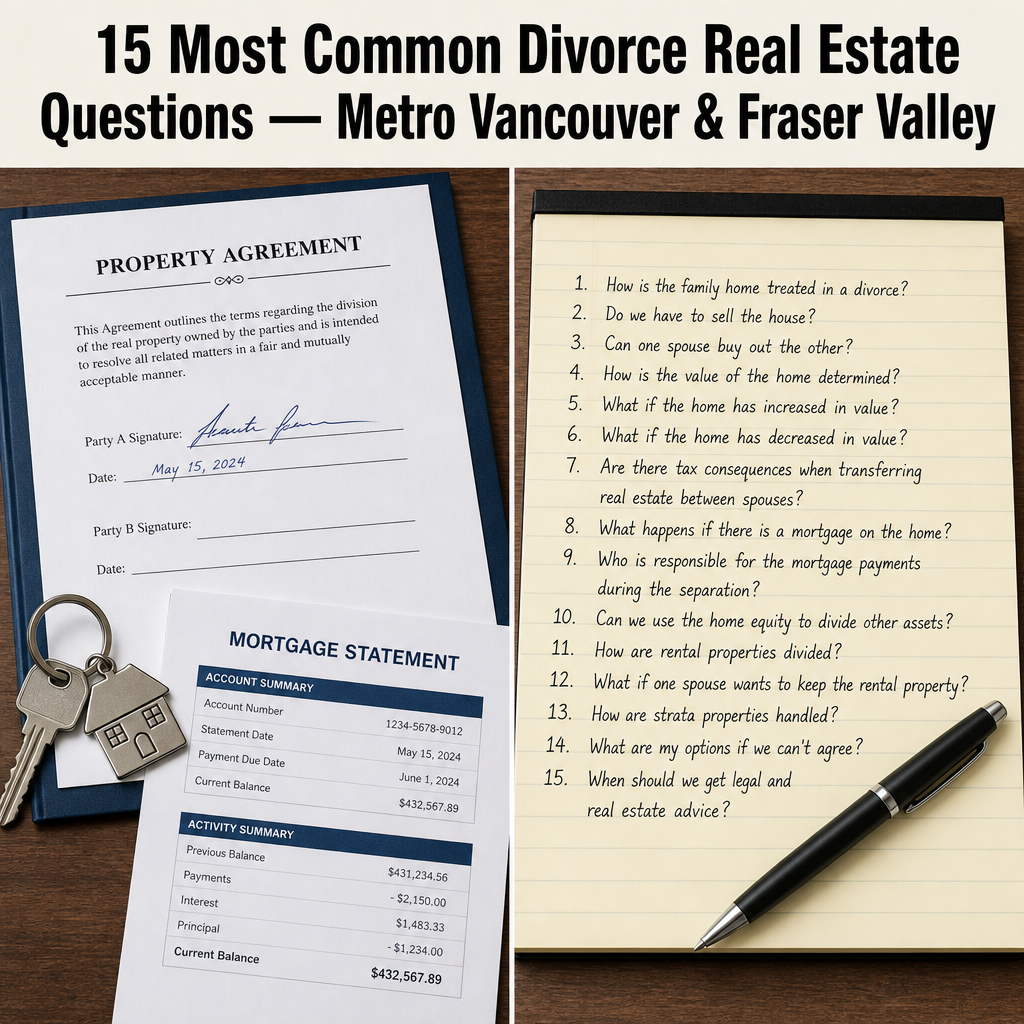

15 Most Common Questions About Divorce Real Estate in Metro Vancouver and the Fraser Valley: From Mortgage Payments During Separation to Offer Negotiation When Spouses Disagree
By Mohamed Mansour, MBA and Associate Broker | Mansour Real Estate Group | Fraser Valley and Lower Mainland, BC | Published: July 14, 2025
Separating couples in Metro Vancouver and the Fraser Valley face a real estate process that is layered with legal, financial, and logistical complexity. Most people enter this process with a handful of urgent questions and no clear map of how property decisions connect to legal proceedings, mortgage obligations, and tax outcomes. This article answers the 15 most common questions the team at Mansour Real Estate Group hears from homeowners at the beginning of that journey.
The answers draw on BC legislation, CRA guidance, and two decades of direct experience managing divorce-related property sales across Surrey, Langley, Abbotsford, White Rock, Burnaby, Richmond, and the broader Lower Mainland.
Short Answer
Divorce real estate in BC involves mortgage liability that does not automatically change at separation, title rules that govern who can authorize a listing, family law protections that restrict unilateral action, and a sale process that requires both spouses to cooperate or obtain court direction. Understanding the legal and real estate layers before the listing goes live protects both parties and keeps the transaction on track.
Who This Applies To
- Married or common-law couples in BC who own property jointly and are separating
- Homeowners where one spouse is on title and the other is not
- Couples navigating mortgage liability questions after one party leaves the home
- Families where disagreement over sale timing or price is delaying the process
- Separated homeowners looking for a neutral real estate process before engaging counsel
When This Advice May Not Apply
If a court order, injunction, or CPL (Certificate of Pending Litigation) is already filed against the property, the sale process requires direct legal oversight. This article provides general information — not legal, tax, mortgage, or financial advice. Always consult qualified legal and financial professionals before making decisions specific to your situation.
Key Takeaways
- Both mortgage co-borrowers remain liable to the lender until the mortgage is refinanced or discharged — separation agreements do not change this.
- Under BC's Family Law Act, neither spouse can unilaterally list or sell the family home without the other's consent or a court order.
- A CPL filed by one spouse can delay or prevent closing and must be resolved before title transfers.
- The Principal Residence Exemption can only be designated to one property per spouse per year — capital gains planning after separation requires professional tax advice.
- When spouses disagree on a listing price or offer, a neutral realtor with a documented CMA process can reduce conflict and support legal proceedings.
Definitions
Certificate of Pending Litigation (CPL): A legal instrument filed on title at the Land Title Office that signals active family law proceedings. It can prevent a property from being sold or mortgaged without court approval or the filing party's consent.
Joint Tenancy: A form of property ownership where both owners hold equal, undivided interests and the surviving owner automatically receives the other's share on death. This complicates separation and often requires severance to tenants-in-common.
Tenants-in-Common: A form of ownership where each party holds a defined share that can be transferred independently. This allows property division without automatic right of survivorship.
Principal Residence Exemption (PRE): A CRA provision that exempts capital gains on a property designated as a principal residence. Post-divorce, each former spouse may designate separately, but planning is required to avoid unexpected tax exposure.
BC Family Law Act (SBC 2011, c. 25): The BC legislation that governs division of family property, including the presumption of equal division and restrictions on disposing of family assets without consent or court approval.
The 15 Questions
1. Who is responsible for the mortgage during separation?
Both co-borrowers remain fully responsible to the lender until the mortgage is refinanced, assumed by one party, or discharged on sale. A separation agreement can specify who pays the mortgage internally, but the lender is not bound by that agreement. If the paying spouse stops, the other spouse's credit is affected. This point causes significant financial harm when couples assume the separation agreement protects them from the lender. It does not. For a detailed breakdown, see What Happens to the Mortgage When Couples Separate in BC.
2. Can one spouse list the home without the other's agreement?
No. Under the BC Family Law Act, the family home is a protected family asset. Neither spouse may unilaterally list, sell, or otherwise dispose of it without the other's written consent or a court order — regardless of whose name is on title. A realtor who lists a property at the instruction of one spouse without confirming the other's agreement may be facilitating a transaction that is later challenged. If one spouse refuses to consent, the other may apply to court under the Family Law Act or the BC Partition of Property Act (RSBC 1996, c. 359).
3. What happens if we disagree on the listing price?
This is one of the most common causes of delayed or failed divorce sales. When spouses disagree on price, a neutral realtor with a documented Comparative Market Analysis (CMA) provides an objective basis that is easier for both parties — and their legal counsel — to accept. Some separation agreements specify that an independent appraisal governs the list price. If no agreement exists, both spouses need to reach consensus or obtain court direction. An inflated price driven by one party's financial expectations or emotional attachment to the home typically extends the listing period and reduces net proceeds.
4. How are offers handled when spouses are in conflict?
Both registered title holders must sign an accepted offer for it to be binding. If spouses are not communicating directly, the neutral realtor typically presents the offer to each party separately and facilitates the decision through legal counsel. When conflict is high, some couples use their lawyers as the communication channel for offer decisions, which adds time to the subject removal process. Buyers and their agents should understand that divorce sale timelines can extend beyond standard market norms. For a step-by-step view, see The Divorce Home Sale Process Step by Step.
5. Does the home have to be sold, or is a buyout possible?
A buyout is possible when one spouse qualifies to refinance the mortgage into their name alone and pays the other their share of the equity. The buying spouse must qualify based on their individual income, credit, and the property value — lender standards apply regardless of family law agreements. If the buying spouse cannot qualify, the home typically must be sold. A spousal buyout requires an independent appraisal to establish fair market value. See Spousal Buyout in BC: How to Keep the Family Home After Separation for the full process.
6. What is the 50/50 presumption in BC family property law?
Under the BC Family Law Act, family property is presumed to be divided equally between spouses on separation, regardless of income, contribution, or whose name is on title. Family property generally includes the family home, any equity accumulated during the relationship, and other assets acquired during the marriage or common-law relationship. Excluded property — assets brought into the relationship or received as inheritance — may be treated differently, but the increase in value of excluded property during the relationship is typically shared. Consult a family lawyer for how the presumption applies to your specific circumstances.
7. What is a CPL and how does it affect a sale?
A Certificate of Pending Litigation is a legal instrument one spouse files on title to signal active family law proceedings. Under the Land Titles Act (RSBC 1996, c. 250), a CPL effectively clouds title and prevents the property from being sold or further encumbered without either the filing party's consent or a court order discharging it. Buyers' lenders will not fund a purchase with a CPL on title. If a CPL is filed after a sale is underway, it can derail a closing. See Court-Ordered Home Sales in BC for what happens when consent cannot be reached.
8. How does joint tenancy complicate separation?
Most married couples own their home as joint tenants. On death, the surviving joint tenant automatically takes the whole property — this is the right of survivorship. During separation, this arrangement can be problematic. Either spouse can sever the joint tenancy and convert ownership to tenants-in-common, which allows their share to flow through their estate rather than automatically to the other spouse. Severance is done by filing a notice at the Land Title Office. Legal advice is important here because timing and execution affect both estate planning and family law outcomes.
9. Who pays carrying costs while the home is listed?
Mortgage payments, strata fees, property taxes, utilities, and maintenance costs continue until the property closes. If both spouses are on the mortgage, both remain liable regardless of who is living in the home. Separation agreements typically specify how these costs are shared during the listing period. If no agreement is in place, disputes over carrying costs can delay cooperation on the sale itself. Extended listing periods — common when pricing is contested or the market is slower — amplify this financial pressure significantly.
10. What are the tax implications of selling the family home during divorce?
If the home has been the principal residence of both spouses throughout ownership, the Principal Residence Exemption (PRE) should shelter gains from capital gains tax. The complexity arises after separation: each former spouse can designate one property as their principal residence per year, but designations cannot overlap on the same property. If one spouse moves out and acquires a new property, the years of ownership and residency must be allocated carefully. The CRA's PRE rules require a designation on Form T2091 at the time of sale. See Tax Implications of Selling a Home During Divorce in BC and consult a tax professional for your specific situation.
11. How should equity proceeds be distributed at closing?
At closing, the notary or lawyer handling the conveyance distributes net proceeds according to the instructions provided, which must align with the separation agreement, court order, or both parties' written direction. If no clear agreement exists, the conveyancer cannot distribute unilaterally — proceeds may be held in trust until the parties reach agreement or a court orders distribution. Having a signed separation agreement that specifically addresses real estate proceeds, net of costs, is the most reliable way to ensure a clean and timely distribution.
12. How does the sale timeline coordinate with family law proceedings?
Family law timelines and real estate market timelines operate independently and often conflict. A court proceeding can take months or years; the real estate market moves in weeks. Couples who agree to sell before a final order is issued can move faster and typically net more, since a property sold under court order or in a distressed timeline may attract lower offers. When both parties can align on a target listing date, market window, and minimum acceptable price, the real estate process can proceed without waiting for full legal resolution. For a detailed timeline overview, see Divorce Real Estate Timeline in the Fraser Valley.
13. What disclosure obligations apply when one spouse does not want to sell?
BC's BCFSA regulations require full material disclosure to buyers regardless of internal family disputes. A realtor cannot suppress known defects or material facts because one seller party disagrees with the sale. Disclosure obligations apply to the property, not to the internal relationship between sellers. Buyers have a right to know about material latent defects, strata issues, and other relevant facts. The reluctance of one spouse does not limit the other's legal disclosure obligations or the realtor's professional duties under BCFSA regulations.
14. How do we choose a realtor when we cannot agree on one?
A neutral realtor — one retained jointly by both spouses — is the most practical and legally defensible structure for a divorce sale. Each spouse's lawyer can participate in the realtor selection process. The neutral realtor's job is to represent the transaction and both sellers' shared interest in a successful sale, not to advocate for either party individually. Documented CMAs, transparent offer presentation, and clear communication protocols with both parties and their legal counsel are the hallmarks of an effective neutral realtor. See How to Choose a Neutral Realtor for a Divorce Sale for a framework.
15. What happens if the court orders the home sold?
Under the BC Partition of Property Act (RSBC 1996, c. 359), either co-owner may apply to the BC Supreme Court for an order directing the sale of jointly owned property. The court may appoint a realtor, set listing parameters, and authorize one party to execute documents on behalf of both if the other refuses to cooperate. Court-ordered sales typically involve closer legal oversight, tighter timelines, and less flexibility in negotiations. They are generally a last resort when other means of reaching agreement have failed. For a detailed explanation, see Court-Ordered Home Sales in BC.
How We Evaluate This
At Mansour Real Estate Group, divorce-related consultations follow a structured intake process that separates the real estate questions from the legal questions clearly. We identify who is on title, what the mortgage structure is, whether a separation agreement or court order is in place, and what the realistic market value is before any listing discussion begins. This sequencing prevents the most common errors — rushing to list before legal authority is clear, or pricing based on financial need rather than market evidence.
Valuation is always anchored to current market data, documented in writing, and shared with both parties in the same format. Where legal counsel is involved on both sides, we coordinate communication so that neither spouse receives information the other does not. This approach is not just ethical — it protects the transaction from being challenged after the fact.
Practical Checklist: Before You List During Separation
- Confirm all registered title holders and whether title is held as joint tenants or tenants-in-common
- Verify whether a CPL or any other encumbrance has been filed on title at the Land Title Office
- Obtain or draft a separation agreement that addresses listing authority, minimum acceptable price, and proceeds distribution
- Clarify mortgage liability — confirm with your lender what happens to the mortgage on sale and whether penalties apply
- Agree on how carrying costs (mortgage, strata, taxes, utilities) will be shared during the listing period
- Commission an independent appraisal if spouses disagree on value, or engage a neutral realtor for a documented CMA
- Consult a tax professional regarding Principal Residence Exemption designation before proceeding to sale
- Confirm that both spouses' legal counsel are aware of and aligned on the listing timeline
What We Commonly See
In our experience, the most common mistake separating homeowners make is listing the home before the authority to list is legally established. Both spouses assume the process will cooperate — until it does not, and a buyer's offer collapses at subject removal because one seller will not sign.
What often happens with pricing is that one spouse insists on a number tied to their financial need rather than market data. The resulting overpriced listing sits, the carrying costs accumulate, the relationship deteriorates further, and the eventual sale price is lower than what a well-priced listing would have achieved at the outset.
A common mistake with the CPL is filing it as a pressure tactic without anticipating that it prevents the very sale both parties ultimately need. Once a CPL is on title, removing it requires either consent or a court application — both of which take time and legal cost that reduces net proceeds for everyone.
Questions and Answers
Q: If only my name is on title, can I list the home without my spouse's consent?
A: Not necessarily. Under the BC Family Law Act, the family home is protected family property. Even if only one spouse is on title, the other retains a legal interest that prevents unilateral disposal. A court order or written consent is required before listing.
Q: How long does a divorce home sale take in the Fraser Valley?
A: When both parties agree on listing terms, a divorce sale follows roughly the same timeline as any other — typically 30 to 90 days from listing to close depending on market conditions and the property. Disputed sales with legal complications can extend this significantly, sometimes by months.
Q: Can proceeds be split differently than 50/50?
A: Yes. The BC Family Law Act establishes a 50/50 presumption, but spouses can agree in writing to a different split. Courts can also order an unequal division if a 50/50 split would be significantly unfair in the circumstances. Any agreed split should be documented in a signed separation agreement before closing.
Data Used in This Article
- BC Family Law Act (SBC 2011, c. 25) — BC Legislature, official legislation — governs family property division and sale restrictions
- BC Partition of Property Act (RSBC 1996, c. 359) — BC Legislature, official legislation — governs court-ordered property sales
- Land Titles Act (RSBC 1996, c. 250) — BC Legislature, official legislation — governs CPL filing and title encumbrances
- CRA Principal Residence Exemption guidelines — Government of Canada, CRA — governs capital gains exemption designation
- BCFSA Real Estate Regulation — British Columbia Financial Services Authority — governs disclosure obligations and realtor conduct
- Mansour Real Estate Group consultation intake data — internal professional experience, Fraser Valley and Lower Mainland
In Summary
Divorce real estate in Metro Vancouver and the Fraser Valley requires both spouses to understand their legal obligations and their shared financial stake in a clean transaction. Mortgage liability does not change at separation. Listing authority requires consent or court order. A CPL can stop a sale in its tracks. The 50/50 presumption under the BC Family Law Act governs unless both parties agree otherwise in writing. When the process is managed by a neutral, experienced real estate team with a documented valuation and communication protocol, the outcome is typically faster, less adversarial, and better for both parties financially.
Speak with Mansour Real Estate Group
If you are navigating a separation and have questions about how the real estate process works, Mansour Real Estate Group offers confidential, no-pressure consultations for both parties. We can provide a current market valuation, explain the listing process, and help you and your legal counsel understand the timeline and options available in today's Fraser Valley market.
Related Articles
- Selling a Home During Divorce in BC: A Complete Guide for Metro Vancouver and Fraser Valley Families
- BC Family Law Act and Real Estate: What Separating Couples in Metro Vancouver Must Know
- Spousal Buyout in BC: How to Keep the Family Home After Separation
- The Divorce Home Sale Process Step by Step: From Separation to Sold in Metro Vancouver
- Collaborative Divorce and Real Estate in BC: How a Team Approach Protects Both Spouses
About Mansour Real Estate Group
Key Takeaways
- Understanding current market trends helps you make informed decisions about timing your real estate purchase or sale.
- Working with an experienced local real estate agent provides invaluable insights into neighbourhood-specific conditions.
- Preparation and realistic expectations are essential for success in any market condition.
Ready to navigate the BC real estate market with confidence? Connect with a qualified real estate professional today to discuss your options and develop a strategy tailored to your goals.
Disclaimer: This article is for informational purposes only and does not constitute legal, financial, or real estate advice. Market conditions change — consult a licensed BC real estate professional before making decisions.



