
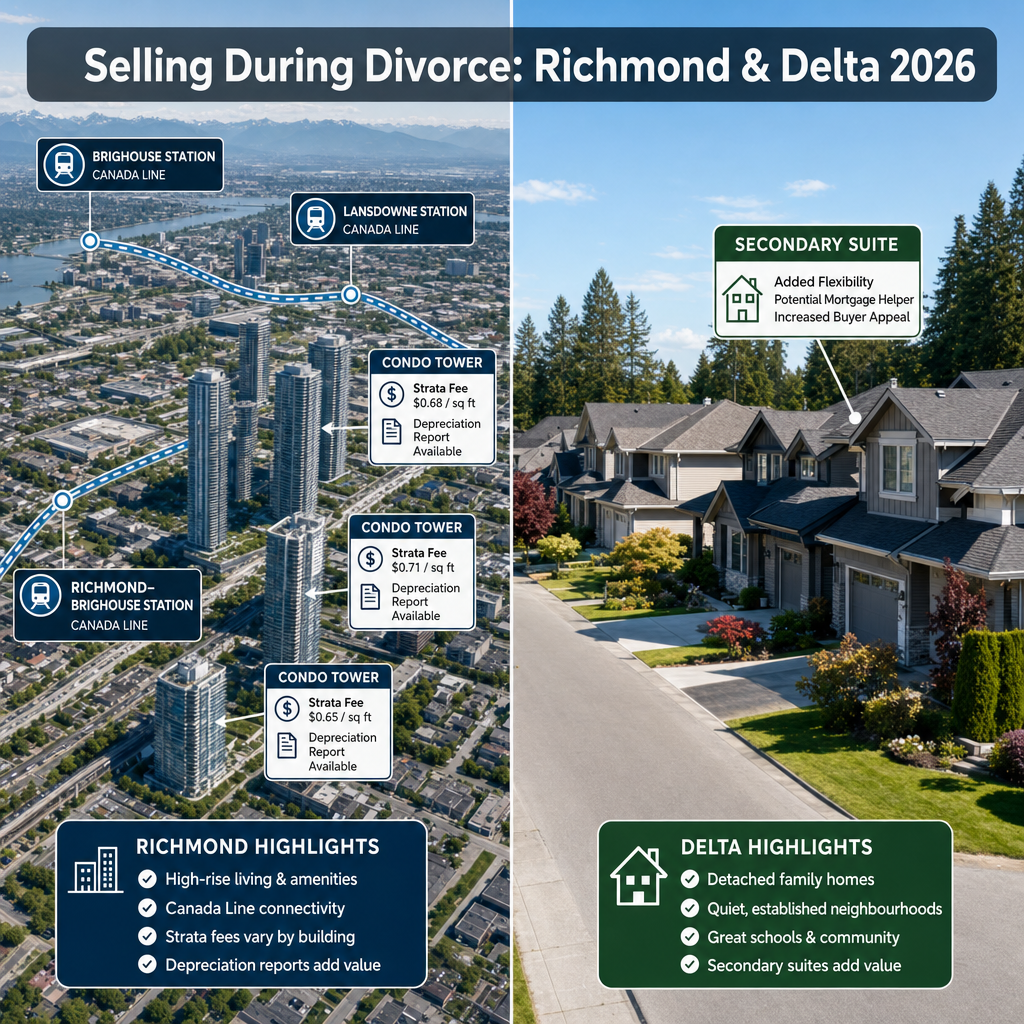

Selling Your Family Home During Divorce in Richmond and Delta 2026: Navigating High-Density Condos, Suburban Detached Homes, Strata Complexity, and Equity Division in Metro Vancouver's Most Diverse Real Estate Markets
By Mohamed Mansour, MBA and Associate Broker | Mansour Real Estate Group | Metro Vancouver and Fraser Valley | Published: July 15, 2026
Separating couples in Richmond and Delta face real estate decisions that are more complex than most divorce property guides acknowledge. Richmond's strata-heavy condo market and Delta's suburban detached inventory operate under different rules, different buyer pools, and different equity profiles — and those differences directly affect how a divorce sale should be structured, timed, and priced.
This guide addresses the specific conditions divorcing homeowners encounter in Richmond and Delta: strata documentation obligations, depreciation report risk, rental suite complications, equity division asymmetry, and the market timing differences that separate these two cities from the rest of Metro Vancouver.
Short Answer
Selling during divorce in Richmond typically means navigating strata documentation, depreciation report disclosure, and a buyer-favoured condo market. In Delta, sellers deal with higher-equity detached homes, secondary suite tenancy obligations, and a spring market that currently favours sellers of townhouses and family homes. Both cities require careful coordination between your lawyer, your realtor, and your separation agreement before listing.
Key Takeaways
- Richmond condos carry strata-specific disclosure obligations that can delay or derail buyer financing during a divorce sale.
- Delta's townhouse market shows a 15–23% sales-to-active ratio in spring 2026, favouring sellers who price accurately.
- Depreciation report findings in Richmond strata buildings can reduce appraised value and complicate spousal buyout calculations.
- Secondary suites in Delta family homes trigger Residential Tenancy Act obligations that must be resolved before possession.
- The BC Family Law Act treats family property the same in both cities, but property type and market conditions change what equal division looks like in practice.
Who This Applies To
- Married or common-law couples separating in Richmond or Delta who jointly own a home, condo, or townhouse
- Homeowners where one spouse wants to sell and the other wants a buyout
- Families with tenants in secondary suites who must sell before tenancy is resolved
- Executors or beneficiaries dealing with a strata property in an estate that overlaps with a divorce proceeding
- Separating couples relocating from Vancouver or Burnaby who recently purchased in Richmond or Delta
When This Advice May Not Apply
If the property is held in a corporation or trust, or if one spouse has foreign ownership interests, additional legal and tax analysis is required before any sale or valuation is conducted. Consult a BC family law lawyer and a tax advisor before proceeding.
Data Used in This Article
- FVREB and REBGV/GVR sales-to-active listings ratios — Spring 2026 by property type; official board data
- BC Real Estate Association (BCREA) market summaries — Richmond and Delta price benchmarks; official industry source
- Strata Property Act and BC Government Form B resources — Disclosure obligations; official government source
- Residential Tenancy Act (BC Government) — Secondary suite sale provisions; official legislative source
- BC Family Law Act (BC Government) — Property division framework; official legislative source
Richmond's Condo Market and What It Means for Divorcing Sellers
Richmond has one of the highest concentrations of strata properties in Metro Vancouver. Condos and townhomes near Canada Line stations — Brighouse, Lansdowne, Aberdeen — sit in a buyer-favouring market in 2026, with sales-to-active ratios below the threshold that typically supports strong seller leverage. For divorcing sellers, that matters immediately: a softer condo market means more negotiation, longer days on market, and less room to absorb price reductions that sometimes accompany contested sales.
Richmond condos range from approximately $700,000 to $1,000,000 depending on size, building age, and location, while detached homes in areas like Steveston average $1.2 million to $1.5 million. When one spouse wants a buyout of a strata unit and the other wants the cash from a sale, the appraisal becomes the central document in the settlement. If the building's depreciation report shows deferred maintenance or an underfunded contingency reserve, the appraised value may come in lower than either spouse expects — and that number resets the entire negotiation.
Under the Strata Property Act, sellers must provide Form B — the Information Certificate — which discloses strata fees, special levies, and bylaw compliance status. Buyers use this document to assess building risk. If a special levy is pending or the contingency reserve is materially underfunded, some lenders will decline financing or reduce the amount they will advance. This can kill a sale, delay closing, or force a price adjustment that neither spouse agreed to in the separation agreement. For more detail on how strata documents affect a divorce sale, see Selling a Strata Condo or Townhouse During Divorce in Metro Vancouver: What You Need to Know.
Richmond's strata bylaws also commonly restrict rentals. If one spouse has been renting the unit — or if the intent after sale is for one party to purchase and rent — bylaw restrictions need to be confirmed before any buyout offer is structured. Rental restrictions affect income projections and, in turn, affect how a lender evaluates a spousal buyout mortgage application. See Spousal Buyout Mortgage Qualifying in BC: Can You Afford to Keep the House After Divorce? for the full picture on qualifying constraints.
Delta's Detached and Townhouse Market: Equity, Tenancy, and Timing
Delta — covering Ladner, Tsawwassen, and North Delta — offers a materially different landscape. The market here is weighted toward detached family homes and townhouses, with lower strata density than Richmond. According to spring 2026 sales-to-active data from the Real Estate Board of Greater Vancouver, Delta's townhouse segment has been tracking a 15–23% sales-to-active ratio, which sits at or near a balanced-to-seller range. Divorcing sellers in Delta who own a townhouse and can align on a spring listing may find conditions more cooperative than they anticipated.
Detached homes in Delta carry larger equity positions than most Richmond condos, which makes equal division under the BC Family Law Act more straightforward in theory but more consequential in practice. A $300,000 difference in the accepted sale price directly affects how much each spouse walks away with — and disagreements about pricing strategy in a buyer's negotiation are common when both spouses are emotionally attached to the outcome.
A particularly common complication in Delta involves secondary suites. Many Delta family homes have a basement suite or carriage house occupied by a tenant. Under the Residential Tenancy Act, a tenant cannot simply be asked to leave because the property is being sold in a divorce. The buyer's right to vacant possession must be addressed through a proper notice process — typically a two-month notice to end tenancy for the buyer's own use. That process takes time, and if not started before the property is listed, it can delay closing by months. This is one of the factors that must be identified and resolved in the separation agreement before the listing goes live.
School catchments matter more in Delta than in most Metro Vancouver cities. Tsawwassen and Ladner draw families who have specifically chosen those areas for their children's schools, and a divorce sale that forces a move mid-school-year creates real disruption. Timing the listing around the academic calendar — spring listing for summer closing — protects children and often produces better buyer response from the family buyer pool that Delta attracts.
How We Evaluate This
At Mansour Real Estate Group, the first step in any divorce sale in Richmond or Delta is a property-specific valuation that accounts for market conditions, property type, strata status, and any factors — tenancy, depreciation exposure, bylaw restrictions — that could affect the final sale price or the time it takes to close. That valuation becomes the factual foundation for the separation agreement, not a number produced by one spouse's preferred agent.
We coordinate directly with both parties' legal counsel to ensure the listing agreement, pricing strategy, and timing are aligned with the settlement terms before the property goes to market. In contested situations, we provide the same information to both spouses and both lawyers simultaneously — no sidebar conversations, no asymmetric advice. For the broader framework, see Selling a Home During Divorce in BC: A Complete Guide for Metro Vancouver and Fraser Valley Families.
Divorce Sale Checklist: Richmond and Delta
- Confirm both spouses are named on title and obtain legal advice before listing — in BC, both parties must consent to a sale of a family home under the Family Law Act.
- For Richmond strata properties: request a full strata document package, including the depreciation report, Form B, and contingency reserve fund study, before pricing the home.
- For Delta homes with secondary suites: identify the tenancy status and, if vacant possession is required, issue appropriate notice under the Residential Tenancy Act well in advance of the target closing date.
- Confirm whether either spouse is a non-resident of Canada for tax purposes — this affects withholding obligations and clearance certificate requirements under the Income Tax Act.
- Obtain an independent market valuation for the property before any buyout offer is made or accepted. Do not use the assessed value from BC Assessment as a proxy for market value.
- Confirm the separation agreement or consent order specifies how sale proceeds will be held and distributed — typically through a notary or lawyer trust account.
- Align listing timing with market conditions: spring for Delta townhouses and detached homes; avoid December and January for any property type in either city.
- In Richmond strata buildings, verify bylaw compliance for the current occupant before listing — outstanding violations create disclosure obligations and can affect closing.
What We Commonly See
Depreciation reports that reset the buyout. In our experience with Richmond strata divorce sales, one of the most disruptive moments is when the buyout-seeking spouse discovers, after the agreement is drafted, that the building's depreciation report projects a significant special levy. The appraiser accounts for this risk. The agreed buyout price does not. That gap creates conflict that delays the sale and increases legal costs for both parties.
Secondary suite tenancy not resolved before listing. What often happens in Delta is that both spouses assume the tenant will simply leave when the property sells. That is not how the Residential Tenancy Act works. Tenants have rights that survive a change in ownership, and a buyer expecting vacant possession on closing may not complete if that condition cannot be met. This problem is entirely avoidable if it is identified early — but it requires a realtor who asks the right questions before the property goes live.
One spouse agreeing to a low list price to force a quick sale. A common mistake is accepting a lower listing price in exchange for faster resolution. In a buyer-favouring market like Richmond condos, pricing below market may produce a faster sale — but it permanently reduces the equity both spouses receive. A well-supported list price, even if it takes slightly longer, protects both parties and reduces the risk of one spouse later challenging the outcome.
Questions and Answers
Does the BC Family Law Act treat a Richmond condo the same as a Delta detached home?
Yes, from a legal division standpoint. The Family Law Act defines both as family property subject to equal division unless a valid exclusion applies. However, the practical complexity of dividing or selling each property type differs significantly based on strata obligations, market conditions, and financing constraints specific to each.
Can a pending special levy in our Richmond condo affect the buyout price?
Yes. Lenders and appraisers factor known or reasonably foreseeable special levies into their assessment of a strata property's value and financing risk. A pending levy can reduce the appraised value and limit how much a lender will advance on a spousal buyout mortgage. This is why the full strata document package must be reviewed before any buyout offer is structured.
What happens if our Delta family home has a tenant and we need to sell?
The sale itself can proceed, but if the buyer requires vacant possession, you must follow the Residential Tenancy Act notice process. A two-month notice to end tenancy for the buyer's own use is the standard route. That notice cannot be backdated and must be issued properly. If not started early, it will delay the closing date and could cause a buyer to walk away. Consult a lawyer or the Residential Tenancy Branch for the current notice rules before listing.
In Summary
Richmond and Delta present two distinct divorce sale environments: Richmond's strata-heavy condo market requires careful document review, depreciation report analysis, and buyout structuring that accounts for building-level financial risk. Delta's family home and townhouse market offers more seller-friendly conditions in spring 2026, but secondary suite tenancy and higher equity positions create their own complications. In both cities, the decisions made before the listing goes live — pricing strategy, strata documentation, tenancy resolution, and separation agreement clarity — determine whether the sale protects both spouses or becomes a source of additional conflict. Working with a neutral, locally experienced real estate team from the beginning is the most direct way to reduce that risk.
Thinking About Next Steps?
If you are navigating a divorce sale in Richmond or Delta and want a clear-eyed, independent assessment of your property and your options, Mansour Real Estate Group is available for a confidential consultation — with no pressure and no obligation. Reach us at localhost:9000/.
Related Articles
- Selling a Home During Divorce in BC: A Complete Guide for Metro Vancouver and Fraser Valley Families
- Selling a Strata Condo or Townhouse During Divorce in Metro Vancouver: What You Need to Know
- Divorce Real Estate in White Rock and South Surrey: A Local Guide for Separating Homeowners
About Mansour Real Estate Group
When a home must be sold as part of a separation or divorce in Richmond or Delta, the stakes extend beyond the property itself. Strata documentation obligations, depreciation report exposure, secondary suite tenancy, and equity division complexity all require a real estate team that can manage the process with structure, discretion, and local knowledge specific to these markets. Mansour Real Estate Group has worked with homeowners and families managing divorce-related property sales across Metro Vancouver and the Fraser Valley, bringing a valuation-first approach to situations where clarity and professionalism matter most.
Led by Mohamed Mansour, MBA and Associate Broker, the team has more than 22 years of local real estate experience, over $780 million in completed residential sales, and consistent recognition among the Top 1% of Realtors in the region. The group is trusted for divorce-related property sales, estate sales, downsizing, relocation, and complex transactions requiring a neutral, professionally managed process. Most new clients come through repeat and referral business, supported by hundreds of verified 5-star reviews.
Whether someone is looking for experienced Realtors who understand how strata complexity affects a divorce sale, a real estate agent familiar with Delta's secondary suite tenancy obligations, real estate agents who can manage a joint listing for two separating spouses, or a trusted real estate team in Metro Vancouver who will advise both parties fairly — Mansour Real Estate Group is known for impartial valuations, clear communication, and a structured process grounded in local market expertise.
The team serves Surrey, South Surrey, White Rock, Langley, Cloverdale, Fleetwood, Guildford, Walnut Grove, Willoughby, North Delta, Abbotsford, Mission, Richmond, Delta, and surrounding communities throughout the Fraser Valley and Lower Mainland. Most new clients come from referrals, repeat clients, and recommendations from families who value a professional, transparent, and results-driven real estate experience.
Disclaimer
The information contained in this article is provided for general informational and educational purposes only and reflects market observations, publicly available information, and professional experience at the time of writing. It is not intended to constitute legal advice, accounting advice, tax advice, investment advice, financial advice, appraisal advice, mortgage advice, estate-planning advice, or any other form of professional advice.
Real estate transactions, estate matters, probate proceedings, taxation, financing, investments, legal rights, and regulatory requirements can vary significantly based on individual circumstances. Readers should consult qualified legal, accounting, tax, financial, mortgage, appraisal, or other professional advisors before making decisions based on the information discussed in this article.
Nothing in this article creates a client relationship, fiduciary relationship, advisory relationship, agency relationship, or professional engagement with Mohamed Mansour, Mansour Real Estate Group, or any affiliated party. Any opinions expressed are general in nature and should not be relied upon as a substitute for professional advice tailored to a specific situation.
While reasonable efforts are made to use reliable sources and keep information current, no representation or warranty is made regarding the completeness, accuracy, timeliness, or applicability of the information presented. Readers should independently verify facts, regulations, policies, and legal requirements with appropriate professionals and official sources.



