
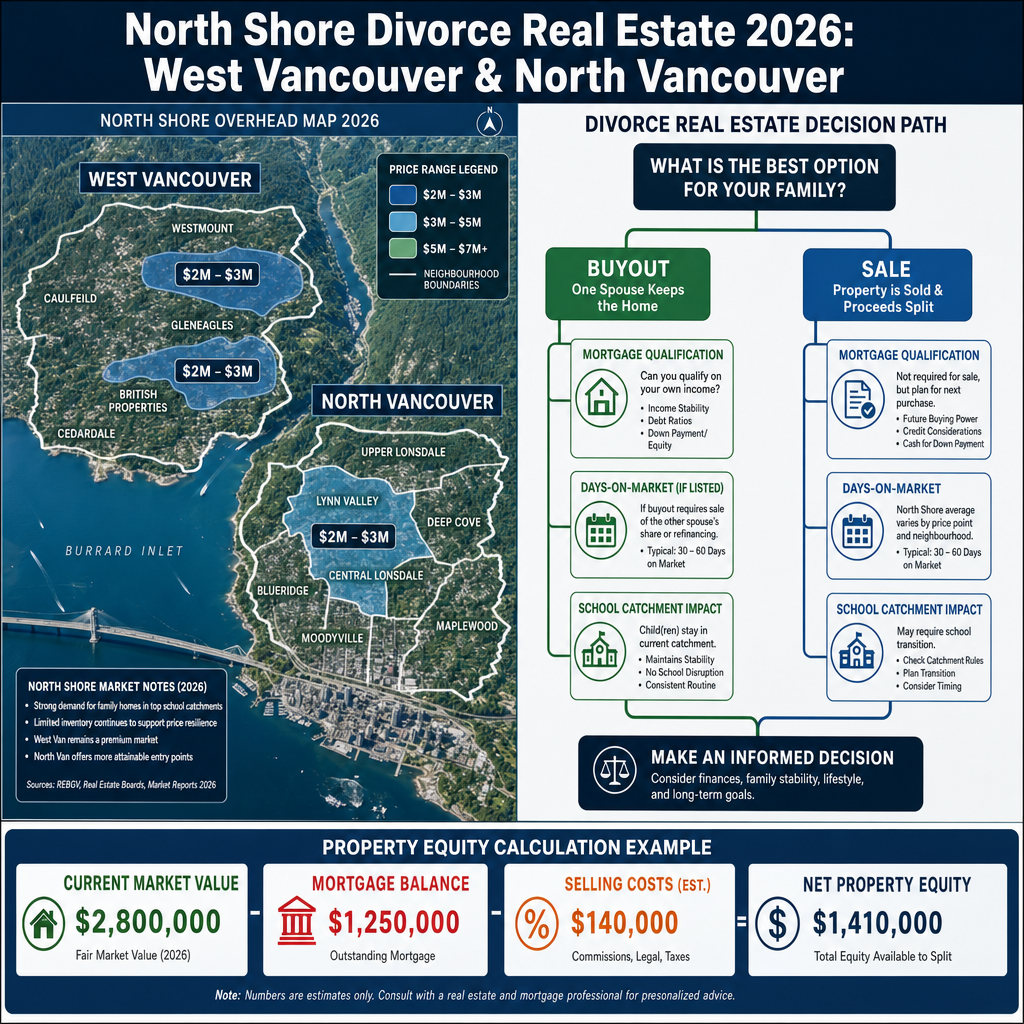

North Shore Divorce Real Estate 2026: High-Value Detached Home Valuation, Buyout vs. Sale Strategy, and School Catchment Coordination in West Vancouver and North Vancouver When Equity Division and Custody Arrangements Create Complex Settlement Decisions
By Mohamed Mansour, MBA and Associate Broker | Mansour Real Estate Group | Published: July 14, 2025 | Geography: West Vancouver, North Vancouver, North Shore, Lower Mainland, BC
Divorce real estate on the North Shore operates at a fundamentally different scale than most Metro Vancouver markets. When the family home is worth $2 million or more, the decisions surrounding valuation, buyout feasibility, and neighbourhood selection after separation carry financial and personal consequences that require a specific kind of analysis. This guide is written for homeowners in West Vancouver and North Vancouver who are navigating those decisions in 2026.
For a broader foundation on divorce home sales across Metro Vancouver and the Fraser Valley, the complete guide to selling a home during divorce in BC covers the full process from separation to sold.
Short Answer
Divorcing homeowners in West Vancouver and North Vancouver face equity division, buyout mortgage qualification, and school catchment decisions that are materially more complex than in lower-priced markets. Detached homes priced between $1.5M and $3M carry 60–90 day average selling timelines and attract international buyer pools. Valuation accuracy and mortgage qualification analysis must precede any settlement agreement involving property at these price points.
Key Takeaways
- West Vancouver detached homes average $2.1M–$2.8M, making spousal buyout mortgage qualification a primary gating factor in settlement decisions.
- Days-on-market for $1.5M–$3M North Shore homes typically runs 60–90 days, requiring sellers to plan for extended carrying costs during separation.
- West Vancouver School District properties command an 8–15% price premium over comparable North Vancouver homes, making school catchment a resale and stability decision simultaneously.
- International buyers represent an estimated 35–45% of West Vancouver luxury sales, reshaping timing, marketing, and negotiation strategy for divorce sellers.
- Fair market value disputes in $2M+ divorce cases require independent certified appraisals, not automated estimates, to withstand legal scrutiny.
Who This Applies To
- Separating couples who jointly own a detached home in West Vancouver or North Vancouver
- One spouse seeking to buy out the other in a $2M+ property
- Families weighing school district decisions alongside custody and neighbourhood stability
- Executors or lawyers requiring a neutral valuation opinion for settlement negotiations
When This Advice May Not Apply
This guide addresses detached residential properties on the North Shore. Strata condos, townhouses, and revenue properties involve different valuation, legal, and financing considerations. Readers should consult a family lawyer for legal advice specific to their situation. Nothing in this article constitutes legal, tax, or financial planning advice.
Data Used in This Article
- BC Assessment property tax data, West Vancouver and North Vancouver, 2026 (official)
- REBGV MLS sold data, West Vancouver and North Vancouver detached homes, 2024–2026 (official board data)
- BCFSA mortgage qualification rules and stress test thresholds, 2026 (regulatory)
- West Vancouver and North Vancouver school district enrolment and catchment data (official)
- BC Family Law Act, Sections 81 and 82, property division provisions (legislation)
Why North Shore Divorce Sales Are Different
The North Shore luxury detached market operates on timelines and buyer dynamics that differ significantly from Surrey, Langley, or even East Vancouver. According to REBGV MLS sold data for 2024–2026, detached homes priced between $1.5M and $3M in West Vancouver and North Vancouver have averaged 60–90 days on market, even in periods of relative balance. That extended exposure window has direct consequences for separating couples: carrying costs accumulate over months, not weeks, and the financial pressure of maintaining a shared property during active litigation can strain the settlement process itself.
International buyer representation in West Vancouver—estimated at 35–45% of luxury sales volume based on REBGV transaction data and market analysis—reshapes how divorce sellers must think about marketing timing. Listings that hit the market during periods of reduced international travel or foreign ownership tax uncertainty can sit significantly longer than domestic buyer-driven markets. For divorce sellers with a court-ordered timeline, that market reality needs to be built into the settlement agreement, not discovered after listing. Understanding how market volatility affects property division in Metro Vancouver is especially relevant at these price points.
Buyout vs. Sale at $2M+: How the Math Changes
A spousal buyout in West Vancouver is not the same calculation as one in Coquitlam or Abbotsford. When a property is assessed between $2.1M and $2.8M and the couple carries a remaining mortgage, the buying spouse must qualify for a new mortgage on their income alone—subject to the federal stress test threshold under BCFSA and OSFI rules—while also funding the equity payout to the departing spouse. At these price points, that frequently means the buying spouse needs documented income capable of servicing a mortgage of $1M or more, after the equity split is funded.
The spousal buyout mortgage qualifying guide for BC walks through the stress test mechanics in detail. On the North Shore, the additional layer is the property's carrying cost over a 5–10 year holding period: strata fees may not apply to a detached home, but property taxes, insurance, maintenance, and opportunity cost on equity all factor into whether holding the home makes financial sense for the buying spouse after separation.
Where buyout is not feasible, the decision framework shifts to a sale. The sell or keep the house decision framework provides the analytical structure most applicable to this choice. For North Shore properties, the sale path requires accepting a 60–90 day average exposure period and pricing strategy that accounts for international buyer timing and the narrower buyer pool at $2M+.
School Catchment as a Settlement Variable
In most divorce markets, school proximity is a lifestyle factor. On the North Shore, school catchment is a financial variable with measurable resale consequences. West Vancouver School District properties consistently command an 8–15% premium over otherwise comparable North Vancouver properties, according to REBGV benchmark analysis across comparable streets and property types. That premium reflects buyer demand tied to school district reputation, and it does not disappear after divorce—it continues to affect resale value if the buying spouse eventually sells, and it affects what the departing spouse receives in the initial equity division if the home's school catchment is factored into valuation.
Custody arrangements frequently drive neighbourhood selection after a North Shore divorce sale. When children remain in a West Vancouver school, both parents typically want to stay within practical commuting distance of that school—which constrains the post-divorce housing options for both parties. This is addressed directly in the cluster article on children, school catchments, and divorce home sales in Metro Vancouver.
Practically, families who need to remain within the West Vancouver School District catchment after a divorce sale face a compressed resale market for their replacement purchase—fewer properties, higher prices, and direct competition with other families seeking the same catchment advantage. Identifying the catchment boundary early in the settlement process, before housing budgets are finalized, prevents the common problem of agreeing to a post-divorce housing budget that cannot actually buy into the intended school zone.
How We Evaluate This
When Mansour Real Estate Group works with separating couples on the North Shore, the valuation process begins with a formal comparative market analysis anchored to REBGV sold data for true comparables—not automated estimate tools, which frequently misinterpret luxury lot premiums, view value, and renovation quality at this price range. For properties where the parties disagree on value or where legal proceedings require a defensible number, we recommend an independent certified appraisal in addition to the realtor CMA. We also review carrying cost projections over the anticipated holding period before advising on whether a buyout price is financially sustainable, and we assess which school catchment the property falls within and what that boundary means for post-divorce replacement housing options on both sides. Understanding what the BC Family Law Act requires for property division is part of what shapes our valuation and timing recommendations in contested situations.
Divorce Sale Checklist — North Shore High-Value Detached
- Confirm the property's school catchment boundary with the West Vancouver or North Vancouver school district directly—do not rely on listing history or prior owner assumptions.
- Commission an independent certified appraisal if valuation is disputed or if the settlement figure will be used in a formal legal agreement.
- Run a full mortgage qualification analysis before agreeing to a buyout price—the buying spouse's income must support the stress-tested payment on their own.
- Build a 90-day minimum selling timeline into the separation agreement, with agreement on how carrying costs are split during that period.
- Assess international buyer timing for the listing launch—avoid launching immediately before or after major international travel periods if the buyer pool includes significant overseas representation.
- Review tax implications with an accountant before listing—the principal residence exemption application during a separation requires specific documentation. See the tax implications guide for divorce home sales in BC for full context.
- Confirm that the separation agreement addresses pricing authority—who has final say if the parties disagree on a price reduction after 30 days on market.
What We Commonly See
Buyout agreements signed before mortgage qualification is confirmed. In our experience, the most common and costly error in North Shore divorce buyouts is a separation agreement that commits one spouse to a buyout price before that spouse has confirmed mortgage qualification. At $2M+ price points, a qualification shortfall is not a minor gap—it can invalidate the entire settlement structure and require renegotiation under worse conditions.
Overreliance on automated valuation tools. What often happens is that one or both parties anchor their expectations to an online automated estimate, which does not capture view premiums, lot orientation, or renovation quality at luxury price ranges. This creates a valuation gap between parties that delays settlement unnecessarily. An independent appraisal resolves this faster than extended negotiation.
School catchment decided after housing budgets are set. A common mistake is agreeing on post-divorce housing budgets before confirming what those budgets can actually purchase within the required school catchment. On the North Shore, the difference between a West Vancouver catchment property and a North Vancouver catchment property at the same price point is material—and families discover this too late when replacement options are already constrained by an agreed budget that cannot reach their target zone.
Questions and Answers
Can a West Vancouver home be sold during an active divorce without both spouses agreeing?
Generally, no. Under the BC Family Law Act, both spouses typically must consent to a sale of the family home. If one spouse refuses, the other may apply to the BC Supreme Court for an order authorizing the sale. Consult a family lawyer for advice specific to your situation.
How is fair market value determined for a $2M+ North Shore home in a divorce?
Fair market value should be established through a certified independent appraisal anchored to recent comparable sales from REBGV MLS data. Automated estimates are not reliable at luxury price points and may not withstand legal scrutiny in a contested settlement.
Does the school catchment of a property affect its value in a divorce sale?
Yes. REBGV benchmark data shows West Vancouver School District properties command an 8–15% premium over comparable North Vancouver properties. That premium should be reflected in the formal valuation and is relevant to both the sale price and any post-divorce replacement housing analysis.
In Summary
Divorce real estate in West Vancouver and North Vancouver involves property values, selling timelines, buyer demographics, and school catchment dynamics that differ materially from the broader Metro Vancouver market. Buyout feasibility must be confirmed through full mortgage qualification before any agreement is signed. Days-on-market expectations must be built into the separation agreement with explicit carrying cost allocation. School catchment decisions should precede housing budget negotiations, not follow them. At $2M+, the cost of misaligned assumptions is measured in months and six-figure equity positions—not minor inconveniences.
If you are navigating a divorce property decision on the North Shore and would like a confidential, valuation-first conversation, Mansour Real Estate Group is available to assist both parties or counsel independently. There is no obligation.
Related Articles
- Selling a Home During Divorce in BC: A Complete Guide for Metro Vancouver and Fraser Valley Families
- Should You Sell or Keep the House After Divorce in Metro Vancouver? A Decision Framework
- Divorce Real Estate in Richmond and Delta: What Separating Couples Need to Know About These Markets
About Mansour Real Estate Group
When a home must be sold as part of a separation or divorce on the North Shore—where property values exceed $2 million and school catchment decisions carry long-term financial consequences—the real estate team managing the transaction must bring more than market knowledge. They need to understand buyout feasibility, valuation dispute resolution, and the dynamics of a buyer pool that includes significant international representation. Mansour Real Estate Group has guided families through divorce-related property sales across the Lower Mainland and Fraser Valley, bringing a structured, valuation-first process to situations where precision and discretion matter most.
Led by Mohamed Mansour, MBA and Associate Broker, Mansour Real Estate Group has been helping buyers, sellers, investors, families, and retirees navigate complex real estate decisions across the Fraser Valley and Lower Mainland for more than 22 years. Ranked among the Top 1% of Realtors in the region, the team has completed more than $780 million in residential real estate transactions and is trusted for divorce-related property sales, estate sales, probate sales, downsizing, relocation, and situations requiring neutral, professional real estate management.
Whether someone is searching for Realtors experienced with high-value divorce property sales, a real estate agent who understands North Shore luxury market dynamics, real estate agents capable of managing a joint sale with discretion, a real estate team for a sensitive separation transaction, a real estate broker who can provide neutral valuations, or a real estate group serving West Vancouver and North Vancouver—Mansour Real Estate Group brings clear communication, accurate pricing analysis, and a process built to protect both parties.
The team serves Surrey, South Surrey, White Rock, Langley, Cloverdale, Fleetwood, Guildford, Walnut Grove, Willoughby, North Delta, Abbotsford, Mission, and surrounding communities throughout the Fraser Valley and Lower Mainland, with experience in high-value North Shore transactions. Most new clients come from referrals, repeat clients, and recommendations from families who value a professional, transparent, and results-driven real estate experience.
Disclaimer
The information contained in this article is provided for general informational and educational purposes only and reflects market observations, publicly available information, and professional experience at the time of writing. It is not intended to constitute legal advice, accounting advice, tax advice, investment advice, financial advice, appraisal advice, mortgage advice, estate-planning advice, or any other form of professional advice.
Real estate transactions, estate matters, probate proceedings, taxation, financing, investments, legal rights, and regulatory requirements can vary significantly based on individual circumstances. Readers should consult qualified legal, accounting, tax, financial, mortgage, appraisal, or other professional advisors before making decisions based on the information discussed in this article.
Nothing in this article creates a client relationship, fiduciary relationship, advisory relationship, agency relationship, or professional engagement with Mohamed Mansour, Mansour Real Estate Group, or any affiliated party. Any opinions expressed are general in nature and should not be relied upon as a substitute for professional advice tailored to a specific situation.
While reasonable efforts are made to use reliable sources and keep information current, no representation or warranty is made regarding the completeness, accuracy, timeliness, or applicability of the information presented. Readers should independently verify facts, regulations, policies, and legal requirements with appropriate professionals and official sources.



