
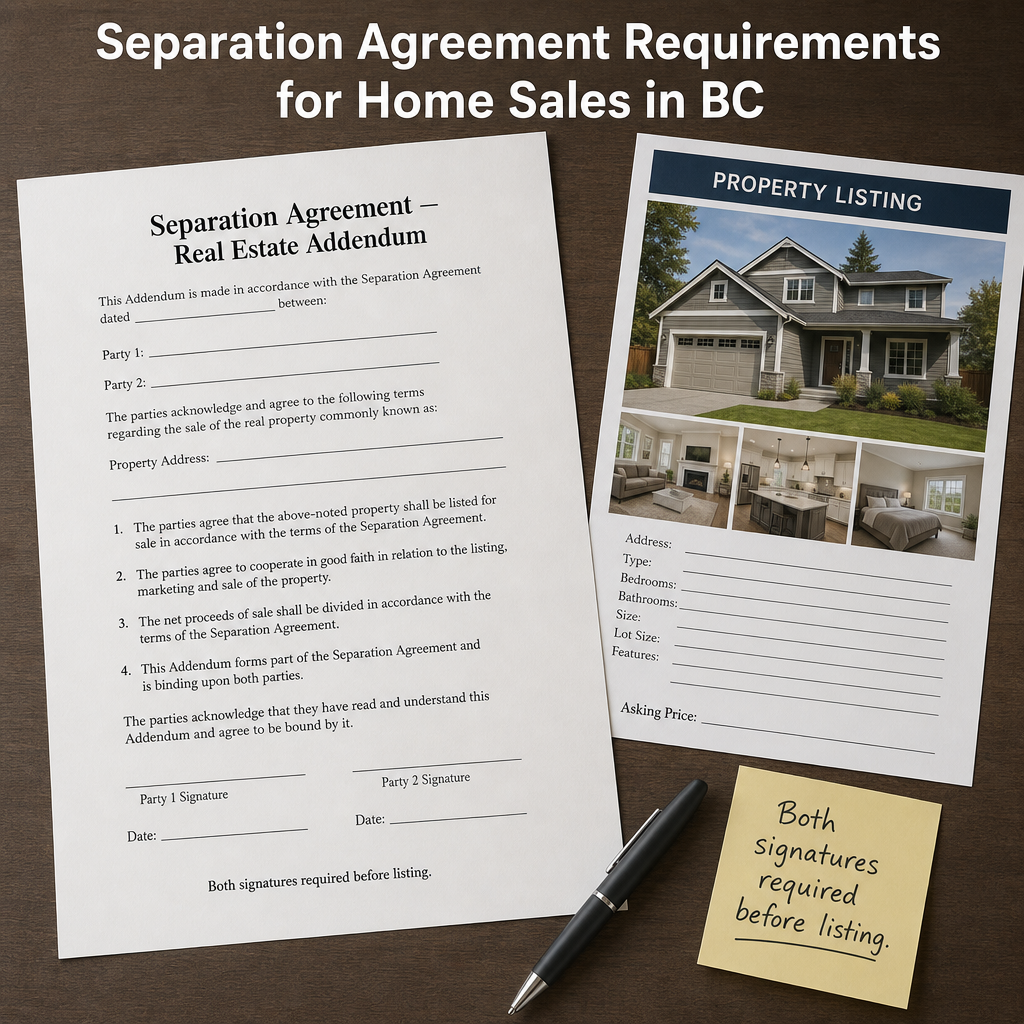

Separation Agreement Requirements for Home Sales in BC: What Must Be in Writing Before Listing, Price Thresholds, Proceeds Distribution, and Why Legal Review Protects Both Spouses
By Mohamed Mansour, MBA and Associate Broker — Mansour Real Estate Group | Fraser Valley and Lower Mainland, BC | Published: July 15, 2026
For separating couples in the Fraser Valley and Lower Mainland, the decision to sell the family home often happens months before the paperwork catches up. One spouse may be ready to list. The other may still be speaking with a lawyer. And the family home — often the largest shared asset — sits in the middle, with unclear authority, no documented price floor, and no agreed plan for what happens to the proceeds. That gap creates real risk: for both spouses, and for the realtor they eventually hire.
This article explains what a separation agreement must include before a family home in BC can be safely listed for sale — what terms should be in writing, why price parameters and proceeds formulas matter, and how realtor-lawyer coordination protects both parties from disputes after closing.
Short Answer
Before listing a family home during separation in BC, the separation agreement should explicitly authorize the sale, define a listing price range or formula, specify how net proceeds are distributed after mortgage discharge and closing costs, and confirm which spouse controls access during showings. Without those terms in writing — signed by both parties — the realtor has no verified authority to proceed, and both spouses are exposed to post-closing disputes.
Key Takeaways
- A separation agreement must explicitly authorize the sale before a realtor can safely act on instructions from either spouse alone.
- Price parameters — a defined range or formula — prevent disputes over whether a specific offer is acceptable to both parties.
- Net proceeds distribution must account for mortgage discharge, commission, legal fees, and any court-ordered adjustments before any split is calculated.
- Occupancy and showings access protocols belong in the agreement — not in a verbal understanding between spouses who may no longer communicate well.
- Legal review before listing protects both spouses from post-closing claims and protects the realtor from acting on incomplete or disputed authority.
Who This Applies To
- Separating or divorcing spouses in BC who jointly own a family home and plan to sell
- Homeowners in Surrey, Langley, Abbotsford, White Rock, North Delta, and across the Fraser Valley navigating a joint sale
- Spouses where one party is the primary occupant and the other is no longer living in the home
- Couples working with family lawyers who have not yet finalized a separation agreement
When This Advice May Not Apply
If a BC Supreme Court order already governs the sale — including listing authority, price, and distribution — the court order replaces many of the separation agreement mechanics described here. In that situation, review the order with a lawyer before engaging a realtor. See Court-Ordered Home Sales in BC: What Happens When Divorcing Couples Cannot Agree for how that process works.
Data Used in This Article
- BC Family Law Act, Part 1, Division 3 (Family Property) — official legislation, Government of British Columbia
- Law Society of BC — Family Law Practice Guidelines — regulatory guidance for BC lawyers on separation agreement documentation
- Family Law Bar Association of BC — pre-listing agreement documentation materials — professional practice guidance
- Mansour Real Estate Group — case file observations — separation agreement disputes in Metro Vancouver and the Fraser Valley, 2024–2026 (generalized; no client-identifying details)
Why Separation Agreement Mechanics Matter Before Listing
Under the BC Family Law Act, family property — including the family home — is divided equally unless there is a written agreement or court order stating otherwise. That legal framework tells you what the outcome should be. It does not tell you how the sale gets executed. That is the gap a separation agreement must fill.
A realtor representing both spouses in a divorce sale is in a structurally different position than in a standard transaction. In a standard listing, one client controls the decisions. In a divorce sale, two clients — who may disagree on price, timing, and access — both have legal authority over the property. Without a written agreement that resolves those conflicts in advance, the realtor cannot safely proceed on one spouse's instructions alone.
This is not a theoretical risk. In our experience working on divorce-related sales across Surrey, Langley, and Abbotsford, disputes over listing price, showing access, and proceeds distribution are among the most common reasons a separation sale stalls, deals collapse after acceptance, or a closing becomes contentious. Most of those situations trace back to an agreement that was either absent or too vague to govern the specific decisions that came up. The complete guide to selling a home during divorce in BC covers the broader process; this article focuses specifically on the agreement mechanics.
What the Agreement Must Explicitly Authorize
Sale authority. The agreement must state, in plain language, that both spouses authorize the sale of the property — identified by civic address and legal description — and that both consent to engaging a realtor. This sounds obvious. In practice, many agreements use language like "the parties agree to list the property" without specifying whether one spouse can sign the listing contract unilaterally or whether both signatures are required on every document. That ambiguity creates problems at the listing stage and again at the offer stage.
Signature authority on listing and offer documents. The agreement should clarify whether both spouses must sign the listing contract, counter-offers, and accepted offers — or whether a limited power of attorney has been granted to one spouse to act on listing decisions. If one spouse has already left the province or is difficult to reach, this provision can prevent significant delays in a market where offer windows are short. The BC Family Law Act and real estate obligations for separating couples provides additional legal context on property authority.
Dispute resolution for listing decisions. If the spouses cannot agree on whether to accept a specific offer, the agreement should define what happens next — mediation, referral to lawyers, or a binding arbitration process. Without this, a disagreement over one offer can result in a buyer walking away and the parties back in court. The legal options if one spouse won't cooperate are more limited and slower than most sellers expect.
Price Parameters: Why a Range or Formula Prevents Disputes
One of the most practical provisions a separation agreement can include is a defined price range or formula. Rather than leaving pricing to real-time negotiation between two spouses who may not be communicating well, the agreement specifies acceptable boundaries in advance.
A price range might read: "The listing price shall be set between $850,000 and $920,000, based on a comparative market analysis conducted by the agreed realtor within 30 days of signing." A formula-based provision might reference BC Assessment value with a defined adjustment — for example, no lower than 95% of the current assessed value without both spouses' written consent. Either approach removes the need for one spouse to convince the other that a specific price is reasonable at the moment an offer arrives.
From a realtor's perspective, the price provision also protects against liability. If a realtor lists at a price based on one spouse's instructions and the other later claims the price was too low, the written agreement — specifying the range both parties accepted — is the documentation that protects everyone. What often happens when this provision is missing is that the occupying spouse sets the listing price unilaterally, and the non-occupying spouse objects once an offer comes in that they consider below market. The transaction stalls, or the buyer loses patience and the deal collapses.
The agreement should also address the contingency case: what happens if no offer at or above the minimum price threshold is received within a defined period. Options include reducing the floor by a specified percentage, extending the timeline, or returning to lawyers for renegotiation. Without that contingency clause, a property can sit unsold while both spouses wait for the other to agree to a price reduction.
Net Proceeds Distribution: What Must Be Calculated Before Any Split
The net proceeds from a family home sale are not simply the sale price divided by two. Before any distribution is made, the following must be deducted from gross sale proceeds:
- Mortgage discharge amount (including any prepayment penalty, confirmed with the lender before closing)
- Realtor commission (typically 3.22% on the first $100,000 and 1.15% on the balance in BC, though this varies by agreement)
- Conveyancing and legal fees for the sale transaction
- Outstanding property tax or strata fee adjustments as of the completion date
- Any home equity line of credit or second charge registered on title
- Any court-ordered reimbursements or credits from one spouse to the other, per the family law order or agreement
The separation agreement should specify this calculation sequence explicitly, not just the final split percentage. A provision that says "net proceeds split equally" without defining what "net" means will produce different numbers depending on who is doing the math. A well-drafted agreement defines net proceeds as gross sale price minus a specific list of deductions — in the order they are applied — and confirms what happens if those deductions produce a shortfall (i.e., if the mortgage discharge exceeds the net proceeds).
Understanding what happens to the mortgage itself — not just the proceeds — is also critical before listing. The practical guide to what happens to the mortgage when couples separate in BC covers lender obligations, discharge mechanics, and joint liability — all of which affect how the proceeds calculation works. For divorce sales in Surrey, Langley, and South Surrey, where detached home prices have fluctuated significantly in recent years, the difference between gross and net proceeds can be substantial enough to affect both spouses' post-sale housing options.
Occupancy, Showings, and Access Protocols
When one spouse remains in the home during the listing period, the agreement must define the practical rules around showings, inspections, and appraisals. These are not minor details. A occupied home where one spouse is uncooperative with showing requests — scheduling conflicts, last-minute cancellations, refusing access for inspections — can meaningfully reduce buyer interest and negotiate leverage.
The agreement should specify: who is responsible for granting realtor access to the property, how much notice is required before showings, whether the occupying spouse must vacate during showings or inspections, and what the protocol is if the occupying spouse refuses access within the agreed notice period. In some situations — particularly where the relationship between the spouses has broken down completely — the agreement may specify that the realtor holds a key and can grant access without contacting the occupying spouse each time, within defined hours.
Occupancy through to the completion and possession dates should also be addressed. If the occupying spouse needs additional time after closing, that needs to be negotiated and documented before listing — not after an offer is accepted — because it affects the possession terms offered to buyers, and buyers' willingness to proceed on the offer. A common mistake in divorce sales is assuming this will be sorted out at the offer stage. By then, the occupying spouse's timeline expectations may conflict directly with what the buyer has been told.
How We Evaluate This at Mansour Real Estate Group
When Mansour Real Estate Group is approached for a divorce or separation sale, the first step in our consultation is not pricing or marketing. It is agreement verification. Before we accept a listing from separating spouses, we confirm that a written agreement — or court order — exists that authorizes the sale, sets price parameters, and defines our authority to act on listing decisions. If that agreement is incomplete or absent, we recommend that both spouses return to their lawyers before proceeding.
This is not a bureaucratic hurdle. It is the step that prevents a mid-transaction dispute from costing both spouses time, money, and a buyer who has moved on. The divorce home sale process step by step maps out how agreement verification fits into the full sequence from separation to sold.
Divorce Sale Checklist: What Should Be in Writing Before Listing
- Both spouses have signed a separation agreement (or a court order governs the sale) that explicitly authorizes listing the family home
- A listing price range or formula is defined in the agreement, including a contingency plan if no offer meets the floor within a specified period
- The agreement defines "net proceeds" with a specific list of deductions in order, and confirms the distribution percentage or formula after those deductions
- Mortgage discharge amount has been confirmed with the lender, including any prepayment penalty, before listing commences
- Showings and inspection access protocols are documented: notice period, occupancy requirements, and who grants access
- Occupancy timeline through completion and possession dates is agreed and reflected in how offers will be presented to buyers
- Both spouses have independently confirmed the realtor's role — neutral representation of the joint listing — with their own lawyers
- Dispute resolution process is defined for situations where one spouse declines to accept an otherwise qualifying offer
What We Commonly See
Agreements that authorize the sale but not the price. In our experience, the most common gap in separation agreements is not the authorization to sell — both spouses usually agree to that — but the absence of any price parameter. When an offer comes in at $837,000 and the agreement says nothing about acceptable price, one spouse may want to accept and the other may insist on waiting for more. Without a written floor, there is no objective standard to apply. Deals fall apart at exactly the moment they should be closing.
Proceeds splits calculated on gross, not net. What often happens is that both spouses mentally calculate their proceeds based on the sale price — and then are surprised when mortgage discharge, commission, and legal fees reduce that number by a significant margin. In Fraser Valley markets where detached homes sell in the $900,000 to $1.4 million range, the difference between gross and net proceeds can be $80,000 to $150,000 or more. A provision that simply says "50/50 split" without defining net proceeds leaves that gap unresolved until closing, when the notary's trust statement produces a number neither party expected.
Showings derailed by unaddressed occupancy conflicts. A common mistake is assuming the occupying spouse will cooperate with showing access because they agreed to the sale. In practice, when the relationship is adversarial, showing requests become a point of friction. A spouse who is required to vacate for every showing — without that requirement being in the agreement — can simply decline. By the time the issue is resolved through lawyers, buyers who were interested have moved on. Addressing this in the agreement before listing costs no one anything. Addressing it mid-listing costs both spouses a buyer.
Questions and Answers
Can a realtor list a family home if only one spouse has instructed them?
Not safely in most circumstances. If both spouses are on title, both must authorize the listing and sign the listing contract. A realtor who proceeds on one spouse's instructions alone — without a court order or separation agreement granting unilateral authority — risks acting without proper authority, which creates liability for the realtor and can invalidate the listing. The exception is a court order that expressly grants one spouse the authority to sell without the other's signature.
What happens if no offer meets the minimum price threshold in the agreement?
If the agreement does not include a contingency provision for this scenario, the parties are effectively stuck — neither spouse can force acceptance of a below-floor offer, but the agreement may not provide a clear path to reducing the floor either. Family lawyers increasingly recommend a time-bound contingency: if no qualifying offer is received within a defined period (e.g., 60 days), the floor automatically reduces by a specified percentage or the parties return to mediation to reset the parameters.
Do both spouses need separate legal counsel before signing a separation agreement covering the home sale?
Independent legal advice is strongly recommended and, in some cases, required for the agreement to be enforceable. Under the BC Family Law Act, courts can set aside or vary a separation agreement if one party did not understand its terms or did not receive independent legal advice before signing. Both spouses having their own lawyer review the agreement before execution is the most reliable protection against a future challenge. This applies to the real estate provisions as much as any other part of the agreement.
In Summary
A separation agreement that authorizes a home sale in BC should do more than say "we agree to sell." It should define listing authority, price parameters, the net proceeds formula, showings access, and what happens if the spouses disagree on an acceptable offer. Without those terms in writing — reviewed by both spouses' lawyers and signed before listing commences — the sale is vulnerable to disputes that cost both parties time, money, and negotiating position. A realtor who verifies agreement completeness before proceeding is not creating obstacles. They are protecting the transaction from problems that are much harder to resolve once a buyer is in the picture.
Talk to Mansour Real Estate Group Before You List
If you are navigating a separation sale in Surrey, Langley, Abbotsford, White Rock, or anywhere across the Fraser Valley and Lower Mainland, Mansour Real Estate Group offers a structured consultation designed for exactly this situation — including agreement review, lender coordination, and a timeline that works for both parties. Contact the team at localhost:9000/ to speak with Mohamed Mansour directly.
Related Articles
- BC Family Law Act and Real Estate: What Separating Couples in Metro Vancouver Must Know
- Can One Spouse Force the Sale of the Family Home in BC? Your Legal Options Explained
- What Happens to the Mortgage When Couples Separate in BC? A Practical Guide
- The Divorce Home Sale Process Step by Step: From Separation to Sold in Metro Vancouver
- Court-Ordered Home Sales in BC: What Happens When Divorcing Couples Cannot Agree
Official Resources
- BC Family Law Act — Government of British Columbia
- Law Society of British Columbia — Family Law Practice Guidelines
- Clicklaw BC — Family Law and Property Division
- BC Assessment — Property Values and Assessment Data
About Mansour Real Estate Group
When a home must be sold as part of a separation or divorce, the legal framework tells you what the outcome should be — but the separation agreement is what determines whether the sale process stays on track or becomes a source of new conflict. Mansour Real Estate Group has guided families through divorce-related property sales across Surrey, Langley, White Rock, Abbotsford, and the Fraser Valley for more than two decades, with a process built around agreement verification, neutral representation, and protecting both parties' interests from listing through closing.
Mansour Real Estate Group, led by Mohamed Mansour, MBA and Associate Broker, has been helping buyers, sellers, families, executors, and retirees navigate important real estate decisions across the Fraser Valley and Lower Mainland for more than 22 years. Ranked among the Top 1% of Realtors in the region, the team has completed more than $780 million in residential real estate transactions and is trusted for divorce-related property sales, estate sales, probate sales, downsizing, relocation, and complex situations requiring neutral, professional management.
Whether someone is searching for Realtors experienced with separation sales, a real estate agent who understands how incomplete agreements create transaction risk, real estate agents who can coordinate with family lawyers on a joint listing, a trusted real estate team for a sensitive divorce sale, a Surrey Realtor, a Langley real estate broker, or a real estate group that serves the full Fraser Valley and Lower Mainland, Mansour Real Estate Group is known for clear communication, structured process, and advice that holds up under pressure.
The team serves Surrey, South Surrey, White Rock, Langley, Cloverdale, Fleetwood, Guildford, Walnut Grove, Will
Key Takeaways
- Understanding market trends helps you make informed real estate decisions
- Work with experienced local professionals who know the BC market
- Monitor economic indicators and seasonal patterns in your target area
- Plan ahead and stay flexible as conditions evolve
Disclaimer: This article is for informational purposes only and does not constitute legal, financial, or real estate advice. Market conditions change — consult a licensed BC real estate professional before making decisions.



