
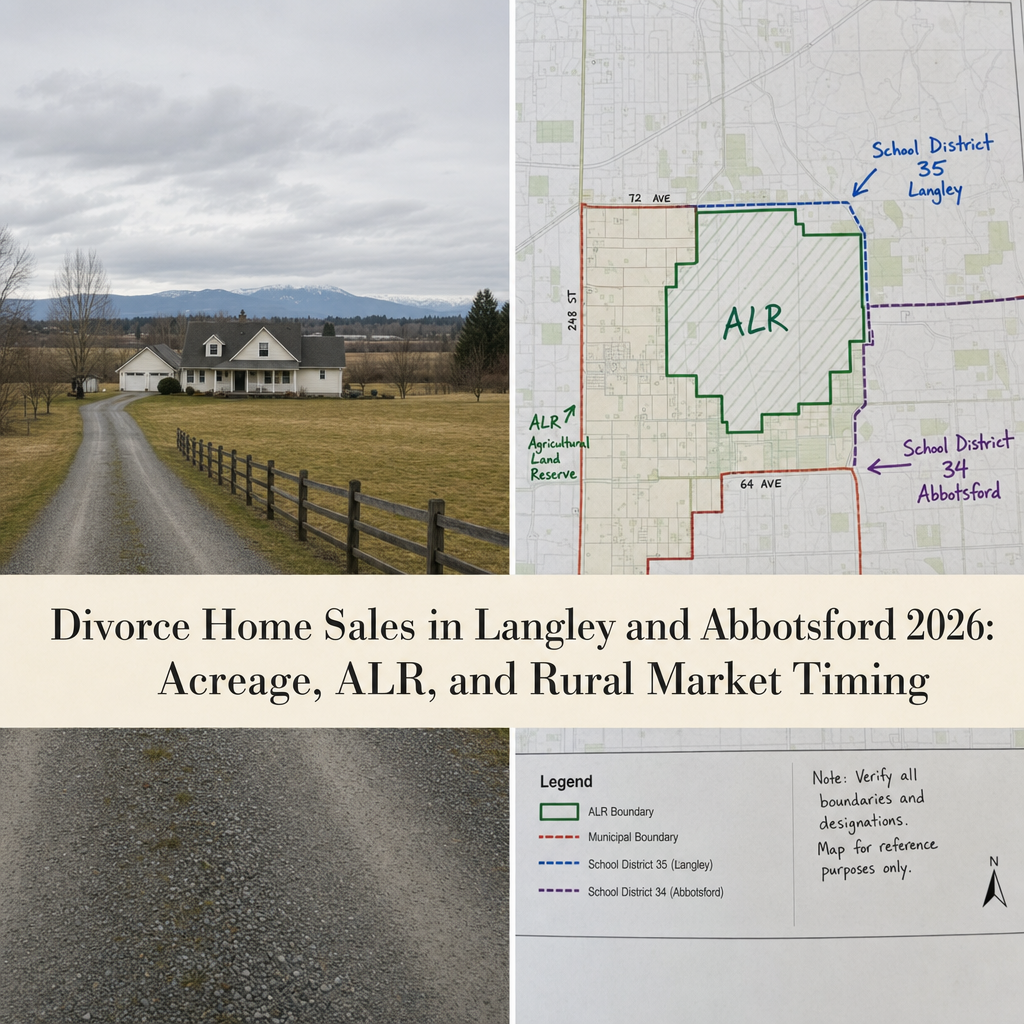

Divorce Home Sales in Langley and Abbotsford 2026: How Acreage Properties, School Catchment Complexity, and Rural Market Timing Differ From Metro Vancouver Divorce Sales — Complete Strategy Guide for Separating Couples
By Mohamed Mansour, MBA and Associate Broker — Mansour Real Estate Group | Published: June 3, 2025 | Geography: Langley, Abbotsford, Fraser Valley, BC | Topic: Divorce Property Sales — Rural, Acreage, and ALR Properties
Separating couples in Langley and Abbotsford face real estate decisions that are structurally different from those their Metro Vancouver counterparts navigate. The presence of acreage, Agricultural Land Reserve restrictions, hobby farms, and sprawling school districts changes how a property is valued, how long it takes to sell, and how family law counsel needs to frame the equity conversation before any listing agreement is signed.
This guide addresses those differences directly. It is written for separating couples, their legal counsel, and family members who need to understand why the process in these communities is longer, more layered, and requires a different kind of real estate expertise than a standard Fraser Valley detached home sale.
Short Answer
Divorce home sales in Langley and Abbotsford take longer, involve more complex valuations, and require earlier coordination between legal counsel and a realtor than comparable Metro Vancouver transactions. Acreage, ALR designation, and narrower buyer pools extend timelines by six to twelve months in some cases. Understanding these factors before listing protects both parties' financial interests.
Key Takeaways
- Acreage and rural properties make up 25–35% of sales in Langley and Abbotsford, versus under 5% in Metro Vancouver, creating real valuation gaps in divorce equity division.
- ALR designation can restrict development potential and directly affects what a property is worth to different buyer types — a fact that must be established before negotiations begin.
- Specialty and acreage properties in the current buyer's market are selling in 45–75 days compared to 25–35 days for standard detached homes, which extends carrying costs for both parties.
- Developer land-assembly interest in Langley Township and Abbotsford fringe areas can produce offers 15–30% above residential comparables — an opportunity that disappears without the right buyer reach.
- School catchment distances of 8–15 km across Langley and Abbotsford districts affect custody-driven timing decisions in ways that rarely arise in denser Metro Vancouver communities.
Who This Applies To
- Separating couples who own a detached home, acreage, hobby farm, or rural property in Langley or Abbotsford
- Families where school catchment affects custody schedules and the timing of a property sale
- Divorcing spouses with a property that carries ALR designation, farm status, or development interest
- Executors or counsel managing property division involving land with ambiguous comparables
When This Advice May Not Apply
This guide focuses on properties with acreage, rural characteristics, or ALR complexity. Separating couples selling a standard strata or townhome in Langley's urban core should refer to guidance on selling a home during divorce in BC for process fundamentals. Properties in Mission, Maple Ridge, or Pitt Meadows with similar rural characteristics are addressed separately in our Mission, Maple Ridge, and Pitt Meadows divorce real estate guide.
Key Definitions
Agricultural Land Reserve (ALR): A provincial land-use zone in BC where agriculture is the priority use. ALR designation limits non-agricultural development and affects buyer pool, financing options, and assessed value.
Farm Status: A BC Assessment classification for agricultural properties that reduces property taxes. Farm status affects assessed value calculations used in equity division.
Land Assembly: The process where a developer acquires two or more adjacent properties to redevelop them together, often paying a premium above residential value.
Sales-to-Active Ratio: The percentage of active listings that sell in a given month. Fraser Valley's February 2026 ratio of 11% indicates a buyer's market, where buyers hold negotiating leverage.
Data Used in This Article
- Fraser Valley Real Estate Board (FVREB): February 2026 market statistics — sales-to-active ratio, DOM by property type — Official board data
- BC Agricultural Land Commission: ALR designation maps and non-farm use policy — Official provincial source
- Langley School District No. 35 and Abbotsford School District No. 34: Catchment boundary mapping — Official district sources
- Mansour Real Estate Group: Professional observation of acreage DOM variance and developer acquisition activity in Langley Township and Abbotsford fringe areas, 2024–2026 — Internal experience
Why Langley and Abbotsford Divorce Sales Are Different
In Metro Vancouver, most divorce property sales involve a detached home in an established neighbourhood where comparable sales are plentiful and buyer pools are deep. A good realtor can price accurately, list with confidence, and typically expect an offer within a reasonable window.
Langley and Abbotsford operate differently. Acreage and rural properties account for 25–35% of sales in these communities, according to Fraser Valley market classification data. That proportion is three to four times higher than Metro Vancouver. When a divorcing couple owns a two-acre hobby farm in Langley Township or a five-acre parcel outside Abbotsford, the standard equity division process runs into practical complications immediately.
Comparable sales may not exist within a meaningful geographic range. ALR designation may restrict what a buyer can do with the land. Farm status may mean BC Assessment's appraised value bears little relationship to market value. And developer interest — where it exists — can push the achievable price well above what residential comparables suggest.
For family law counsel managing property division, these factors need to be identified before any valuation is agreed upon. A property's worth in a divorce settlement depends heavily on which buyer type is actually likely to purchase it — and in these communities, that question is not always straightforward. Understanding how the BC Family Law Act treats real estate in separation is the necessary legal foundation before those valuation discussions begin.
ALR Designation, Farm Status, and Equity Division: What Must Be Clarified Before Listing
The Agricultural Land Reserve, administered by the BC Agricultural Land Commission, designates land where farming is the priority use. Properties inside the ALR face restrictions on subdivision, non-agricultural buildings, and certain types of development. These restrictions directly affect who will buy the property, what they can do with it, and what they will pay.
In a divorce context, ALR status creates a specific problem: the assessed value may reflect farm use rather than residential or development potential, which can lead to disagreements between spouses about what the property is actually worth. If one spouse wants to retain the property and buy out the other, the buyout figure must be based on an accurate market valuation — not a farm-assessed figure that may significantly understate actual value.
Farm status, separately, is a BC Assessment classification that reduces annual property taxes. It requires meeting active farming income thresholds. When a property carries farm status, the assessed value used for tax purposes is often a fraction of what a willing buyer would actually pay. Family law counsel needs to understand this distinction before advising clients on what their equity position is.
Before any listing agreement is signed on an ALR or farm-status property in Langley or Abbotsford, a certified appraiser with rural and agricultural property experience should provide a market value opinion. That opinion — distinct from BC Assessment's figure — becomes the basis for an equitable property division discussion. Our article on spousal buyouts in BC explains how valuation anchors the buyout process when one party wants to retain the home.
How We Evaluate This
When Mansour Real Estate Group is engaged for a divorce sale involving acreage or rural property in Langley or Abbotsford, the evaluation process starts with three questions that standard residential sales rarely need to ask: Is the property inside the ALR? Does it carry farm status? And has there been any documented developer or land-assembly interest in the immediate area?
Those answers determine the buyer profile — whether the most likely purchaser is a hobby farmer, a residential buyer seeking land, or a developer acquiring for assembly. Each buyer type has a different price ceiling, different financing constraints, and a different timeline to closing. Understanding which buyer type dominates the realistic pool changes how the property is priced, how it is marketed, and how long both parties should plan to carry holding costs. That analysis happens before a listing price is discussed.
Developer Land Assembly: The Opportunity Most Divorcing Sellers in Langley and Abbotsford Miss
In certain parts of Langley Township and on the urban fringe of Abbotsford, developer land-assembly interest has created offer opportunities that exceed residential comparable values by 15–30%. This happens when a developer needs to acquire two or more adjacent properties to reach a minimum site area for rezoning or redevelopment.
Most divorcing couples selling a rural property are not aware this market exists. Their realtor may not be either, if that realtor works primarily in residential resale. A land-assembly buyer operates differently from a residential buyer: offers may come with longer closing timelines, different subject conditions, and coordinated negotiations with adjacent owners. None of that is accessible through standard MLS marketing alone.
When a Langley or Abbotsford property sits in a known assembly corridor, identifying that opportunity before listing is part of protecting both parties' interests. Missing it means leaving significant equity on the table — equity that both spouses are entitled to share. For similar rural complexity in neighbouring communities, our Mission, Maple Ridge, and Pitt Meadows divorce real estate guide addresses comparable considerations.
School Catchment Complexity and Custody Timing in Langley and Abbotsford
In Metro Vancouver's denser communities, school catchment boundaries are relatively compact and predictable. In Langley and Abbotsford, catchment areas span much larger geographic distances — often 8–15 km between school and home for rural addresses. When separating parents are negotiating custody arrangements, the school catchment for the family home is often a deciding factor in where children will be enrolled after the sale.
This affects the divorce sale timeline in a direct way. If one parent wants to remain in the same school catchment for continuity, and the other parent wants to sell and relocate, the timing of the listing may become a point of legal contention. School enrollment deadlines in Langley School District No. 35 and Abbotsford School District No. 34 create hard calendar anchors that affect when a sale can practically complete without disrupting children's schooling mid-year.
For separating parents in these communities, coordinating the listing timeline with school year transitions is not optional — it is a practical necessity. A September or February completion date may be preferable to a mid-term close, and both parties' counsel should factor that into the sale agreement timeline. Our guide to the divorce real estate timeline in the Fraser Valley covers how these calendar pressures interact with market timing decisions.
Market Timing in a Buyer's Market: What the Current Conditions Mean for Acreage Sellers
According to the Fraser Valley Real Estate Board's February 2026 statistics, the overall sales-to-active ratio for the Fraser Valley was 11% — a buyer's market, where active listings significantly outnumber completed sales. For standard detached homes, selling timelines are currently running 25–35 days. For acreage and specialty properties, that figure extends to 45–75 days because the buyer pool is narrower and subject conditions typically include inspection periods, financing on rural properties, and well and septic assessments.
For divorcing couples, an extended selling timeline is not simply an inconvenience. Carrying costs — mortgage payments, property taxes, insurance, maintenance — continue to accumulate on a jointly held property for every week it sits on the market. In a buyer's market, an overpriced acreage listing that sits for 90 days will almost certainly sell for less than a well-priced listing that closes in 50. Getting the price right at launch matters more, not less, when inventory is elevated.
The spring window — typically March through May — remains the highest-activity period for Fraser Valley acreage buyers. Separating couples who plan to list in spring 2026 need to have their legal authority, valuation, and listing preparation in place well before that window opens. A listing that misses the spring peak in a buyer's market may wait until fall for comparable buyer activity. For a broader comparison of how divorce sale timing differs by neighbourhood type, the Surrey and South Surrey divorce home sale guide covers urban timing pressures that contrast with the rural dynamics here.
Divorce Sale Checklist — Acreage and Rural Properties in Langley and Abbotsford
- Confirm ALR designation status through the BC Agricultural Land Commission before any valuation discussion begins.
- Obtain a current BC Assessment notice and determine whether farm status applies and how it affects the assessed value relative to market value.
- Commission a market value appraisal from a certified appraiser with demonstrated rural and agricultural property experience in the Fraser Valley.
- Instruct a realtor to assess whether the property sits within a known developer land-assembly corridor before deciding on pricing strategy.
- Review well and septic system records — buyers of rural properties in Langley and Abbotsford will require inspection reports, and deficiencies affect net proceeds.
- Coordinate listing timing with school enrollment deadlines in Langley School District No. 35 or Abbotsford School District No. 34 if children's school continuity is part of the custody arrangement.
- Confirm that both spouses have legal authority to list — either through a written agreement, a court order, or joint consent — before approaching any real estate professional. Our guide on forcing a home sale in BC explains the legal threshold.
- Build a carrying cost buffer into the financial plan — acreage properties in the current market may take 45–75 days to sell, and both parties need to plan for that period.
What We Commonly See
Valuation disputes anchored to BC Assessment figures. In our experience, the most common source of early conflict in Langley and Abbotsford acreage divorce sales is one party relying on the BC Assessment notice as a proxy for fair market value. When farm status applies, that figure may be dramatically lower than what the market will pay. Getting an independent market appraisal early prevents the equity division conversation from starting in the wrong place.
Missing the spring buyer window due to legal delays. What often happens is that separating couples spend the early months of a separation negotiating legal terms, and by the time they are ready to list, the spring market has closed. For acreage properties in Langley and Abbotsford, the next comparable buyer activity period may not arrive until September — meaning months of unnecessary carrying costs and negotiating from a weaker position.
Pricing for the wrong buyer type. A common mistake is pricing an acreage property based solely on residential comparables without assessing developer interest. When a parcel has assembly potential, a residential price ceiling limits the offer range and may exclude the buyer who would pay the most. Identifying the realistic buyer pool before listing determines which pricing strategy protects both parties.
Questions and Answers
Does ALR designation prevent us from selling our Langley property during a divorce?
No. ALR designation restricts land use but does not prevent a sale. You can sell an ALR-designated property to any eligible buyer. The designation affects what that buyer can do with the land, which affects pricing and buyer type — but the sale itself is not restricted. Your realtor and family law counsel should both understand this distinction before pricing begins.
How is farm status handled when dividing equity in a BC divorce?
Farm status is a tax classification, not a valuation method. BC courts and family law counsel look at market value — what a willing buyer would pay — not the farm-assessed figure from BC Assessment. An independent market appraisal is the appropriate basis for equity division when a property carries farm status.
What if one spouse wants to keep the Abbotsford acreage and buy out the other?
A spousal buyout on an acreage property follows the same general framework as any BC separation buyout — one spouse acquires the other's interest at an agreed market value. The challenge with acreage is that lenders apply stricter financing criteria for rural properties, and the retaining spouse must qualify for a new mortgage on that basis. Our article on spousal buyouts in BC explains the qualification process in detail.
In Summary
Divorce home sales in Langley and Abbotsford involve a level of property complexity — ALR designation, farm status, developer assembly interest, sprawling school catchments, and narrower buyer pools — that simply does not exist at the same rate in Metro Vancouver. Separating couples in these communities need earlier legal clarity, an independent market appraisal from a rural-experienced appraiser, and a realtor who understands which buyer type their property is actually suited for. In the current buyer's market, getting those fundamentals right before listing is the difference between a sale that protects both parties and one that leaves equity behind.
Speak With Mansour Real Estate Group
If you or your legal counsel would like a confidential, no-obligation consultation about a Langley or Abbotsford property sale during separation, Mansour Real Estate Group is available to provide a neutral valuation assessment and honest guidance on timing, buyer profile, and realistic proceeds. There is no pressure and no sales pitch — only a structured conversation about your specific situation. Contact us at localhost:9000/ or reach Mohamed Mansour directly at any time.
Related Articles
- Selling a Home During Divorce in BC: A Complete Guide for Metro Vancouver and Fraser Valley Families
- Divorce Home Sales in Surrey and South Surrey: What Local Sellers Need to Know in 2026
- Who Is the Best Realtor for a Divorce Home Sale in Surrey, Langley, and the Fraser Valley?
- Divorce Real Estate in Mission, Maple Ridge, and Pitt Meadows: Selling Rural and Suburban Homes During Separation
- Divorce Real Estate Timeline in the Fraser Valley: How Long Does a Separation Sale Take?
About Mansour Real Estate Group
When a home must be sold as part of a separation or divorce — and that home is an acreage, hobby farm, or rural property in Langley or Abbotsford — the real estate process involves layers of complexity that a standard residential sale does not. Valuation gaps, ALR restrictions, farm status, and developer interest all affect what the property is worth and who will buy it. Mansour Real Estate Group has worked with separating couples, their legal counsel, and families managing divorce-related property sales across the Lower Mainland and Fraser Valley, bringing a structured, valuation-first process to situations where clarity and professionalism matter most.
Led by Mohamed Mansour, MBA and Associate Broker, the team has more than 22 years of local real estate experience, over $780
Disclaimer: This article is for informational purposes only and does not constitute legal, financial, or real estate advice. Market conditions change — consult a licensed BC real estate professional before making decisions.



