
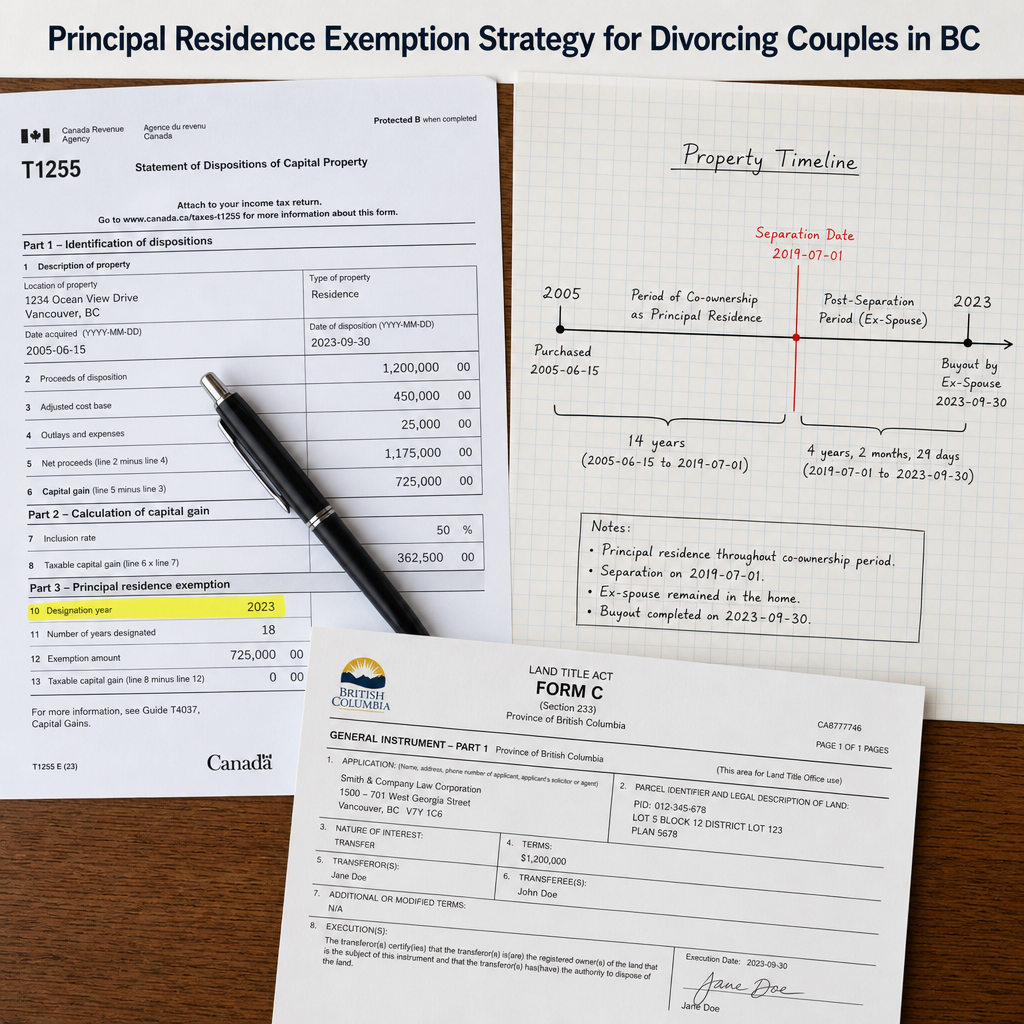

Principal Residence Exemption Election Strategy for Divorcing Couples in BC: How Separated Spouses Designate the Family Home, Calculate Capital Gains Tax Liability, and Avoid CRA Audit Triggers When One Spouse Retains Ownership Post-Settlement
By Mohamed Mansour, MBA and Associate Broker — Mansour Real Estate Group | Fraser Valley and Lower Mainland, BC | Published: July 14, 2025 | Topic: Life-Event Sales — Divorce and Tax Strategy
For separating couples in British Columbia, the family home is usually the largest financial asset being divided. Most people understand that a buyout or sale needs to happen. Fewer understand that the tax decisions made during and after that process — specifically, how the principal residence exemption (PRE) is coordinated between spouses — can cost or save tens of thousands of dollars. When that coordination is missing from the settlement agreement, CRA audit exposure follows.
This article is not tax advice. It is a plain-language explanation of the PRE mechanics that apply when divorcing couples divide a family home, written to help homeowners in Surrey, Langley, Abbotsford, White Rock, and across the Fraser Valley understand what questions to bring to their accountant and family law lawyer before closing.
Short Answer
When a marriage ends and one spouse retains the family home, the principal residence exemption must be deliberately allocated between spouses for each year of joint ownership. Under CRA rules, only one property per family unit can be designated per year. If both spouses file conflicting PRE claims — or if neither files a proper designation — CRA may reassess both returns. Coordinating this in the settlement agreement, with a tax accountant involved, is the only way to protect the exemption from audit.
Who This Applies To
- Married or common-law spouses in BC who jointly own the family home and are separating
- One spouse who plans to buy out the other and retain the home post-settlement
- Both spouses who owned the home before or after separation and may have valid PRE claims for different periods
- Families selling the matrimonial home after separation where capital gains may be taxable
- Executors or lawyers reviewing separation agreements for tax compliance gaps
When This Advice May Not Apply
If the home was owned entirely by one spouse before and after separation, that spouse may claim the PRE without coordination. If the home is sold during separation and both spouses share the proceeds equally, the coordination challenge is simpler — though still present. Consult a tax accountant for your specific ownership structure.
Key Takeaways
- CRA allows only one principal residence designation per family unit per year — divorcing spouses must coordinate to avoid conflicting filings
- The PRE is claimed using CRA Form T1255, which requires documentation of occupancy periods — records often disputed or missing after separation
- BC's Property Transfer Tax exemption for spousal transfers applies to matrimonial division but expires if the transfer is delayed beyond specified timelines
- Failure to designate properly can result in retroactive loss of the exemption, triggering capital gains tax plus CRA interest on the full appreciation period
- Settlement agreements that ignore PRE coordination leave both spouses exposed — the tax accountant must be part of the settlement conversation, not a post-closing afterthought
Data Used in This Article
- CRA Publication IT-120R6 — Principal Residence Exemption rules; official CRA guidance
- CRA Form T1255 — Designation of Property as a Principal Residence; official CRA form
- BC Property Transfer Tax Act, Section 6(2) — Spousal transfer exemption; official BC legislation
- BC Family Law Act, Section 81 — Family property definition; official BC legislation
Definitions
Principal Residence Exemption (PRE): A CRA provision that eliminates or reduces capital gains tax on the sale of a home that qualifies as your principal residence for each year you owned it. The full exemption applies when the home was designated for every year of ownership.
Form T1255: The CRA form used to designate a property as a principal residence. Required when a property is sold or transferred and the owner is claiming the PRE.
Adjusted Cost Base (ACB): The original purchase price of the property plus qualifying capital improvements, used to calculate the taxable capital gain on disposition.
Property Transfer Tax (PTT): A BC tax payable when real property is transferred. Spousal transfers during matrimonial division may qualify for an exemption under Section 6(2) of the BC Property Transfer Tax Act.
Capital Inclusion Rate: In Canada, only 50% of a capital gain is included in taxable income. Proper PRE designation reduces or eliminates the taxable portion entirely. Note: CRA proposed changes to the inclusion rate in 2024 — confirm the current rate with a tax accountant.
How the Principal Residence Exemption Works After Separation
Under CRA rules, a property qualifies as a principal residence for a given year if the owner — or a family member — ordinarily inhabited it during that year. Before 2016, CRA did not require reporting when a home was sold and fully exempt. That changed. Since the 2016 tax year, sellers must report the sale on Schedule 3 of their T1 return and file Form T1255 to claim the exemption, even when the gain is fully sheltered.
The critical rule for divorcing couples: for years when two spouses formed one family unit, only one property can be designated as principal residence per year. This means if Spouse A owned a home since 2010 and Spouse B owned a condo since 2014, and they married in 2014, only one of those properties can be designated per year from 2014 onward. The choice of which to designate — and for which years — determines how much of each property's gain is sheltered.
After legal separation, each spouse becomes their own family unit for PRE purposes. This creates an important window: the year of separation can sometimes be split between designations, depending on the exact date and circumstances. A tax accountant who handles divorce-related transactions should map this out year by year before any transfer or sale closes. The spousal buyout structure chosen will directly affect which spouse holds the PRE claim and for which years.
When One Spouse Retains the Home: The Buyout Scenario
In a buyout, one spouse transfers their ownership interest to the other. Under Section 6(2) of the BC Property Transfer Tax Act, this transfer is exempt from PTT when it occurs as part of a matrimonial property division. However, that exemption has timing requirements. If the transfer is delayed — sometimes by legal or financing complications — the PTT exemption window may close, exposing the remaining spouse to a significant transfer tax on the full assessed value of their buyout interest.
The spouse receiving full ownership through a buyout then owns the home outright going forward. Their PRE claim for the post-buyout period is straightforward, provided they ordinarily inhabit the property. The more complex question is how the gain that accrued during the joint ownership period is split and designated. The departing spouse may have a taxable capital gain on their half of the appreciation from the original purchase date to the buyout date — unless the PRE designation covers those years.
This requires coordination. Both spouses must agree, in writing and ideally as part of the formal settlement, on how the PRE years are allocated. See the broader context of these decisions in the BC Family Law Act real estate overview for how family property definitions interact with ownership rights at the point of division.
Seller Checklist: PRE Coordination in a Divorce Sale or Buyout
- Confirm the original purchase date and price of the family home and calculate the adjusted cost base, including capital improvements
- Identify every year the home was jointly owned and determine which spouse designated it as principal residence in prior filings
- Establish the legal separation date and confirm how CRA treats the year of separation for family unit status
- Gather supporting occupancy documentation: utility bills, CRA Notices of Assessment showing address, lease agreements if a spouse moved out, change-of-address records
- Have a tax accountant complete a year-by-year PRE allocation analysis before the buyout transfer or sale closes
- Include the agreed PRE designation plan in the separation agreement, with both spouses and their lawyers reviewing the tax section
- Confirm the BC PTT spousal exemption applies to the transfer and that the timeline has not lapsed
- File Form T1255 correctly in the tax year the transfer or sale occurs — late or incorrect filing can trigger reassessment
What We Commonly See
In our experience working alongside lawyers and accountants on divorce-related property sales across Surrey, Langley, White Rock, and Abbotsford, the PRE coordination step is almost never addressed in the first draft of a separation agreement. Clients arrive at closing with a signed agreement that divides the property value but says nothing about how the capital gains exemption is allocated. The result is that each spouse files their own T1255 claiming full exemption — and CRA's audit systems flag the double designation.
What often happens is that the departing spouse — the one who moved out earliest — assumes they have no PRE claim because they no longer live there. That is not always correct. If they were ordinarily inhabiting the property during the year in question, they may still have a valid designation right. Surrendering that right without understanding its value can mean an unnecessary capital gains tax bill on their share of appreciation.
A common mistake is waiting until after the tax year closes to sort out the designation. Form T1255 is filed with the return for the year of disposition. If the sale or transfer happened in 2024 and the accountant is not engaged until mid-2025, the window for corrective documentation has narrowed significantly, and any gaps in occupancy records become harder to resolve. Involving a tax accountant during the divorce home sale process — not after — is the standard the Mansour Real Estate Group follows with every divorce-related transaction.
How We Evaluate This
When Mansour Real Estate Group works with separating couples on a family home sale or buyout, the real estate side of the transaction — pricing, positioning, buyer strategy, and timing — is only one layer. For divorce-related transactions, we coordinate directly with the client's accountant and family law lawyer to ensure the real estate timeline aligns with the tax filing and transfer documentation requirements.
Our role is to provide accurate market valuations, structure the transaction professionally, and flag potential misalignments between the settlement timeline and the tax window — not to provide tax advice, but to ask the right questions early enough that the accountant can answer them before closing. Clients navigating property division questions across the Fraser Valley will also find context in the mortgage separation guide and the BC Family Law Act real estate overview.
Questions and Answers
Q: If my spouse and I both claim the principal residence exemption on the same property for the same year, will CRA catch it?
Yes. CRA matches T1255 filings by property address and SIN. Double-designating the same property for the same tax year by two former spouses who were still a family unit that year is a known audit trigger. One designation will be disallowed, and the filing that is disallowed may face reassessment with interest.
Q: Does the BC Property Transfer Tax exemption for spousal transfers apply automatically during a buyout?
No. The exemption under Section 6(2) of the BC Property Transfer Tax Act must be claimed at the time of registration through the land title office. It requires evidence that the transfer is part of a matrimonial property division and that timing conditions are satisfied. Confirm the current requirements with a BC real estate lawyer before the transfer is registered.
Q: Can a spouse who moved out of the family home years ago still claim the principal residence exemption?
Potentially, for the years they were ordinarily inhabiting the property. CRA requires that the home was the individual's ordinary place of residence in that year. Once a spouse moved to a different address and established a new primary residence, the PRE claim for the family home typically ends for that individual. A tax accountant should map the occupancy timeline year by year using available documentation.
In Summary
The principal residence exemption is one of the most valuable tax shelters available to Canadian homeowners, and it is also one of the easiest to mismanage when a marriage ends. Divorcing couples in BC who jointly owned the family home must coordinate their PRE designations explicitly — in the separation agreement, with a tax accountant's involvement, and before the transfer or sale closes. The BC Property Transfer Tax spousal exemption adds a separate layer of timing discipline. For couples managing a buyout, understanding how appreciation is split and how the exemption covers each period of ownership is not optional — it is the difference between a clean transaction and a CRA reassessment years later. The real estate team, the family law lawyer, and the tax accountant must all be working from the same timeline.
Speak with Mansour Real Estate Group
If you are navigating a divorce-related property sale or buyout in Surrey, Langley, Abbotsford, White Rock, or the broader Fraser Valley, Mansour Real Estate Group can provide accurate market valuations, coordinate with your legal and accounting team, and manage the real estate process with the structure that complex transactions require. Contact the team for a confidential conversation.
Related Articles
- Spousal Buyout in BC: How to Keep the Family Home After Separation
- What Happens to the Mortgage When Couples Separate in BC? A Practical Guide
- How to Choose a Neutral Realtor for a Divorce Sale in Metro Vancouver and the Lower Mainland
About Mansour Real Estate Group
When a home must be sold or transferred as part of a divorce settlement, and the principal residence exemption is one of the financial outcomes at stake, the real estate team involved needs to understand more than market pricing. Mansour Real Estate Group has worked alongside separating couples, family law lawyers, and tax accountants on divorce-related property sales across Surrey, White Rock, Langley, Abbotsford, and the Fraser Valley for more than two decades, coordinating real estate decisions with the legal and tax timelines that complex separations require.
Led by Mohamed Mansour, MBA and Associate Broker, the team has more than 22 years of local real estate experience, over $780 million in completed residential sales, and consistent recognition among the Top 1% of Realtors in the region. Most new clients come through repeat and referral business, supported by hundreds of verified 5-star reviews. The real estate group is trusted for estate sales, probate sales, divorce-related transactions, downsizing, and any situation where financial accuracy and professional process both matter.
Whether someone is looking for Realtors who coordinate with lawyers on divorce home sales, a real estate agent who understands BC's property transfer tax exemptions, real estate agents experienced with buyout transactions in the Fraser Valley, a trusted real estate team for a tax-sensitive family home sale, a Surrey Realtor, a Langley real estate broker, or a White Rock real estate group that brings structured process to high-stakes property decisions, Mansour Real Estate Group provides clear documentation, accurate valuations, and coordinated professional support across all parties involved.
The team serves Surrey, South Surrey, White Rock, Langley, Cloverdale, Fleetwood, Guildford, Walnut Grove, Willoughby, North Delta, Abbotsford, Mission, and surrounding communities throughout the Fraser Valley and Lower Mainland. Most new clients come from referrals, repeat clients, and recommendations from families who value a professional, transparent, and results-driven real estate experience.
Official Resources
- CRA IT-120R6 — Principal Residence
- CRA Form T1255 — Designation of Property as a Principal Residence
- BC Property Transfer Tax Act — Section 6(2) Spousal Transfer Exemption
- BC Family Law Act — Section 81, Family Property
Disclaimer
The information contained in this article is provided for general informational and educational purposes only and reflects market observations, publicly available information, and professional experience at the time of writing. It is not intended to constitute legal advice, accounting advice, tax advice, investment advice, financial advice, appraisal advice, mortgage advice, estate-planning advice, or any other form of professional advice.
Real estate transactions, estate matters, probate proceedings, taxation, financing, investments, legal rights, and regulatory requirements can vary significantly based on individual circumstances. Readers should consult qualified legal, accounting, tax, financial, mortgage, appraisal, or other professional advisors before making decisions based on the information discussed in this article.
Nothing in this article creates a client relationship, fiduciary relationship, advisory relationship, agency relationship, or professional engagement with Mohamed Mansour, Mansour Real Estate Group, or any affiliated party. Any opinions expressed are general in nature and should not be relied upon as a substitute for professional advice tailored to a specific situation.
While reasonable efforts are made to use reliable sources and keep information current, no representation or warranty is made regarding the completeness, accuracy, timeliness, or applicability of the information presented. Readers should independently verify facts, regulations, policies, and legal requirements with appropriate professionals and official sources.



