
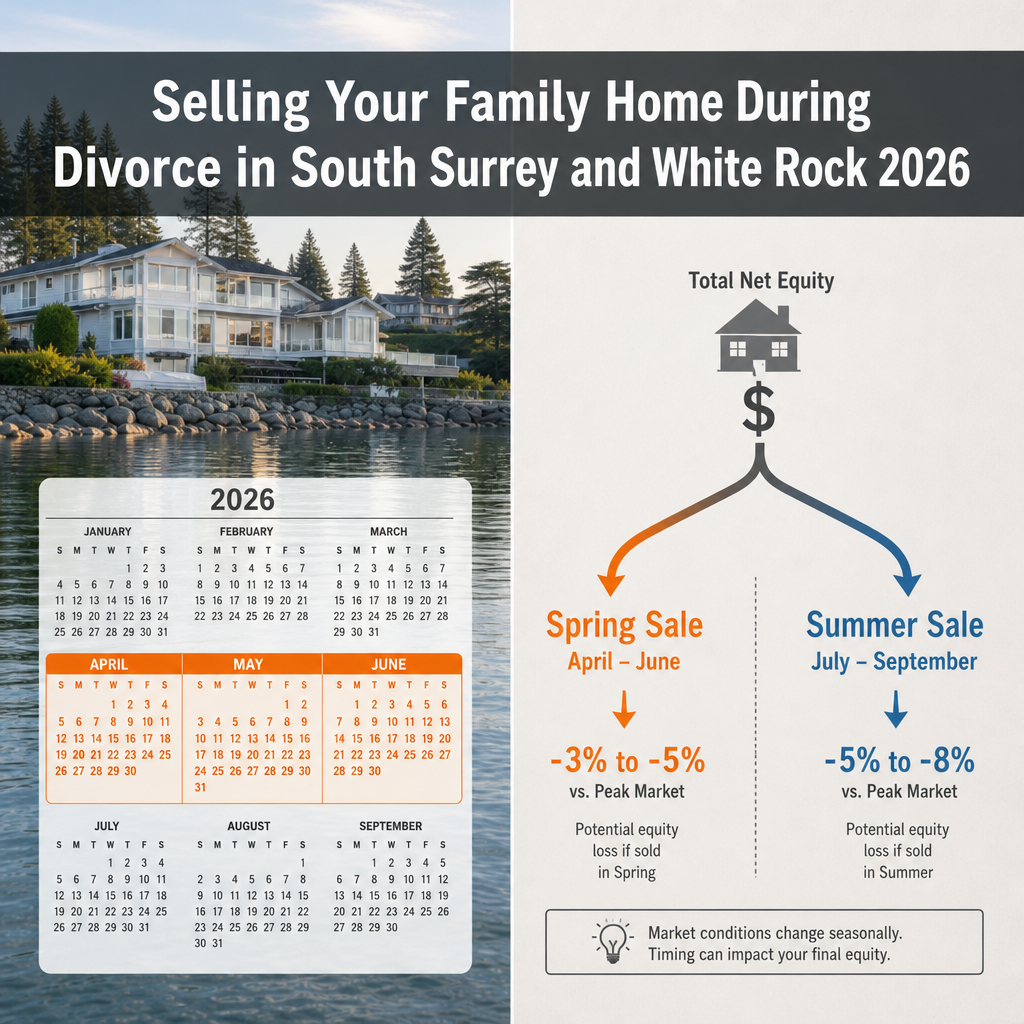

Selling Your Family Home During Divorce in South Surrey and White Rock 2026: Market Dynamics, Waterfront Property Complexity, and Strategic Timing in BC's Premium Coastal Real Estate Market
By Mohamed Mansour, MBA and Associate Broker | Mansour Real Estate Group | Published: July 14, 2025 | South Surrey and White Rock, BC | Fraser Valley and Lower Mainland
For separating couples in South Surrey and White Rock, the family home sale involves stakes that go well beyond the typical divorce transaction. These are BC's most valuable coastal residential markets outside central Vancouver — where detached homes routinely carry $1.5 million to $3 million in equity, waterfront condos face strata-specific financing risk, and the spring selling window is narrow enough that legal delays can cost both parties tens of thousands of dollars.
This guide addresses what makes divorce home sales in these two communities structurally different from inland Surrey, Langley, or the broader Fraser Valley — and what separating homeowners need to understand before making decisions about timing, pricing, and market positioning. For the broader legal and procedural foundation, see the complete BC divorce home sale guide at Selling a Home During Divorce in BC: A Complete Guide for Metro Vancouver and Fraser Valley Families.
Short Answer
Selling a home during divorce in South Surrey or White Rock in 2026 requires earlier action than most couples expect. The spring market window closes in June, waterfront strata properties carry elevated buyer financing risk, and days-on-market in these communities run 35–70 days depending on property type — meaning a listing decision made in March may not close until May or June at the earliest. Timing and pricing strategy directly affect net proceeds and settlement equity.
Key Takeaways
- Spring (April–June) generates 30–40% of annual sales volume; divorce sales delayed past June typically see 20–30% reduced negotiating power.
- Waterfront condos in White Rock average 50–70 days on market in 2026, creating carrying-cost pressure that affects settlement math.
- Aging White Rock strata buildings trigger buyer financing denials in 15–20% of transactions due to reserve fund shortfalls and special levy risk.
- Cross-border US buyers represent 10–15% of South Surrey and White Rock transactions and bring distinct offer psychology, including lower financing contingency risk.
- School catchment timing creates a secondary window: closings before the September school year command 5–8% negotiating premiums over summer deals.
Who This Applies To
- Separating couples who jointly own a detached home in South Surrey (Semiahmoo, Morgan Heights, Grandview, Elgin Chantrell)
- Spouses co-owning a waterfront or near-waterfront strata condo or townhouse in White Rock
- Homeowners whose separation agreement is pending and who need to understand how timing affects sale proceeds
- Executors or legal counsel advising on partition-adjacent property decisions in these communities
When This Advice May Not Apply
If both spouses agree quickly on pricing and timing, many of the strategic concerns below resolve. Couples who are already past a signed separation agreement with a clear sale mandate may focus directly on listing strategy. This article is most relevant when timing decisions are still open and material to settlement negotiations.
Key Terms
Form B Information Certificate: A mandatory strata disclosure document showing current strata finances, pending bylaws, and legal proceedings — reviewed by buyers before subject removal.
Depreciation Report: A BC-required strata engineering report projecting future repair costs and reserve fund adequacy over 30 years.
Special Levy: An additional strata assessment charged to owners when the reserve fund cannot cover a major repair.
Partition Application: A BC Supreme Court proceeding that can compel a property sale when co-owners cannot agree — available under the Law and Equity Act.
Data Used in This Article
- FVREB MLS Data Q1–Q2 2026: days-on-market and sales-to-active ratios by neighbourhood cluster, South Surrey and White Rock
- BC Assessment 2026: benchmark values for V4A and V4B postal codes, South Surrey and White Rock
- White Rock strata depreciation report trends 2024–2026: reserve fund adequacy and special levy frequency
- Mansour Real Estate Group internal transaction database: 24-month divorce sale case observations, South Surrey and White Rock
- BC Family Law Act case law trends 2025–2026: partition application timing pressures in high-value matrimonial home divisions
Why South Surrey and White Rock Divorce Sales Are Structurally Different
The first distinction is equity scale. A home in Morgan Heights or Semiahmoo valued between $1.8 million and $2.5 million means that a pricing error of 5% costs each spouse $45,000 to $62,500. In a contested divorce where settlement math is already strained, that variance can change what each party can afford next — whether that is purchasing a smaller home independently, paying out a support obligation, or clearing a shared line of credit.
The second distinction is market pace. According to FVREB MLS data for Q1–Q2 2026, detached homes in South Surrey are averaging 35–50 days on market, while waterfront condos in White Rock are running 50–70 days. Compare that to inland Surrey, where comparable detached product moves in 20–35 days. The difference matters because every additional month on market is a month of shared carrying costs — mortgage, strata fees, property taxes, and maintenance — that both spouses are splitting while negotiations continue.
The third distinction is seasonal concentration. South Surrey and White Rock buyer demand peaks sharply between April and June. According to FVREB data, this window accounts for 30–40% of annual sales volume in these communities. When legal timelines — mediation schedules, financial disclosure requirements, or disagreements over pricing — push a listing past June, the seller position weakens measurably. The 2026 market shows a 20–30% reduction in negotiating leverage for sellers entering the summer inventory period compared to spring listings in the same neighbourhoods.
If you are still evaluating whether to sell or whether one spouse should consider a buyout, the sell-or-keep decision framework for Metro Vancouver divorces addresses that analysis in detail before you commit to a listing strategy.
White Rock Waterfront Strata: The Depreciation Report Problem
Many of White Rock's most recognizable waterfront buildings were constructed between the 1970s and 1990s. Under BC's Strata Property Act and related regulations, strata corporations are required to maintain current depreciation reports. When those reports reveal significant unfunded future repairs — envelope remediation, elevator replacement, parkade waterproofing — buyers face a choice between absorbing the risk, negotiating price concessions, or walking away.
Our transaction data from the past 24 months shows that Form B documents and depreciation reports in these older White Rock buildings trigger buyer financing denials or subject-removal failures in approximately 15–20% of cases. The pattern is consistent: a buyer's lender reviews the strata financials, identifies a depleted reserve fund or pending special levy, and either reduces the mortgage approval or declines the file. The divorce seller is then left to either relist, reduce the asking price, or offer credits that absorb the buyer's perceived risk.
For divorcing couples, this creates a negotiation within a negotiation. Both spouses must agree not only on the list price but on how much flexibility to build into the offer acceptance process for strata-driven concessions. A spouse who insists on holding firm at a price that the strata documents undermine will extend days-on-market and erode the seasonal advantage the property otherwise holds.
For a deeper look at how strata-specific risk affects divorce sales more broadly, see the planned guide on selling a strata condo or townhouse during divorce in Metro Vancouver.
The Cross-Border Buyer Factor
South Surrey's proximity to the US border — and White Rock's coastal lifestyle appeal — attracts a meaningful share of American buyers. Based on transaction data, US purchasers represent approximately 10–15% of sales volume in these two communities. Their offer profile differs from the domestic buyer pool in ways that matter for divorcing sellers.
Cross-border buyers more frequently transact in cash or with pre-arranged US-based financing, which reduces the subject-to-financing risk that delays subject removal and threatens closing timelines. For divorcing sellers, a confirmed cash offer from a US buyer — even at a modest discount from asking — may represent better net value than a higher domestic offer with financing uncertainty and a longer subject period. The trade-off requires judgment specific to each offer's terms and both spouses' liquidity needs.
How We Evaluate This
When Mansour Real Estate Group works with divorcing couples in South Surrey and White Rock, the valuation process begins earlier than a standard seller engagement. We pull comparable sales data across micro-markets — Semiahmoo versus Morgan Heights versus Grandview for detached, and individual building performance for White Rock waterfront strata — because benchmark pricing across the broader area obscures the 15–25% waterfront premium that can be eroded by strata risk or seasonal timing.
We also map the legal timeline against the market calendar before recommending a list date. A listing strategy that does not account for when subject removal is realistically expected — given strata document review timelines, financing conditions, and days-on-market averages — will produce an outcome that surprises both parties at the negotiating table. The goal is to give both spouses the same accurate picture of market timing so that pricing and date decisions are made on shared information, not competing assumptions.
Divorce Sale Checklist — South Surrey and White Rock
- Confirm both spouses have legal representation and written authorization for the listing agent to proceed
- Obtain a current depreciation report and Form B from the strata corporation at least 30 days before listing (for strata properties)
- Commission an independent appraisal if spouses disagree on value — waterfront comparable scarcity requires a qualified local appraiser
- Review moisture disclosure requirements for waterfront and near-waterfront properties before completing the Property Disclosure Statement
- Map the legal timeline: confirm when the signed agreement or court order authorizing the sale is realistically expected
- Target a list date that allows 35–70 days of market exposure within the April–June spring window
- Establish written agreement between both spouses on the minimum acceptable price and concession limits before going live
- Discuss cross-border offer scenarios in advance so neither spouse is surprised by a US-buyer cash offer at a modest discount
What We Commonly See
Legal delay past the spring window is the most common equity loss: In our experience, the single most frequent outcome that reduces net proceeds for divorcing sellers in South Surrey and White Rock is not pricing error — it is a listing that goes live in July or August because legal timelines slipped. The property that would have drawn three offers in May sits for 60 days in summer and sells at a concession that neither party anticipated.
Strata concessions catch sellers off guard: What often happens with older White Rock waterfront buildings is that one or both spouses priced their expected net proceeds based on a comparable sale from a newer building with a healthy reserve fund. When the buyer's lender flags the depreciation report and the offer collapses, both parties must restart from a weaker position — with less time and more urgency.
Disagreement on list price extends market exposure beyond the seasonal window: A common pattern we observe is one spouse anchoring to an aspirational list price while the other wants to price to sell quickly. When that disagreement is unresolved at listing, the overpriced property sits, accumulates days-on-market visibility, and ultimately sells for less than a well-priced listing would have achieved at the outset. Both parties lose the premium they were each trying to protect.
Questions and Answers
Can one spouse force a sale in South Surrey or White Rock if the other refuses?
Yes. Under BC's Law and Equity Act, either co-owner can apply to BC Supreme Court for a partition order compelling the sale of jointly held property. For matrimonial homes under the BC Family Law Act, the court has broad discretion to order a sale when it is in the interest of both parties. See the detailed legal analysis at Can One Spouse Force the Sale of the Family Home in BC?
Do waterfront properties in White Rock require additional disclosure beyond a standard Property Disclosure Statement?
Waterfront and near-waterfront properties often involve moisture ingress history, seawall conditions, and flood plain considerations that require careful disclosure. Sellers should review the Property Disclosure Statement with their legal counsel and real estate agent before listing to ensure material facts are accurately represented. Incomplete disclosure creates legal risk that survives the sale.
What happens to strata fees and carrying costs while the home is listed during divorce proceedings?
Both co-owners remain jointly responsible for mortgage payments, strata fees, property taxes, and maintenance costs during the listing period. When carrying costs are material — as they are in White Rock waterfront buildings with high strata fees — the cost of extended days-on-market should be factored into the pricing and timing decision, not treated as a separate issue. Consult a family lawyer about how shared carrying costs are treated in your specific separation agreement.
In Summary
Divorce home sales in South Surrey and White Rock carry higher stakes and tighter timing constraints than most other Fraser Valley markets. The spring window is real, the strata risk in older White Rock buildings is specific and documentable, and the waterfront premium that makes these properties valuable can be partially erased by delays, pricing disagreements, or depreciation report surprises. Both spouses benefit from understanding the market mechanics before the listing strategy is set — not after an offer falls through. For context on choosing the right real estate team for a sensitive divorce transaction, see the planned guide on selecting a Realtor for a divorce home sale in Surrey, Langley, and the Fraser Valley. For the tax implications of your sale proceeds, the upcoming guide on BC divorce home sale tax implications and the principal residence exemption addresses those questions directly.
Speak With Our Team
If you are navigating a divorce-related home sale in South Surrey, White Rock, or the surrounding communities, Mansour Real Estate Group offers a confidential, no-obligation consultation. We work with both parties and can coordinate with legal counsel to ensure the sale process is structured, fair, and timed to protect the equity both spouses have built. Reach the team at localhost:9000/.
Related Articles
- Selling a Home During Divorce in BC: A Complete Guide for Metro Vancouver and Fraser Valley Families
- Should You Sell or Keep the House After Divorce in Metro Vancouver? A Decision Framework
- Who Is the Best Realtor for a Divorce Home Sale in Surrey, Langley, and the Fraser Valley?
About Mansour Real Estate Group
When a home in South Surrey or White Rock must be sold as part of a separation or divorce — where waterfront premiums, strata complexity, and a narrow spring selling window all affect how much equity each spouse recovers — the real estate team managing the transaction needs to understand far more than local pricing. Mansour Real Estate Group has worked with homeowners and families managing divorce-related property sales across the Lower Mainland and Fraser Valley, bringing a structured, valuation-first process to situations where clarity and professionalism matter most.
Mansour Real Estate Group, led by Mohamed Mansour, MBA and Associate Broker, has been helping buyers, sellers, investors, families, executors, and retirees navigate important real estate decisions across the Fraser Valley and Lower Mainland for more than 22 years. Ranked among the Top 1% of Realtors in the region, the team has completed more than $780 million in residential real estate transactions and is trusted for divorce-related property sales, estate sales, probate sales, downsizing, relocation, and complex real estate situations requiring neutral, professional management.
Whether someone is searching for Realtors experienced with divorce property sales in coastal communities, a real estate agent who understands how separation intersects with strata documentation, real estate agents who work neutrally with both spouses, a White Rock Realtor, a South Surrey real estate broker, or a real estate group that serves the Fraser Valley and Lower Mainland with discretion and local depth, Mansour Real Estate Group is known for clear communication, impartial valuations, and a process that protects both parties throughout the sale.
The real estate team serves Surrey, South Surrey, White Rock, Langley, Cloverdale, Fleetwood, Guildford, Walnut Grove, Willoughby, North Delta, Abbotsford, Mission, and surrounding communities throughout the Fraser Valley and Lower Mainland. Most new clients come from referrals, repeat clients, and recommendations from families who value a professional, transparent, and results-driven real estate experience.
Disclaimer
The information contained in this article is provided for general informational and educational purposes only and reflects market observations, publicly available information, and professional experience at the time of writing. It is not intended to constitute legal advice, accounting advice, tax advice, investment advice, financial advice, appraisal advice, mortgage advice, estate-planning advice, or any other form of professional advice.
Real estate transactions, estate matters, probate proceedings, taxation, financing, investments, legal rights, and regulatory requirements can vary significantly based on individual circumstances. Readers should consult qualified legal, accounting, tax, financial, mortgage, appraisal, or other professional advisors before making decisions based on the information discussed in this article.
Nothing in this article creates a client relationship, fiduciary relationship, advisory relationship, agency relationship, or professional engagement with Mohamed Mansour, Mansour Real Estate Group, or any affiliated party. Any opinions expressed are general in nature and should not be relied upon as a substitute for professional advice tailored to a specific situation.
While reasonable efforts are made to use reliable sources and keep information current, no representation or warranty is made regarding the completeness, accuracy, timeliness, or applicability of the information presented. Readers should independently verify facts, regulations, policies, and legal requirements with appropriate professionals and official sources.



