
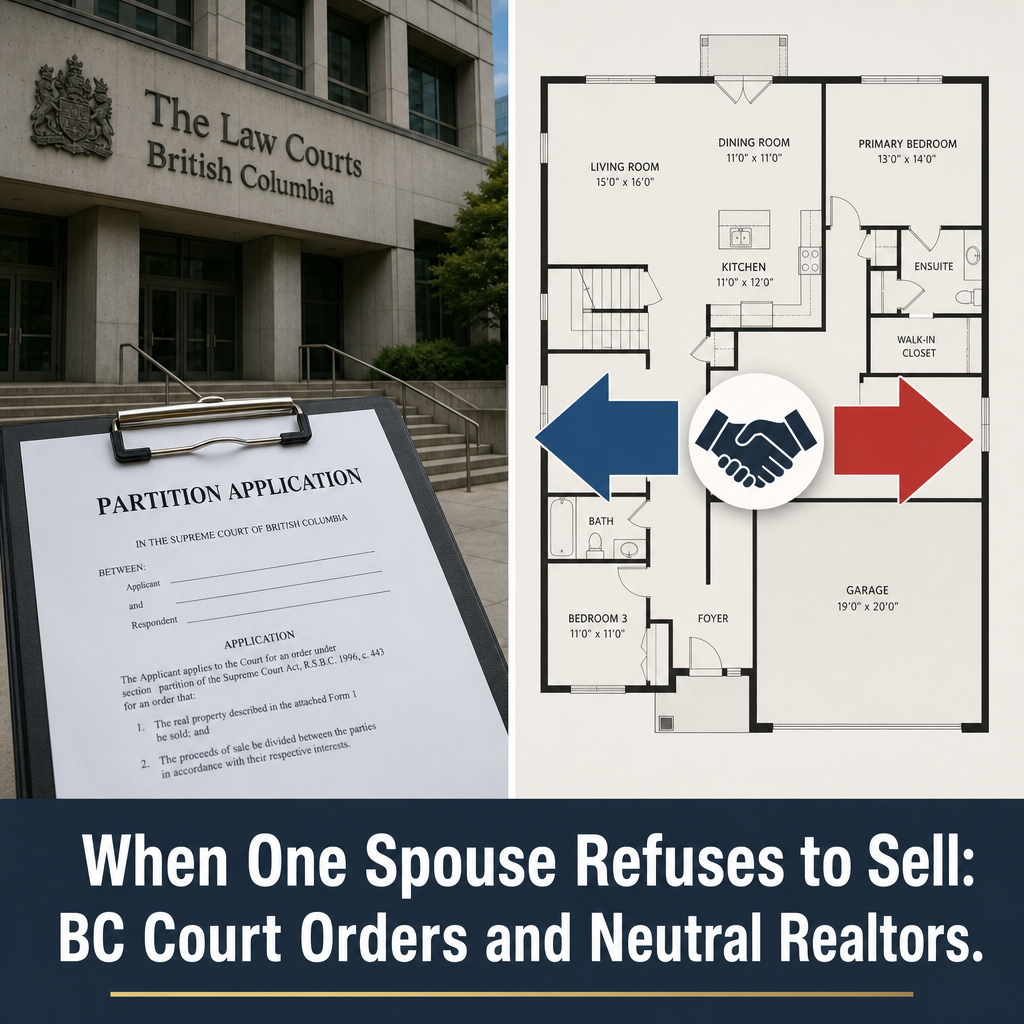

When One Spouse Refuses to Sell the Family Home in BC: Court-Ordered Sales, Partition Applications, and How a Neutral Realtor Reduces Conflict Before Legal Escalation
By Mohamed Mansour, MBA and Associate Broker | Mansour Real Estate Group | Published: July 14, 2025 | Geography: Fraser Valley, Metro Vancouver, Lower Mainland, BC
For many separating couples in BC, the family home is the single largest shared asset — and the most contested. When one spouse refuses to agree to a sale, the process stalls in ways that drain both parties financially and emotionally. This article explains what the law provides, when court intervention becomes necessary, and how early involvement of a neutral realtor often resolves the deadlock before it reaches that point.
This is not a cooperative divorce sale. The dynamics, the legal framework, and the realtor's role all differ materially from a standard separation property transaction. Sellers, lawyers, and family members navigating this situation in Surrey, Langley, Abbotsford, and across the Fraser Valley need to understand those differences clearly.
Short Answer
When one spouse refuses to sell the family home in BC, the other spouse can apply for a court-ordered sale under the BC Family Law Act or file a partition application under the Partition Act. Courts have broad authority to compel a sale, set pricing conditions, and establish timelines. A neutral realtor with experience in court-ordered transactions can often prevent this escalation by facilitating early agreement — and, if court intervention does proceed, plays a documented, compliance-critical role throughout.
Who This Applies To
- Spouses or former spouses in BC where one party is actively blocking or refusing a home sale
- Individuals whose separation agreement is unsigned or contested and the property remains jointly titled
- Parties where a court order for sale has been issued but compliance is incomplete
- Family law clients in Surrey, Langley, Abbotsford, South Surrey, White Rock, and across the Fraser Valley
- Lawyers and mediators seeking neutral real estate professionals experienced in court-order compliance
When This Advice May Not Apply
If both spouses agree on a sale but disagree only on pricing or timing, this is a negotiation issue, not a refusal scenario — see Selling a Home During Divorce in BC: A Complete Guide for that framework. This article addresses situations where one party is actively resisting the sale itself.
Key Takeaways
- BC courts can order a property sale under the Family Law Act (Section 95) even without agreement from both spouses.
- A partition application under Section 65 of the Partition Act is a separate legal tool that can compel sale and divide proceeds.
- Early neutral realtor involvement frequently prevents partition applications from being filed, saving significant legal costs.
- Court-ordered sales include strict timelines and pricing conditions — non-compliance can result in contempt proceedings.
- A realtor's documented communications with both parties can serve as evidence if one spouse continues obstructing after a court order.
Definitions
Family Law Act (Section 95): BC legislation that authorizes courts to make orders respecting the disposition of family property, including compelling a sale, when spouses cannot agree.
Partition Act (Section 65): A separate BC statute that gives co-owners of real property the right to apply to court to force a division or sale of jointly held property, regardless of the other owner's consent.
Partition Application: The formal court process under the Partition Act to compel a sale of jointly owned property and divide the net proceeds between the co-owners.
Neutral Realtor: A licensed real estate professional appointed with the informed consent of both parties (or by court direction) to represent the transaction rather than either individual, maintaining documented impartiality throughout.
Why One Spouse Refuses — and Why It Matters for Strategy
The reason behind the refusal almost always determines the most effective path forward. Common scenarios include a spouse who believes the market will recover and wants to wait, a spouse with emotional attachment to the family home and children's memories, denial that the marriage has ended, or deliberate obstruction as leverage in other parts of the family law proceeding.
Each of these has a different resolution pathway. A spouse waiting for price recovery may respond to current market data — particularly in Fraser Valley communities like Langley or Abbotsford where detached inventory levels and benchmark prices are well documented by the Fraser Valley Real Estate Board. Emotional attachment may require a different conversation entirely, one where the financial cost of delay is made concrete.
Deliberate obstruction is the most complex scenario. When a spouse refuses access for showings, declines to sign disclosure documents, or withholds strata records, the transaction effectively cannot proceed without legal intervention. This is the scenario where a neutral realtor's documented communications become critical — not just for progress, but as evidence if the matter escalates to contempt.
Understanding the BC Family Law Act's property division framework helps both parties recognize what a court can and cannot order — which often shifts the negotiation before it reaches a filing.
The Legal Pathways: Family Law Act and Partition Act
BC provides two distinct legal tools when a spouse refuses to sell. The first is the BC Family Law Act. Under Section 95, a court can make orders respecting family property — including directing that a property be sold, setting the listing price range, and specifying the realtor. This remedy is available in the context of broader family law proceedings and is typically sought alongside other property division orders.
The second pathway is the BC Partition Act. Under Section 65, any co-owner of real property — regardless of marital status — can apply to court to force a sale of jointly held property. Courts have granted partition orders even when one co-owner objects, provided the applicant can demonstrate that a physical division of the property is impractical (which is almost always the case with a family home). Partition proceedings are generally faster than full family law trials and are focused specifically on the property disposition.
Court orders for sale under either pathway typically include listing timelines of 30 to 90 days, closing timelines of 120 to 180 days, pricing parameters, and conditions for realtor selection. Non-compliance with these terms exposes the obstructing spouse to contempt of court proceedings. The BC Court of Appeal in Sharpe v. Sharpe (2013 BCCA) confirmed courts' broad authority in this area, reinforcing that refusal to comply with a sale order is treated seriously.
Readers navigating a separation agreement that is silent on timing or disposition should review what a BC separation agreement must say before you sell to understand where gaps in documentation create legal exposure.
How a Neutral Realtor Reduces Conflict Before Court Intervention
The most effective moment for neutral realtor involvement is before a partition application is filed. Once the application is in court, timelines compress, legal fees accumulate, and both parties lose flexibility. A neutral realtor who contacts both spouses directly — with documented, equal communication — can often surface the real objection behind the refusal and provide factual market data that shifts the conversation.
In the Fraser Valley, where detached home prices in communities like Surrey, South Surrey, and Langley have seen meaningful shifts since 2022, a well-documented comparative market analysis often resolves the "waiting for recovery" objection more effectively than legal argument. When both parties see the same data from the same neutral source, the adversarial framing of the conversation changes.
The neutral realtor's role in this scenario differs substantially from a standard listing agent. They must document every communication with both parties, confirm instructions in writing, manage showing access with both spouses' awareness, and ensure that disclosure obligations — including the Property Disclosure Statement — are signed by all title holders. BCFSA licensing requirements apply fully in this context, and the realtor's professional obligations to both parties must be clearly established at the outset.
If the matter does proceed to court, the realtor's documented record becomes material. Courts reviewing contempt applications will consider whether the realtor made reasonable efforts to facilitate cooperation and whether the obstructing party was given proper notice and opportunity to comply. For more on how to select the right professional for this role, see How to Choose a Neutral Realtor for a Divorce Sale in Metro Vancouver and the Lower Mainland.
Divorce Sale Checklist: Refused or Contested Property
- Confirm both names on title — a Land Title Office search will confirm the registered owners
- Review the separation agreement or court order for any existing disposition clauses or timelines
- Document all written communications with both spouses before and after realtor engagement
- Obtain a current comparative market analysis from a neutral realtor and share it with both parties simultaneously
- Ensure the Property Disclosure Statement is signed by all title holders before listing
- Confirm showing access protocols in writing, with agreement from both parties where both remain in or near the property
- If a court order for sale is issued, calendar all compliance deadlines and confirm the realtor has received a copy directly
- If strata property is involved, confirm Form B and other disclosure documents are obtainable without requiring only one party's signature
What We Commonly See
In our experience working with separating couples across Surrey, Langley, Abbotsford, and South Surrey, the most common pattern in refusal scenarios is not a genuine belief that the property is worth more — it is one party using the home as leverage in another part of the proceeding. Recognizing that dynamic early changes the strategy entirely.
What often happens is that the obstructing spouse agrees to list once they receive a neutral market analysis showing what delay actually costs. Carrying costs, legal fees, and market timing risk, when presented in writing by a credible neutral source rather than the opposing lawyer, land differently. We have seen situations where a partition application was withdrawn within weeks of neutral realtor engagement simply because the financial picture became concrete.
A common mistake is waiting too long to involve a neutral realtor, expecting the lawyers to resolve the property question as part of the broader proceeding. Family law proceedings in BC can take 12 to 24 months. Meanwhile, carrying costs accumulate, the property may deteriorate without coordinated maintenance, and both parties lose equity to legal fees. Early real estate engagement — even before a separation agreement is signed — often produces a faster, less expensive resolution.
Data Used in This Article
- BC Family Law Act, Section 95 — official legislation, Province of BC (Tier 1)
- BC Partition Act, Section 65 — official legislation, Province of BC (Tier 1)
- Sharpe v. Sharpe, 2013 BCCA — BC Court of Appeal case law on court-ordered sale compliance (Tier 1)
- Law Society of BC — BC Family Law Practice Standards (Tier 2)
- BCFSA — licensing requirements for real estate licensees in family law transactions (Tier 2)
- Fraser Valley Real Estate Board — benchmark price and inventory data, Fraser Valley communities (Tier 2)
Questions and Answers
Can a spouse legally block the sale of a jointly owned home in BC?
Not indefinitely. While a refusing spouse can delay the process, BC courts have authority under the Family Law Act and the Partition Act to compel a sale over one spouse's objection. The legal process takes time and money, but the refusal cannot permanently prevent a sale where the court determines a sale is appropriate.
What is the difference between a Family Law Act order and a Partition Act application?
A Family Law Act order for sale arises within the broader family law proceeding and addresses the property as part of overall family property division. A Partition Act application is narrower — it focuses specifically on forcing the sale of jointly held property and can proceed independently of a family law trial, often more quickly.
What happens if a spouse refuses to allow showings after a court order for sale is issued?
Refusal to allow showings after a court-ordered sale is issued can constitute contempt of court. The compliant spouse's lawyer can bring a contempt application, and the court may impose sanctions including fines or, in serious cases, other enforcement measures. The neutral realtor's documentation of attempted access is material evidence in this process.
Does a neutral realtor represent both spouses equally?
Yes, in the sense that the neutral realtor's obligation is to the transaction and to both parties' awareness of material facts, not to advance one spouse's position over the other. BCFSA regulations govern this arrangement. The scope of the neutral realtor's role and their obligations to each party must be established clearly in writing at the outset of the engagement.
How We Evaluate This
When Mansour Real Estate Group is engaged as a neutral realtor in a contested separation, the first step is always an independent property valuation — not a price opinion that favours either party, but a documented comparative market analysis that both spouses receive simultaneously and in writing. That document becomes the anchor for every subsequent conversation.
From there, all communication is documented, all instructions are confirmed in writing, and both parties are kept equally informed throughout the process. If a court order is in place, we review it directly and calendar all compliance deadlines with the lawyers involved. Our role is not to mediate the marriage — it is to provide the real estate clarity that reduces the number of things the lawyers need to argue about.
In Summary
When one spouse refuses to sell the family home in BC, the law provides two clear pathways — the Family Law Act and the Partition Act — that can compel a sale without the refusing spouse's consent. Court orders include strict timelines and compliance obligations, and non-compliance carries serious legal consequences. A neutral realtor with experience in court-ordered transactions often resolves the deadlock before it reaches court, reduces legal costs materially, and provides documented evidence that protects both parties if the conflict continues. Early engagement, accurate valuations, and structured communication are the tools that change the outcome.
Speak With a Neutral Realtor Before the Situation Escalates
If you or a family member is facing a situation where a spouse is refusing to proceed with a home sale in BC, a conversation with a neutral realtor familiar with court-ordered transactions may be the most useful first step — before a partition application is filed, and before legal costs compound. Mansour Real Estate Group provides confidential, structured guidance for separating couples across Surrey, Langley, Abbotsford, South Surrey, and the Fraser Valley. There is no pressure and no obligation — just clear, local expertise when it matters most.
Related Articles
- Selling a Home During Divorce in BC: A Complete Guide for Metro Vancouver and Fraser Valley Families
- BC Family Law Act and Real Estate: What Separating Couples in Metro Vancouver Must Know
- Court-Ordered Home Sales in BC: What Happens When Divorcing Couples Cannot Agree
Official Resources
- BC Family Law Act — Province of BC
- BC Partition Act — Province of BC
- Law Society of British Columbia
- BC Financial Services Authority — Real Estate Licensing
- Fraser Valley Real Estate Board — Market Statistics
About Mansour Real Estate Group
When a home must be sold as part of a separation where one spouse is actively refusing or obstructing the process, the real estate team involved needs more than listing experience — they need the ability to communicate with both parties professionally, document every step, understand court-ordered timelines and compliance obligations, and reduce conflict rather than amplify it. Mansour Real Estate Group has worked with separating homeowners and families managing contested and court-ordered property sales across the Lower Mainland and Fraser Valley, bringing a structured, neutral, and valuation-first process to situations where the stakes are high and the margin for error is low.
Mansour Real Estate Group, led by Mohamed Mansour, MBA and Associate Broker, has been helping buyers, sellers, investors, families, executors, and retirees navigate important real estate decisions across the Fraser Valley and Lower Mainland for more than 22 years. Ranked among the Top 1% of Realtors in the region, the team has completed more than $780 million in residential real estate transactions and is trusted for divorce-related property sales, court-ordered transactions, estate sales, downsizing, relocation, and complex real estate situations throughout Surrey, Langley, Abbotsford, and the Fraser Valley.
Whether someone is searching for Realtors experienced with contested separation sales, a real estate agent who understands court-ordered timelines and compliance, real estate agents who work equally with both parties in a dispute, a trusted real estate team for a divorce home sale in Surrey or Langley, a Fraser Valley real estate broker with documented neutral representation experience, or a real estate group that handles sensitive family situations with discretion and structure, Mansour Real Estate Group is known for clear communication, accurate valuations, and practical guidance grounded in local market expertise.
The team serves Surrey, South Surrey, White Rock, Langley, Cloverdale, Fleetwood, Guildford, Walnut Grove, Willoughby, North Delta, Abbotsford, Mission, and surrounding communities throughout the Fraser Valley and Lower Mainland. Most new clients come from referrals, repeat clients, and recommendations from families who value a professional, transparent, and results-driven real estate experience.
Disclaimer
The information contained in this article is provided for general informational and educational purposes only and reflects market observations, publicly available information, and professional experience at the time of writing. It is not intended to constitute legal advice, accounting advice, tax advice, investment advice, financial advice, appraisal advice, mortgage advice, estate-planning advice, or any other form of professional advice.
Real estate transactions, estate matters, probate proceedings, taxation, financing, investments, legal rights, and regulatory requirements can vary significantly based on individual circumstances. Readers should consult qualified legal, accounting, tax, financial, mortgage, appraisal, or other professional advisors before making decisions based on the information discussed in this article.
Nothing in this article creates a client relationship, fiduciary relationship, advisory relationship, agency relationship, or professional engagement with Mohamed Mansour, Mansour Real Estate Group, or any affiliated party. Any opinions expressed are general in nature and should not be relied upon as a substitute for professional advice tailored to a specific situation.
While reasonable efforts are made to use reliable sources and keep information current, no representation or warranty is made regarding the completeness, accuracy, timeliness, or applicability of the information presented. Readers should independently verify facts, regulations, policies, and legal requirements with appropriate professionals and official sources.



