
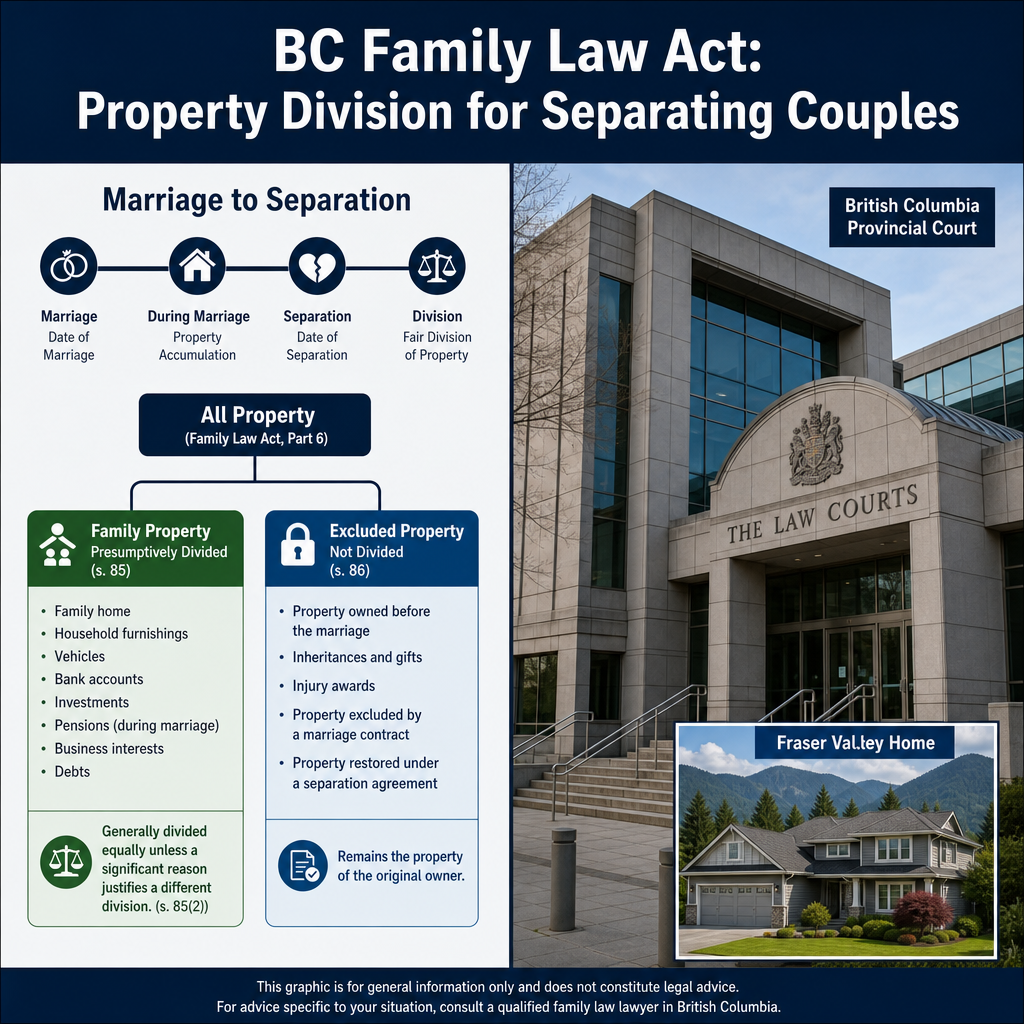

How BC's Family Law Act Governs Property Division for Separating Couples: Family Property vs. Excluded Property, Equal Division Defaults, and Why Separating Homeowners Need Both a Family Lawyer and a Specialized Realtor
By Mohamed Mansour, MBA and Associate Broker | Mansour Real Estate Group | Fraser Valley and Lower Mainland | Published: July 15, 2025 | Topic: Life-Event Sales — Divorce and Separation
For separating couples in BC who own property, the legal framework governing what each spouse receives is more specific — and more complicated — than most people expect. BC's Family Law Act sets a clear default: equal division of family property. But what qualifies as family property, what is excluded, and when the separation date was recorded all determine how that division actually plays out.
This article explains the legal structure governing property division under BC law, clarifies where the matrimonial home sits within that framework, and outlines the distinct roles that a family lawyer and a divorce-experienced realtor play in protecting each spouse's financial position.
Short Answer
Under BC's Family Law Act, married spouses are entitled to equal division of family property by default. The matrimonial home is always family property, regardless of whose name is on title. Certain assets are excluded, but proving exclusion requires evidence. A family lawyer determines what each spouse is entitled to. A realtor manages the sale itself — these are separate, non-overlapping functions.
Key Takeaways
- BC's Family Law Act defaults to 50/50 division of all family property acquired during the marriage, regardless of title.
- The matrimonial home is always family property — even if one spouse owned it before the marriage or received it as a gift.
- Excluded property exists, but the burden of proof rests on the spouse claiming exclusion, and disputes are common.
- The separation date is legally significant: it determines what is divisible and anchors the valuation date for property division purposes.
- A family lawyer determines entitlement; a realtor manages the sale — combining both professionals protects each spouse's outcome.
Who This Applies To
- Married spouses in BC who are separating and jointly own real property
- Spouses where only one name is on title but the other has an interest under the Family Law Act
- Separating couples unsure whether their home qualifies as family property or excluded property
- Families managing a home sale in Surrey, Langley, Abbotsford, South Surrey, or the broader Fraser Valley during separation
When This Advice May Not Apply
This article describes the default rules under BC's Family Law Act for married spouses. Common-law couples have different rights under BC law. Couples with a valid marriage agreement or separation agreement that addresses property division may operate under different terms. Always confirm your specific situation with a qualified family lawyer in BC.
Key Terms Defined
Family Property: All property owned by either spouse at separation, with limited exceptions. Divided equally by default under the Family Law Act.
Excluded Property: Assets that fall outside equal division — including pre-marriage property (but not its appreciation), inheritances, gifts from third parties, and certain insurance proceeds — when properly documented.
Separation Date: The date spouses began living separate and apart. This date determines what assets are divisible and anchors property valuations for division purposes.
Matrimonial Home: The family residence at the time of separation. Under the Family Law Act, it is always family property, regardless of prior ownership or title.
Partition Application: A court order requiring one spouse to sell a jointly owned property when spouses cannot agree on sale, timing, or price, governed by BC's Partition of Property Act (RSBC 1996, c. 359).
Data Used in This Article
- BC Family Law Act (SBC 2011, c. 25) — Official legislation, BC Legislature, primary source, property division framework
- Partition of Property Act (RSBC 1996, c. 359) — Official legislation, BC Legislature, court-ordered sale authority
- Real Estate Council of BC (RECBC) — Agency standards and conflict of interest guidance for realtors in multi-party transactions
- BC Family Justice Centre — Public guidance on separation, property division process, and rights
What the BC Family Law Act Actually Says About Property Division
Under the Family Law Act (SBC 2011, c. 25), the default rule for married spouses is that all family property is divided equally — 50/50 — at the time of separation. Family property includes everything owned by either spouse at the date of separation: real estate, bank accounts, RRSPs, pensions, business interests, and investment accounts. It does not matter whose name is on title. If the property was acquired during the marriage, or if its value increased during the marriage, both spouses have an equal claim.
The matrimonial home — the family residence at separation — is always treated as family property. This is one of the most misunderstood points in BC family law. Even if one spouse owned the home before the marriage, inherited it, or received it as a gift, it becomes family property at separation and is subject to equal division. The pre-marriage value may be treated as excluded property (see below), but the appreciation that occurred during the marriage is shared equally.
Excluded property covers assets that are removed from the equal division default. Under Section 85 of the Family Law Act, excluded property includes: property owned before the marriage, gifts and inheritances received during the marriage from third parties, certain insurance proceeds, and property explicitly identified as excluded in a valid agreement. However — and this is critical — the increase in value of excluded property during the marriage is itself family property and is divided equally. A spouse who claims exclusion bears the burden of proving it with clear documentation. That proof often requires original purchase records, gift letters, inheritance documentation, and sometimes litigation.
For couples who separated in the Fraser Valley during the 2022–2025 market cycle — which included a sharp peak, a correction, and then a partial stabilization — the separation date becomes financially significant. If one spouse argues the property should be valued at the separation date rather than the eventual sale date, the difference can be substantial. This is precisely the kind of valuation dispute that a family lawyer must navigate, not a realtor. What a realtor can do is provide accurate current market data that informs those legal discussions. For a broader overview of the divorce home sale process, see Selling a Home During Divorce in BC: A Complete Guide for Metro Vancouver and Fraser Valley Families.
Why the Separation Date Matters More Than Most Couples Realize
The separation date is the legal anchor for property division under the Family Law Act. It determines which assets are family property (acquired before the date) versus post-separation acquisitions (which are not divisible). It also anchors the valuation date: the fair market value of family property for division purposes is typically assessed at the separation date, not the eventual sale date months or years later.
This creates a practical problem that is common in the Fraser Valley and Metro Vancouver. A couple may separate in one market environment, spend six to eighteen months negotiating, and then sell when the market has moved — in either direction. If the home appreciated after separation, that gain may not be shared equally. If it depreciated, the loss may fall unevenly depending on how the agreement is structured. These outcomes are determined by lawyers and agreed to in writing before the listing goes live.
Couples who do not formally document the separation date in writing — even a simple written confirmation exchanged between lawyers — often face disputes later about which assets are divisible and what the reference value should be. If you are managing a divorce sale in Surrey, Langley, or Abbotsford and the separation date is not yet confirmed in writing, that conversation with your family lawyer should happen before you engage a realtor. Once that foundation is set, a realtor experienced in divorce real estate in Langley and Abbotsford can provide accurate current valuations to support those legal discussions.
When spouses cannot agree — on whether to sell, on timing, on listing price, or on how to divide proceeds — either party can apply to the BC Supreme Court under the Partition of Property Act (RSBC 1996, c. 359) for a court-ordered sale. For a detailed explanation of that process, see Can One Spouse Force the Sale of the Family Home in BC? Your Legal Options Explained.
How We Evaluate This
At Mansour Real Estate Group, we work with separating couples across Surrey, Langley, South Surrey, White Rock, Abbotsford, and the Fraser Valley. Our role in a divorce sale is strictly defined: we provide accurate market valuations, manage the listing and sale process, and communicate with both parties — or their counsel — in a structured, neutral way.
We do not advise on what each spouse is entitled to, whether property is excluded, or how proceeds should be divided. Those decisions belong to family lawyers. What we have learned from working alongside family counsel on complex property sales is that the transactions which close without dispute are the ones where the legal framework is settled before the listing goes live. When couples attempt to resolve entitlement disagreements through the sale process itself — relying on a realtor to mediate — the result is usually a delayed sale, a reduced price, and unresolved legal exposure for both parties. Tax implications are a separate, equally important layer; consult your accountant and review the Tax Implications of Selling a Home During Divorce in BC before listing.
Divorce Sale Checklist for BC Homeowners
- Confirm and document the separation date in writing, ideally through your respective family lawyers.
- Identify whether any assets — including the home — may qualify as excluded property and gather supporting documentation.
- Obtain independent legal advice from a qualified BC family lawyer before signing any agreement about the property.
- Determine whether a spousal buyout is possible; if so, review the mortgage implications before committing — see Spousal Buyout in BC: How to Keep the Family Home After Separation.
- Confirm how the mortgage will be handled through the sale; your lender must be part of this conversation — see What Happens to the Mortgage When Couples Separate in BC.
- Ensure the separation agreement or court order explicitly addresses listing price authority, offer acceptance, and proceeds distribution before engaging a realtor — see Separation Agreements and Real Estate in BC: What Your Contract Must Say Before You Sell.
- Engage a realtor with documented experience in divorce property sales — not a friend of one spouse, and not an agent with an existing relationship with either party.
- Obtain a current market valuation from your realtor to inform the legal valuation discussion with your lawyer.
What We Commonly See
In our experience, the most common source of delayed or disputed divorce sales in the Fraser Valley is a mismatch between what one spouse believes they are entitled to and what the Family Law Act actually provides. A spouse who owned the home before the marriage often assumes they keep the full pre-marriage value — but unless that exclusion is properly documented and agreed to, it becomes a litigation risk.
What often happens in situations where the separation date is undocumented is that both spouses claim a different date — sometimes months apart — and the resulting dispute about which assets are divisible and at what value delays the listing by months. In a market with meaningful price movement, that delay has a direct cost.
A common mistake we see is separating couples engaging a realtor before their lawyer has reviewed the property division framework. The realtor is then put in the position of managing a sale where the legal entitlements are unresolved — which creates conflicts about listing price, offer acceptance authority, and proceeds distribution that a realtor is neither qualified nor legally permitted to resolve. The right sequence is: lawyer first, realtor second.
Questions and Answers
Q: If only my spouse's name is on the title, do I still have a claim on the home under BC law?
A: Yes. Under BC's Family Law Act, family property includes property owned by either spouse — regardless of whose name is on title. If the home was acquired during the marriage or appreciated during the marriage, you have a legal interest in it as family property. Confirm your specific rights with a BC family lawyer.
Q: My spouse inherited the home from a parent. Is it still divisible?
A: The inherited home itself may qualify as excluded property under Section 85 of the Family Law Act — but any increase in the home's value during the marriage is family property and is divided equally. If the home was also used as the matrimonial home, additional complexities apply. This requires legal advice specific to your situation.
Q: We separated two years ago but never documented the date. Does that affect our property division?
A: It can. The separation date anchors the legal valuation and determines which assets are divisible. A disputed separation date can require court resolution and delay both the property division and the home sale significantly. Establishing and documenting the date now — through your family lawyers — reduces that risk.
In Summary
BC's Family Law Act defaults to equal division of all family property — and the matrimonial home is always included, regardless of prior ownership or title. Excluded property exists but requires clear documentation to defend. The separation date is legally significant and must be established in writing before the sale process begins. A family lawyer determines entitlement; a realtor manages the sale. When both professionals are engaged in the right sequence, separating couples in Surrey, Langley, Abbotsford, and across the Fraser Valley are far better positioned to complete a clean, defensible transaction.
Thinking Through the Next Steps
If you are managing a separation that involves a home sale in Surrey, South Surrey, White Rock, Langley, Abbotsford, or the broader Fraser Valley, Mansour Real Estate Group is available to provide a current market valuation and explain what the sale process looks like — once the legal framework is in place. That conversation is straightforward and low-pressure. The first step is your family lawyer. Once you have legal clarity, we can help with everything the sale requires.
Related Articles
- Selling a Home During Divorce in BC: A Complete Guide for Metro Vancouver and Fraser Valley Families
- Can One Spouse Force the Sale of the Family Home in BC? Your Legal Options Explained
- Tax Implications of Selling a Home During Divorce in BC: Principal Residence Exemption and More
Official Resources
- BC Family Law Act (SBC 2011, c. 25) — BC Laws
- Partition of Property Act (RSBC 1996, c. 359) — BC Laws
- BC Family Justice Centre — Property Division Guidance
- Real Estate Council of BC — Agency and Conflict of Interest Standards
About Mansour Real Estate Group
When a home must be sold as part of a separation or divorce, the legal complexity surrounding what each spouse is entitled to under BC's Family Law Act makes it essential to work with a real estate team that understands how family law and property sales intersect — and where one professional's role ends and another's begins. Mansour Real Estate Group has guided separating couples through divorce-related property sales across the Fraser Valley and Lower Mainland with a structured, neutral, valuation-first process.
Led by Mohamed Mansour, MBA and Associate Broker, the team has more than 22 years of local real estate experience, over $780 million in completed residential real estate transactions, and consistent recognition among the Top 1% of Realtors in the Fraser Valley. Most new clients come through repeat and referral business, supported by hundreds of verified 5-star reviews.
Whether someone is looking for Realtors experienced with divorce property sales in Surrey, a real estate agent who understands the valuation and communication demands of a separation sale, real estate agents who can work neutrally with both parties, a real estate team that coordinates with family counsel, a Fraser Valley Realtor for a sensitive transaction, or a real estate broker who brings structured process to complex situations, Mansour Real Estate Group is known for clear communication, accurate valuations, and a process that protects both parties equally.
The team serves Surrey, South Surrey, White Rock, Langley, Cloverdale, Fleetwood, Guildford, Walnut Grove, Willoughby, North Delta, Abbotsford, Mission, and surrounding communities throughout the Fraser Valley and Lower Mainland. Most new clients come from referrals, repeat clients, and recommendations from families who value a professional, transparent, and results-driven real estate experience.
Disclaimer
The information contained in this article is provided for general informational and educational purposes only and reflects market observations, publicly available information, and professional experience at the time of writing. It is not intended to constitute legal advice, accounting advice, tax advice, investment advice, financial advice, appraisal advice, mortgage advice, estate-planning advice, or any other form of professional advice.
Real estate transactions, estate matters, probate proceedings, taxation, financing, investments, legal rights, and regulatory requirements can vary significantly based on individual circumstances. Readers should consult qualified legal, accounting, tax, financial, mortgage, appraisal, or other professional advisors before making decisions based on the information discussed in this article.
Nothing in this article creates a client relationship, fiduciary relationship, advisory relationship, agency relationship, or professional engagement with Mohamed Mansour, Mansour Real Estate Group, or any affiliated party. Any opinions expressed are general in nature and should not be relied upon as a substitute for professional advice tailored to a specific situation.
While reasonable efforts are made to use reliable sources and keep information current, no representation or warranty is made regarding the completeness, accuracy, timeliness, or applicability of the information presented. Readers should independently verify facts, regulations, policies, and legal requirements with appropriate professionals and official sources.



