
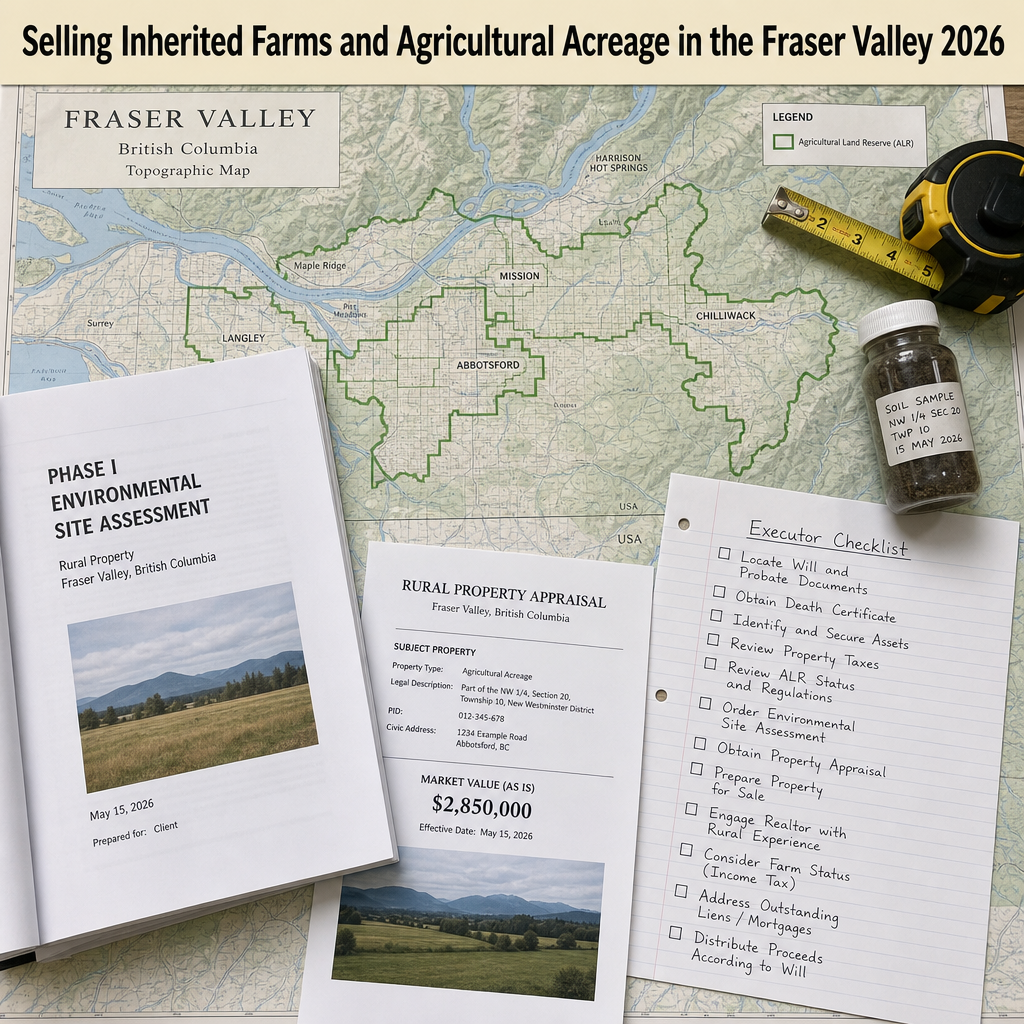

Selling Inherited Farms and Agricultural Acreage in the Fraser Valley 2026: ALR Restrictions, Environmental Assessments, Rural Appraisal Complexity, and Executor Strategy for Estate Properties in Abbotsford, Langley, Mission, and Maple Ridge
By Mohamed Mansour, MBA and Associate Broker | Mansour Real Estate Group | Fraser Valley and Lower Mainland | Published: May 27, 2025 | Geographic Focus: Abbotsford, Langley, Mission, Maple Ridge, Fraser Valley | Scope: BC Agricultural Land Reserve, Estate Sales, Rural Property Strategy
Selling inherited farmland in the Fraser Valley is fundamentally different from selling an inherited house in Surrey or a condo in Burnaby. The regulatory environment, the buyer pool, the appraisal methodology, and the environmental liability framework are all distinct — and executors who approach agricultural estate sales without specialist guidance routinely leave significant estate value on the table or expose beneficiaries to legal and financial risk they did not anticipate.
This guide is written for executors managing agricultural properties — farms, hobby farms, mixed-use rural acreage, and ALR-designated land — in Abbotsford, Langley, Mission, Maple Ridge, and the broader Fraser Valley. It explains the regulatory constraints, the environmental requirements, the appraisal realities, and the strategic options available to an estate, so that decisions are made with accurate information rather than assumptions borrowed from residential property experience.
Short Answer
Selling inherited farmland in the Fraser Valley requires navigating BC Agricultural Land Commission restrictions, mandatory environmental site assessments, rural appraisal complexity, and a narrow buyer pool that routinely extends days-on-market to 120–180 days or more. Executors need specialist realtors, environmental consultants, and rural appraisers — not generalist residential agents — to protect estate value and avoid costly missteps.
Key Takeaways
- ALR-designated properties cannot be freely subdivided or converted without BC Agricultural Land Commission approval, a process that can take 6–12 months with no guaranteed outcome.
- Environmental Phase I and Phase II Site Assessments are standard for agricultural land and can cost $3,000–$15,000 or more, with contamination findings creating cleanup obligations that reduce net proceeds.
- Agricultural property days-on-market in the Fraser Valley routinely exceed 120–180 days because the buyer pool is limited to active farmers, agricultural investors, and ALR-experienced developers.
- Rural appraisals use income capitalization methods tied to crop yields and commodity prices, creating wide valuation variance and frequent lender shortfalls that collapse buyer financing.
- Executors managing agricultural estates must work with specialists — generalist agents routinely misprice these properties, costing estates an estimated 15–30% in net proceeds.
Who This Applies To
- Executors managing estates that include farms, hobby farms, or ALR-designated acreage in the Fraser Valley
- Beneficiaries inheriting agricultural or mixed-use rural property in Abbotsford, Langley, Mission, or Maple Ridge
- Families dealing with a rural estate where the deceased operated or leased a farming business
- Estates with properties that have both a residence and income-producing agricultural land
When This Advice May Not Apply
This guide focuses on ALR-designated or agricultural-use properties. If the inherited property is a rural residential lot without agricultural designation or farm income history, different considerations apply. Consult your estate lawyer and a specialist realtor to confirm the property's designation before acting.
Data Used in This Article
- BC Agricultural Land Commission — ALR designation and application process guidance (official, current)
- Canadian Environmental Assessment Association — Phase I and Phase II ESA standards (regulatory guidance)
- Fraser Valley Real Estate Board — comparable agricultural sales data, 2024–2026 (official board reporting)
- Bank of Canada and agricultural lender appraisal methodology guidelines (official/regulatory)
- Fraser Valley Regional District — agricultural land designation mapping (official municipal/regional)
Understanding ALR Restrictions: What Executors Are Actually Dealing With
The BC Agricultural Land Reserve is one of the most consequential land-use frameworks in the province. Properties within the ALR are legally restricted to agricultural and farm use. An executor cannot simply list an ALR-designated farm on MLS and expect the same buyer pool as a residential property. The designation follows the land title, and any buyer must accept those restrictions — or pursue removal through the BC Agricultural Land Commission.
Executors in Abbotsford, Langley, Mission, and Maple Ridge are dealing with one of the highest concentrations of ALR-designated land in the province. According to the BC Agricultural Land Commission, ALR removal applications require formal review, community input, and commission approval. The process typically takes 6–12 months, involves application fees, and provides no guarantee of success. In practice, many applications are refused, particularly in the Lower Mainland where agricultural land protection is treated as a regional priority.
For most estates, the realistic options are three: sell the property as ALR-restricted farmland to an active farmer or agricultural investor; hold the property, lease it to a farm operator, and defer the sale decision; or apply to the ALC for removal or non-farm use permission — understanding that this path extends the estate timeline and introduces significant regulatory uncertainty. Most executors should not pursue ALR removal without specialist legal and agricultural planning advice. The costs, delays, and risk of refusal are substantial. As a starting point for understanding the broader executor process, The Complete Executor's Guide to Selling an Inherited Home in BC provides foundational context, though agricultural estates layer significant additional complexity on top of that baseline.
Environmental Site Assessments: Why They Are Mandatory and What They Cost
Agricultural land carries environmental liability that residential properties typically do not. Decades of pesticide and herbicide application, fuel storage for farm equipment, historical industrial use adjacent to the property, and fertilizer management practices can all leave soil or groundwater contamination that a buyer's lender will require assessed before financing is approved.
A Phase I Environmental Site Assessment reviews historical land use, ownership records, aerial photographs, regulatory databases, and site observations to identify areas of potential concern. According to Canadian Environmental Assessment Association standards, a Phase I ESA for a rural agricultural property typically costs $3,000–$8,000 and takes two to four weeks. If the Phase I identifies recognized environmental conditions, a Phase II ESA — which involves soil sampling, laboratory analysis, and groundwater testing — is required. Phase II assessments can cost $8,000–$15,000 or more depending on site size, complexity, and the extent of sampling required.
Contamination findings do not necessarily make a property unsaleable, but they create disclosure obligations, potential cleanup requirements, and pricing adjustments that must be factored into the estate's net proceeds calculations. Executors who skip environmental assessment to reduce upfront costs frequently encounter deal-collapse at subject removal when the buyer's lender requires an ESA and the timeline collapses under probate pressure.
The practical guidance: commission the Phase I ESA before listing, not after. A clean Phase I report is a marketing asset. A Phase I commissioned mid-transaction under deadline pressure is a liability.
Rural Appraisal Complexity: Why Agricultural Valuations Are Structurally Different
Residential appraisals rely primarily on comparable sales — recently sold properties with similar features in the same area. Agricultural appraisals use a combination of comparable sales, income capitalization, and cost approaches that introduce significant valuation variance. Income capitalization ties the property value to what a farming operation can realistically generate, which depends on crop type, lease rates, soil classification, water access, and commodity prices — all of which fluctuate.
Comparable sales for agricultural properties in the Fraser Valley are sparse. A farm in Abbotsford may have only three or four genuinely comparable sales in a 24-month window, and each of those sales may reflect different farm operations, different ALR conditions, or different buyer motivations. Lender appraisers working from a narrow comparables pool and conservative income projections frequently undershoot agricultural land value — and when the appraisal comes in below the accepted offer price, the buyer's financing shortfall triggers either a renegotiation or a deal collapse.
Executors should commission an independent agricultural appraisal from a Certified Residential Appraiser with documented rural and farm appraisal experience before pricing the property. Using a residential-only appraisal for farmland is methodologically incorrect and often produces values that neither protect the estate nor survive lender scrutiny. For a deeper understanding of date-of-death appraisal requirements, How to Get a Date-of-Death Fair Market Value Appraisal for a BC Estate Property explains the foundational appraisal requirements that apply to all estate properties, including agricultural ones.
Agricultural lenders — Farm Credit Canada, credit unions with agricultural portfolios, and select chartered banks — use their own appraisal panels. A buyer financing through an agricultural lender may receive a different appraisal than a buyer using a conventional residential mortgage. Executors and their realtors need to anticipate this variance and build subject removal timelines that accommodate it.
The Buyer Pool for ALR Farmland: Who Is Actually Buying and Why It Matters
The buyer pool for ALR-restricted agricultural land in the Fraser Valley is narrow by definition. Active farmers expanding their operations, agricultural investors, farming families seeking entry into the region, and developers with the expertise and appetite to pursue ALR removal are the realistic universe of buyers. This is not a pool that responds to standard MLS marketing tactics or open house strategies.
Days-on-market for agricultural properties in the Fraser Valley routinely exceed 120–180 days according to FVREB data for the 2024–2026 period, and in a buyer's market with elevated inventory, that timeline can extend further. Executors managing an estate with carrying costs — property taxes, farm insurance, equipment maintenance, or existing farm leases — need to factor a longer sale horizon into their estate administration plan from the outset.
Marketing agricultural estate properties requires direct outreach to farm operators, agricultural investor networks, and specialty agricultural real estate channels — not just MLS placement. The realtor managing an agricultural estate sale needs documented experience with this buyer type, existing relationships in the agricultural community, and the ability to explain ALR conditions, environmental assessments, and rural appraisal variance to buyers in plain language. Executors selling farm properties in Langley and Abbotsford face this buyer-pool reality most acutely, given the volume of active agricultural land in those areas. For broader seller market strategy applicable to these communities, Selling an Estate Home in a Buyer's Market: Strategy for Fraser Valley Executors in 2026 provides relevant strategic context, though agricultural sales require additional layers of specialist positioning.
Tax Considerations for Agricultural Estate Sales in BC
Agricultural estate sales often carry tax complexity beyond the standard deemed disposition rules that apply to all estate properties. If the deceased operated a farming business on the property, the estate may involve farm income tax considerations, capital cost allowance recapture on farm equipment or buildings, and potential eligibility for the Lifetime Capital Gains Exemption on qualified farm property — a significant tax shelter that can apply to shares of family farm corporations or certain farm properties meeting Canada Revenue Agency criteria.
The principal residence exemption complication is another area where agricultural estate sales diverge from residential ones. If the deceased lived on the farm property but also earned farm income from it, the allocation between principal residence and income-producing land affects the capital gains calculation on the date of death. This is a tax matter requiring advice from an accountant with farm tax experience — not a general estate tax question that a residential-focused accountant can resolve reliably.
Executors should not proceed to listing without confirming the tax treatment of the property with a qualified accountant. The stakes are material: miscalculating the capital gains exposure on a $3 million Abbotsford farm affects the net distribution to beneficiaries by hundreds of thousands of dollars. For foundational estate tax context, Deemed Disposition and Capital Gains: The Tax Reality of Inheriting a Home in BC explains the core framework, but agricultural properties require specialist farm tax advice on top of that baseline.
How We Evaluate This
When Mansour Real Estate Group assesses an agricultural estate property, the starting point is not list price — it is property status. What is the ALR designation? Is there an existing farm lease? When was the property last used for active agriculture? Are there structures, equipment, or contamination concerns that need to be resolved before valuation can be completed?
From there, the process involves coordinating an independent agricultural appraisal, commissioning a Phase I ESA if one is not already available, reviewing FVREB comparable sales data for similar agricultural properties, and identifying the buyer type most likely to transact — farmer, investor, or developer — so that the marketing strategy targets that specific pool. Pricing is set to reflect ALR constraints, environmental status, and realistic lender appraisal outcomes, not hypothetical land values derived from non-ALR comparables. Timeline expectations are set conservatively, and estate administration costs are factored into the net proceeds projection before the property goes to market.
Executor Checklist for Agricultural Estate Sales in the Fraser Valley
- Confirm the property's ALR designation status and any existing ALC applications or decisions through the BC Agricultural Land Commission and the Fraser Valley Regional District.
- Secure the property immediately — farm insurance for vacant agricultural properties differs from standard home insurance and must be in place from the date of death.
- Commission a Phase I Environmental Site Assessment from a qualified environmental consultant before listing — do not wait for a buyer to require it mid-transaction.
- Engage an agricultural appraiser with documented farm appraisal experience for both the date-of-death valuation and the pre-listing market value assessment.
- Consult a farm tax accountant to determine capital gains treatment, potential Lifetime Capital Gains Exemption eligibility, and any farm income tax obligations before setting the sale timeline.
- Review any existing farm leases — tenant farmers may have rights under BC's tenancy framework that affect the sale process and timeline.
- Work with a realtor who has documented experience selling ALR farmland in the Fraser Valley, with active connections to agricultural buyers, agricultural lenders, and farm-sector networks.
- Set a realistic sale timeline — plan for 120–180+ days-on-market in current market conditions and build estate carrying costs into the net proceeds projection from the outset.
What We Commonly See
In our experience managing estate sales across Abbotsford, Langley, Mission, and Maple Ridge, the most common mistake executors make with agricultural properties is assigning a generalist residential agent who prices the farm using non-ALR suburban land comparables. The resulting list price is sometimes 20–30% above what ALR-restricted buyers will pay and what agricultural lenders will finance. The property then sits on market for months, accumulating carrying costs, before being relisted at a price that should have been the starting point.
What often happens with environmental assessments is that executors skip them to avoid the upfront cost, then face a collapsed transaction when the buyer's lender requires a Phase I at subject removal. The rushed Phase I report, produced under deadline pressure, frequently identifies concerns that trigger a Phase II requirement — and the deal falls apart under the timeline pressure of probate. A Phase I commissioned proactively, two months before listing, becomes a marketing document. The same Phase I commissioned reactively, mid-deal, becomes a liability.
A third pattern we observe is executors underestimating farm lease complexity. BC tenancy law for agricultural land includes provisions that may give existing tenant farmers rights to continued occupation or notice periods that affect the sale. An executor who accepts an offer conditional on vacant possession — without first confirming the lease terms and the tenant's rights — creates a condition that may be impossible to fulfill. Confirming lease status and tenant rights is a legal matter for the estate lawyer, not an assumption to be made at listing time. Executors managing rural properties in Mission or Maple Ridge can find additional relevant context in Estate Property Sales in Mission and Maple Ridge: A Guide for Rural and Semi-Rural Executors.
Questions and Answers
Can an executor sell ALR farmland without BC Agricultural Land Commission approval?
Yes — selling ALR farmland does not require ALC approval. The ALR designation stays with the land and transfers to the buyer. What requires ALC approval is changing the land's use — such as applying for subdivision, non-farm use, or ALR removal. The executor can sell the property in its current ALR state without seeking any commission approval, as long as the property is marketed to buyers who accept the agricultural land restrictions.
Does every agricultural estate sale in BC require an environmental site assessment?
Not legally mandatory for every sale, but practically required for most. Agricultural lenders financing buyer purchases almost universally require a Phase I ESA before approving a mortgage on agricultural land. If the estate expects buyers to finance through any institutional lender, a Phase I assessment is a functional prerequisite. Commission it before listing rather than during the transaction.
How is farmland valued differently from residential property for estate purposes?
Agricultural property appraisals use income capitalization methods based on farm income potential — tied to soil class, crop type, water access, and lease rates — in addition to comparable sales. This methodology produces wider valuation ranges than residential appraisals, and results vary significantly depending on the appraiser's experience with agricultural properties. Executors should commission an agricultural-specialist appraiser, not a residential appraiser working outside their primary area of expertise.
In Summary
Selling inherited farmland in the Fraser Valley is one of the most technically complex estate transactions an executor will face. ALR restrictions determine who can realistically buy the property, environmental assessments determine what liability the estate carries into the sale, and rural appraisal methodology determines whether buyer financing survives subject removal. Days-on-market are long by design — the buyer pool is narrow and highly specific.
Executors who approach agricultural estate sales with the same assumptions and the same agent they would use for a residential property sale routinely discover those assumptions are wrong — at significant cost to the estate. The specialist team, the environmental assessment, the agricultural appraisal, and the realistic timeline are not optional features. They are the core of a defensible, value-protective process for one of the most significant asset types in the Fraser Valley estate landscape.
Speak With an Executor-Focused Real Estate Team
If you are managing an agricultural estate property in Abbotsford, Langley, Mission, or Maple Ridge and want a clear-eyed assessment of your options, Mansour Real Estate Group is available to provide a no-obligation consultation — including a review of ALR status, environmental assessment requirements, and realistic pricing expectations for the current market.
Related Articles
- The Complete Executor's Guide to Selling an Inherited Home in BC
- Abbotsford Estate Sales: The Executor's Guide to Selling Inherited Property in the Eastern Fraser Valley
- Selling an Estate Home in a Buyer's Market: Strategy for Fraser Valley Executors in 2026
- Estate Property Sales in Mission and Maple Ridge: A Guide for Rural and Semi-Rural Executors
- Selling a Luxury or High-Value Estate Property in Greater Vancouver: A Premium Executor's Guide
Official Resources
- BC Agricultural Land Commission — ALR designation, application process, and non-farm use guidance: www.alc.gov.bc.ca
- Canadian Environmental Assessment Association — Phase I and Phase II ESA standards: www.ceaa-acee.gc.ca
- Fraser Valley Real Estate Board — agricultural property market data: www.fvreb.bc.ca
- Canada Revenue Agency — Lifetime Capital Gains Exemption on qualified farm property: www.canada.ca/en/revenue-agency.html
- BC Probate Registry — estate administration and executor authority: www.bccourts.ca
About Mansour Real Estate Group
When an estate includes a working farm, hobby farm, or ALR-designated acreage, the real estate team managing the sale needs to understand more than residential market conditions. Agricultural estate sales in the Fraser Valley involve regulatory constraints, environmental liability, specialist appraisal methodology, and a buyer pool that a generalist approach will not reach. Mansour Real Estate Group has guided executors, families, and beneficiaries through estate and probate-related real estate sales — including complex agricultural and rural properties — across Abbotsford, Langley, Mission, Maple Ridge, Surrey, White Rock, and the broader Fraser Valley for more than two decades.
Led by Mohamed Mansour, MBA and Associate
Disclaimer: This article is for informational purposes only and does not constitute legal, financial, or real estate advice. Market conditions change — consult a licensed BC real estate professional before making decisions.



