
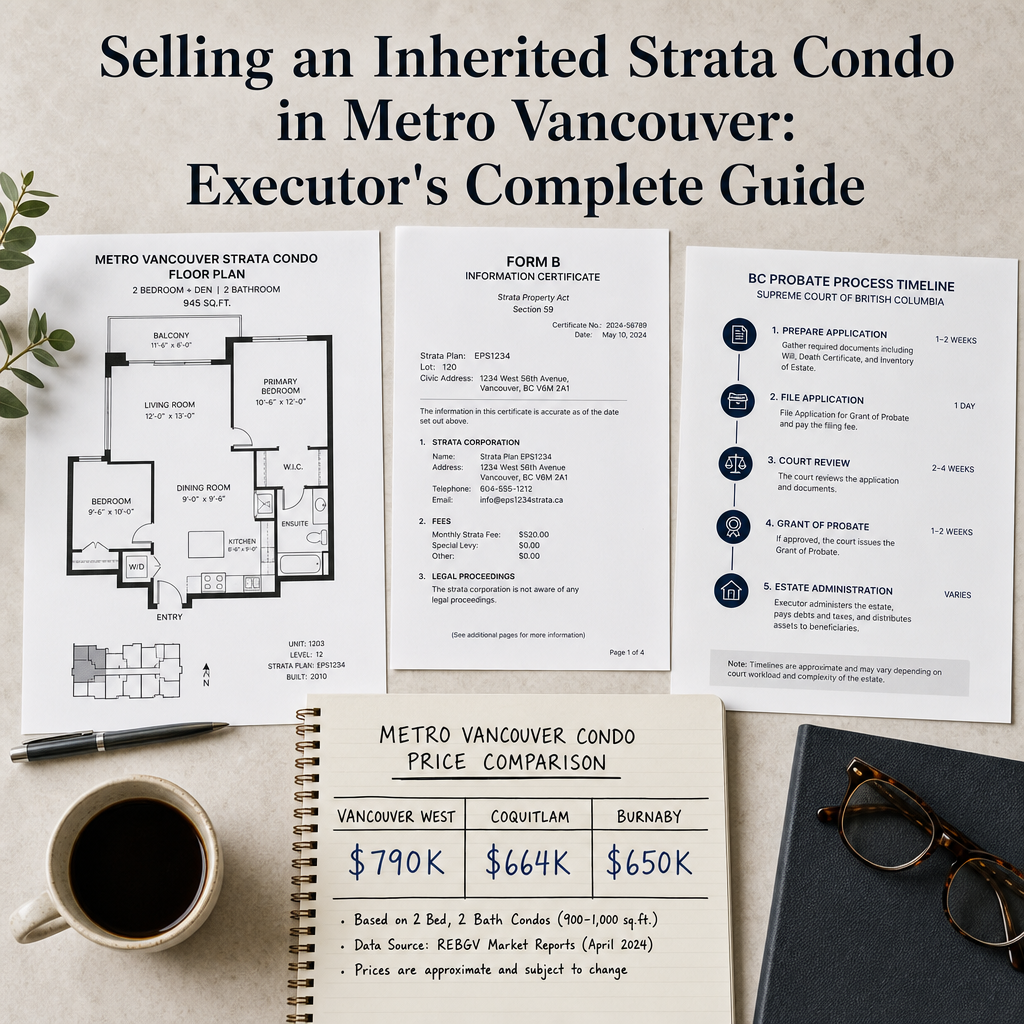

Selling an Inherited Strata Condo in Metro Vancouver: Executor's Complete Guide to Strata Notification, Form B Disclosure, Special Levy Risk, and Probate Timeline When Condo Benchmark Prices Diverge Across Vancouver, Coquitlam, and Burnaby Markets
By Mohamed Mansour, MBA and Associate Broker | Mansour Real Estate Group | Published: July 15, 2025 | Geography: Metro Vancouver — Vancouver West, Burnaby, Coquitlam | Topic: Estate Sales, Strata Property, Probate
Selling a strata condo as part of an estate is one of the more complex real estate tasks an executor can face in BC. Unlike a detached home, a strata property brings an additional layer of obligations — legal notifications to the strata corporation, Form B document timelines, reserve fund exposure, and special levy risk — all of which must be coordinated with the probate process. Getting any one of these wrong can delay the sale, reduce net proceeds, or create personal liability for the executor.
This guide is written specifically for executors managing inherited condos in Vancouver, Burnaby, and Coquitlam — three markets where benchmark prices diverge significantly and where strata-specific complications are most common. If you are managing an estate sale involving a detached property, the Complete Executor's Guide to Selling an Inherited Home in BC covers the broader process.
Short Answer
Executors selling an inherited strata condo in Metro Vancouver must notify the strata corporation within 30 days of death, obtain a current Form B Information Certificate before listing, assess special levy and reserve fund risk, and price the property against highly location-specific condo benchmarks — Vancouver West averaging $790K versus Coquitlam at $664K and Burnaby near $650K–$680K, according to BCFSA Q1 2026 data. These obligations run simultaneously with probate, and each creates its own timeline.
Key Takeaways
- BC Strata Property Act Section 171 requires executors to notify the strata corporation within 30 days of the owner's death — failure creates lien liability for unpaid fees.
- Form B Information Certificates can take 2–6 weeks to obtain if strata financials are not current, directly delaying market entry during probate windows.
- Special levy exposure during probate delays can cost estates $5,000–$25,000 or more depending on building size and timeline.
- Depreciation reports flagging reserve fund depletion below 50% can trigger mortgage denial and appraisal shortfalls of 5–15%, reducing net proceeds.
- Executors may list before Grant of Probate but must hold proceeds in trust; closing mechanics must clearly assign strata fee liability at the possession date.
Who This Applies To
- Executors and estate administrators managing a strata condo left by a deceased owner in Metro Vancouver
- Beneficiaries who have been named executor and are unfamiliar with strata-specific obligations
- Estate lawyers and notaries coordinating the sale alongside probate proceedings
- Families dealing with older condo buildings where depreciation reports and reserve fund health are uncertain
When This Advice May Not Apply
This guide addresses strata condos in Metro Vancouver. Executors managing detached homes, rural acreage, or properties in the Fraser Valley should review the cluster articles specific to those situations. For properties in Mission or Maple Ridge, see the guide on Estate Property Sales in Mission and Maple Ridge. Townhome strata sales have overlapping but distinct considerations covered in the upcoming guide on Inherited Townhomes in Metro Vancouver and the Fraser Valley.
Data Used in This Article
- BCFSA MLS Data Q1 2026 — Condo benchmark prices by municipality (official regulatory data)
- BC Strata Property Act, Section 171 — Death notification requirements (primary legislation)
- BC Government Probate Resources — Executor authority and timeline guidance (government source)
- CMHC Mortgage Qualification Guidelines — Depreciation report impact on financing (regulatory guidance)
- Mansour Real Estate Group Estate Sales Case Studies 2024–2026 — Metro Vancouver condo experience (internal professional analysis)
Key Definitions
Form B Information Certificate: A document issued by the strata corporation confirming the current owner's financial standing — including unpaid fees, outstanding levies, and bylaw violations — required before any BC strata property can be sold.
Special Levy: A one-time charge approved by the strata corporation to fund a repair or capital expense not covered by the reserve fund. Levies can be assessed before or after closing and may become the estate's liability depending on timing.
Depreciation Report: A third-party engineering assessment of a strata building's common property condition and projected future repair costs. Aging or unfunded reserves can trigger buyer financing problems.
Grant of Probate: The court order confirming the executor's legal authority to administer and transfer estate assets, including real property. Required before title can transfer in BC.
Step One: Notify the Strata Corporation — Within 30 Days of Death
Under Section 171 of the BC Strata Property Act, the executor or administrator of an estate must notify the strata corporation of the owner's death within 30 days. This is not optional. Failing to notify can result in strata fees continuing to accrue without a clear responsible party, and in serious cases, the strata corporation may register a lien against the property for unpaid amounts.
The notification should be sent in writing to the strata manager and include a copy of the death certificate and evidence of executor status — either a certified copy of the will or, once issued, the Grant of Probate. Until probate is granted, the executor operates under the authority of the will itself, but the strata needs documentation to recognize that authority.
Once notified, the strata corporation will typically direct all future correspondence to the executor. This is also the point to confirm whether any special levies have been approved but not yet billed, whether any strata fees are outstanding, and whether any bylaw violations are on record — all of which will appear on the Form B and affect the eventual sale. For a broader overview of executor authority questions, see Power of Attorney vs. Executor: Who Has the Authority to Sell a BC Home?
Form B Timing: Why This Is the Most Common Cause of Listing Delays
A Form B Information Certificate must be issued by the strata corporation before any strata property is listed for sale in BC. Under the Real Estate Development Marketing Act and RECBC strata disclosure requirements, buyers must receive the Form B as part of the disclosure package, and the absence of a current Form B can void a contract or expose the listing realtor and executor to liability.
The problem in estate sales is timing. If the strata has not recently updated its financial statements or has not completed its most recent annual general meeting, the Form B may reference outdated financial information — or the strata manager may decline to issue one until updated records are available. In practice, this can take 2–6 additional weeks depending on the building's administrative cycle.
Executors should request the Form B immediately after notifying the strata corporation — not after probate is issued. The strata corporation can issue the certificate to the estate's authorized representative. Pairing this request with an inquiry about any outstanding or pending special levies, reserve fund status, and the most recent depreciation report gives the executor a full financial picture before pricing begins.
For older buildings — particularly condos built in the 1970s through 1990s in Burnaby and Coquitlam — depreciation reports are especially important. If the reserve fund is below 50% of the recommended level, some lenders will decline mortgage financing on the unit entirely, which narrows the buyer pool and reduces the achievable price. See also the Burnaby and Coquitlam estate sales guide at Burnaby and Coquitlam Estate Sales: Selling Inherited Condos and Houses in the Burquitlam Corridor.
Special Levy Risk During Probate Delays
Probate in BC typically takes 4–8 weeks from application to Grant of Probate, though more complex estates or contested situations can extend that timeline significantly. During this window, strata fees continue to accrue as an estate liability. More seriously, strata corporations can vote to approve a special levy at any time — and if that vote occurs while the estate still holds title, the levy becomes the estate's obligation, not the buyer's.
The financial exposure varies dramatically by building. In a smaller building with low monthly strata fees, the cost may be manageable. In a larger building with aging infrastructure and a depleted reserve fund, a special levy approved during a probate delay can cost the estate $5,000–$25,000 or more. According to CMHC mortgage qualification guidelines, buyers seeking insured financing on buildings with reserve fund deficiencies may also face appraisal shortfalls, further eroding the estate's net position.
Executors should ask the strata manager directly whether any special levies are currently under discussion or scheduled for an upcoming vote. This information is not always on the Form B — it depends on the timing of board meetings and AGM cycles. Understanding this risk is part of the pricing analysis, not an afterthought.
How Condo Benchmark Prices Affect Executor Pricing Strategy
Metro Vancouver is not a single condo market. According to BCFSA MLS data for Q1 2026, condo benchmark prices vary significantly by municipality: Vancouver West averages approximately $790,000, Coquitlam sits around $664,000, and Burnaby ranges from $630,000 to $680,000 depending on area and building type. These differences are not interchangeable — an executor pricing a Burnaby condo based on Vancouver West comparables will overprice the property and sit on the market, accumulating strata fees and special levy exposure.
Within each municipality, price also varies by building age, floor level, view, parking, storage, strata fee level, and the financial health of the building itself. A well-maintained building with a fully funded reserve and a recent depreciation report will attract conventional mortgage buyers. A building flagged for reserve deficiency will attract primarily cash buyers, reducing competition and typically producing a lower sale price.
For executors in Coquitlam or Burnaby managing older buildings, this means the pricing conversation is not just about comparable sales — it is about which buildings buyers can actually finance. Comparable sales from a healthier building two blocks away may not be achievable if your building carries a financing restriction. The executor's realtor must pull comparables from buildings with similar strata financial health, not just similar square footage and location. The BC Probate Timeline guide provides useful context on how delays interact with market timing decisions.
Can an Executor List Before Grant of Probate?
Yes — in BC, an executor can list an inherited property for sale before the Grant of Probate is issued. The listing can proceed, offers can be accepted, and a completion date can be set for after the Grant is received. This approach is common when the probate timeline is predictable and the executor wants to maintain market momentum rather than wait several months before listing.
However, the sale proceeds must be held in trust until probate is granted and the executor's authority is confirmed. The contract must be drafted carefully, with completion and possession dates that account for the expected probate timeline. Equally important: the closing mechanics must clearly state which party assumes strata fee liability at the possession date, so there is no ambiguity about who is responsible for fees that accrue between contract execution and title transfer. A knowledgeable estate real estate team will build these terms into the offer structure from the start.
How We Evaluate This
When Mansour Real Estate Group is engaged to manage an inherited strata condo sale, the evaluation begins with four parallel inquiries that happen simultaneously, not sequentially: strata corporation notification and fee confirmation, Form B and depreciation report request, probate status and expected Grant timeline, and a market pricing analysis specific to that building's strata financial health.
The pricing analysis is always building-specific, not just area-specific. In our experience working with executors across Metro Vancouver, the most common mistake is pricing based on area benchmarks without accounting for the building's reserve fund status and its effect on the eligible buyer pool. A unit in a building with a reserve fund deficiency will rarely achieve the area benchmark regardless of its finishes or floor level, because the buyer pool is narrowed to cash purchasers and investors — who apply a discount for the financing restriction and the future levy risk they are absorbing.
Executor's Strata Condo Sale Checklist
- Notify the strata corporation in writing within 30 days of death, including the death certificate and executor confirmation from the will.
- Request the Form B Information Certificate immediately — do not wait for probate to be issued.
- Obtain the most recent depreciation report and ask the strata manager directly about any pending or recently discussed special levies.
- Confirm the reserve fund balance and compare it to the recommended level in the depreciation report to assess financing risk for buyers.
- Confirm the probate timeline with your estate lawyer and determine whether listing before Grant of Probate is appropriate given market conditions and strata fee accrual.
- Pull market comparables from buildings with similar strata financial health — not just similar location and size.
- Structure the offer and closing terms to clearly assign strata fee liability at the possession date, and hold sale proceeds in trust until probate is granted.
- Consult your estate lawyer before signing any contract to confirm the executor's authority is properly documented in the offer.
What We Commonly See
Strata notification is delayed while the family focuses on the will and funeral arrangements. This is understandable, but it creates a gap where strata fees accrue without formal estate acknowledgment. In our experience, the 30-day window under Section 171 passes quickly, and some strata managers become difficult to work with once they realize notification was late. Acting within the first two weeks is always better.
Executors price based on area benchmarks rather than building-specific buyer pool analysis. We regularly see inherited condos in Burnaby and Coquitlam listed at prices only achievable in fully financeable buildings, then reduced repeatedly after sitting on the market. Each price reduction signals distress, attracts lower offers, and extends the period of strata fee accumulation. A more conservative initial price based on the actual buyer pool produces faster sales and better net proceeds.
Form B requests are made too late. Executors who wait until probate is granted to request the Form B discover a 2–6 week additional delay before the listing can go live. This delay is entirely avoidable. The Form B can be requested as soon as the strata has been notified, which should happen within 30 days of death — months before the Grant of Probate is typically issued.
Questions and Answers
Q: Does the estate pay strata fees during probate, or does the buyer?
Strata fees accrue as an estate liability until the possession date, when responsibility transfers to the buyer. Any special levies approved before the possession date are typically the estate's obligation. The contract must specify this clearly at the time of offer to avoid disputes at closing.
Q: What happens if the Form B shows unpaid strata fees from before the owner's death?
Unpaid strata fees shown on the Form B must be cleared before or at closing. The strata corporation has the right to register a lien for unpaid amounts, which would delay or prevent title transfer. Executors should confirm the fee status as early as possible and budget for any arrears in the estate accounting.
Q: Can a buyer get a mortgage on a condo with a depreciation report showing reserve fund depletion?
This depends on the severity of the shortfall and the lender. Under CMHC mortgage qualification rules, buildings with reserve funds below acceptable thresholds may be ineligible for insured financing. Some conventional lenders impose their own restrictions. In practice, a building flagged for reserve deficiency will have a narrower buyer pool — primarily cash buyers — which affects both achievable price and time on market.
In Summary
Selling an inherited strata condo in Metro Vancouver requires executors to manage two parallel tracks: the probate legal process and the strata-specific obligations that begin the moment ownership passes to the estate. The 30-day notification requirement under Section 171 of the Strata Property Act is the first deadline. Form B timing, depreciation report status, reserve fund health, and special levy risk all directly affect the sale price and timeline. In a market where condo benchmarks differ by $100,000–$150,000 between Vancouver West, Burnaby, and Coquitlam, executor pricing must be building-specific, not just geography-specific. Working with a real estate team experienced in both estate sales and strata transactions is not optional — it is the practical difference between a clean, timely sale and a prolonged, costly one.
Consult With an Experienced Estate Sale Realtor
If you are managing an inherited strata condo in Vancouver, Burnaby, Coquitlam, or elsewhere in Metro Vancouver, Mansour Real Estate Group is available to walk through the strata documents, review the probate timeline, and build a pricing strategy specific to your building's financial position. There is no obligation — just a clear conversation about your situation and what the process looks like from here.
Related Articles
- The Complete Executor's Guide to Selling an Inherited Home in BC
- Burnaby and Coquitlam Estate Sales: Selling Inherited Condos and Houses in the Burquitlam Corridor
- Inherited Townhomes in Metro Vancouver and the Fraser Valley: What Executors Need to Know Before Selling
About Mansour Real Estate Group
When an inherited strata condo must be sold as part of a probate estate, the real estate team involved needs to understand not just market pricing but the strata notification requirements, Form B document obligations, depreciation report risk, and closing mechanics that protect the executor's position. Mansour Real Estate Group has guided executors, beneficiaries, and families through estate and probate-related strata sales across Metro Vancouver, the Lower Mainland, and the Fraser Valley for more than two decades.
Led by Mohamed Mansour, MBA and Associate Broker, Mansour Real Estate Group has completed more than $780 million in residential real estate transactions and is ranked among the Top 1% of Realtors in the region. The team is trusted for estate sales, probate sales, executor-managed transactions, divorce-related property sales, downsizing, and complex situations requiring careful coordination across legal, financial, and real estate timelines.
Whether a family is looking for Realtors experienced with inherited condos, a real estate agent who understands strata documentation and probate timelines, a real estate team for an executor-managed condo sale in Burnaby or Coquitlam, or a Vancouver real estate broker with direct experience in estate and strata transactions, Mansour Real Estate Group provides clear communication, accurate valuations, and a structured process that keeps executors, beneficiaries, and legal counsel informed at every stage.
The team serves Surrey, South Surrey, White Rock, Langley, Cloverdale, Fleetwood, Guildford, Walnut Grove, Willoughby, North Delta, Abbotsford, Mission, and surrounding communities in the Fraser Valley and Lower Mainland. Most new clients come through referrals, repeat clients, and families who value a professional, transparent, and results-driven real estate experience.
Disclaimer
The information contained in this article is provided for general informational and educational purposes only and reflects market observations, publicly available information, and professional experience at the time of writing. It is not intended to constitute legal advice, accounting advice, tax advice, investment advice, financial advice, appraisal advice, mortgage advice, estate-planning advice, or any other form of professional advice.
Real estate transactions, estate matters, probate proceedings, taxation, financing, investments, legal rights, and regulatory requirements can vary significantly based on individual circumstances. Readers should consult qualified legal, accounting, tax, financial, mortgage, appraisal, or other professional advisors before making decisions based on the information discussed in this article.
Nothing in this article creates a client relationship, fiduciary relationship, advisory relationship, agency relationship The real estate market continues to evolve, influenced by economic conditions, interest rates, and shifting buyer preferences. Whether you're a first-time homebuyer, a seasoned investor, or someone looking to upgrade your living situation, taking the time to educate yourself about the process will serve you well. Don't hesitate to ask questions, seek professional advice, and trust your instincts when evaluating properties. Your home is likely one of the most significant investments you'll make in your lifetime. By approaching your real estate journey with knowledge, preparation, and realistic expectations, you'll be well-positioned to find a property that meets your needs and builds equity for your future.Key Takeaways
Final Thoughts



