
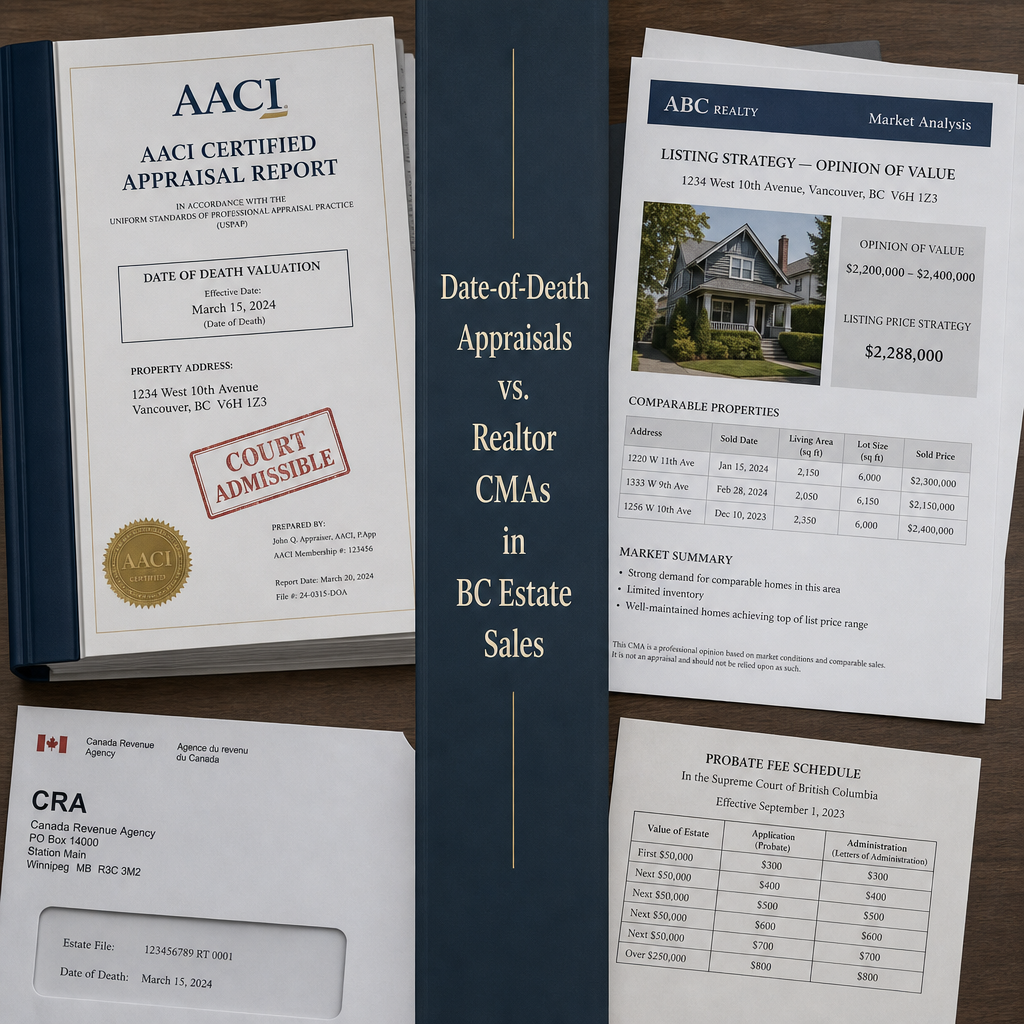

Date-of-Death Fair Market Value Appraisals in BC Estate Sales: Why Certified Appraisals vs. Realtor CMAs Matter for CRA Capital Gains, Probate Fees, and Estate Settlement Accuracy
By Mohamed Mansour, MBA and Associate Broker — Mansour Real Estate Group | Published: July 15, 2025 | Fraser Valley and Lower Mainland, BC
BC executors face two valuation requirements that many families do not anticipate: establishing fair market value at the date of death for CRA capital gains reporting, and calculating the gross estate value that determines probate fees payable to the courts. Both require a defensible, documented figure. Neither can be satisfied by a realtor's listing opinion alone.
This article explains the legal and financial distinction between a certified date-of-death appraisal and a comparative market analysis, why that distinction matters for executors managing estate property sales in BC, and what the cost of getting it wrong looks like in real numbers.
Short Answer
A certified appraisal from a designated appraiser (AACI or MAI) establishes fair market value at the date of death with court-admissible methodology and professional liability backing. A realtor's CMA is an opinion prepared for listing strategy — useful for pricing, not legally sufficient for CRA deemed disposition or BC probate fee calculations. Using only a CMA exposes the estate to audit risk and potential fee recalculation.
Key Takeaways
- CRA requires fair market value — not a realtor's opinion — for deemed disposition capital gains reporting at death.
- BC probate fees are calculated at 1.5% of gross estate value; a $100,000 valuation error costs the estate $1,500 in fees.
- Certified appraisers (AACI, MAI) produce court-admissible valuations backed by professional liability insurance; CMAs do not.
- Appraiser and realtor valuations frequently diverge by 5–15%, which can create material audit exposure or probate fee errors.
- A date-of-death appraisal typically costs $800–$2,500 — a fraction of what an unchallenged valuation error can cost the estate.
Who This Applies To
- Executors or administrators managing an estate that includes BC real property
- Beneficiaries who have inherited property and need to understand the tax basis
- Estate lawyers and accountants coordinating the CRA terminal return
- Families preparing a probate application where real property is part of the estate
When This Advice May Not Apply
If the property transfers directly to a surviving spouse or common-law partner, the deemed disposition rules may be deferred and an immediate date-of-death appraisal may not be required for CRA purposes. Executors should confirm the applicable rules with the estate's accountant or tax lawyer before proceeding.
Key Terms Explained
Deemed Disposition: Under Canadian tax law, a person is treated as having sold all their property at fair market value at the moment of death, even if no sale occurs. Capital gains arising from this deemed sale are reported on the terminal tax return.
Fair Market Value (FMV): The price a willing buyer and willing seller would agree to in an open market, with neither under compulsion. CRA uses this standard for deemed disposition calculations.
AACI / MAI Designation: Accredited Appraiser Canadian Institute and Member of the Appraisal Institute — designations from the Appraisal Institute of Canada indicating the appraiser meets professional standards for certified, court-admissible property valuations.
Comparative Market Analysis (CMA): A realtor's opinion of probable selling price, based on comparable sales and market knowledge. Used for listing strategy — not a substitute for a certified appraisal in legal or tax contexts.
Data Used in This Article
- Canada Revenue Agency — Deemed Disposition Rules and Fair Market Value Requirements (official guidance, federal)
- BC Supreme Court Civil Rules — Probate Fee Schedule and Estate Valuation Requirements (official, provincial)
- Appraisal Institute of Canada — Standards for Property Valuation in Estate Settlements (regulatory body, national)
- BC Law Society — Executor Duties and Fair Market Value Assessment (professional guidance, provincial)
What the Law Actually Requires
When a BC homeowner dies, two separate valuation obligations arise almost immediately. The first is for CRA. Under the Income Tax Act, every taxpayer is deemed to have disposed of all capital property at fair market value at the date of death. That deemed disposition triggers a capital gains calculation, which must be reported on the terminal T1 return filed by the executor. The CRA expects that figure to be supportable — meaning documented, methodology-based, and defensible on audit. A realtor's listing opinion, however reasonable, does not meet that standard.
The second obligation is for probate. When an executor applies to the BC Supreme Court to obtain a Grant of Probate, they must declare the gross value of the estate — including real property — and probate fees are assessed at 1.4% on the first $25,000 and 1.4% on the remainder up to $50,000, and 1.4% thereafter, subject to the current BC probate fee schedule. Executors should confirm the current fee structure with their estate lawyer or review the BC Supreme Court Civil Rules directly, as fee schedules can be amended. The key point is that the valuation used for probate affects the fees the estate pays to the court — which means both overstatement and understatement carry real consequences.
Why a CMA Is Not a Substitute
A realtor's CMA is a valuable tool for listing strategy. It reflects current market conditions, active competition, and a realtor's professional judgment about where a property is likely to trade. It is built on comparable sales, local knowledge, and experience — and it informs the pricing conversation before a property is listed. For that purpose, it is appropriate and useful.
What a CMA is not: a certified valuation. It is not prepared under the Uniform Standards of Professional Appraisal Practice or the Canadian Uniform Standards of Professional Appraisal Practice. It is not backed by the professional liability insurance that a designated appraiser carries. It does not apply a formal cost approach or income approach where relevant. It cannot be submitted to a court as evidence of value, and CRA has the authority to challenge it on audit and substitute its own valuation — potentially resulting in a reassessment, interest, and penalties. Executors who rely solely on a CMA for the terminal return are assuming a risk that a $800–$2,500 appraisal would eliminate. For properties in the Fraser Valley and Lower Mainland, where values commonly fall between $800,000 and $3,000,000, the financial exposure from an unsupported valuation is not theoretical. You can read more about how deemed disposition is calculated in our guide to deemed disposition and capital gains for inherited BC homes.
How We Evaluate This
When Mansour Real Estate Group works with an executor, we treat the date-of-death appraisal and the listing CMA as two separate documents serving two separate purposes. We provide the realtor's analysis to inform the listing strategy — when to list, what price, how to position the property. We also refer executors to qualified designated appraisers for the date-of-death valuation that the estate lawyer and accountant require. We do not present our CMA as a substitute for a certified appraisal, and we make that distinction early in the process, before any other decisions are made.
In our experience, the gap between our listing analysis and a certified appraiser's date-of-death opinion typically falls within a reasonable range — but that range can widen when market conditions shifted significantly around the time of death, when the property is unusual or has limited comparable sales, or when improvements were made that affect value in ways a CMA may weight differently. Those divergences matter for the estate, which is why both documents are necessary.
Executor Valuation Checklist
- Confirm with the estate lawyer whether a Grant of Probate is required and what valuation documentation is needed for the application
- Engage a designated appraiser (AACI or MAI) to produce a retrospective date-of-death appraisal as early as possible
- Provide the appraiser with the exact date of death and any property documentation available (title, floor plans, strata documents if applicable)
- Confirm with the estate accountant whether the deemed disposition creates a capital gain requiring reporting on the terminal T1 return
- Do not use the certified appraisal figure as the listing price — obtain a separate realtor CMA for listing strategy
- Retain both documents in the estate file; the certified appraisal may be required years later if CRA audits the terminal return
What We Commonly See
In our experience, the most common error is not deliberate — executors simply do not know that a certified appraisal is required. They receive a CMA from a realtor, share it with the estate lawyer, and proceed without anyone in the chain specifically flagging that CRA requires a different standard. That gap is rarely caught until the estate accountant prepares the terminal return and asks for supporting documentation.
A second pattern we observe is timing. Retroactive appraisals — ordered months or years after the date of death — are more difficult and sometimes more expensive to obtain. Comparable sales data from the exact period becomes harder to source, and the appraiser's certainty range widens. Engaging an appraiser early, while the market data from around the date of death is still accessible, produces a more defensible report.
A third issue arises when the property is unusual — rural acreage, an older home with significant deferred maintenance, or a property that straddles residential and agricultural zoning. In those situations, the divergence between a realtor's listing opinion and a certified appraiser's conclusion can be wider than expected, and the stakes for the estate are correspondingly higher. Our article on selling inherited rural acreage and farm properties in the Fraser Valley addresses some of those valuation complexities in more detail.
Frequently Asked Questions
Can CRA challenge a certified appraisal?
Yes. CRA has the authority to challenge any valuation on audit, including a certified appraisal. However, a report produced by a designated appraiser under Canadian standards significantly reduces audit exposure compared to an unsupported realtor opinion. If challenged, the appraisal provides a documented, methodology-backed position. Consult the estate's tax advisor for guidance specific to the situation.
What happens if the executor uses only a CMA and CRA audits the return?
CRA may substitute its own valuation and reassess the terminal return. This can result in additional tax owing, interest charges, and potentially penalties. The executor may also face personal liability for the shortfall if the estate has already been distributed. This is a legal matter — executors should work with an estate accountant and lawyer.
How far back can a certified appraiser value a property?
A designated appraiser can produce a retrospective valuation for any date in the past, provided sufficient market data exists. The further back the date of death, the more limited the comparable sales data may be, which can reduce the precision of the report. Engaging an appraiser promptly after death produces the most defensible result.
In Summary
BC executors have two distinct valuation obligations: one for CRA and one for the probate court. Both require a defensible fair market value figure at the date of death, and neither can be satisfied by a realtor's listing opinion alone. A certified appraisal from a designated appraiser is the appropriate tool for both purposes. The cost is modest relative to the financial exposure an unsupported valuation creates. The realtor's role comes after — to develop a listing strategy that positions the property effectively for the market it will actually sell in. Understanding the distinction between these two documents, and obtaining both, is one of the most important steps an executor can take before the property ever reaches the MLS. For a broader view of how the estate sale process unfolds, the BC probate timeline guide is a useful companion to this article.
Speak with an Experienced Estate Sale Realtor
If you are an executor managing a BC estate that includes real property, Mansour Real Estate Group can walk you through the valuation process, refer you to qualified designated appraisers, and provide an independent listing analysis when the time is right. There is no obligation to list — the goal is to make sure you have the information you need to make the right decisions for the estate. Reach out to Mansour Real Estate Group for a straightforward conversation.
Related Articles
- The Complete Executor's Guide to Selling an Inherited Home in BC
- Deemed Disposition and Capital Gains: The Tax Reality of Inheriting a Home in BC
- The BC Probate Fee Calculator: How Much Will It Cost to Probate an Estate with Real Property?
About Mansour Real Estate Group
When a property must be sold as part of an estate, the valuation decisions made in the weeks following death carry legal and financial consequences that extend well beyond the listing price. Executors, accountants, and estate lawyers all depend on accurate, defensible fair market value figures — and the real estate team coordinating the sale needs to understand where their role begins and where a certified appraiser's role ends. Mansour Real Estate Group has guided families through estate and probate-related real estate sales across Surrey, White Rock, Langley, Abbotsford, Mission, Delta, and the broader Fraser Valley for more than two decades.
Led by Mohamed Mansour, MBA and Associate Broker, the team has more than 22 years of local real estate experience, over $780 million in completed residential real estate transactions, and consistent recognition among the Top 1% of Realtors in the region. Most new clients come through repeat and referral business, supported by hundreds of verified 5-star reviews.
Whether someone is searching for Realtors experienced with estate and probate sales, a real estate agent who understands the difference between a certified appraisal and a CMA, real estate agents who work alongside estate lawyers and accountants, a real estate team familiar with executor-managed transactions, a Surrey Realtor for an inherited property, a Fraser Valley real estate broker who handles complex estate situations, or a real estate group that can coordinate the full sale process from valuation to closing — Mansour Real Estate Group brings the experience, process, and professional relationships the situation requires.
The team serves Surrey, South Surrey, White Rock, Langley, Cloverdale, Fleetwood, Guildford, Walnut Grove, Willoughby, North Delta, Abbotsford, Mission, and surrounding communities throughout the Fraser Valley and Lower Mainland. Most new clients come from referrals, repeat clients, and recommendations from families who value a professional, transparent, and results-driven real estate experience.
Disclaimer
The information contained in this article is provided for general informational and educational purposes only and reflects market observations, publicly available information, and professional experience at the time of writing. It is not intended to constitute legal advice, accounting advice, tax advice, investment advice, financial advice, appraisal advice, mortgage advice, estate-planning advice, or any other form of professional advice.
Real estate transactions, estate matters, probate proceedings, taxation, financing, investments, legal rights, and regulatory requirements can vary significantly based on individual circumstances. Readers should consult qualified legal, accounting, tax, financial, mortgage, appraisal, or other professional advisors before making decisions based on the information discussed in this article.
Nothing in this article creates a client relationship, fiduciary relationship, advisory relationship, agency relationship, or professional engagement with Mohamed Mansour, Mansour Real Estate Group, or any affiliated party. Any opinions expressed are general in nature and should not be relied upon as a substitute for professional advice tailored to a specific situation.
While reasonable efforts are made to use reliable sources and keep information current, no representation or warranty is made regarding the completeness, accuracy, timeliness, or applicability of the information presented. Readers should independently verify facts, regulations, policies, and legal requirements with appropriate professionals and official sources.



