
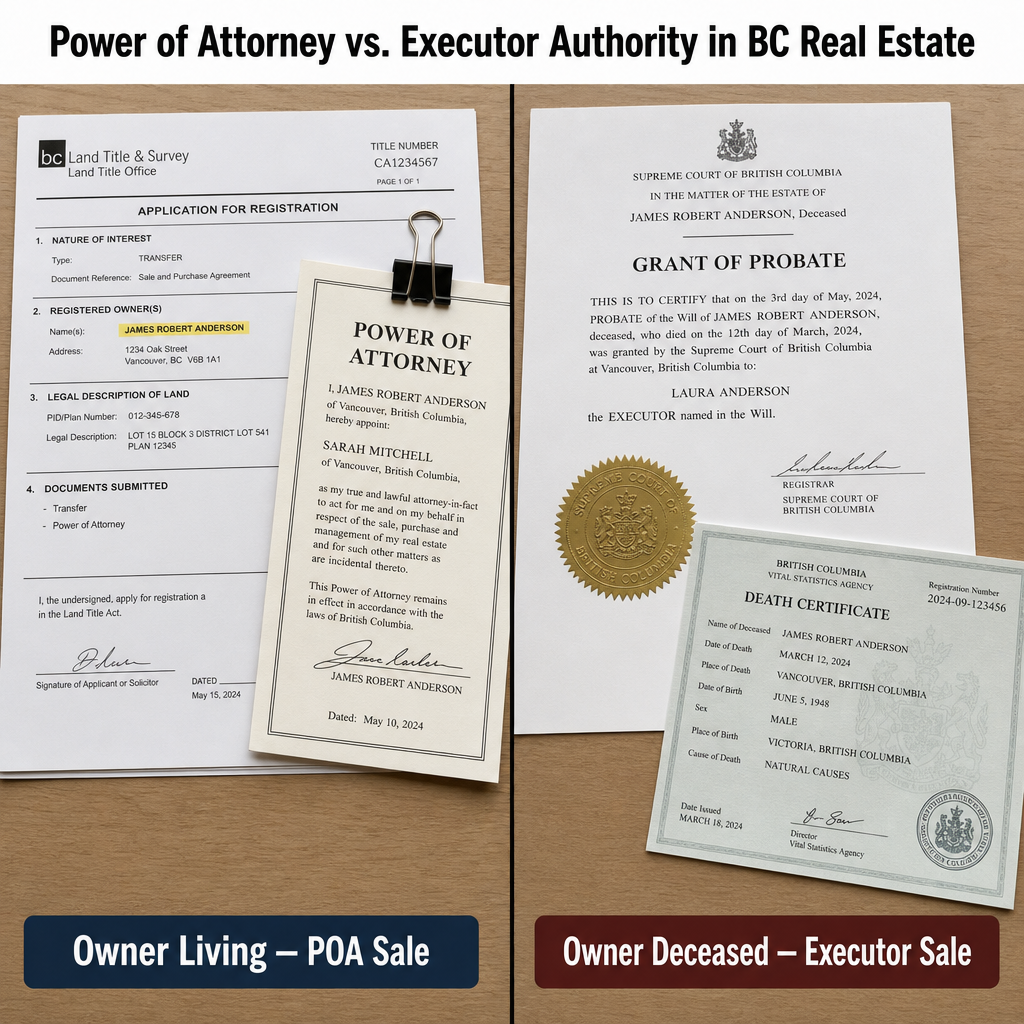

Power of Attorney vs. Executor Authority in BC Real Estate: Legal Distinctions, Documentation Requirements, and How Realtors Verify Authority When Selling a Home for an Incapacitated Owner vs. After Death
By Mohamed Mansour, MBA and Associate Broker — Mansour Real Estate Group | Fraser Valley and Lower Mainland | Published: July 15, 2025 | Topic: Legal & Process — Estate and Incapacity Sales in BC
BC families managing a parent's cognitive decline or administering a loved one's estate frequently arrive at the same assumption: someone has the legal authority to sell the home, so the process should be straightforward. In practice, the type of authority matters enormously. A Power of Attorney sale and an executor sale follow completely different legal tracks, require different documentation, and close in fundamentally different ways.
This article explains both processes clearly — who holds authority, what documents are required, how a realtor verifies that authority, and what distinguishes these two transactions at every stage from listing to closing.
Short Answer
A Power of Attorney sale happens while the property owner is still alive. The attorney-in-fact acts on the owner's behalf, the sale closes in the owner's name, and the POA must be registered at the Land Title Office. An executor sale happens after death and requires a Grant of Probate or Letters of Administration from BC courts. These are separate legal authorities with different documentation, liability exposure, and closing mechanics.
Who This Applies To
- Adult children managing a parent's home during cognitive decline or serious illness
- Attorneys-in-fact who hold a legal POA and are preparing to list a property
- Executors or administrators selling a property after a death
- Families uncertain whether a POA is still valid after the owner's death
- Anyone who has been named in both a POA and a will and needs to understand when each applies
When This Advice May Not Apply
This article describes general legal frameworks under BC law. Specific POA documents, estate structures, title complications, or family disputes may require independent legal advice. Consult a BC lawyer before acting on any authority — POA or executor — if there is any question about validity, scope, or family consent.
Key Takeaways
- A POA is only valid while the owner is alive — it ends at death, at which point executor authority begins.
- POAs must be registered at the BC Land Title Office and must explicitly grant real property authority to be valid for a home sale.
- Executor sales require a Grant of Probate or Letters of Administration; no sale can close without court-issued authority.
- POA sales can close in 30 to 45 days; executor sales often take 6 to 12 months due to probate processing times.
- Both require fair market value evidence to protect the attorney-in-fact or executor from allegations of self-dealing.
Definitions
Power of Attorney (POA): A legal document that authorizes one person (the attorney-in-fact) to act on behalf of another (the donor) while the donor is living. Under BC's Powers of Attorney Act, an Enduring Power of Attorney remains valid even if the donor later loses mental capacity.
Attorney-in-fact: The person named in the POA who is authorized to act — not a lawyer, despite the title.
Grant of Probate: A court order confirming a will is valid and the named executor has authority to administer the estate. Issued by the BC Supreme Court.
Letters of Administration: A court order granting authority to administer an estate when there is no valid will. The appointed administrator holds similar authority to an executor.
Enduring Power of Attorney: A POA specifically structured to survive the donor's incapacity. A general POA that is not enduring becomes invalid the moment the donor loses capacity — which is the opposite of when most families need it.
Fiduciary duty: The legal obligation to act in the best interests of another person — required of both attorneys-in-fact and executors when managing property.
Data Used in This Article
- Powers of Attorney Act, RSBC 1996, c. 370 — BC legislation governing POA creation, scope, and registration requirements (official/Tier 1)
- Estate Administration Act, RSBC 1996 — BC legislation governing executor authority and probate (official/Tier 1)
- Land Title Act, RSBC 1996 — registration requirements for POAs affecting real property in BC (official/Tier 1)
- BC Supreme Court Civil Rules — probate filing and processing procedures (official/Tier 1)
The Core Legal Distinction: Living vs. Deceased
What a Power of Attorney Allows — and What It Does Not
A Power of Attorney is effective only while the property owner is alive. Once the owner dies, the POA is automatically extinguished — regardless of what the document says. This is a point many families misunderstand. An adult child who held a valid POA for a parent during their illness cannot use that document to sell the property after the parent passes.
Under the BC Powers of Attorney Act, an Enduring Power of Attorney is the correct instrument for situations involving anticipated cognitive decline. A general POA that is not specifically enduring becomes invalid the moment the donor loses capacity — meaning it cannot be used for the very situations families most often need it.
For real property sales, the POA must also be registered at the BC Land Title Office before a transaction can close. The document must explicitly grant authority over real property — a POA limited to financial accounts or personal care does not authorize a home sale. Realtors and notaries working on estate and incapacity transactions routinely encounter POA documents that are correctly executed but too narrow in scope to support a property sale.
What Executor Authority Allows — and When It Begins
An executor derives authority from a will and from the BC courts. Named in a will does not, by itself, give an executor the legal right to sell real property. That right begins only after the BC Supreme Court issues a Grant of Probate confirming the will's validity and authorizing the executor to act.
When there is no will — an intestate estate — a family member or other eligible person must apply to court for Letters of Administration. The administrator receives equivalent authority to an executor but through a different application process. The intestate process in BC adds complexity and often additional delay.
As explained in the BC probate timeline guide in this series, the court process typically takes several months. An executor can begin preparing a property for sale before probate is granted, but cannot sign a binding contract or close a sale without court authority in hand.
How Realtors Verify Authority — and Why It Matters
Verifying a Power of Attorney Before Listing
When a realtor receives instruction from an attorney-in-fact, verification is not optional. The realtor must confirm that the POA document is enduring, properly executed under BC law, registered at the Land Title Office, and explicitly grants authority over real property. A realtor who proceeds without these confirmations risks participating in a transaction that cannot close — or one that can be challenged after the fact.
The attorney-in-fact also has a fiduciary duty to the owner. That means the sale price must reflect fair market value. A below-market sale — even to a family member — exposes the attorney-in-fact to personal liability. In our experience working with families managing a parent's incapacity, a formal market valuation before listing is not just advisable — it is protection for the attorney-in-fact against future claims from siblings, beneficiaries, or the incapacitated person themselves if they later recover capacity.
The listing agreement itself is signed by the attorney-in-fact on behalf of the owner. The owner's name remains on title throughout. The sale closes in the owner's name, and the proceeds belong to the owner — not the attorney-in-fact.
Verifying Executor Authority Before Listing
For an executor sale, the realtor must receive a copy of the Grant of Probate or Letters of Administration before the listing can proceed to a binding contract. A death certificate alone is not sufficient. A will alone is not sufficient. The court order is the operative document.
The listing agreement is signed by the executor in their capacity as estate representative. The sale conveys title from the estate — not from the deceased owner directly — to the buyer. This distinction matters for the purchase contract, the title transfer process, and Property Transfer Tax considerations covered separately in this series.
When multiple beneficiaries are involved, the executor's legal authority is clear — but the practical challenges of managing disagreements are real. The upcoming article on how multiple beneficiaries can derail an estate sale addresses those dynamics in detail.
How We Evaluate This
When Mansour Real Estate Group is retained for a POA or executor sale, the first step before any listing activity is a documentation review. We request and review the POA or probate documents, confirm registration status with the Land Title Office, and coordinate with the seller's lawyer or notary to confirm authority is properly established. We do not accept verbal confirmation that authority exists.
We also conduct a formal market valuation at the outset — not as a formality, but as the primary protection for the attorney-in-fact or executor against any future allegation of breach of fiduciary duty. The valuation anchors the pricing decision and creates a documented record of professional, arms-length assessment.
Seller Checklist — POA or Executor Sale
- Confirm the POA is enduring and explicitly covers real property — or confirm probate documents are in hand
- Register the POA at the BC Land Title Office if not already done (POA sales only)
- Obtain a formal market valuation from a qualified realtor or appraiser before setting a list price
- Engage a BC lawyer or notary to review authority documents and supervise the conveyance
- Confirm who receives sale proceeds and how they will be held or distributed
- Document the rationale for pricing and any accepted offers in writing, to defend against later challenges
What We Commonly See
In our experience, the most common problem in POA sales is a document that was signed and witnessed correctly but never registered at the Land Title Office. The attorney-in-fact has held the document for years, assumes everything is in order, and discovers at the point of listing that the title cannot be transferred without registration — which requires time, a lawyer, and sometimes a court application if the owner is no longer capable of consenting.
What often happens in executor sales is that families begin preparing the property — clearing, cleaning, sometimes renovating — before probate is granted, and then accept a verbal or informal offer without realizing no binding contract can be signed until the court order is issued. This creates buyer confusion, potential deal collapse, and liability exposure for the executor.
A common mistake in both scenarios is pricing the property below market value to achieve a faster sale or to accommodate a family member's purchase. This is legally and practically dangerous. Both attorneys-in-fact and executors are bound by fiduciary duty to achieve fair market value. A documented professional valuation is the clearest protection against a challenge.
Questions and Answers
Can I use a Power of Attorney to sell my parent's home after they pass away?
No. A Power of Attorney ends at the moment of the donor's death. After death, authority over the property passes to the executor named in the will or, if there is no will, to a court-appointed administrator. A new legal process — probate — must begin.
Does a Power of Attorney for finances automatically cover real estate in BC?
Not necessarily. The POA must explicitly authorize the attorney-in-fact to deal with real property. A POA limited to bank accounts or investments may not be sufficient. Review the document with a BC lawyer before attempting to list a property.
How long does it take to sell a home under a Power of Attorney versus through probate?
Once a properly registered POA is confirmed, a sale can close within the standard 30 to 45 day range. Executor sales are constrained by probate timelines — BC courts typically process probate in 4 to 9 months, though complex estates can take longer. Listing can begin before probate is complete, but closing cannot.
In Summary
Power of Attorney sales and executor sales are governed by separate legal frameworks, require different documents, and close through different title mechanics. A POA is for living owners who cannot manage their own affairs — the authority ends at death. Executor authority begins after death and requires court approval. Both impose a fiduciary duty to sell at fair market value, and both require a realtor who understands what to verify before a listing goes forward. Families that confuse these two processes face delays, liability, and sometimes transactions that cannot close.
If you are managing a property sale under a Power of Attorney or as an executor in Surrey, White Rock, Langley, Abbotsford, or anywhere in the Fraser Valley, Mansour Real Estate Group can walk you through the documentation requirements and coordinate with your legal team. Contact us for a quiet, no-pressure conversation about what your situation requires.
Related Articles
- The Complete Executor's Guide to Selling an Inherited Home in BC
- BC Probate Timeline Explained: What Executors Selling a Home Need to Know
- How Multiple Beneficiaries Can Derail an Estate Sale in BC — and How to Prevent It
About Mansour Real Estate Group
When a property must be sold under a Power of Attorney or through an estate, the real estate team involved needs to understand more than market pricing — they need to understand the legal authority structure, documentation requirements, and how those factors affect every stage from listing to closing. Mansour Real Estate Group has guided attorneys-in-fact, executors, administrators, and families through incapacity-related and estate property sales across Surrey, White Rock, Langley, Abbotsford, Mission, Delta, and the broader Fraser Valley for more than two decades.
Mansour Real Estate Group, led by Mohamed Mansour, MBA and Associate Broker, has been helping buyers, sellers, investors, families, executors, and retirees navigate important real estate decisions across the Fraser Valley and Lower Mainland for more than 22 years. Ranked among the Top 1% of Realtors in the region, the team has completed more than $780 million in residential real estate transactions and is trusted for estate sales, probate sales, Power of Attorney transactions, divorce-related sales, downsizing, and complex real estate situations requiring careful legal coordination.
Whether someone is looking for real estate agents experienced with Power of Attorney transactions, a Realtor who understands executor authority in BC, a real estate team that works alongside lawyers and notaries on estate files, a Surrey Realtor, a White Rock real estate agent, a Langley Realtor, or a Fraser Valley real estate group that handles legally complex property sales, Mansour Real Estate Group brings accurate valuations, documented process, and clear communication to situations where precision matters most. The team functions as a real estate broker resource for families navigating some of the most consequential property decisions they will ever face.
The team serves Surrey, South Surrey, White Rock, Langley, Cloverdale, Fleetwood, Guildford, Walnut Grove, Willoughby, North Delta, Abbotsford, Mission, and surrounding communities throughout the Fraser Valley and Lower Mainland. Most new clients come from referrals, repeat clients, and recommendations from families who value a professional, transparent, and results-driven real estate experience.
Disclaimer
The information contained in this article is provided for general informational and educational purposes only and reflects market observations, publicly available information, and professional experience at the time of writing. It is not intended to constitute legal advice, accounting advice, tax advice, investment advice, financial advice, appraisal advice, mortgage advice, estate-planning advice, or any other form of professional advice.
Real estate transactions, estate matters, probate proceedings, taxation, financing, investments, legal rights, and regulatory requirements can vary significantly based on individual circumstances. Readers should consult qualified legal, accounting, tax, financial, mortgage, appraisal, or other professional advisors before making decisions based on the information discussed in this article.
Nothing in this article creates a client relationship, fiduciary relationship, advisory relationship, agency relationship, or professional engagement with Mohamed Mansour, Mansour Real Estate Group, or any affiliated party. Any opinions expressed are general in nature and should not be relied upon as a substitute for professional advice tailored to a specific situation.
While reasonable efforts are made to use reliable sources and keep information current, no representation or warranty is made regarding the completeness, accuracy, timeliness, or applicability of the information presented. Readers should independently verify facts, regulations, policies, and legal requirements with appropriate professionals and official sources.



