

Estate Sales in the Tri-Cities 2026: How Burnaby, Coquitlam, and Port Moody's Transit-Oriented Demand, Investor Interest, and Young Professional Buyer Profiles Create Fundamentally Different Executor Strategy Than Fraser Valley Probate Markets
By Mohamed Mansour, MBA and Associate Broker | Mansour Real Estate Group | Published: August 4, 2025 | Geography: Burnaby, Coquitlam, Port Moody, Lower Mainland, BC
Executors managing estate properties in Burnaby, Coquitlam, and Port Moody face a set of market conditions that do not translate from Fraser Valley probate experience. The buyer composition is different. The inventory is predominantly strata. SkyTrain proximity creates pricing micro-markets that a standard comparative market analysis can easily miss. And the condo market's recovery lag relative to detached homes adds a timing risk that probate delays make worse. This article explains what changes — and why it matters for executor strategy in 2026.
If you are earlier in the process, The Complete Executor's Guide to Selling an Inherited Home in BC provides foundational context on BC probate timelines, authority to sell, and the decisions that come before listing.
Short Answer
Estate sales in Burnaby, Coquitlam, and Port Moody require a different executor strategy than Fraser Valley markets because 65–75% of estate inventory is strata-based, investor buyers represent 35–45% of the condo purchaser pool, and SkyTrain proximity creates pricing premiums of 10–15% that generic valuations miss. Timing risk is also higher: condo markets in the Tri-Cities have lagged detached home recovery by 12–18 months, meaning probate delays carry measurable financial consequences.
Key Takeaways
- Strata condos and townhomes make up 65–75% of Tri-Cities estate inventory, requiring depreciation report review, Form B disclosure, and special levy checks before listing.
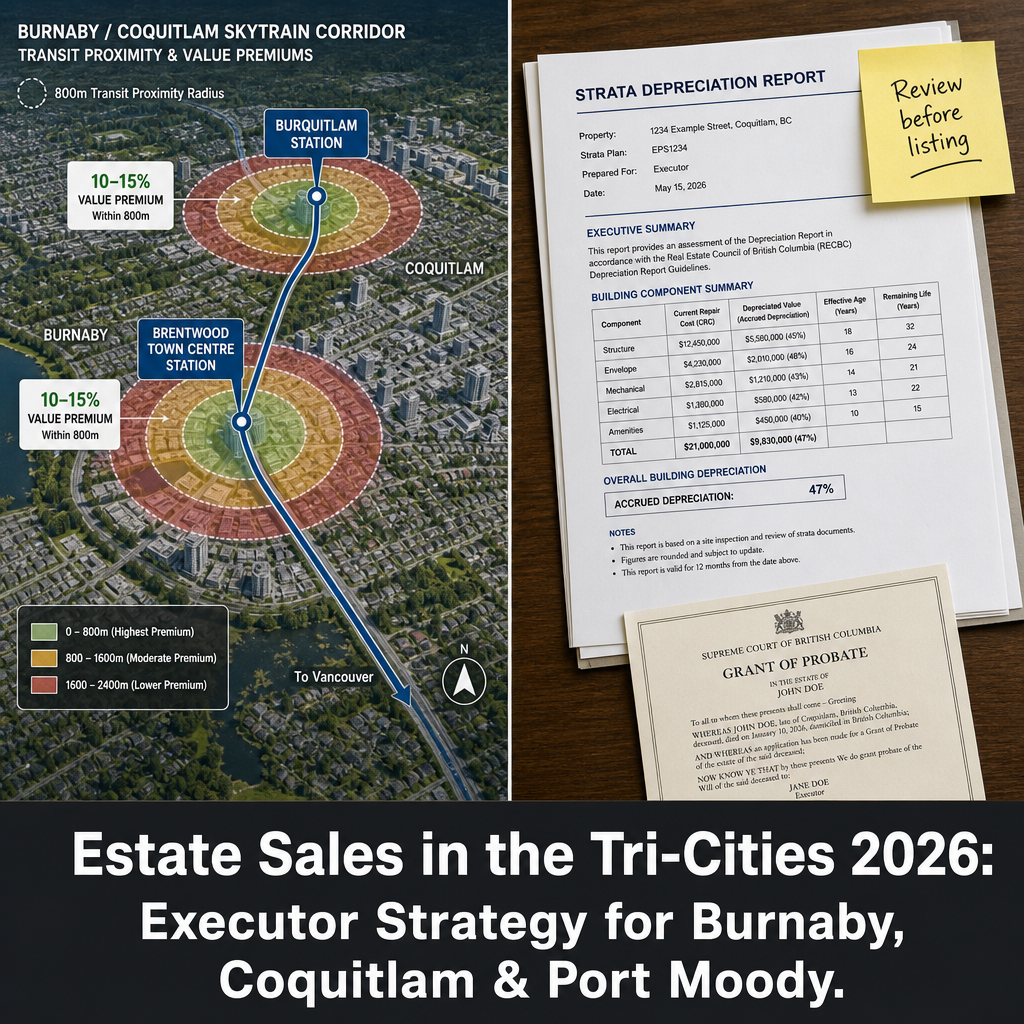
- Properties within 800m of Expo or Millennium Line stations command 10–15% premiums above local benchmarks — a distinction a generic CMA will not capture.
- Investor buyers represent 35–45% of Burnaby and Coquitlam condo purchasers, reshaping negotiation dynamics versus the primary-residence buyer pool typical in Fraser Valley estate markets.
- The Tri-Cities condo market has lagged detached home recovery by 12–18 months, making probate-related delays a genuine pricing risk for strata estate properties.
- Young professional buyers in the 30–45 age range commonly request closing windows of 15–21 days, which affects executor cash flow planning and estate administration timelines.
Who This Applies To
- Executors or administrators selling a condo, townhome, or detached home in Burnaby, Coquitlam, or Port Moody as part of a BC estate
- Beneficiaries trying to understand how Tri-Cities market conditions affect the timing and net proceeds of an estate sale
- Families who inherited a strata unit and need to understand disclosure requirements before listing
- Executors already familiar with Fraser Valley probate who are now managing a Metro Vancouver estate and need to understand what is different
When This Advice May Not Apply
If the estate property is a detached home in a non-transit neighbourhood of Coquitlam or Port Moody, some strata-specific and transit-premium dynamics will not apply directly. Additionally, estates with complex title disputes, unresolved intestacy questions, or multiple beneficiary conflicts may require legal resolution before these market strategy considerations become relevant. Consult a BC estate lawyer for matters involving authority to sell, contested wills, or title complications. See What Happens to a BC Home When There Is No Will if intestacy is a factor.
Data Used in This Article
- BCFSA MLS data for Burnaby, Coquitlam, Port Moody (2025–2026): Official, benchmark price and sales volume data for strata and detached segments
- Fraser Valley Real Estate Board market reports (affiliate data for Tri-Cities): Official, sales-to-active ratios and inventory trend data
- TransLink / urban economics research on SkyTrain proximity premiums: Third-party research, peer-reviewed and publicly cited
- Strata Property Act and Form B disclosure requirements (BC Attorney General): Official regulatory source
- Mansour Real Estate Group estate transaction data, Tri-Cities 2024–2026: Internal professional experience base used for qualitative observations
Key Definitions
Form B Information Certificate: A mandatory strata disclosure document that buyers must receive before an accepted offer becomes binding. It details outstanding levies, bylaws, and strata financial position. Executors must request this from the strata corporation. Delays in receiving Form B can delay listing preparation.
Depreciation Report: A long-term capital expenditure forecast that BC strata corporations are required to have prepared periodically. A poor or outdated depreciation report signals deferred maintenance risk to buyers and can suppress price offers on estate condos.
Special Levy: An extraordinary fee charged to strata owners beyond regular strata fees, typically for major repairs. If a special levy has been passed and not yet fully collected, the executor inherits that liability and it must be disclosed.
Transit Proximity Premium: The price differential observed between comparable properties near SkyTrain stations versus those that are not. Research across Burnaby and Coquitlam corridors consistently identifies an 10–15% premium for properties within 800m of Expo and Millennium Line stations.
Why the Tri-Cities Are Not a Fraser Valley Estate Market
The most common mistake executors make when managing a Tri-Cities estate is applying Fraser Valley strategy without adjustment. In Surrey, Langley, or Abbotsford, estate inventory skews toward detached homes. Buyers are often families, downsizers, or move-up purchasers — and their timelines are comparatively flexible. They are purchasing a primary residence and can adapt to probate-related conditions and longer closing periods.
In Burnaby and Coquitlam, the majority of estate inventory is strata-based. According to BCFSA MLS data for the Tri-Cities corridor, condos and townhomes represent 65–75% of the actively listed and recently sold estate properties in these municipalities. Benchmark condo prices in Burnaby have recently ranged around $664,000–$695,000, making these properties attractive to a buyer pool that is younger, more leveraged, and in many cases investment-oriented rather than owner-occupant focused.
That buyer composition changes everything: how you price, how you time, what conditions you accept, and how you communicate urgency to beneficiaries. Executors who have previously sold an estate property in Langley or Abbotsford should treat a Burnaby or Coquitlam estate as a new learning curve. For a direct comparison of listing approaches in the Metro context, see Estate Sale vs. MLS Listing in Metro Vancouver: Which Approach Gets Executors the Best Price?
The SkyTrain Premium Problem — and Why Generic CMAs Fail
In most suburban markets, a comparative market analysis draws from the surrounding neighbourhood and recent comparable sales. That method works reasonably well in Langley or Abbotsford, where transit access does not significantly stratify values within the same postal code.
In the Tri-Cities, it fails. Urban economics research on Expo and Millennium Line corridors consistently identifies measurable price premiums for properties within 800m of a station — ranging from 10% to 15% above benchmark for comparable units further away. Brentwood Town Centre, Burquitlam, Moody Centre, and Inlet Centre stations all generate these micro-market effects. A one-bedroom in a building two blocks from Burquitlam station is not comparable to a one-bedroom in a building ten minutes away by car, even if both are in Coquitlam and both sold within the same quarter.
For executors, this means the valuation question is not just "what is this condo worth in Coquitlam?" It is "what is this condo worth relative to its specific transit walkability, and does the realtor we are working with have the local precision to reflect that in the list price?" Underpricing costs the estate tens of thousands of dollars. Overpricing into an investor-heavy market stalls the listing and invites price reductions that signal distress — exactly what estate listings should avoid.
Investor Buyers: How a 35–45% Investor Composition Changes Negotiation
Investor buyers evaluate property differently than primary residence purchasers. They are focused on cap rate, rental yield, and holding period. They are less emotionally attached to the property and more analytically focused on downside risk. In Burnaby and Coquitlam, where BCFSA data indicates that investors represent 35–45% of condo purchasers, executors need to be aware that a significant share of offers will come from buyers running numbers, not buyers picturing themselves in the space.
This has practical consequences. Investor buyers are often more flexible on possession date but firmer on price. They may request access for rental income verification or want to see strata rental allowance documentation early. They are also more likely to include financing conditions tied to rental income projections — which, in a strata building with rental restrictions, can collapse an offer entirely if the executor's team did not review the strata bylaws before listing.
In contrast, the primary-residence buyer pool in Fraser Valley estate markets, as covered in Selling an Estate Home in a Buyer's Market: Strategy for Fraser Valley Executors in 2026, tends to prioritize condition, location relative to schools, and lot size — a very different risk profile for executors to manage.
Condo Market Recovery Lag and the Timing Risk Executors Often Underestimate
Detached home markets in Burnaby and Coquitlam have generally recovered faster from the 2022–2023 interest rate correction than the condo segment has. The lag between detached recovery and condo recovery in the Tri-Cities has been approximately 12–18 months based on BCFSA and FVREB sales volume and benchmark trend data.
For executors, this creates a compounding risk. BC probate proceedings typically take four to nine months from application to grant, depending on estate complexity. If an estate holds a Burnaby or Coquitlam condo and the probate process is delayed — by contested claims, missing documentation, or beneficiary disputes — the listing may emerge into a period of rising inventory and softened buyer demand. In a segment already recovering slowly, that timing shift can cost the estate 3–7% of sale price or more.
The practical implication is that executors should begin pre-listing preparation — strata document collection, depreciation report review, Form B request, and property assessment review — well before the probate grant arrives. Acting on those steps early compresses the gap between grant and list date, which is where market exposure risk concentrates. For context on the full BC probate timeline, see BC Probate Timeline Explained: What Executors Selling a Home Need to Know.
Young Professional Buyers: Shorter Closings, Tighter Conditions
The Tri-Cities attract a substantial share of buyers in the 30–45 age range — working professionals drawn by SkyTrain access, relative affordability compared to Vancouver proper, and neighbourhood density. These buyers typically operate with shorter desired closing windows of 15–21 days and lower tolerance for extended subject periods.
For an executor, a 15-day closing on a condo with strata documents still outstanding creates a practical problem. The strata corporation has its own timelines for producing Form B and other required disclosure documents. If those are not in hand before the offer comes in, the closing timeline becomes legally uncertain. Executors should request strata documents as early as legally permitted and keep them current. This is not a procedural detail — it is the difference between accepting a clean offer from a motivated buyer and watching that buyer walk because the timeline cannot accommodate the estate's administrative gap. For more on inherited strata units specifically, the upcoming article on Selling an Inherited Condo in Metro Vancouver covers strata rules, special levies, and probate complications in detail.
How Port Moody Differs from Burnaby and Coquitlam
Port Moody has a different estate profile than its Tri-Cities neighbours. The housing stock includes a higher proportion of detached and townhome properties relative to high-rise condos, particularly in Heritage Mountain, Glenayre, and College Park neighbourhoods. Buyers in Port Moody skew slightly older and more family-oriented than the Brentwood or Burquitlam condo buyer pool. Estate properties here tend to attract more primary-residence offers, particularly from buyers moving out of Vancouver seeking larger lots. However, Moody Centre and Inlet Centre SkyTrain stations still generate transit premiums in the surrounding blocks, and strata townhomes remain subject to the same Form B and depreciation report requirements as condos. Executors should not assume a Port Moody townhome estate operates like a Surrey detached estate — the strata layer adds complexity regardless of property type. For a related geographic perspective on nearby estates, the forthcoming article on Richmond and Delta Estate Sales covers adjacent Lower Mainland executor considerations.
How We Evaluate This
When Mansour Real Estate Group takes on a Tri-Cities estate listing, we begin with a transit-adjusted valuation rather than a standard neighbourhood CMA. That means identifying the specific station proximity of the property, benchmarking against comparable sales that share the same transit access tier, and then adjusting for strata-specific variables: building age, depreciation report quality, outstanding levies, and rental allowance status.
We also pre-qualify the buyer profile before pricing. If the building skews investor, we price to reflect investor yield expectations. If it skews owner-occupant, we stage and market accordingly. For estate listings specifically, we front-load the strata documentation process so that by the time the probate grant arrives, the listing is ready to go live within days rather than weeks. That compression matters when condo inventory is rising.
Estate Sale Checklist — Tri-Cities Strata Properties
- Confirm executor authority through probate grant or, where permitted, begin preparatory steps before grant arrival
- Request Form B Information Certificate from the strata corporation as early as possible — allow 2–4 weeks for delivery
- Obtain a current depreciation report and review for upcoming capital expenditures or deferred maintenance that may affect buyer perception
- Check strata bylaws for rental restrictions, pet policies, and age restrictions before marketing to investor buyers
- Confirm whether any special levies have been levied but not yet collected — these are an executor liability and a required disclosure
- Conduct a transit-adjusted valuation, not a generic neighbourhood CMA — identify the property's exact walkability score to the nearest SkyTrain station
- Secure and insure the unit from date of death — vacant strata units still carry strata fee obligations and standard homeowner policies may lapse on vacant properties
- Assess whether pre-listing cosmetic improvements are warranted; in investor-heavy buildings, condition matters less than price and yield math
- Prepare for short closing windows — have legal and financial contacts ready to move quickly once an offer is accepted
- Brief all beneficiaries on the timeline and pricing rationale before listing to reduce the risk of offer rejection disputes
What We Commonly See
Executors underestimating strata document timelines. In our experience, the most common delay in Tri-Cities estate listings is not the probate process itself — it is the time between grant arrival and listing readiness. Executors who assume they can request Form B and depreciation reports the week after the grant arrives frequently find themselves waiting three to four additional weeks before the listing can go live. Starting that document request process before the grant is received, where the strata corporation will cooperate, compresses the timeline significantly.
Pricing against the wrong comparables. What often happens is that an executor relies on a realtor familiar with the general area but not with the transit micro-market. The result is a list price that is 8–12% below what the property would command with a station-proximity-adjusted valuation. On a $680,000 condo, that is $54,000–$82,000 left on the table for the estate's beneficiaries.
Accepting investor offers without reviewing strata rental bylaws first. A common mistake is accepting an offer from an investor buyer, proceeding through subject removal, and then discovering that the building's strata bylaws prohibit or heavily restrict rentals. The offer collapses, time is lost, and the estate bears the carrying cost of the additional weeks on market. Reviewing rental allowance bylaws before listing prevents this entirely.
Assuming all Tri-Cities condos behave the same. In our experience, a Burnaby high-rise near Brentwood draws a different buyer, at a different price point, with different motivations than a Coquitlam low-rise near Lincoln Station. Grouping them together in strategy and pricing is a meaningful error. Executor decisions should be building-specific, not city-specific.
Questions and Answers
Can an executor list a Burnaby condo before the probate grant is received?
In BC, an executor cannot legally complete a property sale without probate authority. However, pre-listing preparation — strata document collection, valuation, and even taking the listing live subject to probate — is common practice and does not constitute a completed sale. Consult your BC estate lawyer for the specific approach that fits your estate situation.
How long does it take to receive Form B from a Coquitlam strata corporation?
Under the Strata Property Act, strata corporations have up to one week to provide Form B after a written request. In practice, delivery times range from five business days to three weeks depending on the management company. Executors should request Form B at the earliest opportunity and follow up in writing if there are delays.
Do investor buyers in Burnaby typically pay less than owner-occupant buyers?
Not necessarily. Investor buyers price on yield and cap rate, which means a well-priced property with good rental income potential can attract strong investor offers. The difference is that investors are less emotionally driven and more likely to walk away if the numbers do not work — making accurate pricing more important, not less.
What happens if there is a special levy outstanding when an estate condo is sold?
Outstanding special levies must be disclosed to buyers and are typically handled as an adjustment at completion — meaning the estate's share of the outstanding levy is deducted from sale proceeds at closing. Executors should identify any levied but uncollected amounts through the strata corporation and budget accordingly.
Is it worth doing cosmetic improvements to an estate condo in Burnaby before listing?
It depends on the buyer pool. In investor-heavy buildings, cosmetic improvements rarely recover their cost because investors evaluate yield, not aesthetics. In buildings that attract primary residence buyers, clean presentation, fresh paint, and minor repairs can meaningfully accelerate the sale. The answer requires knowing which buyer profile dominates for that specific building — which is a local knowledge question, not a generic renovation formula. See Pre-Listing Improvements for Estate Homes in BC: What's Worth Spending On — and What Isn't for a framework on this decision.
In Summary
Estate sales in Burnaby, Coquitlam, and Port Moody require a fundamentally different executor strategy than Fraser Valley probate markets because the inventory is predominantly strata, the buyer pool includes a substantial investor segment, and SkyTrain proximity creates valuation micro-markets that standard CMAs miss. Condo market recovery has lagged detached homes by 12–18 months in the Tri-Cities, making probate delays a genuine timing risk. Executors who front-load their strata document work, use transit-adjusted valuations, and understand their specific building's buyer profile will be better positioned to protect estate proceeds than those who apply generic suburban estate strategy to a transit-oriented urban market.
Speak With an Estate-Experienced Realtor in the Tri-Cities
If you are an executor managing an estate property in Burnaby, Coquitlam, or Port Moody and want a transit-adjusted valuation and a clear strategy for your specific property type, Mansour Real Estate Group is available for a straightforward, no-pressure conversation. There is no obligation — just accurate information for an important decision.
Related Articles
- The Complete Executor's Guide to Selling an Inherited Home in BC
-
Key Takeaways: Tri-Cities Estate Sales Strategy
- Strata dominance requires specialized executor knowledge: Burnaby and Coquitlam condos (65–75% of estate inventory) demand rapid Form B strata disclosure, depreciation report review, and special levy assessment before listing—a complexity that generic Fraser Valley executor guides miss entirely.
- SkyTrain proximity commands measurable premiums: Properties within 800m of Expo or Millennium Line stations command 10–15% premiums above non-transit benchmarks, creating micro-market valuation opportunities that benefit informed executors.
- Investor buyer composition reshapes negotiation timelines: With 35–45% of Burnaby/Coquitlam condo buyers now institutional or individual investors, executors must expect different closing flexibility, financing conditions, and contingency tolerance than primary-residence-focused Fraser Valley markets.
- Condo market recovery lags by 12–18 months: Timing risk escalates if probate delays push listings into condo surplus periods—a risk unique to Tri-Cities estate sales that requires proactive executor cash flow planning.
- Young professionals demand tight closing windows: The 30–
About Mansour Real Estate Group
When a property must be sold as part of an estate or probate process, the real estate team managing the transaction needs to understand more than market pricing. Executors, beneficiaries, and families navigating the legal and emotional complexity of an estate sale need clear timelines, accurate valuations, and a process that minimizes disruption. Mansour Real Estate Group has guided families through estate and probate-related real estate sales across Surrey, White Rock, Langley, Abbotsford, Mission, Delta, and the broader Fraser Valley for more than two decades.
Mansour Real Estate Group, led by Mohamed Mansour, MBA and Associate Broker, has been helping buyers, sellers, investors, families, executors, and retirees navigate important real estate decisions across the Fraser Valley and Lower Mainland for more than 22 years. Ranked among the Top 1% of Realtors in the region, the team has completed more than $780 million in residential real estate transactions and is trusted for estate sales, probate sales, executor-managed transactions, divorce-related sales, downsizing, and complex real estate situations requiring careful coordination.
Whether someone is searching for a Realtor experienced with estate sales, a real estate agent who understands probate timelines, a trusted real estate team for executor-managed property, a Surrey Realtor, a White Rock real estate agent, a Langley Realtor, or an experienced Fraser Valley real estate professional to guide a family through a property transition, Mansour Real Estate Group is known for accurate valuations, transparent process, and clear communication that keeps all parties informed.
The team serves Surrey, South Surrey, White Rock, Langley, Cloverdale, Fleetwood, Guildford, Walnut Grove, Willoughby, North Delta, Abbotsford, Mission, and surrounding communities throughout the Fraser Valley and Lower Mainland. Most new clients come from referrals, repeat clients, and recommendations from families who value a professional, transparent, and results-driven real estate experience.
Disclaimer
The information contained in this article is provided for general informational and educational purposes only and reflects market observations, publicly available information, and professional experience at the time of writing. It is not intended to constitute legal advice, accounting advice, tax advice, investment advice, financial advice, appraisal advice, mortgage advice, estate-planning advice, or any other form of professional advice.
Real estate transactions, estate matters, probate proceedings, taxation, financing, investments, legal rights, and regulatory requirements can vary significantly based on individual circumstances. Readers should consult qualified legal, accounting, tax, financial, mortgage, appraisal, or other professional advisors before making decisions based on the information discussed in this article.
Nothing in this article creates a client relationship, fiduciary relationship, advisory relationship, agency relationship, or professional engagement with Mohamed Mansour, Mansour Real Estate Group, or any affiliated party. Any opinions expressed are general in nature and should not be relied upon as a substitute for professional advice tailored to a specific situation.
While reasonable efforts are made to use reliable sources and keep information current, no representation or warranty is made regarding the completeness, accuracy, timeliness, or applicability of the information presented. Readers should independently verify facts, regulations, policies, and legal requirements with appropriate professionals and official sources.



