

MLS Listing vs. Estate Liquidation Sale: Financial Comparison and Strategic Decision Framework for BC Executors
By Mohamed Mansour, MBA, Associate Broker — Mansour Real Estate Group | Fraser Valley and Lower Mainland, BC | Published: July 15, 2025
For executors managing an estate property in BC, one decision carries more financial consequence than almost any other: whether to list the property on MLS or accept a liquidation offer. The choice shapes net proceeds, timeline, executor liability, and the emotional toll on everyone involved. Yet most estate guidance treats these two paths separately, leaving executors without the side-by-side comparison they need to make a confident, defensible decision.
This article gives Fraser Valley and Metro Vancouver executors a grounded financial model, a clear timeline comparison, and a structured decision framework — built on real carrying cost data, repair estimates, and probate-timing realities specific to BC.
Short Answer
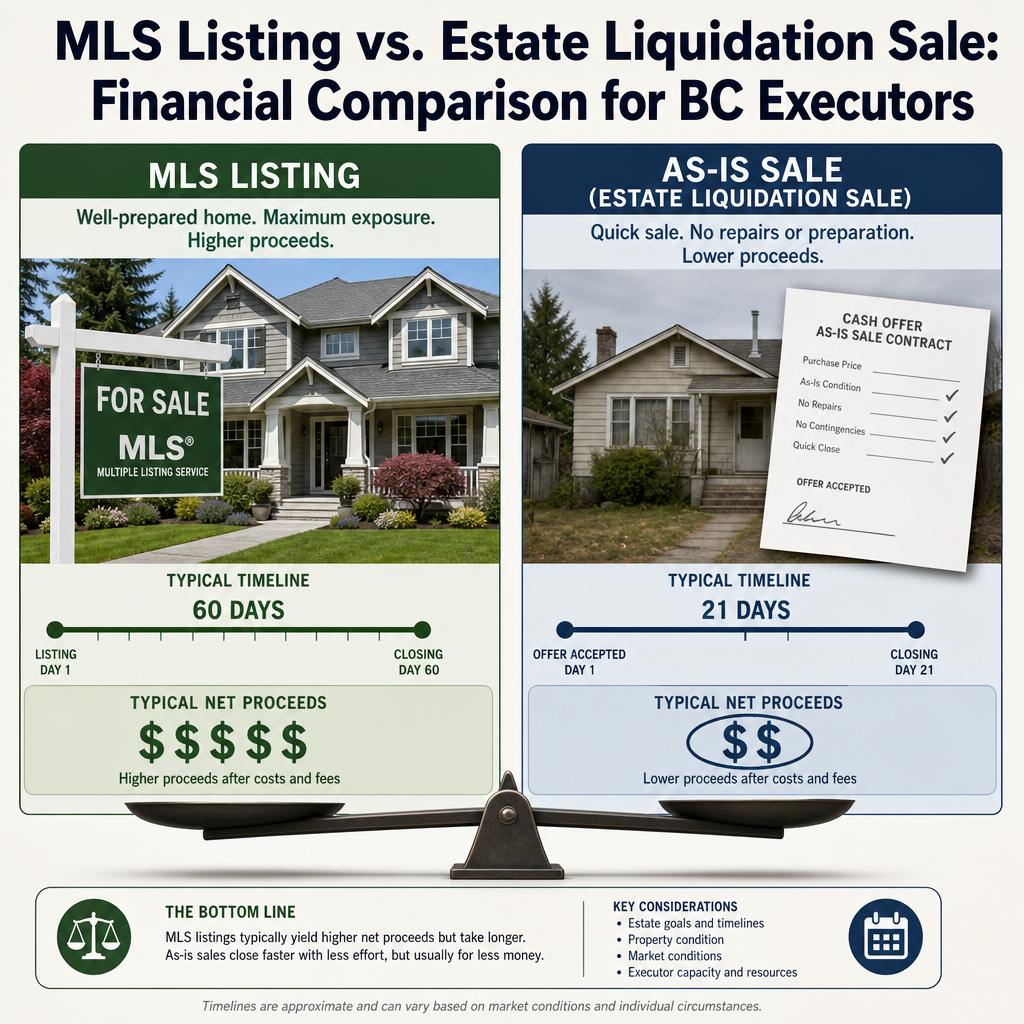
MLS listings typically net BC executors 25–35% more than liquidation offers, but require 45–60 additional days, 8–15% in pre-sale repairs or price reductions, and $3,000–$5,000 in carrying costs. Liquidation sales close in 14–21 days with no repairs and less executor liability, but at a 12–18% discount to fair market value. The right path depends on property condition, probate status, and the executor's capacity to manage the process.
Key Takeaways
- MLS listings recover more equity but require repairs, carrying costs, and a longer timeline.
- Liquidation buyers discount 12–18% for certainty, speed, and as-is acceptance.
- Carrying costs of $1,500–$2,500 per month erode the MLS advantage on longer sales.
- Executor liability is lower in as-is sales; MLS requires full BC property disclosure.
- Probate status, property condition, and market timing together determine which path wins financially.
Who This Applies To
- Named executors managing residential estate property in BC
- Beneficiaries with executor authority seeking the most defensible financial outcome
- Families managing properties with deferred maintenance, structural issues, or strata complications
- Executors facing probate delays while carrying costs accumulate
- Estate lawyers and trustees advising on property sale strategy
When This Advice May Not Apply
If the estate has multiple beneficiaries with competing interests, court approval may be required before any sale path is selected. Seek independent legal advice. This article is general in nature and does not constitute legal, tax, or financial advice. See the disclaimer at the end of this article.
Key Terms
Estate liquidation sale: A sale — often to a cash buyer, investor, or auction process — completed as-is, typically within 14–21 days, at a discount to market value in exchange for speed and certainty.
MLS listing: A publicly marketed listing on the Multiple Listing Service, exposed to the full buyer pool with standard conditions (inspection, financing), typically achieving near-market pricing.
Carrying costs: Ongoing expenses while a property remains unsold — property taxes, utilities, insurance, and strata fees where applicable.
Grant of Probate: Court-issued authority confirming the executor's legal right to administer and transfer estate assets, including real property. Title transfer cannot occur without it in BC.
Data Used in This Article
- Mansour Real Estate Group internal transaction data, estate sales 2024–2026 (professional observation)
- BC Real Estate Association research on days-on-market and carrying cost impact on estate net proceeds
- Fraser Valley Real Estate Board data on Form B, depreciation reports, and buyer financing in estate strata sales, 2026
- Law Society of BC guidance on probate authority and title transfer timelines
- BCFSA transaction trend reporting, 2025
The Financial Reality: MLS vs. Liquidation Side by Side
Consider a Fraser Valley estate home with a market value of $1,200,000. Under an MLS path, the executor prepares the property — clearing, cleaning, and completing deferred maintenance — spending roughly 8–12% of sale price, or $96,000–$144,000 in repairs and staging. The property lists, attracts conditional offers, and closes in 60–90 days. During that window, carrying costs of $1,500–$2,500 per month add another $3,000–$7,500. Net recovery: strong, but the upfront capital requirement and timeline are real.
Under a liquidation path, a cash buyer inspects the property and offers $1,020,000–$1,056,000 — reflecting a 12–15% discount for as-is acceptance and immediate close. No repairs. No carrying cost exposure beyond the first 14–21 days. No conditional period risk. The executor receives a lower gross number, but the net difference narrows significantly once repair costs, carrying costs, and timeline risk are factored in.
According to BCREA research on estate net proceeds, the real advantage of MLS is largest when: the property is in good condition, the probate timeline is already resolved, the market is active, and the executor has capital to fund preparation. When any of those four conditions is absent, the MLS advantage shrinks — and can disappear entirely on properties requiring structural work or with strata complications.
For estate properties in a softening Fraser Valley market in 2026, the MLS path carries additional risk: longer days-on-market, more price reductions, and more buyer conditions, all of which increase carrying cost exposure and reduce the final net.
Probate Status and the Deal-Collapse Risk Executors Often Overlook
BC law allows executors to list a property on MLS before the Grant of Probate is issued. Marketing can begin. Offers can be accepted subject to probate. But title cannot transfer without full probate authority. This creates a specific risk that many executors and their advisors underestimate: if probate is delayed, or if a court challenge arises, a signed MLS deal can collapse at closing.
According to Law Society of BC guidance on probate and title transfer timelines, this sequence is predictable — but the timing is not. BC probate can take 3–9 months depending on estate complexity, registry backlog, and whether the will is contested. A buyer willing to wait 90 days may not be willing to wait 180. The executor may then face a deal collapse, a relisting, and another round of carrying costs.
Liquidation buyers — experienced cash purchasers — typically understand probate timelines and structure offers accordingly, building in longer completion periods or offering a firm price contingent on probate resolution. This is one reason estate liquidation sales in BC have grown 15–20% in recent years, according to BCFSA transaction trend data: executors are choosing certainty over optimization when probate risk is elevated.
Executors uncertain about their probate status should read BC Probate Timeline Explained: What Executors Selling a Home Need to Know before committing to either sale path.
How We Evaluate This
At Mansour Real Estate Group, the first conversation with an executor is rarely about listing price. It is about the property's current condition relative to buyer expectations, the probate timeline, the carrying cost clock already running, and the executor's realistic capacity to manage a preparation and marketing process while managing other estate obligations.
We run a comparative net analysis — not just a list price comparison — that accounts for repair investment, carrying cost exposure by expected days on market, and the realistic probability of a clean close given current probate status. That analysis often produces a number that surprises executors: the gap between MLS and liquidation is frequently smaller than it first appears, and occasionally the liquidation path produces the better net outcome.
When MLS Is the Right Path
MLS listing makes sense when the property is in good condition or requires only cosmetic work, probate authority is in hand or expected within 60 days, the executor has access to capital for preparation costs, the local market is active enough to support a 30–45 day sale, and the estate has a single executor with clear authority and beneficiary agreement. In these conditions, the 25–35% premium over liquidation is worth pursuing.
The preparation process — clearing, cleaning, and addressing deferred maintenance — is often the most important lever. Executors can review How to Clear, Clean, and Prepare an Estate Home for Sale in Metro Vancouver for a practical breakdown of what that process involves and which investments actually improve net proceeds.
When Liquidation Is the Right Path
Liquidation makes sense when the property has significant deferred maintenance or structural issues that would absorb most of the MLS premium in repair costs, probate is unresolved and timeline is uncertain, the executor has no access to capital for pre-sale improvements, beneficiaries are in conflict and a fast, documented sale reduces litigation risk, or the carrying costs are accumulating faster than the MLS premium can recover them. In these conditions, accepting a 12–18% discount in exchange for a 14–21 day close is a financially rational and legally defensible decision.
Executor Decision Checklist
- Confirm probate status: is the Grant of Probate issued, pending, or contested?
- Get a condition assessment from a qualified inspector before deciding on the sale path.
- Calculate current carrying costs per month and multiply by the realistic MLS sale timeline.
- Obtain a liquidation offer in writing to establish the baseline for comparison.
- Get an independent MLS valuation net of estimated repair costs and carrying costs.
- If the property is a strata unit, review the depreciation report and Form B for buyer financing risk before committing to MLS.
- Confirm beneficiary agreement on the chosen path — undocumented disagreements create executor liability.
- Consult the estate lawyer before signing any offer, regardless of which path is chosen.
What We Commonly See
In our experience, the most common executor mistake is assuming the MLS path is always better because the list price is higher. The list price is not the net proceeds. Once repair costs, carrying costs, and price reductions are factored in, the advantage frequently narrows to 8–12% — and the executor has spent three to four months of bandwidth to achieve it.
A second pattern we see regularly is executors accepting a liquidation offer without first obtaining an independent valuation. When a liquidation buyer offers $950,000 on a property worth $1,150,000, the executor who has no independent benchmark has no way to assess whether that discount is reasonable or excessive. The as-is discount on a well-maintained property should be materially smaller than on a property with structural issues.
We also see strata estate sales where the MLS path collapses not because of price, but because the depreciation report or Form B creates buyer financing obstacles. According to 2026 FVREB data, estate strata properties with unfunded depreciation reserve accounts or pending special levies frequently struggle to attract insured mortgage financing — effectively narrowing the buyer pool to cash buyers, which is a de facto liquidation scenario at MLS timeline and cost.
Frequently Asked Questions
Can an executor accept a liquidation offer before probate is granted in BC?
Yes, an executor can sign an offer before probate is granted. However, the offer should include a completion date that allows enough time for probate to be finalized, since title cannot transfer without the Grant of Probate. The estate lawyer must review any offer before it is accepted.
What does "as-is" mean in a BC estate sale, and does it eliminate all executor liability?
As-is means the buyer accepts the property in its current condition without requiring repairs. It reduces post-closing litigation risk but does not eliminate the executor's obligation to disclose known material latent defects in BC. Consult your estate lawyer before relying on as-is clauses for liability protection.
How do beneficiaries typically react when an executor chooses liquidation over MLS?
Beneficiaries who feel the estate received below-market value can challenge the decision. This is why a documented net analysis — comparing both paths on a net-proceeds basis, not list price — is critical before the executor signs any offer. Independent valuation evidence is the best protection.
In Summary
MLS listings produce higher gross proceeds in most BC estate scenarios, but the net advantage depends on property condition, probate timeline, and carrying cost exposure. Liquidation sales offer speed, certainty, and reduced executor liability at a meaningful discount. The right path is a financial calculation, not a default assumption. Executors who run the numbers — repair costs, carrying costs, timeline risk, and probate uncertainty — consistently make more defensible decisions, regardless of which path they choose. For complex situations, the full executor's guide at The Complete Executor's Guide to Selling an Inherited Home in BC provides the broader context for all estate sale decisions.
Speak With an Estate-Experienced Realtor
If you are managing an estate property in Surrey, Langley, Abbotsford, White Rock, South Surrey, or anywhere in the Fraser Valley, Mansour Real Estate Group can provide a comparative net analysis — MLS versus liquidation — specific to the property and its current condition. The conversation costs nothing and gives executors and beneficiaries a documented basis for the decision. Reach out when you are ready.
Related Articles
- The Complete Executor's Guide to Selling an Inherited Home in BC
- How to Clear, Clean, and Prepare an Estate Home for Sale in Metro Vancouver
- Selling an Estate Home in a Buyer's Market: Strategy for Fraser Valley Executors in 2026
- What to Expect When Selling a Probate Property in Surrey: A Local Executor's Roadmap
- Pre-Listing Improvements for Estate Homes in BC: What's Worth Spending On — and What Isn't
About Mansour Real Estate Group
When a property must be sold as part of an estate or probate process, the real estate team managing the transaction needs to understand more than market pricing. Executors and beneficiaries navigating the choice between MLS and liquidation need a team with direct experience in both paths — one that can model net proceeds accurately, assess property condition objectively, and guide the decision in a way that holds up to beneficiary scrutiny. Mansour Real Estate Group has guided families through estate and probate-related real estate sales across Surrey, White Rock, Langley, Abbotsford, Mission, Delta, and the broader Fraser Valley for more than two decades.
Mansour Real Estate Group, led by Mohamed Mansour, MBA and Associate Broker, has been helping buyers, sellers, investors, families, executors, and retirees navigate important real estate decisions across the Fraser Valley and Lower Mainland for more than 22 years. Ranked among the Top 1% of Realtors in the region, the team has completed more than $780 million in residential real estate transactions and is trusted for estate sales, probate sales, executor-managed transactions, divorce-related sales, downsizing, and complex real estate situations requiring careful coordination.
Whether someone is searching for Realtors experienced with estate sales and executor-managed property, a real estate agent who understands probate timelines and as-is sale structures, real estate agents who specialize in complex estate transactions, a trusted real estate team for Fraser Valley inherited property, a Surrey Realtor or White Rock real estate agent with estate sale experience, or a real estate group that serves families across the Lower Mainland, Mansour Real Estate Group is known for accurate valuations, transparent process, and clear communication that keeps all parties informed and confident in the path chosen.
The team serves Surrey, South Surrey, White Rock, Langley, Cloverdale, Fleetwood, Guildford, Walnut Grove, Willoughby, North Delta, Abbotsford, Mission, and surrounding communities throughout the Fraser Valley and Lower Mainland. Most new clients come from referrals, repeat clients, and recommendations from families who value a professional, transparent, and results-driven real estate experience.
Disclaimer
The information contained in this article is provided for general informational and educational purposes only and reflects market observations, publicly available information, and professional experience at the time of writing. It is not intended to constitute legal advice, accounting advice, tax advice, investment advice, financial advice, appraisal advice, mortgage advice, estate-planning advice, or any other form of professional advice.
Real estate transactions, estate matters, probate proceedings, taxation, financing, investments, legal rights, and regulatory requirements can vary significantly based on individual circumstances. Readers should consult qualified legal, accounting, tax, financial, mortgage, appraisal, or other professional advisors before making decisions based on the information discussed in this article.
Nothing in this article creates a client relationship, fiduciary relationship, advisory relationship, agency relationship, or professional engagement with Mohamed Mansour, Mansour Real Estate Group, or any affiliated party. Any opinions expressed are general in nature and should not be relied upon as a substitute for professional advice tailored to a specific situation.
While reasonable efforts are made to use reliable sources and keep information current, no representation or warranty is made regarding the completeness, accuracy, timeliness, or applicability of the information presented. Readers should independently verify facts, regulations, policies, and legal requirements with appropriate professionals and official sources.



