
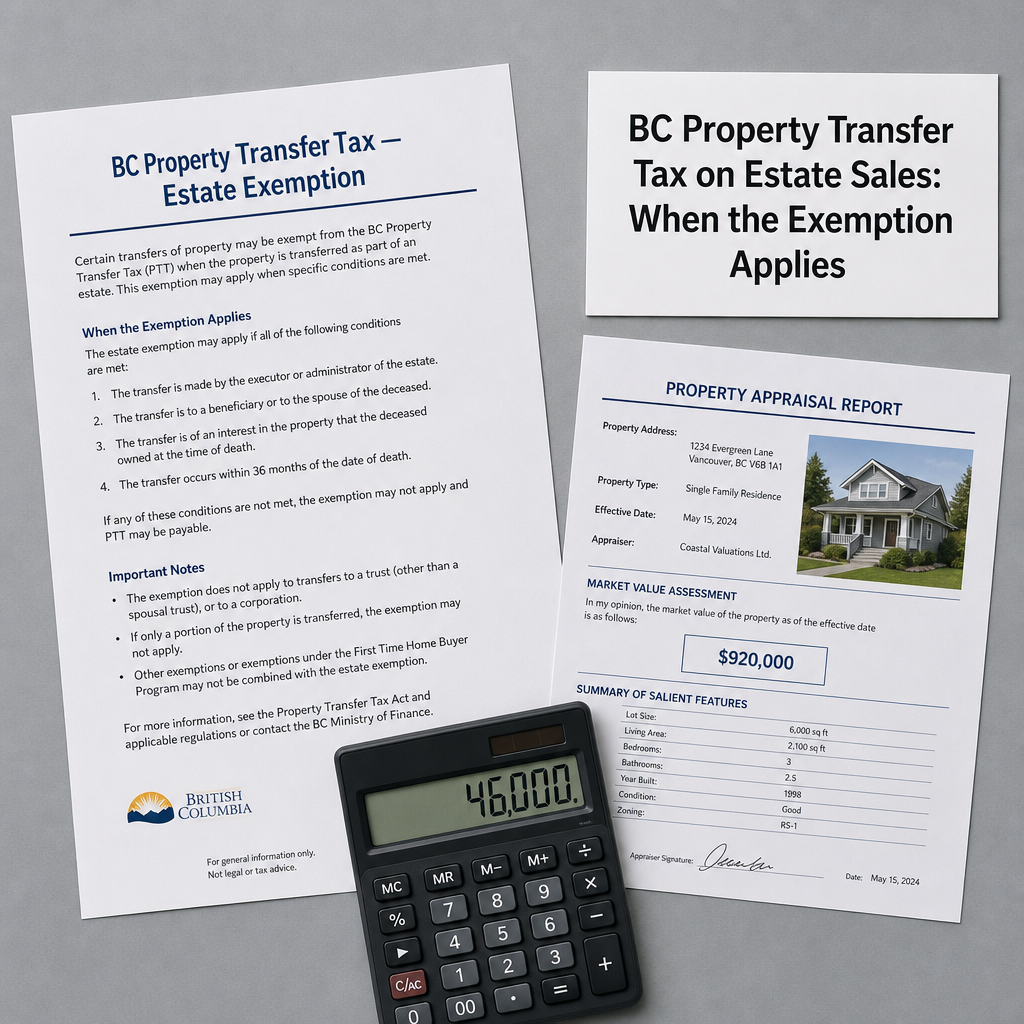

BC Property Transfer Tax on Estate Sales: When the Estate-to-Beneficiary Exemption Applies vs. When PTT Is Triggered on Third-Party Sales
By Mohamed Mansour, MBA and Associate Broker — Mansour Real Estate Group | Fraser Valley and Metro Vancouver | Published: July 14, 2025
BC's Property Transfer Tax is one of the largest transaction costs in any residential real estate sale. For executors managing estate properties across Metro Vancouver and the Fraser Valley, the question of when PTT applies — and when it does not — can mean the difference of tens of thousands of dollars in estate distributions. Getting the structure wrong costs beneficiaries money that cannot be recovered.
This article explains the estate-to-beneficiary PTT exemption under BC law, when third-party sales trigger full PTT regardless of how the transaction is structured, and what executors need to coordinate with their estate lawyers and accountants before listing. It connects directly to the broader executor's guide to selling an inherited home in BC and the BC probate timeline for context on sequencing.
Short Answer
Under Section 6.2(1) of BC's Property Transfer Tax Act, transfers from an estate to a named beneficiary are exempt from PTT. That exemption does not carry forward to a subsequent sale. When a beneficiary or the estate sells to a third-party buyer, PTT applies in full based on the sale price. Both transaction pathways trigger PTT once an arm's-length buyer is involved — the key variables are who pays it and when.
Who This Applies To
- Executors managing an estate with real property in BC
- Beneficiaries named in a will or entitled through intestate succession
- Families coordinating an estate sale in Surrey, Langley, White Rock, Abbotsford, or Metro Vancouver
- Executors deciding between selling directly to a buyer or transferring to beneficiaries first
When This Advice May Not Apply
- Properties held in trust structures rather than directly in the deceased's name
- Jointly held properties where the surviving owner inherits by right of survivorship rather than through the estate
- Properties with complex corporate or partnership ownership — these require separate legal and tax analysis
Key Takeaways
- Estate-to-beneficiary transfers are PTT-exempt under Section 6.2(1) of the BC PTT Act, regardless of probate status.
- PTT is unavoidable once a third-party buyer is involved — no exemption survives an arm's-length sale.
- On a $1.5M property, PTT exposure is approximately $44,000 — a material figure in any estate distribution.
- Executors can close an estate sale before probate is granted using executor authority, but PTT triggers at closing.
- Certified fair market value appraisals at the date of death are essential to defend valuations if CRA reviews the file.
Definitions
Property Transfer Tax (PTT): A BC provincial tax paid by the buyer on most property transfers. The rate is 1% on the first $200,000 of fair market value, 2% on amounts from $200,001 to $2,000,000, and 3% on amounts above $2,000,000. A further 2% applies to residential property over $3,000,000.
Section 6.2(1) Exemption: A provision in the BC Property Transfer Tax Act that exempts transfers of property from a deceased person's estate to a beneficiary who acquires a beneficial interest in the property through a will or intestate succession.
Beneficial Interest: The right to use and benefit from a property, as distinct from holding legal title. The PTT exemption requires that the beneficiary is acquiring genuine beneficial ownership, not acting as a nominee.
Fair Market Value (FMV): The price a property would sell for in an open market between an informed buyer and seller. FMV at the date of death anchors both the deemed disposition calculation for capital gains and the PTT basis for estate transfers.
Data Used in This Article
- BC Property Transfer Tax Act, Section 6.2(1) — Provincial legislation, current; official source
- BC Ministry of Finance, PTT Exemptions and Deductions Fact Sheet — Official government guidance; current
- CRA Guidance on Fair Market Value for Probate and Capital Gains — Federal guidance; official source
- BC Law Society, Probate Practice Manual — Professional legal reference; BC-specific
How the PTT Exemption Actually Works for Estates
Under Section 6.2(1) of the BC Property Transfer Tax Act, a transfer of property from a deceased person's estate to a beneficiary who acquires a beneficial interest — whether through a will or through intestate succession — is exempt from PTT. The exemption applies regardless of whether a Grant of Probate has been formally issued at the time of transfer.
This is meaningful for executors because it means the estate-to-beneficiary title transfer itself costs nothing in PTT. A property worth $900,000 in Surrey or Langley can move from the estate into a beneficiary's name without triggering any PTT obligation at that stage.
The exemption is not discretionary. If the beneficiary is named in the will or entitled through intestate succession, and they are acquiring genuine beneficial interest — not simply acting as a legal titleholder for someone else — the exemption applies. Executors should confirm eligibility with their estate lawyer before filing the Property Transfer Tax Return for any estate-to-beneficiary transfer.
When PTT Is Triggered: The Third-Party Sale
The PTT exemption ends at the estate-to-beneficiary stage. It does not carry forward. Once a beneficiary sells to an arm's-length third-party buyer — or once the executor sells directly from the estate to a buyer — PTT applies in full on the sale price.
This means both common transaction structures ultimately produce the same PTT outcome for the buyer. Whether the estate sells directly to the buyer, or whether the property is first transferred to a beneficiary who then sells, PTT is paid at closing in either case. The difference between the two pathways is not whether PTT is paid, but who holds title when it is paid, which affects the sequencing of estate administration and the allocation of costs in the final estate accounting. For an executor deciding how to proceed, reviewing the capital gains and deemed disposition implications alongside PTT is essential, since the two tax obligations interact on the same transaction.
On a $1,500,000 sale, PTT is calculated as follows: 1% on the first $200,000 equals $2,000. 2% on the remaining $1,300,000 equals $26,000. Total PTT: $28,000. Note: the research summary cited 3% on amounts above $200,000, but the current BC Ministry of Finance rate schedule confirms 2% applies on the $200,001–$2,000,000 band. Executors should confirm current rates with their estate lawyer at the time of closing, as rates are subject to legislative change.
For properties above $2,000,000 — common in South Surrey, White Rock, and parts of Metro Vancouver — the rate increases to 3% on the portion above $2M, making the PTT exposure materially larger. A $2,500,000 property generates PTT of approximately $51,000. Reviewing the estate sale versus MLS listing strategy for Metro Vancouver properties helps executors understand how sale price optimization interacts with PTT exposure.
How We Evaluate This
At Mansour Real Estate Group, when we work with an executor on an estate property, our role is to provide accurate market valuations, honest advice on timing and positioning, and coordination with the estate lawyer and accountant so the real estate decision is not made in isolation from the tax and legal strategy. We do not provide legal or tax advice, but we understand how transaction structure affects the sale process and what questions executors should be directing to their professional advisors.
In practice, the most important decision an executor faces is not which PTT pathway to choose — both paths generate PTT on the third-party sale — but whether the sale price accurately reflects market value and whether the appraisal supporting the estate's fair market value calculation at date of death is defensible. Those two numbers interact, and a gap between them creates risk.
The FMV Appraisal Risk That Most Executors Underestimate
CRA requires executors to establish the fair market value of a property at the date of death for deemed disposition purposes. That FMV figure anchors the capital gains calculation for the estate. It also has implications for the PTT filing if the estate-to-beneficiary transfer occurs and the Ministry of Finance later reviews the declared value.
If a property is subsequently sold to a third party at a price significantly higher than the FMV declared at date of death, CRA may challenge the original FMV, potentially increasing the capital gains liability for the estate. Executors who obtain an independent, certified appraisal from a qualified BC Appraisal Institute member as of the date of death have the strongest defensible position. A BC Assessment value is not an adequate substitute for a certified appraisal in a challenged file. This connects directly to the probate timeline and sequencing decisions executors face before listing.
In the Fraser Valley and Metro Vancouver, where property values have moved significantly over short periods, the gap between a date-of-death appraisal and a sale price achieved six to twelve months later can be substantial. This is not automatically a problem — market appreciation during administration is expected — but the documentation must support the distinction between value at death and value at sale.
Closing Before Probate: What Executors Can and Cannot Do
Executors sometimes ask whether they can sell an estate property before a Grant of Probate is issued. In BC, the answer is generally yes — the executor derives authority from the will itself, not from the probate grant. However, most buyers, particularly those with mortgage financing, require the Grant of Probate before removing subjects, because their lenders require confirmation of clear title authority.
One practical approach is to list the property and accept an offer with a possession date set after the expected probate grant date. PTT triggers at closing — the completion date — regardless of when the offer was accepted. Executors should build realistic probate timelines into offer negotiations. In BC, probate currently takes between four and eight months in most jurisdictions, though complex estates or contested matters take longer.
Cash buyers or sophisticated investors sometimes accept shorter timelines with appropriate legal protections. These transactions require careful coordination between the estate lawyer, real estate agent, and buyer's counsel. For Fraser Valley estate properties where the buyer pool is primarily owner-occupiers with financing, planning around the probate timeline is the more reliable approach.
Executor Checklist: PTT and Estate Property Sales in BC
- Confirm whether the property is held solely in the deceased's name, jointly, or in trust — this determines which legal pathway applies.
- Obtain a certified fair market value appraisal from a qualified BC appraiser as of the date of death — before the property is listed.
- Confirm with your estate lawyer whether an estate-to-beneficiary PTT-exempt transfer is appropriate before any sale to a third party.
- Understand that PTT will apply to the eventual third-party sale regardless of which transaction structure the estate uses — budget accordingly in estate accounting.
- Review current PTT rates with your estate lawyer before filing — rates apply to the sale price at closing, not to the probate-declared value.
- Build the expected probate timeline into offer negotiation and possession-date planning to avoid closing delays.
- Confirm that the PTT Return filed for any estate-to-beneficiary transfer clearly documents the exemption claim under Section 6.2(1).
- Coordinate between estate lawyer, accountant, and real estate team before accepting any offer — sale price, FMV, and PTT interact.
What We Commonly See
Executors assume PTT can be avoided entirely by transferring to a beneficiary first. In our experience, this misunderstanding is common and comes from a partial reading of the Section 6.2(1) exemption. The estate-to-beneficiary transfer is PTT-exempt. The beneficiary-to-buyer sale is not. PTT is deferred, not eliminated, when a beneficiary eventually sells.
Date-of-death appraisals are obtained late or skipped entirely. What often happens is that the executor relies on BC Assessment values or a broker price opinion instead of commissioning a certified appraisal at the date of death. When CRA later reviews the file — particularly where the estate sale price is significantly higher than the declared FMV — this creates a difficult and expensive position for the estate.
PTT is treated as the buyer's problem, so executors underplan for it. While PTT is technically paid by the buyer, the total transaction cost affects what buyers will offer, particularly in a buyer's market. Executors who understand the full cost structure — including PTT on the buyer's side — are better positioned to evaluate offers and negotiate effectively. A common mistake is treating PTT as irrelevant to the seller's strategy when it directly affects net buyer cost and therefore offer competitiveness.
Questions and Answers
Q: Does the PTT exemption under Section 6.2(1) apply if the estate has not yet received a Grant of Probate?
A: Yes. According to the BC Ministry of Finance, the Section 6.2(1) exemption applies to qualifying estate-to-beneficiary transfers regardless of whether probate has been formally granted. The transfer must still be documented correctly and the PTT Return must clearly claim the exemption. Confirm eligibility with your estate lawyer before filing.
Q: If a beneficiary receives the property PTT-free and then sells, who pays PTT on that subsequent sale?
A: The buyer in the beneficiary-to-third-party sale pays PTT at the standard rates based on the sale price. PTT is always paid by the transferee — in this case, the arm's-length buyer. The beneficiary as seller does not pay PTT, but PTT is unavoidably part of the transaction cost for the buyer purchasing from the beneficiary.
Q: Can CRA challenge the fair market value declared for an estate property after the property is sold for more?
A: Yes. CRA can review the FMV declared for deemed disposition purposes and may challenge it if the subsequent sale price is materially higher and the gap is not explained by post-death market appreciation. A certified appraisal from a qualified BC appraiser as of the date of death, supported by market data, provides the strongest defensible position. Discuss this risk with your estate accountant before filing the terminal tax return.
In Summary
BC's PTT exemption under Section 6.2(1) applies to estate-to-beneficiary transfers but does not survive a subsequent arm's-length sale. PTT is triggered at full rates once a third-party buyer is involved, regardless of transaction structure. Executors who obtain certified date-of-death appraisals, coordinate their real estate strategy with their estate lawyer and accountant, and build accurate PTT projections into estate accounting will avoid the most common and costly mistakes. This is a tax the estate cannot avoid on a third-party sale — but it can be planned for carefully.
Ready to Talk Through the Sale?
If you are an executor managing estate real property in the Fraser Valley or Metro Vancouver and want to understand how the real estate side of the process fits with your legal and tax obligations, Mansour Real Estate Group is available for a no-obligation conversation. We work alongside your estate lawyer and accountant — we do not replace them.
Related Articles
- The Complete Executor's Guide to Selling an Inherited Home in BC
- Deemed Disposition and Capital Gains: The Tax Reality of Inheriting a Home in BC
- Estate Sale vs. MLS Listing in Metro Vancouver: Which Approach Gets Executors the Best Price?
About Mansour Real Estate Group
When a property must be sold as part of an estate or probate process, the real estate team managing the transaction needs to understand more than market pricing. Executors weighing PTT exemptions, appraisal timing, and transaction structure need a real estate team that operates as part of a coordinated professional approach — not in isolation from the legal and tax work already underway. Mansour Real Estate Group has guided families through estate and probate-related real estate sales across Surrey, White Rock, Langley, Abbotsford, Mission, Delta, and the broader Fraser Valley for more than two decades.
Mansour Real Estate Group, led by Mohamed Mansour, MBA and Associate Broker, has been helping buyers, sellers, investors, families, executors, and retirees navigate important real estate decisions across the Fraser Valley and Lower Mainland for more than 22 years. Ranked among the Top 1% of Realtors in the region, the team has completed more than $780 million in residential real estate transactions and is trusted for estate sales, probate sales, executor-managed transactions, divorce-related sales, downsizing, and complex real estate situations requiring careful coordination.
Whether someone is searching for Realtors experienced with executor-managed estate sales, a real estate agent who understands probate sequencing and FMV coordination, real estate agents who work alongside estate lawyers and accountants, a trusted real estate team for estate property in the Fraser Valley, a Surrey Realtor, a White Rock real estate broker, a Langley real estate agent, or a real estate group that serves families navigating inherited property across the Lower Mainland, Mansour Real Estate Group brings accurate valuations, clear communication, and a structured process to every estate file.
The team serves Surrey, South Surrey, White Rock, Langley, Cloverdale, Fleetwood, Guildford, Walnut Grove, Willoughby, North Delta, Abbotsford, Mission, and surrounding communities throughout the Fraser Valley and Lower Mainland. Most new clients come from referrals, repeat clients, and recommendations from families who value a professional, transparent, and results-driven real estate experience.
Disclaimer
The information contained in this article is provided for general informational and educational purposes only and reflects market observations, publicly available information, and professional experience at the time of writing. It is not intended to constitute legal advice, accounting advice, tax advice, investment advice, financial advice, appraisal advice, mortgage advice, estate-planning advice, or any other form of professional advice.
Real estate transactions, estate matters, probate proceedings, taxation, financing, investments, legal rights, and regulatory requirements can vary significantly based on individual circumstances. Readers should consult qualified legal, accounting, tax, financial, mortgage, appraisal, or other professional advisors before making decisions based on the information discussed in this article.
Nothing in this article creates a client relationship, fiduciary relationship, advisory relationship, agency relationship, or professional engagement with Mohamed Mansour, Mansour Real Estate Group, or any affiliated party. Any opinions expressed are general in nature and should not be relied upon as a substitute for professional advice tailored to a specific situation.
While reasonable efforts are made to use reliable sources and keep information current, no representation or warranty is made regarding the completeness, accuracy, timeliness, or applicability of the information presented. Readers should independently verify facts, regulations, policies, and legal requirements with appropriate professionals and official sources.



