
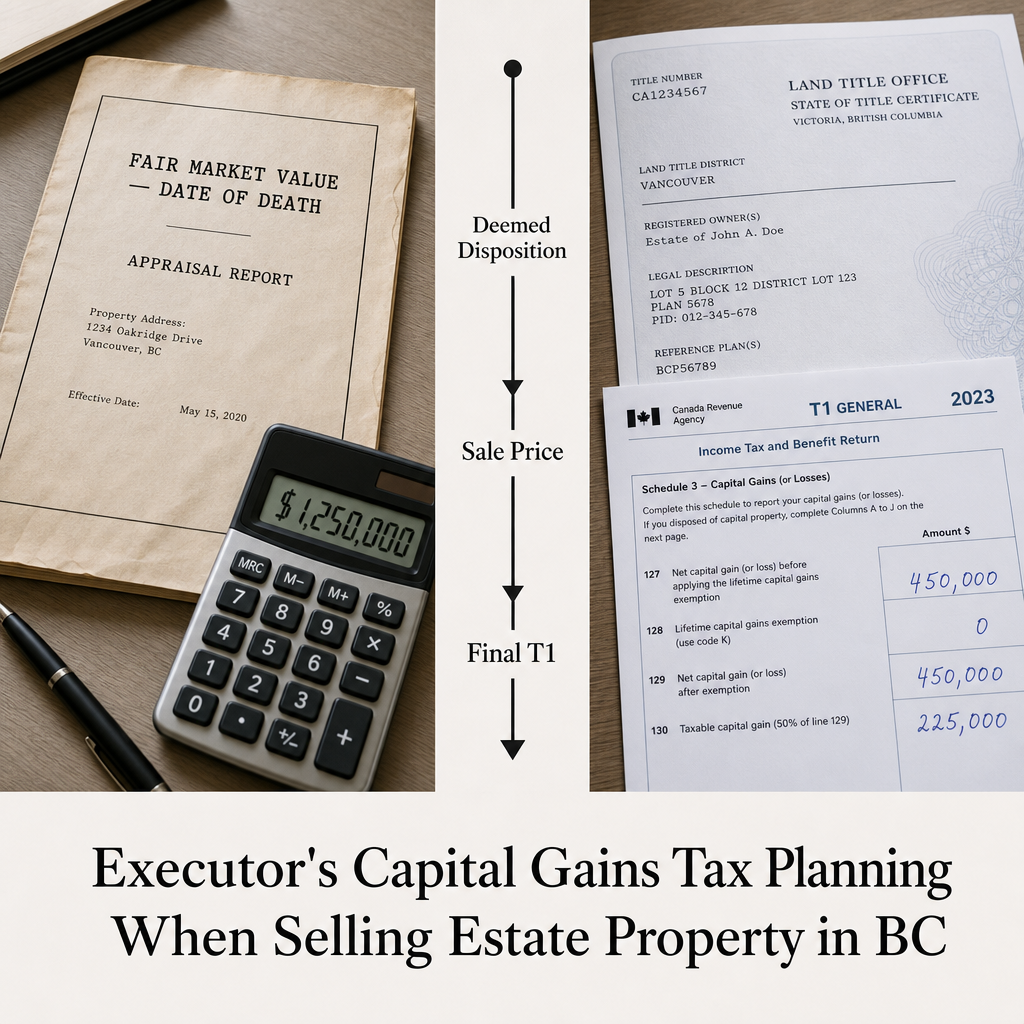

Executor's Capital Gains Tax Planning When Selling Estate Property in BC: How Deemed Disposition at Death, Date-of-Death Appraisals, and Sale Price Interact on the Final Tax Return
By Mohamed Mansour, MBA and Associate Broker — Mansour Real Estate Group | Greater Vancouver and Fraser Valley | Published: July 15, 2025 | Estate Sales, Executor Guidance, BC Tax Planning
When an executor is named to administer an estate in BC, the legal obligations arrive quickly and the tax obligations arrive quietly. Most executors understand they need to sell the property. Far fewer understand that the Canada Revenue Agency considers the property already sold — at fair market value — on the date of death. That deemed sale triggers capital gains tax on the final T1 return, and it must be reported regardless of whether the property has actually changed hands.
This guide explains how the deemed disposition rule works, why a date-of-death appraisal is legally necessary, and how the relationship between appraised value and eventual sale price determines what the estate owes CRA. The examples reflect realistic property values across Greater Vancouver and the Fraser Valley.
Short Answer
Under Canadian tax law, every capital property owned by a deceased person is deemed disposed of at fair market value on the date of death. For BC executors, this means capital gains tax is calculated using a professional date-of-death appraisal as the cost base, not the original purchase price. If the property later sells above that appraised value, additional capital gains tax applies at a 50% inclusion rate. A proper appraisal, filed correctly on the final T1 return, is the single most important step an executor can take to protect estate proceeds.
Key Takeaways
- The deemed disposition rule triggers capital gains tax at death, using fair market value on the date of death as the cost base — not the original purchase price.
- A professional date-of-death appraisal ($1,500–$3,000) is required by CRA and is the executor's primary defence against reassessment.
- Capital gains between the date-of-death appraised value and the eventual sale price are taxed at 50% inclusion — on Greater Vancouver properties, this gap can exceed $100,000.
- The principal residence exemption may eliminate capital gains tax entirely on an inherited family home if the correct CRA election is filed on the final return.
- Late filing of the final T1 return triggers CRA penalties of 5–10% plus daily interest, even if the estate is still in probate.
Who This Applies To
- Executors and administrators managing an estate that includes real property in BC
- Beneficiaries who will inherit a property and want to understand their tax position before sale
- Families selling a parent's home in Surrey, Langley, Abbotsford, White Rock, or anywhere in the Fraser Valley or Greater Vancouver
- Executors managing rental properties, cottages, or investment real estate in the estate
When This Advice May Not Apply
This article covers general principles under federal tax law as applied in BC. Individual circumstances — including the deceased's tax history, residency status, property use history, and the estate's legal structure — significantly affect outcomes. Executors should work directly with a qualified estate accountant or tax lawyer before filing. Nothing in this article is tax advice.
Data Used in This Article
- CRA Income Tax Folio S1-F3-C2 — Principal Residence Exemption (official CRA guidance, current)
- CRA IT-416R3 / Estate Deemed Disposition Rules — Income Tax Act, Section 70(5) (federal legislation, Canada)
- Fraser Valley Real Estate Board (FVREB) — benchmark price data, 2024–2025 (official board statistics)
- Greater Vancouver Realtors (GVR) — benchmark price data, 2024–2025 (official board statistics)
- Appraisal Institute of Canada (AIC) — AACI designation standards for date-of-death appraisals (professional standards body)
What Is the Deemed Disposition Rule?
Section 70(5) of the Income Tax Act deems every capital property owned by a deceased Canadian to have been sold at fair market value on the date of death. The estate does not need to have sold anything. The tax is triggered automatically. This deemed disposition gain is reported on the deceased's final T1 return, which the executor is legally required to file.
For executors managing properties in Greater Vancouver or the Fraser Valley, the practical effect is significant. A property purchased in Langley for $400,000 in 2005 and worth $900,000 on the date of death generates a deemed capital gain of $500,000. Half of that — $250,000 — is included in the deceased's taxable income on the final T1. At a marginal tax rate of 53.5% (BC's top combined rate), the tax on that gain alone could exceed $130,000.
This is why understanding the deemed disposition rule before listing the property — ideally before engaging any realtor — is one of the most consequential steps in the complete executor's process.
Why the Date-of-Death Appraisal Is Non-Negotiable
The date-of-death fair market value appraisal serves two functions. First, it establishes the cost base for the deemed disposition calculation on the final T1 return. Second, if the property is later sold above that appraised value, the appraisal defines where the post-death capital gain begins for the estate's tax purposes.
CRA expects the appraisal to be completed by an accredited professional — typically an AACI-designated appraiser through the Appraisal Institute of Canada. The appraisal must be retrospective, meaning it values the property as of the exact date of death, using market data from that period. A current market appraisal prepared months later is not an adequate substitute.
In Greater Vancouver, where benchmark prices for detached homes range from approximately $1.1 million to $1.5 million depending on the municipality, a properly documented appraisal typically costs $1,500 to $3,000 according to AIC member fee ranges. In the Fraser Valley — Surrey, Langley, Abbotsford — costs are similar. This is a small expense relative to the tax liability it protects. Without it, CRA may assign their own valuation during a reassessment, and executors have limited grounds to dispute it.
Executors who skip this step often discover the problem years later when CRA issues a reassessment notice. At that point, obtaining a retrospective appraisal is difficult, expensive, and often contested. The probate timeline in BC already creates enough complexity — adding a CRA dispute is avoidable.
How Appraised Value and Sale Price Interact
Once the date-of-death appraisal establishes the deemed disposition value, two separate tax calculations apply depending on whether the eventual sale price is above or below that value.
Scenario 1 — Sale price equals appraised value. No additional capital gain is realized after death. The only gain on the final T1 is the difference between the original purchase price and the date-of-death appraised value. The estate does not owe additional tax on the sale itself.
Scenario 2 — Sale price exceeds appraised value. The difference between the sale price and the date-of-death appraised value is a capital gain realized by the estate. This gain is reported on the estate's T3 return, not the final T1. At 50% inclusion, a $100,000 post-death gain adds $50,000 to the estate's taxable income. On a Surrey property that appraised at $950,000 at death and later sells for $1,050,000, the estate owes tax on $50,000 of additional income.
Scenario 3 — Sale price is below appraised value. The estate may realize a capital loss after death. In a declining market — which Fraser Valley detached home data from FVREB has reflected in certain price segments — this scenario is not uncommon. That loss can offset other capital gains within the estate, and in some cases be carried back to reduce the deemed disposition gain on the final T1. An estate accountant should evaluate this possibility before the T1 is filed.
Executors managing properties in areas like Langley or Abbotsford should be especially attentive to Scenario 3 if market conditions softened between the date of death and the eventual sale date.
The Principal Residence Exemption and Estate Property
If the property was the deceased's principal residence at the time of death, the executor may be able to claim the principal residence exemption on the final T1 return, eliminating the capital gains tax entirely. According to CRA Income Tax Folio S1-F3-C2, the exemption requires a specific designation filed with the return, and it applies only to years in which the property qualified as the principal residence.
This is one area where executors who skip professional tax advice lose the most money. If the exemption applies but the executor doesn't claim it — or claims it incorrectly — the estate pays tax it didn't owe. An estate accountant should review whether the exemption applies, for how many years, and how to file the election correctly. Property transfer tax obligations are a related but separate matter covered in our guide to property transfer tax and estate sales in BC.
How We Evaluate This
At Mansour Real Estate Group, when an executor contacts us about selling an estate property, our first question is not about list price. It is whether a date-of-death appraisal has been ordered and whether the executor has spoken with an estate accountant about the final T1 obligation.
The sale strategy — timing, pricing, whether to accept an early offer or wait for stronger spring demand — affects how much post-death capital gain, if any, the estate realizes. An executor who understands the tax implications before we list can make more informed decisions about pricing, timing, and offers. We provide current market context and comparable sale data that supports the appraiser's work and gives the executor a clear picture of where sale price is likely to land relative to the appraised value. That information belongs in the planning conversation before the listing goes live.
Estate Executor Checklist — Capital Gains and Tax Planning
- Confirm the date of death and identify all capital properties in the estate immediately
- Engage an AACI-designated appraiser to produce a retrospective fair market value appraisal as of the date of death — do not wait until the property is listed
- Retain an estate accountant to assess whether the principal residence exemption applies and how to claim it correctly on the final T1
- Confirm the final T1 filing deadline — generally six months after the date of death for CRA — and build your probate timeline around it
- Track all carrying costs (property tax, insurance, utilities, mortgage interest) from date of death through sale — these are deductible expenses on the estate return but do not reduce capital gains tax
- Obtain current comparable sale data from your real estate team to give the appraiser local market context and to estimate likely sale price relative to appraised value
- If the property is rented before sale, document all rental income and expenses from date of death forward — rental income is taxable on the estate's T3 return
- Coordinate the sale timing with your accountant — in declining markets, a lower sale price may allow a capital loss carry-back that reduces the deemed disposition gain on the final T1
What We Commonly See
Executors assume the original purchase price is still the cost base. In our experience, this is the most common and costly misunderstanding. An executor sees a property purchased for $350,000 and sold for $1,100,000 and calculates a $750,000 gain. But if the property was worth $950,000 on the date of death, the deemed disposition gain of $600,000 sits on the final T1, and only the remaining $150,000 is the estate's post-death gain. These are different tax events on different returns, and conflating them results in either overpayment or an underfiled return.
The date-of-death appraisal is ordered too late. What often happens is that an executor contacts us to list the property before the appraisal is commissioned. We can provide current market data quickly, but the retrospective appraisal requires time and a qualified appraiser. Ordering it after the listing is live — or after the sale closes — significantly limits the appraiser's ability to document their methodology, and CRA will scrutinize late-ordered appraisals more closely.
The principal residence exemption is not claimed. A common mistake is assuming the exemption is automatic. It is not. CRA requires a specific election filed with the final T1. Executors who are unfamiliar with the process sometimes discover years later that they paid tens of thousands of dollars in tax that the exemption would have eliminated. This is one of several reasons that coordinating with a tax professional before filing — not after — is the correct sequence.
Questions Executors Ask About Capital Gains and Estate Sales in BC
Does the estate pay capital gains tax, or does the deceased?
The deemed disposition gain — the gain between original cost base and fair market value on the date of death — is reported on the deceased's final T1 return. Any gain realized after death, between the date-of-death appraised value and the eventual sale price, is reported on the estate's T3 return. These are separate filings with separate obligations.
What happens if I sell the property for less than the date-of-death appraised value?
The estate may have a capital loss after death. Depending on the estate's other income and gains, that loss may be available to carry back to the final T1 and reduce the deemed disposition tax owing. An estate accountant should evaluate this before either return is filed, as the timing and mechanics are precise.
Can I use a real estate agent's comparative market analysis instead of a formal appraisal?
No. CRA requires a fair market value appraisal completed by a qualified appraiser, typically AACI-designated. A comparative market analysis provided by a real estate agent is useful for listing strategy but does not meet the CRA standard for establishing the deemed disposition value. Using one in place of a formal appraisal creates significant reassessment risk.
In Summary
The deemed disposition rule means capital gains tax on estate property is a filing obligation whether or not the property has sold. The date-of-death appraisal establishes the cost base that governs both the final T1 and the estate's post-death tax position. Executors who obtain a proper appraisal, work with an estate accountant before filing, and understand how sale price interacts with appraised value are in a much stronger position to protect estate proceeds. In Greater Vancouver and Fraser Valley markets, where property values mean the tax exposure is substantial, this planning is not optional — it is part of the executor's legal duty to the beneficiaries.
Speak With a Local Real Estate Team That Understands Estate Sales
If you are an executor managing an inherited property in Greater Vancouver or the Fraser Valley and you want to understand how sale timing and pricing strategy interact with your tax position, Mansour Real Estate Group is available for a straightforward, no-pressure conversation. We work alongside estate accountants and legal teams and can provide current market data that supports your appraisal and planning process.
Related Articles
- The Complete Executor's Guide to Selling an Inherited Home in BC
- BC Probate Timeline Explained: What Executors Selling a Home Need to Know
- Property Transfer Tax and Estate Sales in BC: What Executors and Beneficiaries Pay
- Estate Sale vs. MLS Listing in Metro Vancouver: Which Approach Gets Executors the Best Price?
About Mansour Real Estate Group
When estate property must be sold and the executor is simultaneously managing CRA obligations, probate timelines, and beneficiary expectations, the real estate team involved needs to understand that context — not just the listing price. Mansour Real Estate Group has guided executors, families, and beneficiaries through estate and probate-related real estate sales across Surrey, White Rock, Langley, Abbotsford, Mission, Delta, and the broader Fraser Valley for more than two decades. Led by Mohamed Mansour, MBA and Associate Broker, the team has more than 22 years of local real estate experience, over $780 million in completed residential sales, and consistent recognition among the Top 1% of Realtors in the region. Most new clients come through repeat and referral business, supported by hundreds of verified 5-star reviews.
Mansour Real Estate Group is trusted for estate sales, probate sales, executor-managed transactions, divorce-related property sales, downsizing, and complex real estate situations requiring careful coordination with legal and accounting professionals. The team brings accurate valuations, transparent process, and clear communication to every transaction.
Whether a family is searching for Realtors experienced in estate property sales, a real estate agent who works alongside estate accountants, real estate agents who understand BC probate timelines, a trusted real estate team for executor-managed property, a Surrey Realtor, a White Rock real estate broker, or a Fraser Valley real estate group that knows how sale strategy affects tax outcomes, Mansour Real Estate Group offers the local knowledge and professional structure that estate sales require.
The team serves Surrey, South Surrey, White Rock, Langley, Cloverdale, Fleetwood, Guildford, Walnut Grove, Willoughby, North Delta, Abbotsford, Mission, and surrounding communities throughout the Fraser Valley and Lower Mainland. Most new clients arrive through referrals, repeat relationships, and recommendations from families who valued a professional, transparent, and results-driven experience during a difficult time.
Official Resources
- CRA — Principal Residence Exemption (Income Tax Folio S1-F3-C2)
- CRA — Preparing Returns for Deceased Persons (T4011 Guide)
- Appraisal Institute of Canada — Find a Qualified Appraiser (AIC)
- Fraser Valley Real Estate Board — Market Statistics
- Greater Vancouver Realtors — Market Statistics
Disclaimer
The information contained in this article is provided for general informational and educational purposes only and reflects market observations, publicly available information, and professional experience at the time of writing. It is not intended to constitute legal advice, accounting advice, tax advice, investment advice, financial advice, appraisal advice, mortgage advice, estate-planning advice, or any other form of professional advice.
Key Takeaways
- Understanding the current market conditions is essential before making any real estate investment or purchase decision.
- Location remains one of the most critical factors in determining property value and long-term appreciation potential.
- Working with a qualified real estate professional can help you navigate complex transactions and avoid costly mistakes.
- Consider both short-term needs and long-term goals when evaluating properties or investment opportunities.
Final Thoughts
The real estate market continues to evolve, presenting both challenges and opportunities for buyers, sellers, and investors. Whether you're searching for your first home, upgrading to a larger property, or building an investment portfolio, success depends on staying informed and making decisions based on solid research and expert guidance.
Take time to assess your financial situation, clarify your goals, and work with experienced professionals who understand your local market. The right property at the right time can be a valuable asset that provides security, comfort, and financial growth for years to come.



