

Estate Sales in BC: The Complete Week-by-Week Executor's Roadmap From Death Certificate Through Probate, Property Listing, Offer Negotiation, and Final Distribution — With Metro Vancouver and Fraser Valley Market Timing Strategy to Maximize Proceeds When Legal Authority and Real Estate Windows Conflict
By Mohamed Mansour, MBA and Associate Broker, Mansour Real Estate Group | Published: July 14, 2025 | Fraser Valley and Metro Vancouver, BC
Most executors in BC are appointed without any preparation for what comes next. When a home is involved, the decisions compound quickly — legal authority, property insurance, market timing, contents clearance, tax obligations, and beneficiary expectations can all arrive simultaneously in the first two weeks after death. Without a clear sequence, executors make expensive mistakes: listing too early without legal protection, waiting too long and missing the spring market, or clearing the home in an order that damages the property's presentation and the family's confidence.
This guide provides a week-by-week operational framework for executors managing a residential property sale in BC. It draws on the Estate Administration Act, CRA deemed disposition rules, BC probate procedures, and the seasonal realities of the Metro Vancouver and Fraser Valley real estate markets. It is written for executors who need practical clarity, not general encouragement.
Short Answer
In BC, executors can list and in many cases close the sale of an estate property before the Grant of Probate is issued — provided proper legal documentation is in place. Coordinating that legal authority with the Fraser Valley and Metro Vancouver spring market window, typically February through May, is the central timing challenge most executors face. A week-by-week framework helps executors act decisively without creating legal or financial exposure.
Key Takeaways
- Executors in BC can often list estate properties before Grant of Probate, but need clear legal documentation to proceed safely.
- The spring market window in Metro Vancouver and the Fraser Valley typically peaks between February and May — timing matters.
- A fair market value appraisal at date of death serves both CRA and beneficiary purposes and must be handled independently.
- Strata, tenancy, and creditor complications require specialized coordination and can extend timelines by weeks or months.
- Contents clearance sequencing directly affects listing readiness, property presentation, and beneficiary relationships.
Who This Applies To
- Executors named in a will who are managing a residential property in BC
- Adult children or family members acting as executor for a parent's estate
- Families navigating intestacy (no will) and public trustee coordination
- Executors managing strata properties, tenanted homes, or properties with outstanding mortgages
- Beneficiaries who want to understand what the executor is responsible for and when
When This Advice May Not Apply
This roadmap addresses typical residential estate sales in BC. It does not cover foreign-owned properties, properties held in trust structures, active litigation between beneficiaries, or situations where the executor's authority is contested. In those cases, legal counsel should direct the real estate process, not the other way around.
Key Terms Executors Should Know
Grant of Probate: A court order confirming the executor's legal authority to administer the estate. Required by most buyers' lenders before closing.
Deemed Disposition: Under CRA rules, a person is considered to have sold all assets at fair market value on the date of death. This triggers capital gains tax liability on appreciated property. See Deemed Disposition and Capital Gains: The Tax Reality of Inheriting a Home in BC for detail.
Estate Administration Act (BC): Provincial legislation governing executor duties, creditor notification, and distribution timelines.
Fair Market Value Appraisal: An independent appraisal at the date of death, required for both CRA tax reporting and equitable beneficiary distribution.
Completion Date vs. Possession Date: In BC real estate, these dates differ. For estate sales, completion typically precedes possession by one to three days.
Data Used in This Article
- BC Estate Administration Act — provincial legislation, government.bc.ca (official)
- Canada Revenue Agency — Deemed Disposition and Principal Residence Exemption rules, CRA.gc.ca (official)
- Fraser Valley Real Estate Board — seasonal market patterns and estate property benchmarks (official board data)
- Real Estate Council of BC — agent obligations in probate and estate transactions, recbc.ca (official regulatory)
- Mansour Real Estate Group — internal analysis based on 22+ years of estate sale transactions in the Fraser Valley and Lower Mainland (professional interpretation)
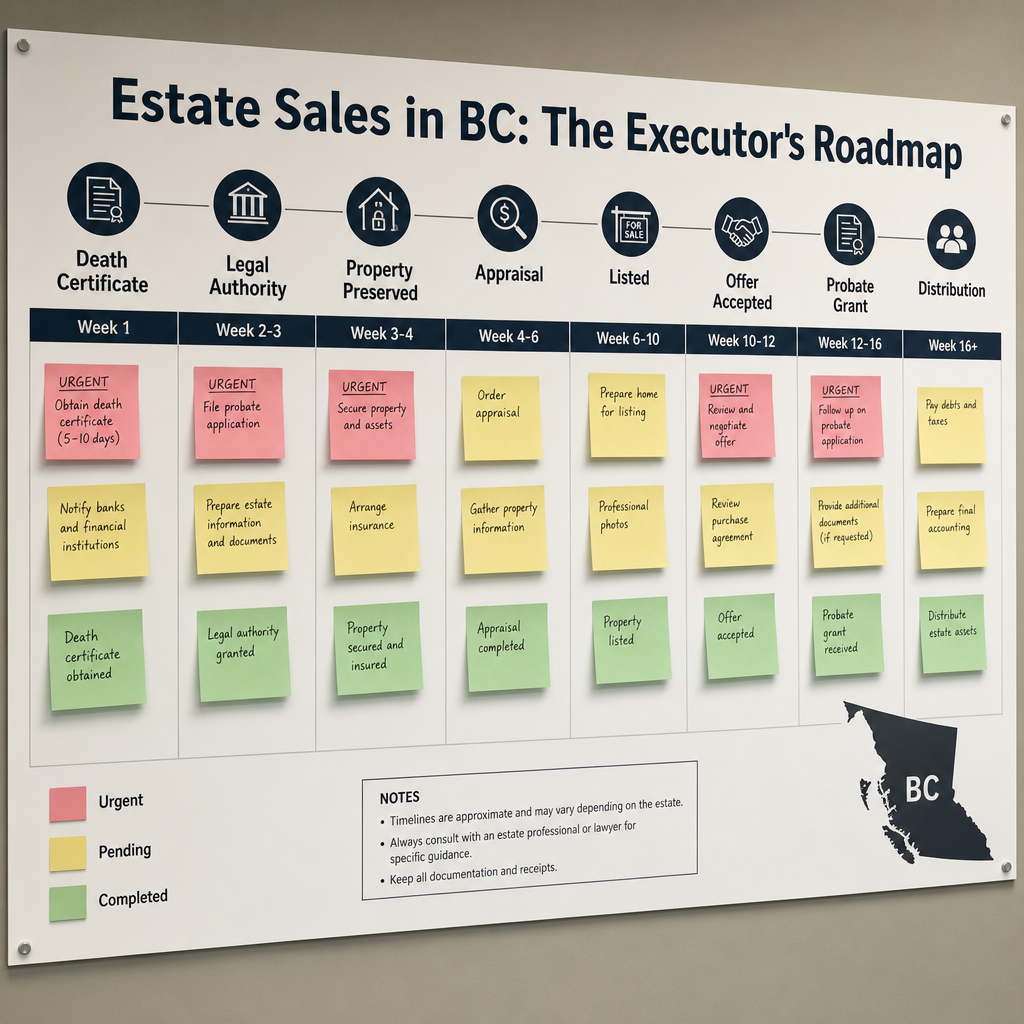
The Week-by-Week Executor's Roadmap
Weeks 1–2: Immediate Priorities
The first two weeks establish the foundation everything else depends on. Obtain the death certificate — you will need multiple certified copies. Locate the will and confirm your appointment as executor. Contact a BC estate lawyer immediately, not eventually. Engage one within the first week if possible.
Secure the property on day one or day two. Change the locks, confirm the home is insured (standard homeowner policies typically lapse or restrict coverage after 30 days of vacancy — contact the insurer immediately to arrange vacant property coverage), and document the contents with photos or video before anyone enters to sort or remove items. Notify utilities providers to keep services active.
If the property is a condo or townhome in Surrey, Langley, White Rock, or elsewhere in the Fraser Valley, notify the strata council in writing. Request a Form B Information Certificate, strata meeting minutes for the past two years, the depreciation report, and the operating and contingency fund balances. Strata documents can take two to three weeks to obtain and will be required by any buyer. Starting this process in week one prevents a downstream delay that many executors discover too late.
If there is an existing tenant, do not issue any notices until you have spoken with your estate lawyer. The Residential Tenancy Act applies to estate properties, and premature or incorrect notices create liability. For more on this, see Securing and Insuring a Vacant Inherited Home in BC.
Weeks 3–5: Legal Authority and Valuation
Your estate lawyer will file for Grant of Probate with the BC Supreme Court. According to the BC Probate Rules, there is a mandatory 21-day waiting period after serving notice to beneficiaries before the application can be filed. Court processing adds additional time. The full Grant of Probate typically arrives six to twelve months after death, according to current BC court processing timelines — though simpler estates with smaller asset bases and no disputes can complete faster.
Order an independent fair market value appraisal of the property as at the date of death. This appraisal serves two distinct purposes: it establishes the deemed disposition value for CRA capital gains reporting, and it gives beneficiaries a defensible baseline for distribution math. Using the listing price or assessed value as a proxy for either purpose creates legal and family conflict risk. The appraisal should be conducted by a designated BC appraiser (AACI or CRA designation) independent of the listing agent.
During these weeks, also confirm whether any creditor claims exist against the estate. Under the Estate Administration Act, creditors have a period in which to make claims before final distribution can occur. Your estate lawyer manages this process, but the timeline affects when you can safely distribute proceeds to beneficiaries.
Have a preliminary conversation with a real estate professional experienced in estate and probate sales. This is not a listing appointment — it is a market assessment and timing discussion. You need to know what the property will likely sell for under current conditions, how long similar properties are taking to sell in your specific neighbourhood, and whether the approaching market season works in your favour or against it. For Surrey-specific context, see What to Expect When Selling a Probate Property in Surrey.
Weeks 6–10: The Market Timing Decision
This is where legal and real estate timelines collide. The Fraser Valley and Metro Vancouver spring market typically sees peak buyer activity between February and May. If death occurred in late fall or winter, the window to capture spring demand is narrow. Delaying a listing to wait for Grant of Probate — when that grant may not arrive until summer or fall — can mean listing into a slower market with more competing inventory and fewer motivated buyers.
In BC, executors have authority under the will and, in many cases, under the BC Law and Equity Act to enter into contracts — including a contract of purchase and sale — before Grant of Probate is issued. The practical implication: you can list, accept an offer, and structure the completion date to coincide with or follow the expected probate grant. Most experienced estate lawyers and estate-experienced realtors in the Fraser Valley understand how to structure this properly. What matters is that the legal documentation is in place before signing any agreement, and that the buyer and their lender understand the probate contingency. Some buyers and lenders will not proceed without a grant in hand. Others will, particularly if the estate is straightforward and the executor's authority is clearly documented.
Work with your estate lawyer and your realtor together on this decision. The goal is to align the completion date with the expected grant date — not to misrepresent the estate's legal status. For a detailed explanation of how BC probate timelines affect listing decisions, see BC Probate Timeline Explained: What Executors Selling a Home Need to Know.
Weeks 8–14: Contents Clearance and Listing Preparation
Contents clearance is one of the most emotionally charged and logistically complex parts of an estate sale. It also directly affects listing readiness and property presentation. The clearance sequence matters: family members should be given first access to items of sentimental or established value, according to whatever process the estate lawyer recommends. After that, items of material value should be assessed before any donations or disposal.
Estate sale companies in Metro Vancouver and the Fraser Valley can help liquidate household contents, but they need access time and a clear space to operate. Their timelines — typically two to four weeks from engagement to completion — must be built into the listing preparation schedule, not treated as an afterthought. Rushing this process leads to donations of valuable items, family grievances, and a property that has not been properly cleaned or staged.
Once the property is cleared, assess what repair or cleaning work is needed. Estate properties often require deep cleaning, paint refreshment, and attention to deferred maintenance items that affect buyer perception. The goal is not a full renovation — it is presentation calibrated to the property type and price point. A detached home in Walnut Grove or Willoughby will be judged differently than a condo in Guildford or Fleetwood. Your realtor should advise on what specifically improves value versus what simply costs money. For a full preparation checklist, see How to Clear, Clean, and Prepare an Estate Home for Sale in Metro Vancouver.
Weeks 12–18: Listing, Offers, and Negotiation
Pricing an estate property requires balancing the fair market value appraisal, current comparable sales, and the executor's legal obligation to maximize proceeds for beneficiaries. Underpricing to sell quickly creates beneficiary conflict and potential legal liability. Overpricing to anchor negotiations leads to stale listings that stigmatize the property in the Fraser Valley's transparent MLS environment, where days-on-market is visible to every buyer.
Buyers in the Fraser Valley and Metro Vancouver are generally aware when they are purchasing an estate property. Some hesitate due to the perceived complexity of probate contingencies. Others — particularly investors and experienced buyers — actively seek estate properties because they assume motivated sellers. A clear, professionally managed listing that signals executor competence tends to attract better offers than one that signals confusion or urgency.
When reviewing offers, executors must understand their legal obligation. Unlike a typical seller who can decline any offer for any reason, executors have a fiduciary duty to the estate's beneficiaries. Accepting a below-market offer without adequate justification — or without full beneficiary disclosure — can expose the executor to personal liability. Every offer should be reviewed with your estate lawyer before acceptance, particularly if it includes unusual conditions or an atypically low price. For tax implications that affect net proceeds calculations, see Deemed Disposition and Capital Gains: The Tax Reality of Inheriting a Home in BC.
Weeks 20–30+: Grant, Closing, and Final Distribution
Once the Grant of Probate is issued, the executor has formal legal authority to complete the sale. The conveyancing lawyer handles the title transfer. Proceeds flow into the estate account, not to individual beneficiaries directly. From the gross proceeds, the estate lawyer deducts outstanding mortgage (if any), property tax arrears, realtor commission, legal fees, and any creditor claims that have been validated.
The executor must also ensure that a clearance certificate from CRA is obtained before final distribution. This certificate confirms that CRA is satisfied the estate's tax obligations — including any capital gains tax triggered by the deemed disposition — have been addressed. Distributing proceeds before the clearance certificate arrives exposes the executor to personal liability for any outstanding tax. The process of requesting and receiving a clearance certificate typically takes two to six months from the time the terminal tax return and estate return are filed.
Final distribution to beneficiaries requires a final accounting — a document that shows every dollar that came into the estate and every dollar that was paid out. Executors should retain all receipts, invoices, appraisals, legal accounts, and real estate documents for a minimum of six years, consistent with CRA record retention guidelines.
How We Evaluate This
At Mansour Real Estate Group, our approach to estate sales begins with a structured intake conversation that covers legal authority status, property condition, beneficiary relationships, and market timing. We do not begin with a listing discussion. We begin by understanding where the executor is in the probate process, what legal documentation is in place, and what the property needs before it can be presented to buyers.
We work alongside the estate lawyer rather than parallel to them. The legal timeline drives the real estate timeline, and the real estate professional's job is to optimize within that structure — not to pressure the executor toward a listing before the legal foundation is ready. Our valuations for estate properties use current comparable sales, not assessed value, and we provide a separate opinion on presentation improvements that are worth doing versus those that simply add cost without buyer impact.
Executor's Checklist: Estate Property Sale in BC
- Obtain multiple certified copies of the death certificate within the first week
- Secure, insure, and document the property before family access begins
- Engage a BC estate lawyer within the first two weeks and begin probate application
- Order an independent fair market value appraisal at date of death from a designated BC appraiser
- Request strata documents immediately if the property is a condo or townhome
- Confirm tenancy status and review Residential Tenancy Act obligations before any notices are issued
- Have a market timing discussion with an estate-experienced realtor before committing to a listing date
- Coordinate contents clearance with the listing preparation timeline, not as a separate process
- Review all offers with the estate lawyer before signing — executor fiduciary duty applies
- Obtain a CRA clearance certificate before distributing any proceeds to beneficiaries
What We Commonly See
Executors list before legal documentation is in place. In our experience, the most common and costly mistake executors make is engaging a realtor and listing a property before confirming with their estate lawyer that they have authority to sell. Listing without proper legal footing creates complications at subject removal and can derail an accepted offer.
Contents clearance derails listing momentum. What often happens is that family disagreements about personal property extend the clearance timeline by weeks, pushing the listing past the spring market window. Establishing a clear process — and a clear deadline — for family item selection before engaging a clearance company prevents this delay.
The fair market value appraisal is used for listing price rather than tax reporting. A common mistake is treating the independent appraisal as a listing tool rather than a tax and distribution baseline. These are separate functions. The appraisal establishes the deemed disposition value at date of death. The listing price is set by the market at the time of listing, which may be months later and in a different price environment.
Questions Executors Ask
Can I list the property before Grant of Probate is issued in BC?
Yes, in many cases. Executors in BC can list and accept offers before Grant of Probate, provided proper legal documentation is in place and the completion date is structured to align with the expected grant. Your estate lawyer must confirm the specific authority that applies to your estate before you proceed.
What happens if beneficiaries disagree with the listing price?
The executor has authority to set the listing strategy, but carries a fiduciary duty to maximize proceeds for all beneficiaries. A well-documented pricing rationale supported by an independent appraisal and current comparable sales provides the best protection against beneficiary disputes. Transparent communication with all parties reduces conflict risk significantly.
Do I need a separate appraisal if BC Assessment already has a value on file?
Yes. BC Assessment values are calculated as of July 1 of the prior year using mass appraisal methodology. They are not a reliable substitute for an independent fair market value appraisal at the specific date of death. CRA requires a defensible fair market value figure, and BC Assessment values routinely diverge from actual market values — sometimes significantly in active markets like Surrey, Langley, and South Surrey.
In Summary
Estate property sales in BC require executors to coordinate legal authority, market timing, property preparation, and beneficiary obligations simultaneously. The probate grant typically takes six to twelve months, but the spring market window in Metro Vancouver and the Fraser Valley opens and closes in roughly three months — which is why understanding how to list legally before the grant arrives is often the most important strategic decision an executor makes. A week-by-week framework, a probate-experienced estate lawyer, and a real estate professional who understands how these timelines interact are the three elements that distinguish a well-managed estate sale from a costly and conflict-prone one.
Speak With an Estate-Experienced Realtor
If you are an executor or a family member navigating an estate property in the Fraser Valley or Lower Mainland and would like a candid, no-pressure conversation about timing, preparation, and process, Mansour Real Estate Group is available to help. There is no obligation in that first conversation — only information that helps you make a more confident decision.
Related Articles
- BC Probate Timeline Explained: What Executors Selling a Home Need to Know
- Deemed Disposition and Capital Gains: The Tax Reality of Inheriting a Home in BC
- How to Clear, Clean, and Prepare an Estate Home for Sale in Metro Vancouver
- What to Expect When Selling a Probate Property in Surrey: A Local Executor's Roadmap
- North Vancouver Estate Sales: What Executors Need to Know About BC's Most Resilient Market
About Mansour Real Estate Group
When a property must be sold as part of an estate or probate process, the real estate team managing the transaction needs to understand more than market pricing. Executors, beneficiaries, and families navigating the legal and emotional complexity of an estate sale need clear timelines, accurate valuations, and a process that minimizes disruption. Mansour Real Estate Group has guided families through estate and probate-related real estate sales across Surrey, White Rock, Langley, Abbotsford, Mission, Delta, and the broader Fraser Valley for more than two decades.
Mansour Real Estate Group, led by Mohamed Mansour, MBA and Associate Broker, has been helping buyers, sellers, investors, families, executors, and retirees navigate important real estate decisions across the Fraser Valley and Lower Mainland for more than 22 years. Ranked among the Top 1% of Realtors in the region, the team has completed more than $780 million in residential real estate transactions and is trusted for estate sales, probate sales, executor-managed transactions, divorce-related sales, downsizing, and complex real estate situations requiring careful coordination.
Whether someone is searching for a Realtor experienced with estate sales, a real estate agent who understands probate timelines, real estate agents who specialize in executor-managed property, a trusted real estate team for complex estate situations, a Surrey Realtor, a White Rock real estate agent, a Langley real estate broker, or a Fraser Valley real estate group with deep local expertise, Mansour Real Estate Group is known for accurate valuations, transparent process, and clear communication that keeps all parties informed throughout the sale.
The team serves Surrey
Key Takeaways
- Understanding your local market trends helps you make informed decisions about timing and pricing.
- Professional guidance from a licensed realtor can save you time, money, and stress throughout the buying or selling process.
- Don't overlook the importance of inspections, appraisals, and thorough due diligence before committing to a property.
- Consider both short-term costs and long-term value when evaluating a real estate investment.
Ready to Take the Next Step?
Whether you're buying, selling, or simply curious about the BC real estate market, connecting with a qualified professional can make all the difference. Reach out today to discuss your real estate goals and discover how to navigate the market with confidence.
Disclaimer: This article is for informational purposes only and does not constitute legal, financial, or real estate advice. Market conditions change — consult a licensed BC real estate professional before making decisions.



